

The Plearnprai Three Elements Series · Book 7
ENVIRONMENT BY THE ELEMENTS
Creating Spaces That Support Everyday Well-Being
First English Edition · 2026
A COMPANION TO EVERYDAY CARE
ENVIRONMENT BY THE ELEMENTS
Creating Spaces That Support Everyday Well-Being
The Plearnprai Three Elements Series · Book 7
Plearnprai · English editorial adaptation
13 October 2026 · First English Edition
This edition follows the chapter route of the Thai source, retaining its practical examples, reflections and original illustrations. It uses the agreed concise type names and the inclusive voice “we”.
Traditional interpretations, Plearnprai's current framework and clinical information are distinguished where needed. Constitution and current state are treated as distinct concepts.
Published in the Plearnprai Library · 13 October 2026.
Contents
Introduction · A Book for Our Home41 · The Foundations of a Supportive Home62 · Colour and the Character of a Room93 · Light and Brightness124 · Sound, Music and Quiet155 · Scent and Air186 · Surfaces, Materials and Touch227 · The Bedroom258 · Living Rooms and Shared Spaces289 · Kitchens and Places to Eat3110 · Bathrooms and Everyday Personal Care3411 · Work and Study Spaces3712 · Gardens, Balconies and Outdoor Places4013 · Children's Spaces4314 · A Home for Different Elements47Closing · A Home That Supports Everyone Within It52Sources and Further Reading54ENVIRONMENT BY THE ELEMENTS
Introduction · A Book for Our Home
Another part of everyday care
Across the Three Elements series, we have explored the food we eat, the ways we move and the attention we bring to our inner life. There is another part of care that accompanies these practices quietly: the surroundings in which we live.
Every evening at home, every night in bed, every meal at the kitchen table and every hour at a desk takes place somewhere. The room has a temperature. Light reaches our eyes. We hear voices or traffic, notice a scent, lean against a chair and feel fabric against our skin. Often we adapt without thinking about it. Sometimes we remain uncomfortable without noticing which part of the room could change.
In this book, the environment is a fourth pillar alongside food, movement and emotional care. This is a way of organising our attention, rather than a ranking of treatments or a claim that decorating has the same effects as nutrition or healthcare. Surroundings can make ordinary care easier to carry out.
Why our home deserves attention
Imagine coming home tired and unsettled to a room that feels chilly, bare and unwelcoming. Or trying to concentrate when the air is hot and still and a bright light shines into our eyes. Or waking in a dark room with no clear sign that the day has begun.
The elemental language offers three images for these experiences. Wind may ask for warmth and a place to settle. Fire may ask for relief from heat and intensity. Water may ask for daylight and an invitation to begin. These images are useful when they help us identify an actual need. They do not establish that everyone of a particular type responds in the same way.
A suitable environment can reduce the effort required for care. A clear kitchen makes preparing a meal easier. A reading lamp placed well means we do not have to choose between glare and darkness. A blanket within reach allows one person to feel warm without overheating everyone else.
Our aim is a home that supports the people who really live there. We are not trying to make the room change our constitution. In Plearnprai's framework, constitution describes an enduring pattern; our current state, preferences and circumstances can change. Both our usual tendencies and today's needs deserve a place in the conversation.
The route through the book
We begin with foundations: the traditional ideas of similar qualities reinforcing one another and contrasting qualities providing balance. We then turn these ideas into practical questions about comfort.
Five chapters explore colour, light, sound, scent and air, and surfaces and materials. Temperature runs through all of them. Next we bring the dimensions together in seven settings: bedrooms, shared living areas, kitchens and dining spaces, bathrooms, work and study spaces, gardens and balconies, and children's spaces.
The final main chapter brings the whole household into view. People may need different things from the same room. We will return often to this situation, because practical advice must work for families, partners, housemates and different generations—not only for someone decorating a room alone.
Three agreements before we begin
First, we do not have to change the whole home at once. A lamp moved to a better position, a curtain opened at the right time or one clear surface may be a worthwhile beginning. Understanding what helps matters more than buying a complete new interior.
Second, this is a book about inhabiting a home comfortably, rather than meeting a particular style. A room can be attractive and supportive, but appearance alone cannot tell us how it feels to live there. We can value beauty without letting a magazine image decide our needs.
Third, every home has limits. We may rent, share decisions, have little spare money or need adaptations for disability, illness or age. A useful suggestion must fit those conditions. Safety, accessibility and healthcare needs come before an elemental preference. Changes to a room do not replace assessment of persistent sleep, breathing, mood or other health problems.
With those agreements, we can start where we are: in one real room, noticing what it asks of us and what might make it easier to live in.
ENVIRONMENT BY THE ELEMENTS
1 · The Foundations of a Supportive Home
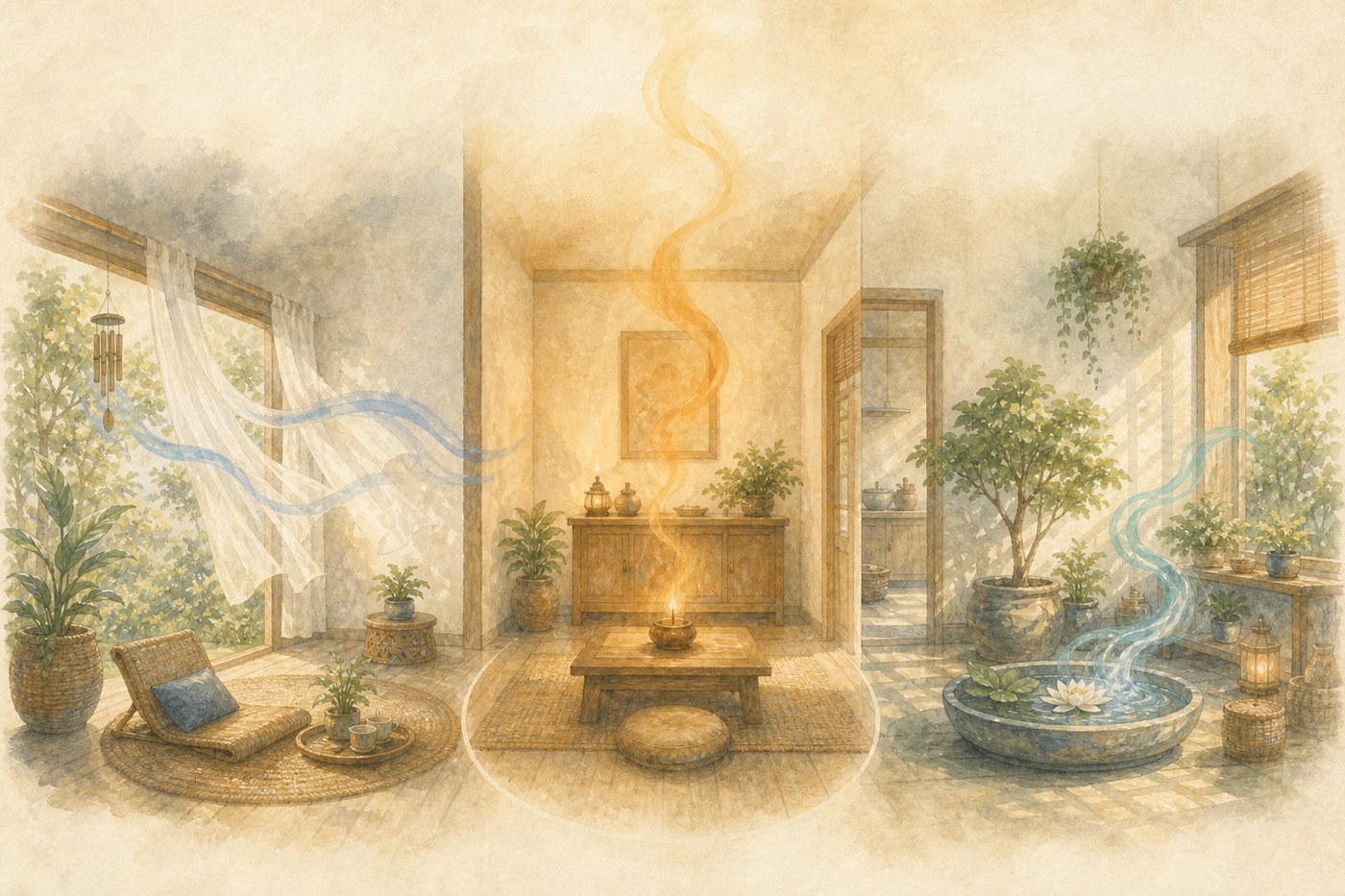
A shared language of qualities
Traditional elemental thinking uses the same qualities to describe a person and a place: warm or cool, light or heavy, still or moving, dry or moist. A room can therefore offer a useful vocabulary for something we already feel.
If we are chilly, sitting in a cold draught may increase that discomfort. If we feel overheated, a hot, poorly ventilated room may be harder to tolerate. These ordinary observations sit alongside the traditional phrase like increases like. The phrase is a framework for reflection; it is not proof of an invisible transfer of an element or a universal physiological rule.
Contrasting qualities as a starting point
A second traditional principle is that contrasting qualities can provide balance. We do not need to push a contrast to an extreme. Comfortable warmth is different from overheating; relief from stuffiness is different from an icy room.
| Traditional pattern | Qualities in the elemental description | Environmental possibilities to explore |
|---|---|---|
| Wind Type | Cool, dry, light, moving | Comfortable warmth, appropriate moisture, softness, continuity |
| Fire Type | Hot, forceful, sharp | Relief from heat, gentleness, less pressure and glare |
| Water Type | Cool, heavy, moist, still | Comfortable warmth, lightness, daylight and an invitation to act |
This table is a starting map. Actual comfort, health needs, climate and preference decide whether a suggestion belongs in our home. A Wind Type reader may love a blue wall. A Water Type reader may need quiet and rest. A Fire Type reader may feel cold today. We can listen to the person without treating the exception as a mistake.
Six dimensions to notice
Temperature includes room heat, cold surfaces, draughts and the difference between one seat and another. Everyone needs protection from unsafe heat and cold.
Light includes brightness, timing, glare, shadows and the colour appearance of a lamp. Daylight and darkness help organise our daily rhythm; enough light for a task also matters.
Colour contributes to the visual character of a room. A warm-looking colour does not physically heat the air, but it may help create an atmosphere we enjoy.
Sound includes chosen music, conversation, appliances, traffic and quiet. Predictability, volume and our ability to control a sound may matter as much as its source.
Scent and air are related but different. A pleasant smell does not prove that air is clean. Ventilation, pollution and dampness deserve attention whether or not we add fragrance.
Surfaces and materials include the chair beneath us, the floor underfoot, bedding and objects we handle. Support, texture, temperature, cleaning and ease of movement all count.
The next five chapters examine colour, light, sound, scent and air, and materials. Temperature is considered throughout rather than in a separate chapter.
Learning to read our own home
Before buying anything, walk through the rooms we use and ask three questions.
- How does my body feel here? Warm or cold, supported or strained, comfortable or crowded?
- How does my attention or mood feel here? Settled or restless, engaged or sleepy, welcome or eager to leave?
- Which qualities are most noticeable? Bright or dim, still or lively, soft or hard, open or enclosed?
A comfortable room may offer a helpful contrast to how we arrive in it. But the answers can have several explanations. A headache is not proof of too much Fire; a musty room needs inspection for dampness, not simply a different scent. Notice patterns and practical causes before attaching a label.
Repeat the walk at another time if useful. The morning sun, evening noise and number of people present can change the same room considerably.
Different people, one home
Most homes contain different preferences. A parent, partner, child or older relative may experience the same room differently from us. Two principles will recur throughout the book.
Give the user a voice in personal space. A bedroom, desk or private corner should reflect the needs of the person using it, within safety and household limits.
Use a shared base with adjustable options. A common room can have a broadly acceptable temperature and colour scheme, with a warmer seat, a better-ventilated corner or a brighter place to read. These are options for anyone, not permanent seats assigned by type.
Try this · Walk through the home again
This weekend, answer the three questions in each room. Write one short observation about comfort and one possible change. Ask another household member separately. Differences between the answers are useful information, not something to resolve by deciding whose type is right.
Our first practical step is colour: a visible part of the home that can often be changed through a small, movable object.
ENVIRONMENT BY THE ELEMENTS
2 · Colour and the Character of a Room
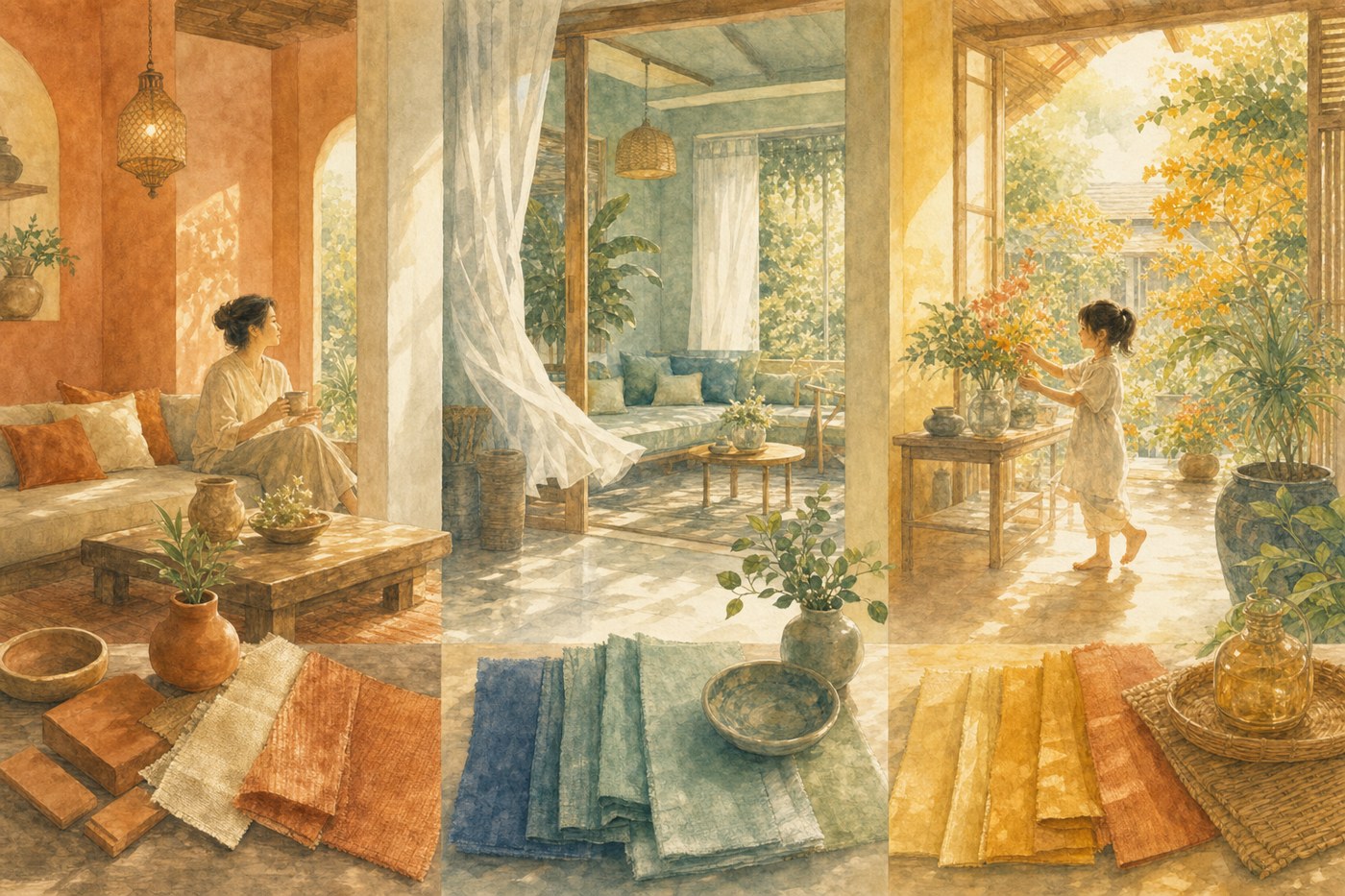
What we notice before we explain it
We may feel drawn to a room before we can describe why. Colour is part of that first impression. Terracotta can suggest warmth; a pale green may recall a shaded garden. The associations are personal and cultural as well as visual. A colour does not have one inevitable emotional effect.
Colour is useful because it can be introduced on a small scale. We do not have to repaint a wall to discover whether a different atmosphere feels welcome. A cushion, cloth, picture or flower can begin the experiment.
Three palettes to explore
The following palettes express the elemental design language. They are choices to try, not medical prescriptions or forbidden-colour lists.
| Aspect | Wind Type inspiration | Fire Type inspiration | Water Type inspiration |
|---|---|---|---|
| Overall tone | Warm, gentle, earthy | Cool-looking, soft, light | Lively, warm, clear |
| Examples | Terracotta, peach, soft orange, warm yellow | Pale blue, soft green, lavender, pearl white | Warm red, orange, golden yellow, fresh green |
| Intensity | Muted to moderate | Gentle rather than striking | Clear accents rather than a dark overall effect |
| Notice whether these feel uncomfortable | Icy blue, cool grey, stark white | Large areas of strong red, orange or bright yellow | Heavy dark brown, navy, extensive dark grey |
| Image | The warmth of late sunlight | Shade on a hot day | A bright morning in a garden |
Wind: warmth and a sense of arrival
If a room feels cold or bare when we are already unsettled, warm earth colours may make it more inviting. Terracotta, light brown, peach, clay orange, sandy yellow and warm cream offer a family of related tones. They can suggest something steady and familiar without filling the room with competing colours.
The image is gentle afternoon sunlight: warm but not dazzling. Try moderate colour rather than assuming that a stronger orange will be more effective. A soft cloth over the back of a chair may be enough.
Icy blue, cool grey or brilliant white may feel distant to one person and restful to another. We need not remove them because we recognise Wind tendencies. Instead, ask whether the room needs one warmer point of contact—a wooden tray, a peach cushion or a picture we enjoy.
Fire: shade and visual gentleness
When we want relief from intensity, pale blue, soft green, mint, lavender, light violet, pearl white and light grey can suggest shade. Think of sitting beneath a tree on a hot day, or looking at a soft rainy-season morning.
These colours may change how a room feels without changing its temperature. If the room is genuinely too hot, it still needs shade, ventilation or cooling. A blue wall cannot prevent heat illness.
Large areas of vivid red, strong orange or bright yellow can feel energetic. If that is more stimulation than we want, move a strong colour into a smaller accent rather than treating it as harmful in itself. A brilliant blue can also feel visually intense. Gentleness depends on the whole room, including brightness and contrast, not simply on whether a hue is called cool.
Water: colour that invites engagement
If a space feels lifeless, a clear warm red, orange, golden yellow, fresh green, pink or flower colour may make it more appealing to enter. An accent near the breakfast table can become a pleasant point of attention at the start of the day.
A room dominated by dark brown, navy, charcoal or black can be beautiful. It may also feel too enclosed for someone seeking a brighter beginning. Try contrast and daylight before assuming that every dark object must go. A golden cloth, fresh green plant or colourful image may change the balance.
The purpose is an invitation, not a demand to be energetic. Colour is not a treatment for depression, nor does difficulty getting up mean that the bedroom has failed a Water test.
Colour when we share a home
Three choices help different preferences coexist. In a personal room, give the user a strong voice. In a shared room, choose a base that people can comfortably accept. Soft cream, sand, warm beige and light brown are possible starting points, but no palette is universally neutral.
Then add movable accents. A pale-blue throw might suit someone who enjoys a cool-looking corner. A warm-toned lamp or picture could make a reading desk more welcoming. Flowers near a window might brighten the view from another seat. Ask the people using these places rather than choosing on their behalf.
A room can change without renovation
Wall colour costs time and money to alter. Cushions, curtains, covers, small objects and flowers are easier to move, borrow or reuse. Seasonal changes can also be modest. During a grey rainy period, someone who feels sluggish may enjoy one brighter accent. During hot weather, a lighter-looking cover may feel welcome.
Our enduring constitution does not have to change for our preference to change. Weather, work, illness and life events can all influence what we want from a room.
Try this · Add one colour
Choose the room we use most. Ask what atmosphere is missing: warmth, gentleness or liveliness. Add one movable object—a terracotta cushion, pale-blue cloth or yellow flowers, for example. Over the next few days, notice whether we enjoy being there more. Keeping the change is optional.
Light will affect every colour we choose. We turn next to brightness, timing and the practical character of the lamps and windows around us.
ENVIRONMENT BY THE ELEMENTS
3 · Light and Brightness
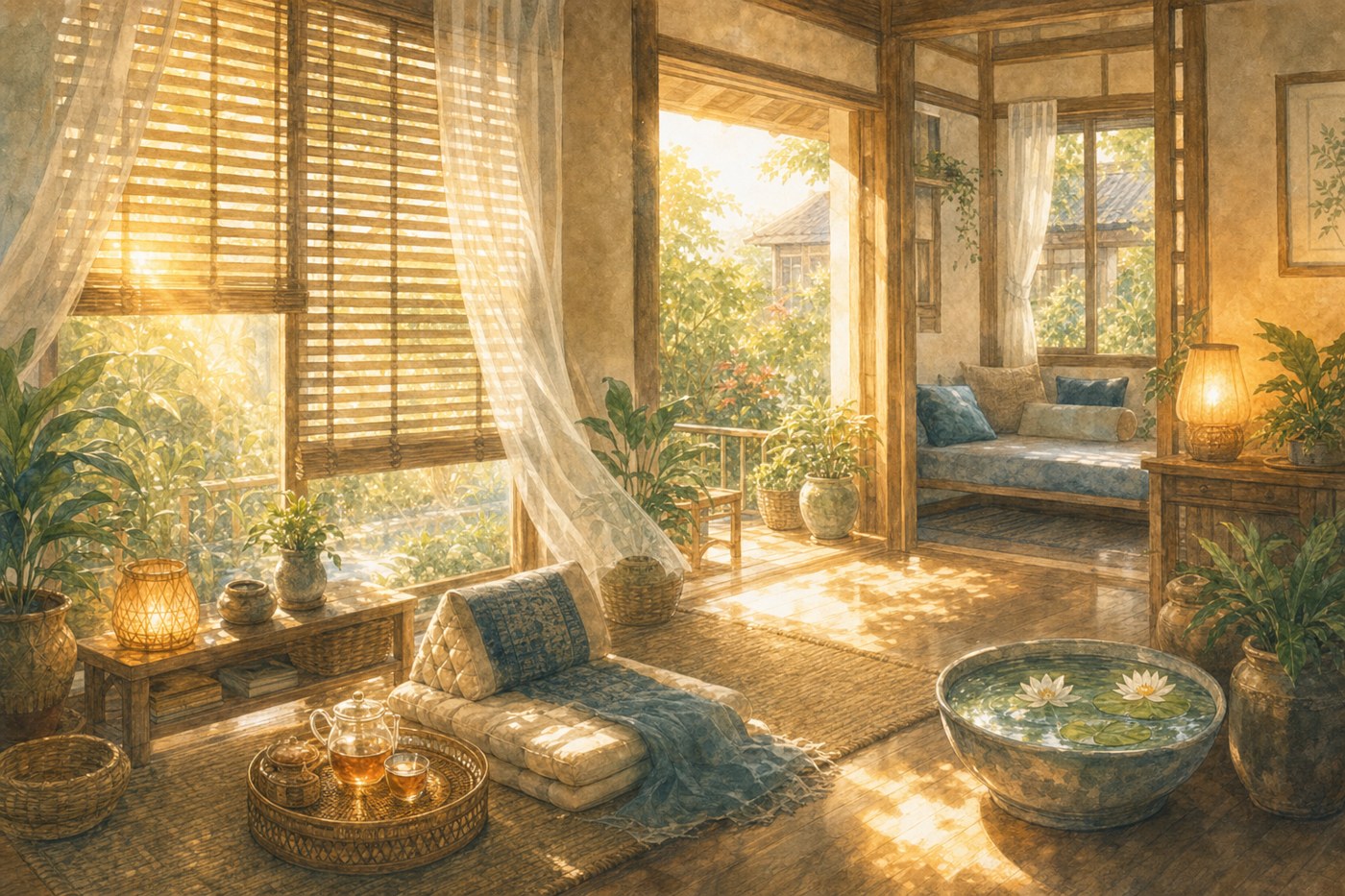
Light helps organise the day
Light is more than decoration. The daily light–dark cycle influences our circadian rhythm, sleep and alertness. Timing matters: the light we seek after waking serves a different purpose from the light we use while preparing for sleep. [1]
Elemental design offers different starting atmospheres, but it does not establish three separate biological lighting requirements. We need enough light to move and work safely, protection from glare and a rhythm that fits our sleep schedule.
Lighting possibilities
| Aspect | Wind Type inspiration | Fire Type inspiration | Water Type inspiration |
|---|---|---|---|
| Daytime character | Moderate, even and predictable | Soft, glare-controlled | Bright enough to feel engaged, especially after waking |
| Lamp colour examples | Warm appearance, about 2700–3000 K | Neutral appearance, about 3500–4000 K | Daylight-like appearance, about 4000–5000 K |
| Natural light | Gentle morning or afternoon light | Filtered daylight and shade | Access to daylight after waking |
| Problems to notice | Flicker, sharp contrast, exposed bright bulbs | Glare, direct sun and unnecessary heat | Inadequate task light or a persistently dim daytime room |
| Image | Warm evening sunlight | Gentle shade | A fresh morning |
Kelvin describes a lamp's colour appearance, not its brightness or a therapeutic dose. A high-Kelvin lamp can be dim; a warm-coloured lamp can be dazzling. These ranges are design examples, not type-specific clinical thresholds. For everyone, the period before sleep generally calls for less bright light rather than an insistence on a particular elemental colour.
Wind: even and welcoming
A warm-looking lamp around 2700–3000 K may help create an atmosphere of welcome. Think of late sunlight rather than the sharp beam of a spotlight. If we find abrupt changes distracting, distribute light so that the desk is visible without leaving everything around it completely dark.
The aim is comfortable visibility. Check whether a bare bulb shines into our eyes or whether our hand throws a shadow across what we are reading. A shade, a different lamp position or an additional modest light can help.
Flickering lamps and strong light–dark contrasts can be uncomfortable. Replace faulty lighting rather than assigning the problem to a constitution. Bright screens or lamps late at night may also interfere with winding down; this concern applies beyond Wind Type.
Fire: relief from glare
Soft daylight or a neutral-looking lamp may feel less pressing when we are already tired of visual intensity. The useful qualities are diffusion and control. A sheer curtain can soften direct sun; a shaded task light can illuminate a page without shining into the face.
A bulb around 3500–4000 K is one possible daytime choice. It is not inherently softer than a warmer bulb: brightness, the fixture and placement matter. Nor does orange-looking light literally add internal Fire.
Avoid sitting in uncomfortable direct midday sun simply because the view is attractive. Heat and glare are practical concerns. Adjust the blind, move the chair or use shade while keeping enough light for the task.
Water: a visible beginning
When a room remains dim through the morning, making daylight easier to reach may help mark the start of the day. Open curtains after the intended waking time, move breakfast to a brighter spot or spend a little time outdoors when conditions are suitable.
For daytime work, a lamp around 4000–5000 K may create a clear, daylight-like appearance. Choose comfortable brightness rather than the strongest possible bulb. Even someone who enjoys a lively daytime room needs an appropriate dark period for sleep.
Curtains should therefore be adjustable. A heavy curtain can protect sleep from street lighting; opening it after waking can support a morning routine. We do not have to leave a room exposed to unwanted light all night to receive daylight later.
Layers of light for a shared room
One ceiling fitting cannot meet every need. Layered lighting combines a general light with table lamps, wall lights, reading lamps or dimmable fixtures. Someone can read under a task lamp while another person rests in a softer corner.
A tunable bulb can change colour appearance and brightness. A less expensive alternative is two ordinary lamps with different purposes. We can use brighter task lighting by day and a gentler arrangement in the evening. Ensure that switches are reachable and walkways remain safe; a relaxing room should not become a fall hazard.
The same living room might be bright during breakfast, quieter in appearance later and softly lit before bed. Negotiating timing is often more effective than choosing one permanent setting for a whole family.
Daylight without a promise
Ordinary daylight after waking can be a helpful part of a daily rhythm. It is not a universal five-minute treatment, and it does not replace care for depression or a sleep disorder. Medical light therapy is a separate intervention requiring suitable advice, particularly where an eye condition, medication sensitivity or bipolar disorder is relevant.
We can begin simply: open a curtain, sit near a suitable window or take a brief outdoor walk. Do not stare at the sun. Heat, outdoor pollution, weather and personal access may change the plan.
Try this · Read the light in one room
Is the light warm-looking or cool-looking? Is there enough for the task? Is it even, or are there uncomfortable bright points and dark areas? Change one lamp position or bulb if needed, then observe comfort over the following week. Notice the time of day as well as the lamp.
Next we listen to the room. Sound can remain in the background of our attention while still influencing how easy it is to rest or concentrate.
ENVIRONMENT BY THE ELEMENTS
4 · Sound, Music and Quiet
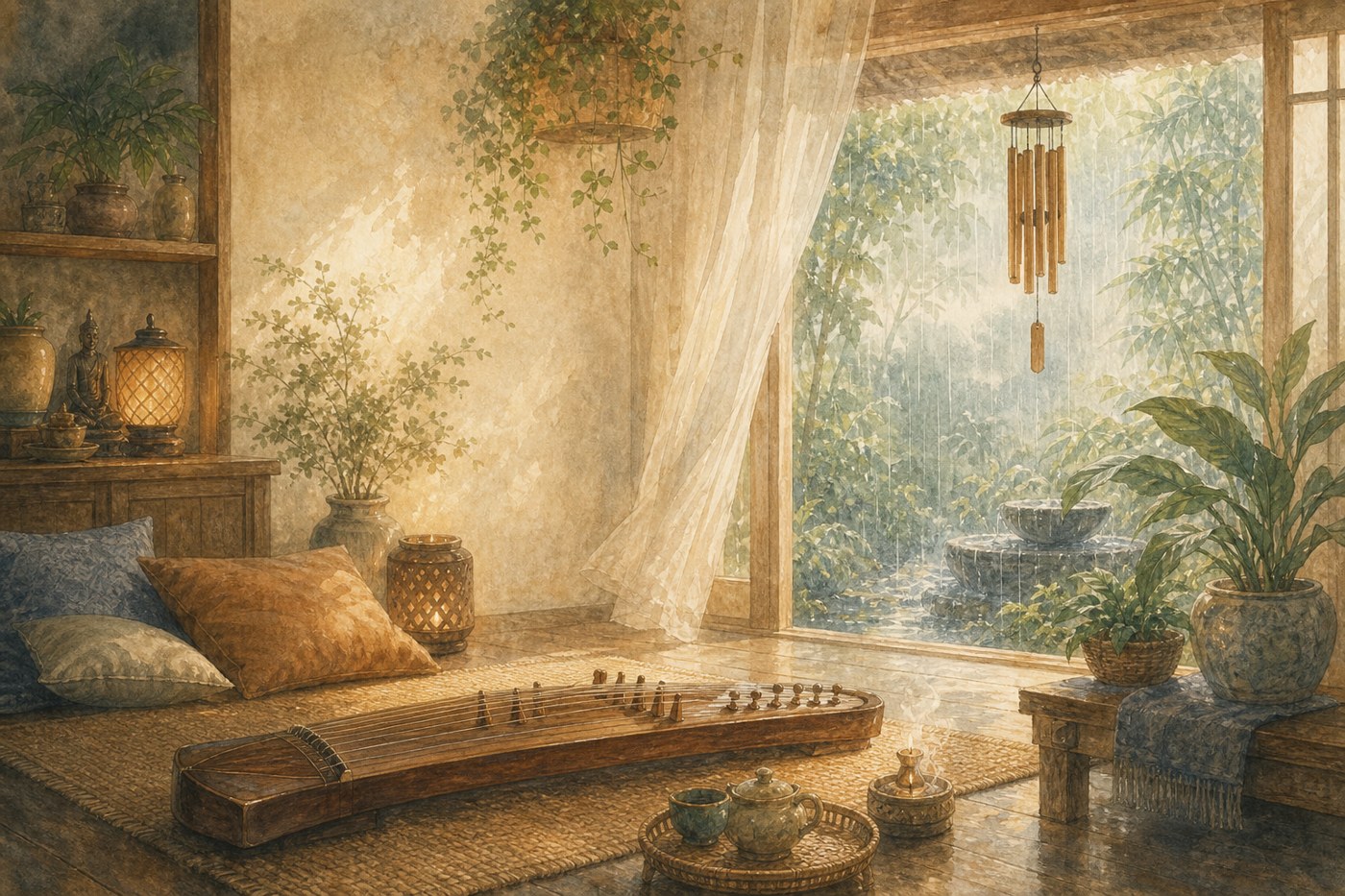
A part of the home we may overlook
When planning a room, we often notice colour and furniture before sound. Yet a television, a refrigerator, traffic through a window, voices in the next room and music we deliberately choose all belong to its atmosphere.
Quiet is part of that atmosphere too. Some of us welcome it; others find a gentle sound more companionable. The question is not which response is correct. It is whether we have enough choice and whether the sound level is safe.
Three sound atmospheres
| Aspect | Wind Type inspiration | Fire Type inspiration | Water Type inspiration |
|---|---|---|---|
| Sound to explore | Soft, steady, predictable | Quiet or gentle music | Lively rhythm that invites movement |
| Examples | Unhurried piano, strings, rain or water | Soft instrumental music, wind or woodland sounds | Enjoyable folk music, dance music, a cheerful morning song |
| Quiet | May be welcome or may leave attention unsettled | Can offer relief from intensity | May be restful or feel isolating |
| Notice discomfort from | Sudden loud sounds and abrupt changes | Aggressive volume, pressured news, strong echoes | Music that deepens an unwanted low mood |
| Image | Gentle rain | Rest beneath a tree | A lively morning market |
These are invitations to listen, not evidence that type determines hearing sensitivity. Anyone can need silence, and no one needs constant stimulation to prevent an element from accumulating.
Wind: a reliable background
If sudden sound leaves us unsettled, a steady, quiet background may be easier to live with. Gentle rain, flowing water, waves, unhurried classical music, piano or soft strings can offer continuity. We may find one of them useful while cooking, reading or resting.
Complete silence is also an option. The purpose of a background sound is to help, not to ensure that we never hear our own thoughts. If music becomes another thing to monitor, turn it off.
Television programmes with abrupt advertising breaks, sudden volume changes and unpredictable loud sounds can make a room harder to settle into. Lower the volume, use available volume controls or choose something less intrusive. These adjustments respond to what we notice rather than to a rule about Wind.
Fire: room to hear less
After a day of decisions or intense conversation, quiet can feel like relief. A short period without news, messages or music may give us space to stop responding.
If music is welcome, choose something that does not add urgency: soft instrumental pieces, a gentle natural sound or simply a familiar recording we enjoy. There is no need to use music labelled for meditation.
Notice strong echoes from bare hard surfaces. Curtains, suitable furnishings or other acoustic improvements may make speech less harsh without adding continuous background sound. Loud, aggressive music and pressured news are not forbidden, but they need not occupy every shared moment.
Water: a little life in the morning
A familiar song can invite us to move while preparing breakfast or getting dressed. Folk music, light dance music or any cheerful rhythm we like may make a small task easier to begin. We can move in a chair, tap a hand or simply listen.
Family conversation may also make a home feel lived in. Continuous television is not required. A chosen programme or a short music period gives us more control than leaving sound on all day.
Sad music can be meaningful and comforting. If a particular playlist leaves us more stuck when we want to re-engage, try another sound or some quiet. Low mood that persists deserves attention beyond the playlist.
Sound in a shared home
First, headphones can allow different choices in the same room. Keep the volume moderate and take listening breaks. Headphones do not make high-volume listening safe, and we still need to hear alarms or people who depend on us. [2]
Second, personal space offers more choice, but sound crosses walls. A bedroom is not permission to disturb someone else's sleep. Agree on volume and timing.
Third, shared space needs shared consent. Soft instrumental music or a natural sound may suit everyone on one day; no added sound may be better on another. There is no universally neutral soundtrack.
Children also need adults to notice volume and overload. Avoid repeated startling noise, offer quiet when needed and make room for songs and play at suitable times. Their responses are observations, not proof of a fixed elemental nervous system. Hearing protection and safe volume matter for every child.
How much quiet?
The elemental images can help us begin a conversation: “I need a quiet interval,” “A little soft sound helps me settle,” or “Could we play something cheerful while we cook?” The answers may vary from day to day.
Making room for these differences is an ordinary skill of living together. We do not need to decide whether silence is medicine for one type and harmful to another.
Try this · Listen to the home for a day
Notice background sounds, interruptions, chosen music and quiet. Which sounds do we control? Which could be reduced? Change one thing—lower the television, turn off an unused device or choose a short music period—and notice how the next hour feels. Ask the other people in the room too.
Scent and air are next. They can alter our impression of a room quickly, but a pleasant smell and healthy air are not the same thing.
ENVIRONMENT BY THE ELEMENTS
5 · Scent and Air
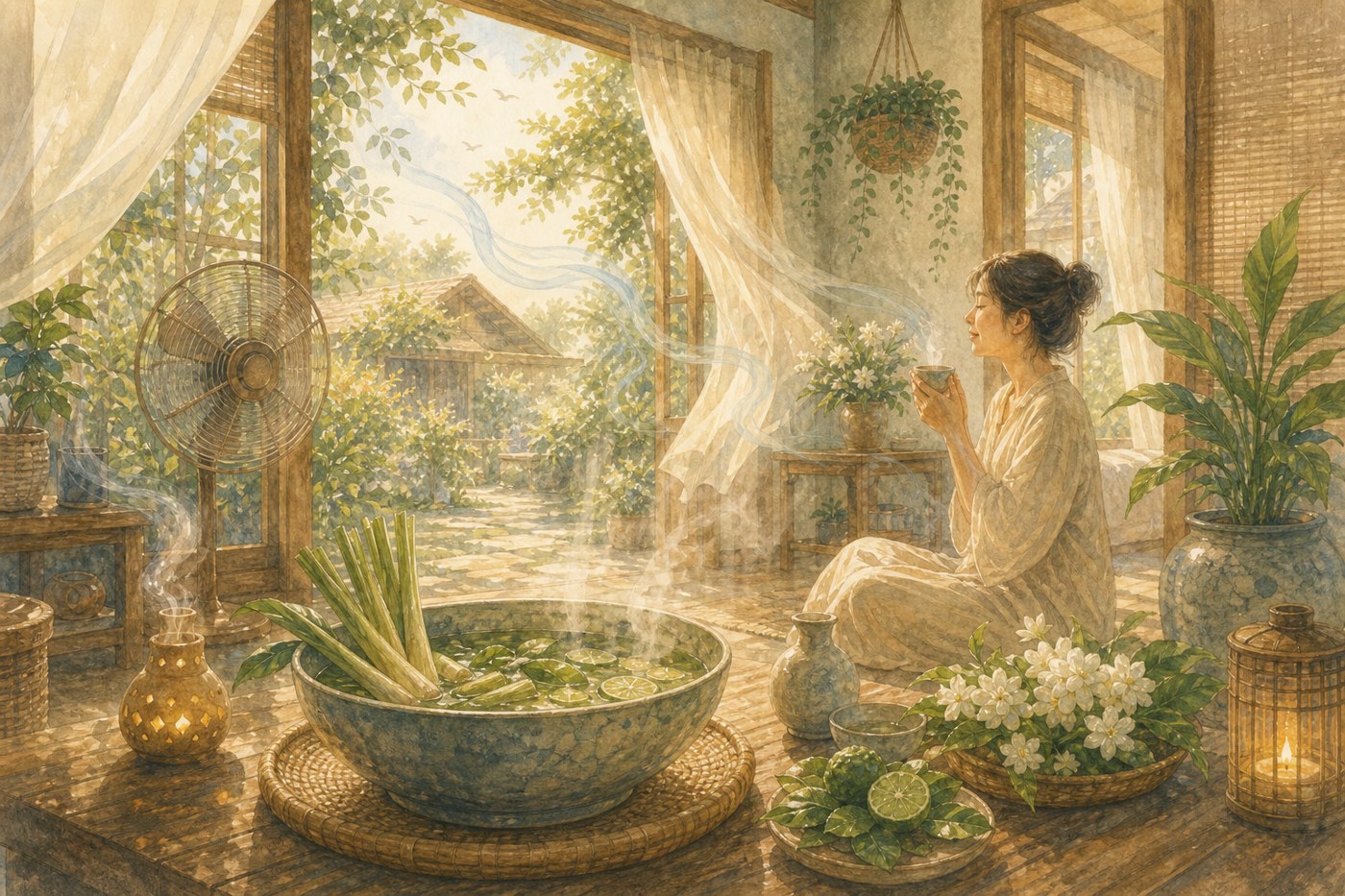
Memory, preference and the air around us
A familiar smell can bring a place or person to mind before we have words for the memory. Smell is closely connected with emotion and memory, but its effect is not identical for everyone. A fragrance that feels welcoming to us may cause discomfort for someone else.
There are two separate questions in this chapter: whether we want to add a scent, and whether the air itself needs attention. Fragrance is optional. Clean air is a practical priority.
Scent families in elemental design
| Aspect | Wind Type inspiration | Fire Type inspiration | Water Type inspiration |
|---|---|---|---|
| Scent character | Soft, warm, gently sweet | Light floral or fresh | Lively herbal, citrus or spice associations |
| Familiar examples | Vanilla, sandalwood, cinnamon, ginger, cardamom | Rose, jasmine, lavender, mild mint, sandalwood | Rosemary, lemongrass, citrus, ginger |
| Air comfort | Comfortable warmth without excessive dryness | Relief from heat and stuffiness | Fresh-feeling, well-managed air without dampness |
| Notice discomfort from | Sharp, concentrated scents | Heavy or strongly spiced scents | Cloying sweetness or a musty room |
| Image | A welcoming morning kitchen | An early garden | Fresh herbs at a market |
The examples describe scent associations. They are not instructions to inhale concentrated oils, put them on skin or use them medicinally. Camphor, eucalyptus, peppermint, juniper and pepper also appear in traditional scent lists, but “warming,” “cooling” or “stimulating” does not establish safety. Aromatherapy research does not validate a type-specific prescription. [3]
Wind: a gentle sense of welcome
Vanilla, sandalwood, cinnamon, ginger or cardamom may recall a warm kitchen or a familiar home. A mild scent from ordinary food preparation may provide that atmosphere without a separate fragrance product.
A concentrated peppermint, eucalyptus or camphor smell can feel sharp. Strong synthetic fragrance can be intrusive too. Natural and synthetic are not reliable categories of safe and unsafe: concentration, ingredients, exposure and the person matter.
Diffusers, scented candles and simmering spices are sometimes used to scent a room. None is necessary. Diffusers add substances to the air; candles involve combustion and fire; a simmering pot needs supervision. Choose an unscented room if that is simpler or more comfortable.
Fire: freshness without pressure
Rose, jasmine, lavender, a little mint or sandalwood may suggest a soft garden atmosphere. Fresh flowers or an intact herb nearby can be enough if everyone tolerates them. We do not need to spray the room or make the scent stronger to obtain a better effect.
Heavy incense, intense spice scents or a sharp perfume may feel excessive. Removing an unwanted fragrance is often more useful than covering it with another. A scent can be pleasant without reducing body temperature or treating irritability.
Water: an invitation to begin
Rosemary, lemongrass, ginger, citrus or mint can make a morning kitchen feel lively. An herb pot provides both a familiar smell when handled and a small activity to care for. A citrus fruit being prepared for breakfast offers another ordinary possibility.
Traditional lists sometimes include eucalyptus, juniper and pepper as stimulating scents. This does not show that smelling them improves circulation or treats low energy. Stronger is not better, and a scent-free room is not stagnant merely because it has no fragrance.
Notice whether a sweet, heavy smell feels sleepy or comforting today. We are free to choose either, depending on what we need.
The quality of the air itself
Pollution sources, inadequate ventilation and dampness matter for everyone. The main practical approaches are to control sources, provide appropriate ventilation and use suitable filtration where needed. Opening a window is not always the right answer during outdoor smoke, high pollution or extreme weather. [4]
A fan moves air but does not necessarily bring fresh air in or remove pollutants. Air conditioning also varies in what it does. Check the actual system rather than assuming that cool air is clean air.
Measure humidity before adding moisture. EPA guidance suggests keeping indoor humidity below 60%, ideally around 30–50%, while considering local conditions. Too much moisture can encourage problems such as mould. A humidifier is not automatically appropriate for Wind Type. If used, follow cleaning and operating instructions and stop if dampness develops. [4], [5]
Persistent mustiness, visible mould or condensation needs investigation. Adding fragrance does not solve the source of the problem.
Plants: companionship, not an air-cleaning system
Plants can bring colour, interest and a living task into a room. They should not replace ventilation, source control or appropriate filtration. A few pots are not a reliable way to purify household air or meaningfully increase the oxygen available to us. [6]
For a steady visual impression, we might like a thick-leaved ficus, a ZZ plant or a palm. For a lighter-looking corner, flowers or a fern may appeal. For an active kitchen relationship, rosemary, holy basil or lemongrass can be useful.
These are aesthetic and practical choices. Check plant identity and toxicity before choosing for a home with children or animals; some familiar houseplants are unsafe if chewed. Avoid overwatering and standing water. We can enjoy a view of a plant elsewhere if caring for one adds too much work.
Sharing scent fairly
Even a private-room fragrance may spread. Ask before adding it, and take a person's asthma, allergy, migraine, nausea or sensory discomfort seriously. A scent-free shared space is often the easiest base.
If a household wants fragrance, keep it modest and removable. A changing daily atmosphere—citrus at breakfast, something gentler later—is a preference, not a required schedule. No one should have to endure a scent to support another person's element.
Safety · Oils, candles and vulnerable household members
Do not swallow essential oils or apply undiluted oil to skin. Keep products secured away from children. Pregnancy, breastfeeding, infants, young children, asthma and other health conditions call for product-specific professional advice; a short list of oils to avoid in one trimester does not establish that all other uses are safe. Stop exposure if it causes symptoms. Camphor and several essential oils can be poisonous when misused. [7]
Ask a veterinarian before using oils around pets, especially cats and birds. Keeping an animal out of one room is not a complete safety plan. Do not apply products to an animal or leave oils where they can be licked or spilled. [13]
Never leave a candle or simmering pot unattended. Keep flames away from curtains, children and pets. An unscented, flameless alternative is available: add no fragrance at all.
Try this · One scent, or none
Choose one familiar, mild scent only if everyone sharing the space agrees and it is suitable for the household. Fresh flowers or an intact culinary herb may be enough. Notice comfort, not an expected therapeutic effect. If someone dislikes it or develops symptoms, remove it; improving the air without adding scent is an equally good experiment.
We turn next from what surrounds the body to what touches it: the surfaces and materials of the home.
ENVIRONMENT BY THE ELEMENTS
6 · Surfaces, Materials and Touch

The room beneath our hands and feet
A room meets us through contact as well as sight. We sit on a chair, step onto a floor, lean against a counter and pull bedding around us. A handle can feel cold; a fabric can scratch; a cushion can support us or make getting up difficult.
These small experiences deserve attention. We do not need to believe that a material changes an element to notice whether we feel comfortable using it.
Three material atmospheres
| Aspect | Wind Type inspiration | Fire Type inspiration | Water Type inspiration |
|---|---|---|---|
| Feel | Soft, warm, comfortably enclosing | Smooth, breathable, cool-feeling | Light, supportive, easy to move from |
| Fabric and furniture examples | Thicker cotton, wool or fleece if tolerated | Lighter cotton, linen, smooth surfaces | Light cotton, silk, bamboo, rattan, supportive chairs |
| Flooring possibilities | Wood or a secure soft mat | Wood, suitable cool flooring, a thin mat | Wood, clear floor space, a small secure rug |
| Notice difficulties from | Uncomfortable cold metal, stone or glass | Heat-trapping bedding and thick coverings | Deep seats, unstable cushions and bulky obstructions |
| Image | A room that offers an embrace | A room with room to breathe | A room that makes movement easier |
Fit and safety come first. Fibre labels alone do not determine comfort, and “natural” does not mean suitable for every skin, allergy or climate.
Wind: softness and warmth
A thicker cotton cover, a soft woollen or fleece blanket, a cushion to hold or a comfortable throw may make a resting place feel more welcoming. Try something already at home before buying a full set of fabrics.
A deep-pile rug can feel warm underfoot but may create a trip hazard, be hard to clean or impede a walking aid. In a home with children, older adults or anyone at risk of falling, prefer a stable, low-profile surface with secure edges and appropriate non-slip backing—or leave the floor clear.
If a metal chair or glass table feels unpleasantly cold, a suitable cushion, mat or change of position may help. There is no need to remove all stone or glass from a room.
In bed, an extra light layer may give the feeling of being covered without overheating. Thick bedding is an adult comfort option, not a rule for every Wind Type and never an instruction for an infant's sleep space.
Fire: smoothness and breathability
Light cotton, linen or another comfortable fabric may help if bedding feels hot or damp. Silk can feel smooth to some people; its care needs and individual feel still matter. A thin cover on a sofa may be preferable to a thick plush layer in a hot room.
Stone, tile or glass can contribute a cool tactile impression in suitable places. Their hardness, slipperiness and sharp edges also matter. A pleasant touch should not create a hazard.
Some dense fabrics trap more heat than we want, but synthetic fibres are not uniformly poor and natural fibres are not uniformly breathable. Judge the actual weave, product and experience. Skin irritation, sweating or discomfort calls for a practical adjustment, not endurance in the name of a type.
Water: support and ease of movement
A chair with a clear, stable structure may be easier to rise from than a deep, sagging sofa. Light-looking bamboo, rattan or wood can leave a room feeling open. Test strength, seat height, support and ease of getting in and out rather than choosing by appearance alone.
Thinner cotton, linen or a manageable bedcover may feel fresh. The aim is comfortable sleep and easy handling, not making the bed unpleasant so that we are forced to leave it. Mattress firmness depends on the person and any relevant health needs.
Bulky furniture can make a room difficult to navigate. Removing one unused item may be more useful than replacing every textile. Clear space is especially valuable when a wheelchair, walking aid or caregiver needs room.
Order without rigidity
Predictable storage can reduce the effort of finding things. In Wind imagery, a familiar place for each object provides a point of return. In Fire imagery, clear structure makes a task easier to begin. In Water imagery, reviewing accumulated belongings can create room for activity.
These are possibilities, not personality verdicts. Anyone can struggle with clutter because of fatigue, disability, grief, limited storage or competing responsibilities. A practical system should help the people using it rather than give someone a new reason to criticise them.
Choose a small category, make its storage reachable and decide together what can leave. Do not discard another person's belongings without agreement.
Materials in a shared room
Let each person choose the bedding and frequently touched objects they use where possible. A shared base might include comfortable cotton, wood or moderate-weight linen, but actual preferences decide.
One sofa can offer a thicker soft cushion at one end and a lighter linen cushion at the other. Keep a throw within reach rather than covering every seat with it. Leave an open area for standing, stretching or other activity. Different options can coexist without assigning each person a permanent corner.
Try this · Touch the room again
Notice the bedding, chair, floor, handles and covers we use most. Which contact is pleasant, and which is uncomfortable or difficult? Change one frequently used item or its position. Check safety and cleaning needs as well as immediate comfort.
We now bring the dimensions together, beginning with the room in which we hope to rest: the bedroom.
ENVIRONMENT BY THE ELEMENTS
7 · The Bedroom
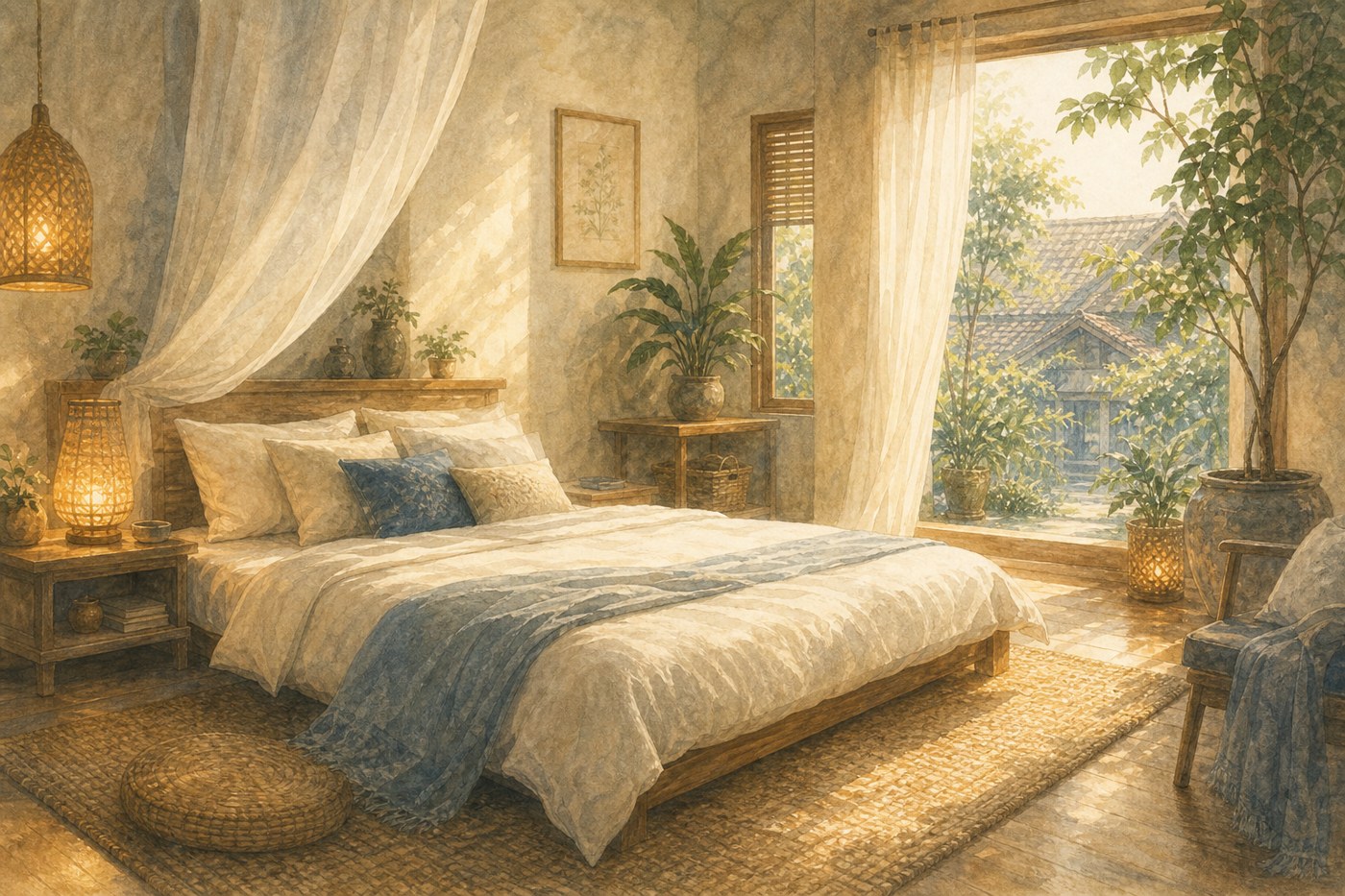
A personal place for rest
We spend a substantial part of life asleep, so bedroom comfort is worth taking seriously. Light, noise, heat and bedding can make sleep easier or harder. We do not need to imagine that our defences disappear or that our element becomes exposed while we sleep.
A broadly sleep-friendly room is quiet, comfortably cool and dark during the intended sleep period, with a dim night light if needed for safety. Individual needs and health conditions still matter. Persistent unrefreshing sleep, loud snoring with breathing pauses or marked daytime sleepiness should not be explained solely by room design. [8]
Bedroom possibilities
| Aspect | Wind Type inspiration | Fire Type inspiration | Water Type inspiration |
|---|---|---|---|
| Colour | Warm cream, peach, earth tones | Pale blue, soft green, pearl white | A lively but comfortable palette |
| Evening light | Gentle and warm-looking | Gentle, without glare | Gentle before sleep; brighter after waking |
| Curtains | Control unwanted light and draughts | Adjustable shade and privacy | Night-time darkness plus access to morning light |
| Bedding | An extra comfortable layer if needed | Breathable, not excessively warm | Manageable, supportive and easy to use |
| Temperature | Avoid uncomfortable cold | Avoid overheating | Comfortable, with suitable air management |
| Sound | Quiet or a low steady sound if helpful | Quiet if preferred | Quiet for sleep; a suitable waking cue |
| Belongings | Predictable storage | Clear, usable layout | Clear routes and manageable belongings |
The table describes options for adults, not a reason to restrict sleep according to type. Everyone needs enough rest.
Wind: a welcoming nest
Warm cream, peach, muted terracotta or light brown may make the room feel familiar. In the evening, a shaded lamp can reduce the need for a bright overhead light. Curtains can limit passing headlights and unwanted draughts.
Choose bedding that feels comfortably covering. Thick cotton or wool may suit one climate; a light extra layer may be enough in another. Warmth should not mean sweating or a room that feels stuffy.
If the air is genuinely dry, review humidity and any humidifier using the guidance in Chapter 5. A humidifier is not a routine requirement for a Wind bedroom.
Some people prefer quiet; others like a low, steady fan or rain sound. Keep any sound modest and ensure important alarms remain audible. Notice whether it supports rest rather than assuming that shallow sleep is inevitable for our type.
Fire: relief from the day's intensity
Pale blue, soft green, lavender or pearl white may suggest a quiet retreat. Soft lighting, breathable bedding and a clear floor can help the room feel less demanding.
A fan or air conditioner may improve comfort in hot weather, used safely and with appropriate maintenance. A cool damp cloth can feel pleasant, but persistent overheating or feeling unwell needs more than a bedside accessory.
Use curtains according to actual light exposure. Fire Type does not make a person immune to unwanted morning or street light. The intended sleep schedule matters more than a claim that one type does not mind brightness.
If silence feels restorative, agree on quiet hours and reduce avoidable noise. Clearing a crowded bedside surface can be a small way to end the day without unfinished tasks filling the view.
Water: protect sleep and welcome the morning
A Water Type reader may sleep well, struggle to sleep or have difficulty waking. We should not assume that their only problem is sleeping too much. A room can support both adequate sleep at night and a clear beginning after waking.
Use a lively colour accent if welcome, and arrange curtains so that daylight is available at the intended waking time. A timed curtain may help, but ordinary curtains opened by hand work too. Shift workers and people with different sleep schedules need another timing plan.
Choose a supportive mattress and bedding that can be managed comfortably. Do not remove warmth or comfort as a punishment for tiredness. An alarm placed a little away from the bed is an option only when the route is safe and getting up is easy; it is unsuitable if it creates a fall risk. A familiar, lively waking sound may be preferable to a startling one.
Keep routes clear and remove unused bulky furniture if it gets in the way. A comfortable chair is not forbidden. The question is whether the room supports the life and rest we actually need.
Sharing a bedroom with different needs
Agree on what affects both people and personalise what can be separated. Separate blankets can provide different warmth on one bed. One person may use an additional layer while another has a safely positioned fan that does not blow uncomfortably across the other.
Choose a room temperature both can tolerate rather than treating the remote control as a contest. Positioning beds or seats may help with light, but do not assume that a window-side arrangement resolves every difference. Adjustable curtains and a shared waking plan can be more useful.
Sound devices should be safe and considerate. Do not rely on headphones that block essential alarms or create uncomfortable overnight use. Start with low volume and shared agreement.
A neutral-looking colour both people like can form the base, with individual bedding or small accents. Personalisation should make each person feel included, not divide the room into opposing camps.
Try this · One bedroom change
Before bed, review colour, light, curtains, bedding, temperature, sound and belongings. Choose the most practical improvement for the coming week. If sharing, ask the other person what they notice. Observe sleep comfort without promising that a single change will solve a sleep problem.
Next we move into the room where different needs meet most visibly: the shared living space.
ENVIRONMENT BY THE ELEMENTS
8 · Living Rooms and Shared Spaces
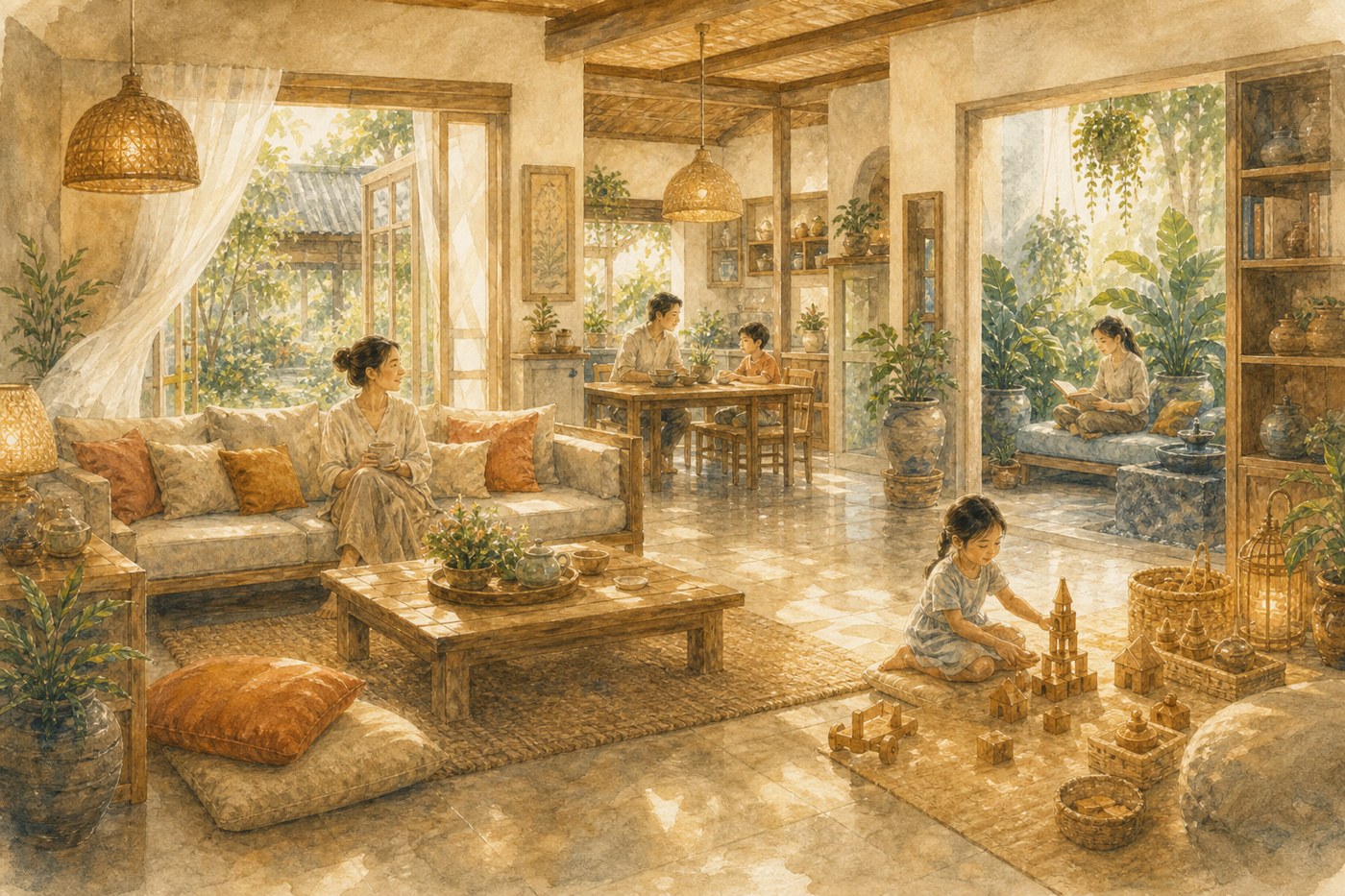
A room with more than one answer
A living room may hold a person reading, a child playing, someone resting after work and another person wanting conversation. One fixed atmosphere rarely suits every activity or every person all day.
Two principles help: a shared base people can accept, and adjustable options within it. The aim is not to find a colour or temperature that never affects anyone. It is to make ordinary differences easier to accommodate.
Several possibilities in one room
| Place | Possible arrangement | Elemental inspiration |
|---|---|---|
| A soft, welcoming seat | A comfortable throw, soft cushion and warm-looking lamp | Wind |
| An airy seat | Breathable fabric, a lighter cushion, suitable ventilation | Fire |
| A bright activity corner | Supportive chair, side table, book or hobby near daylight | Water |
| Clear central space | An accessible open area, with a secure mat only if useful | Shared activity and movement |
Anyone can use any of these places. The arrangement offers choices rather than allocating seats by constitution.
Choosing the shared base
Soft cream, light brown, warm beige or a gentle white can be a starting palette. Ask whether it feels agreeable to the people who live there. A fashionable “neutral” may still be unpleasant to someone.
Layered lighting is particularly useful. General light, a standing lamp, a reading lamp and accessible switches allow different tasks without making the entire room equally bright. Dimmers are helpful where suitable, but not essential.
Wood and comfortable fabric may offer a flexible base for the main furniture. If the room feels hard and cold, add a suitable soft surface. If it feels heavy and crowded, remove an unnecessary layer or item. We do not need rules against all glass, stone or carpet.
For temperature, seek an acceptable middle and provide options: a throw within reach, a safely positioned fan or a seat away from a draught. Check that a change for one person does not create discomfort or a hazard for another.
Creating the smaller places
A Wind-inspired corner might sit away from a strong draught. A shaded warm-looking lamp, a comfortable chair, a soft cover and a thick-leaved plant can suggest a place to settle. The seat still needs adequate support and an easy way to stand up.
A Fire-inspired corner might have good air movement, a breathable seat and a soft light. Flowers or a light-looking plant can add interest if safe and welcome. Avoid direct heat and glare; a window is helpful only when the actual conditions suit the person.
A Water-inspired corner might be close to daylight, with a stable chair, a side table and something inviting to do. A book, handwork or an herb pot can provide a reason to spend time there. It need not be the brightest or busiest point in the room.
These corners remain flexible. Someone who usually likes activity may want to curl up on a difficult day. Someone who normally seeks enclosure may choose the airy seat. Our current needs can move around the room without changing our identity.
Leave some room unassigned
Open floor space has a practical value. It may allow a child to play, someone to stretch, a wheelchair to turn or a family to sit together. It can also make a small home feel less crowded.
We do not need a large empty centre. One clear route and one usable area may be enough. Check the space at the scale of the people who use it: a low table that is easy for one person to step around may obstruct another.
A shared place for shared belongings
Living rooms collect the evidence of daily life: toys, clothes, papers, unopened post and things carried in from elsewhere. A return-to-place routine can help, but it should not fall silently to one household member.
Give frequently used objects reachable storage. A basket may work better than a complicated system. Agree on a brief evening reset if useful, and accept that a lived-in room will not always look finished.
Clutter is not a moral failing or proof of an element becoming stagnant. The practical question is whether the room can still be used comfortably and safely. If not, begin with the obstruction that matters most.
Try this · Make one new option
Create one corner that responds to a household member's stated need: a warmer seat, a place with less glare or a brighter hobby spot. Use movable objects first. Invite everyone to try it rather than reserving it for a type. Notice whether the room becomes easier to share.
The kitchen and dining area bring another set of shared needs: making food, eating it and finding a rhythm together.
ENVIRONMENT BY THE ELEMENTS
9 · Kitchens and Places to Eat
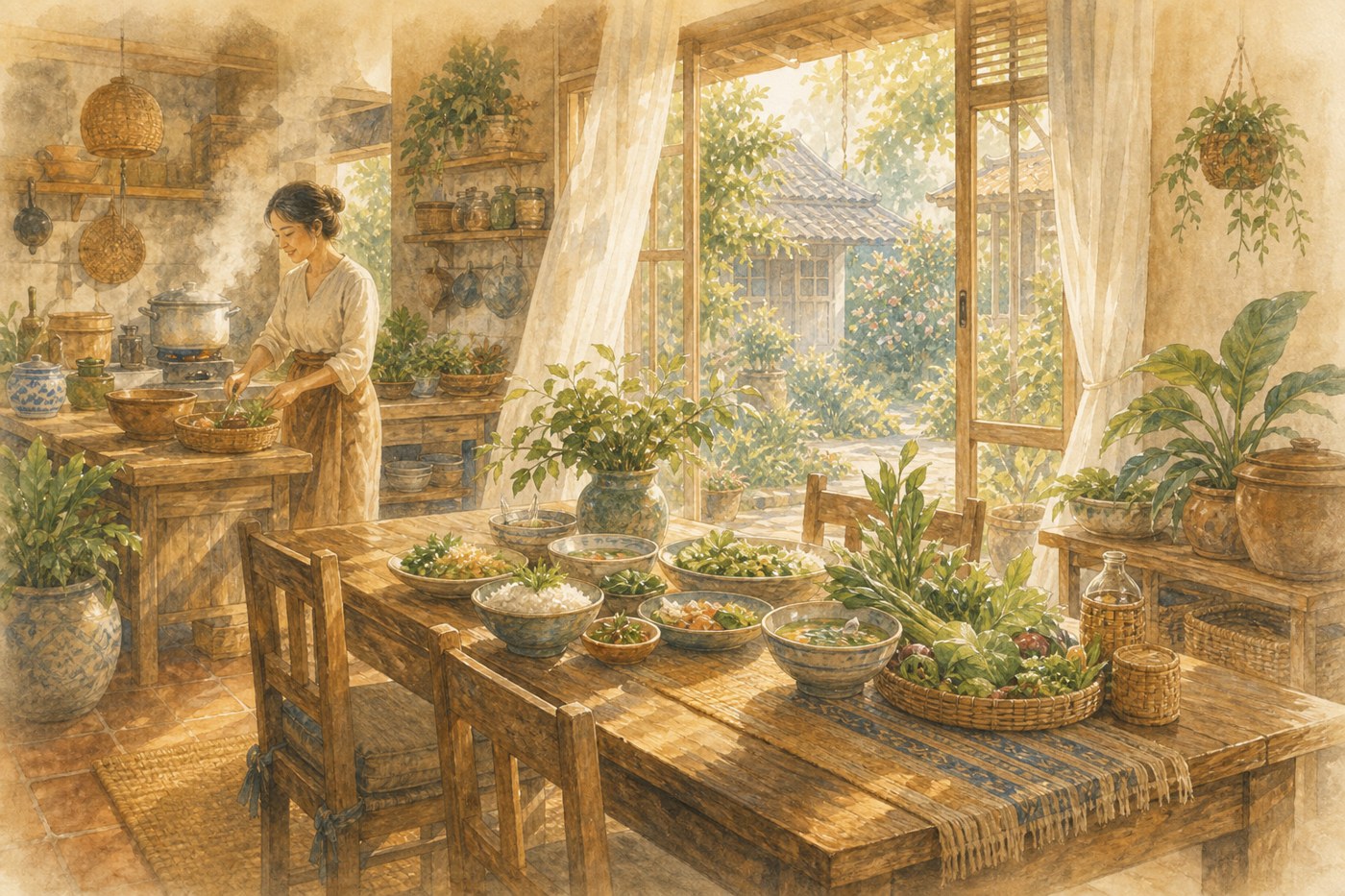
Where food and surroundings meet
Food care and environmental care meet at the kitchen counter and table. The Wind Type, Fire Type and Water Type books explore everyday eating; here we consider the place in which preparing and sharing food happens.
An accessible, comfortable kitchen can make cooking easier. A less pressured meal may be more enjoyable. Atmosphere does not replace food quality or make an unsafe meal safe, but it can support habits we want to practise.
Kitchen possibilities
| Aspect | Wind Type inspiration | Fire Type inspiration | Water Type inspiration |
|---|---|---|---|
| Atmosphere | Welcoming, orderly, predictable | Relief from cooking heat and stuffiness | Bright and inviting to use |
| Colour | Warm earth tones | Gentle white, pale blue or green | Lively accents within a comfortable base |
| Sound while eating | Quiet or soft sound, with company if wanted | Unpressured conversation or quiet | Companionable conversation if welcome |
| Table position | Familiar, usable place | Away from uncomfortable cooking heat | Daylight or a lively view |
| Difficulty to reduce | Rushing and having nowhere comfortable to sit | Heat and demanding discussions | A dim, inconvenient place that discourages use |
Wind: a kitchen with familiar places
Warm cream, beige or wood may make a kitchen feel welcoming. Choose adequate task light: soft-looking does not mean too dim to handle knives or read labels safely.
A place for each frequently used object reduces searching. Arrange utensils, pans and ingredients where they are easy to reach. If a cupboard is confusing, simplify one shelf rather than trying to organise the whole kitchen at once.
A familiar place and a workable rhythm for meals may help when our day feels scattered. Sitting down can provide a pause. Company or a little soft sound may be welcome, but eating alone or quietly is not harmful in itself. Choose what makes a meal manageable rather than adding another rule we must satisfy.
Fire: managing the heat of cooking
Cooking can make a room hot and introduce pollutants. Appropriate extraction and ventilation benefit everyone. Use an externally venting hood where available and maintain it. Opening a window may help when outdoor air is suitable; a fan alone is not necessarily removing pollutants. [4]
Pale blue, green, gentle white or light grey can create a cool-looking atmosphere if we like them. They do not replace actual heat control. A table away from the stove may be more comfortable than one directly beside it.
Meal conversation matters too. A meal does not have to become a meeting about every unresolved household problem. We can agree to leave a demanding subject for another time, making room to eat without rushing or defending ourselves.
Water: an invitation to prepare something
A visible, usable work surface and enough light may make beginning easier. A colourful accent, a favourite recipe or an organised spice box can create a point of interest. The aim is access, not proving that we cook from scratch every day.
Convenience food is not automatically unsuitable for a type. Time, money, mobility and energy affect what is possible. A practical kitchen supports the best manageable choice within those conditions.
Enjoyable music can accompany preparation when it does not distract from safety. The ordinary scent of ginger, turmeric or other culinary ingredients may make a morning routine pleasant. These are food choices, not circulation treatments.
A table near daylight or a view of the day may feel more inviting than an unused dark corner. A substantial lunch and a lighter, earlier evening meal are one possible rhythm, but work schedules, hunger, medicines and health needs may call for another. The room cannot guarantee a change in weight or metabolism.
One kitchen, several preferences
A shared kitchen can have a broadly agreeable colour scheme, good task lighting, effective ventilation and predictable storage. A spice box that is easy to find helps everyone. A clear preparation area matters more than assigning each cupboard an element.
If possible, place the table where there is comfortable natural light, away from excessive stove heat and separate from the television. A screen-free meal can create room for conversation, provided the agreement works for the household and any access needs.
We might hear an idea from someone who has been quiet, give a tired decision-maker a break or make someone feel included. These benefits come through the relationship, not automatically through a type. Shared meals should leave room for different appetites, communication styles and schedules.
Try this · Change one part of the eating place
Move a chair or table if that improves access and light, use a cloth already at home or add a safe, unobtrusive flower arrangement. Notice whether the change makes the meal easier or more pleasant. A clear table and a less rushed conversation count as changes too.
Next we visit another everyday setting for transitions: the bathroom and the place where we get ready.
ENVIRONMENT BY THE ELEMENTS
10 · Bathrooms and Everyday Personal Care
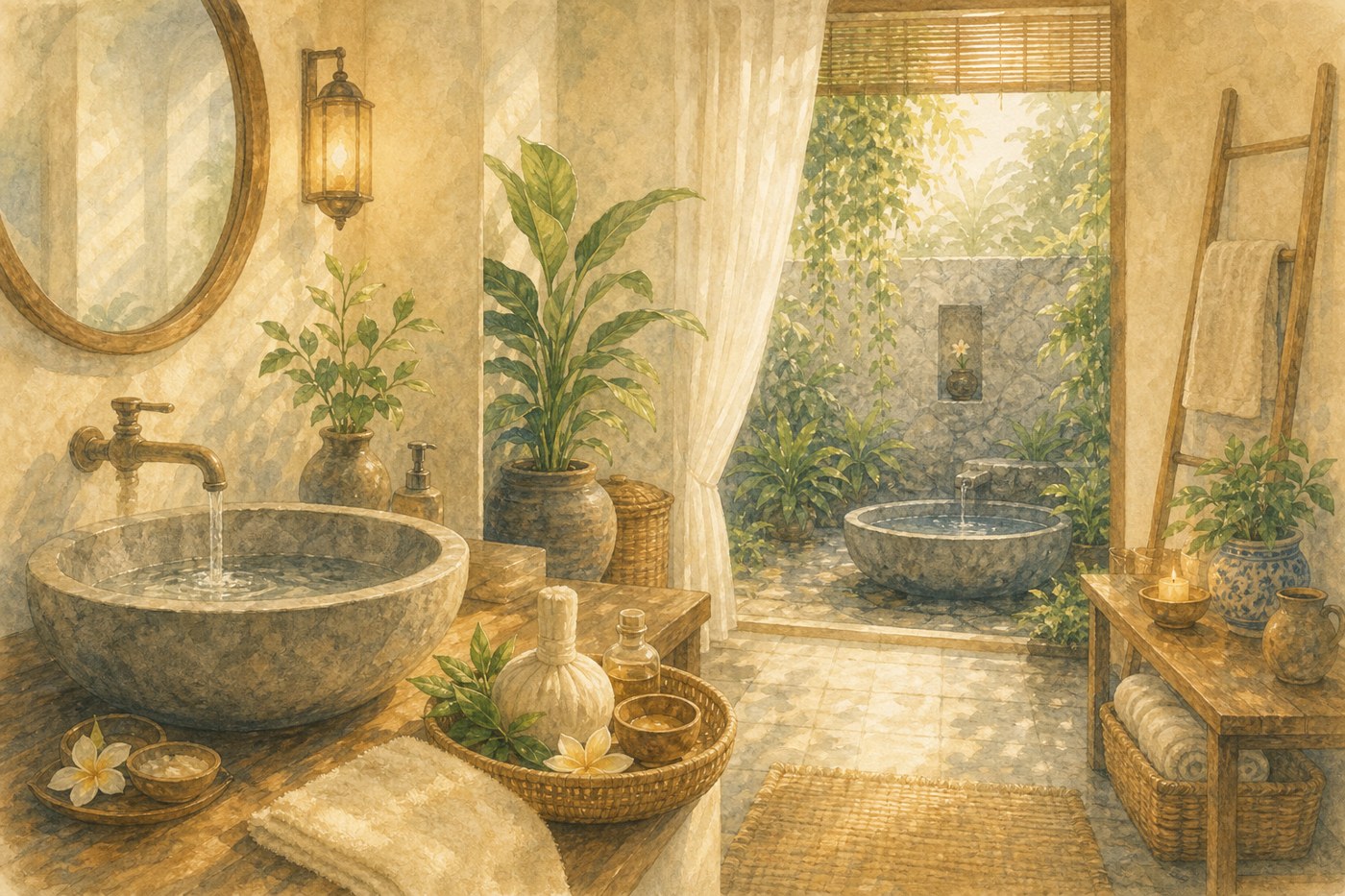
A place of transition
The bathroom often marks the beginning and end of a day. We wash, dress and prepare to leave; later we return to wash again and prepare for rest. A small room can support these transitions through good light, accessible storage and comfortable conditions.
The elemental images offer different atmospheres to explore. Safety around water, heat, electricity and slippery surfaces comes first for everyone.
Bathroom possibilities
| Aspect | Wind Type inspiration | Fire Type inspiration | Water Type inspiration |
|---|---|---|---|
| Room comfort | Avoid an uncomfortable cold draught when wet | Avoid excessive heat and stuffiness | A clear, fresh-feeling morning space |
| Bathing water | Comfortably warm, not hot | A comfortable temperature, avoiding heat extremes | A comfortable temperature; no need for hot–cold contrast |
| Colour | Cream, beige, warm wood accents | Pale blue, green, pearl white | A lively colour accent |
| Scent | Optional soft warm association | Optional light floral association | Optional citrus or herbal association |
| Useful objects | A suitable moisturiser and accessible towel | A comfortable towel and good ventilation | Clearly arranged essentials and enough light |
| Check first | Draughts, dry skin, slipping | Heat, steam and inadequate ventilation | Dim light, obstacles and unsafe attempts to stimulate |
A scent-free product can suit any column. The suggestions are not requirements to buy a different bathroom routine for each type.
Wind: comfortable warmth and skin care
If stepping out of the shower feels unpleasantly cold, have a towel and clothing within easy reach. A room that avoids a draught may be enough. Do not bring a portable electric heater near the bath, shower or basin. Bathroom heating should be suitable for the location and installed according to local electrical requirements. [9]
Use comfortably warm water rather than very hot water, and avoid unnecessarily long hot showers if they leave the skin dry or irritated. A suitable moisturiser may be more useful than changing the room's colour. [14]
Traditional Ayurvedic routines include oil massage, sometimes using sesame oil; coconut oil also appears in home-care routines. These are optional practices, not essential treatment for Wind. Skin reactions, allergies, medical conditions and slippery surfaces matter. A familiar fragrance-free moisturiser may be the simplest choice. Seek advice for persistent skin problems or before massage where there is injury, swelling or reduced sensation.
Vanilla, sandalwood or the association of Thai flowers such as phikun and champa may feel warm and familiar. Enjoying such a smell does not require concentrated oils or a scented product on skin.
Fire: relief from stuffiness
Ventilation can help manage moisture and heat. A window or exhaust system needs to work with privacy, outdoor conditions and household safety. A cool-looking palette may be pleasant, but the actual room still needs to dry properly.
Choose bathing water that feels comfortable. A less warm shower in hot weather may be welcome; sudden cold exposure is not required to reduce emotional intensity. Neither a type nor a preference establishes that temperature extremes are safe.
A heat lamp that makes the room uncomfortable can be left off or reconsidered. It is not forbidden by constitution; its suitability depends on the room, installation and user. Similarly, rose, lavender or mild mint associations are preferences, not necessary remedies.
Water: a clear beginning to the day
Daylight can make the morning bathroom feel more connected to the day. Where there is no window, adequate artificial light can support shaving, washing and finding what we need. Avoid glare and ensure switches are reachable.
A lively colour, a clean mirror and essentials ready to use may be more helpful than a complicated routine. Citrus, rosemary, eucalyptus or peppermint scents are sometimes described as stimulating, but scented products remain optional and may irritate skin or breathing.
Alternating hot and cold water is not needed to awaken an element or improve circulation. Temperature extremes can stress the body. Comfortable washing and a manageable morning activity are enough. [15]
Dry brushing and creams marketed as circulation-stimulating are also optional rather than type-based care. Brushing can irritate skin and is not a treatment for swelling or a circulatory problem. New or persistent symptoms need assessment rather than more vigorous scrubbing.
The dressing table and wardrobe
Getting dressed is easier when frequently used objects can be found. A Wind-inspired approach might group clothing into familiar categories and reduce the number of decisions made in a rush. A Fire-inspired approach might clear the work surface and improve glare-free mirror lighting. A Water-inspired approach might put the day's clothes within easy reach and review unused items gradually.
These ideas can help anyone. Do not throw away another person's clothes or treat accumulated belongings as a personality defect. Ask what makes dressing difficult: storage height, fastenings, pain, fatigue, lighting or lack of space may matter more than type.
A shared bathroom
A broadly acceptable base, clear storage and adjustable water temperature can serve several people. Personal baskets can keep individual products separate. Keep medicines, oils and cleaning products secured from children rather than simply placing them in an attractive open basket.
Use suitable non-slip surfaces, reachable towels and any needed support fittings. An adjustable tap should not allow unsafe scalding temperatures; additional safeguards may be needed for children or people with reduced sensation. Do not add oil to bathwater as a casual fragrance method.
Try this · One easier personal-care step
Review a soap or moisturiser, but change it only if there is a reason. A tolerated, fragrance-free product may already be suitable. Alternatively, move a towel, improve light or clear one shelf. Notice whether beginning or ending the day feels easier without requiring a stronger scent or sensation.
We next turn to the place where many of us spend our working and learning hours.
ENVIRONMENT BY THE ELEMENTS
11 · Work and Study Spaces
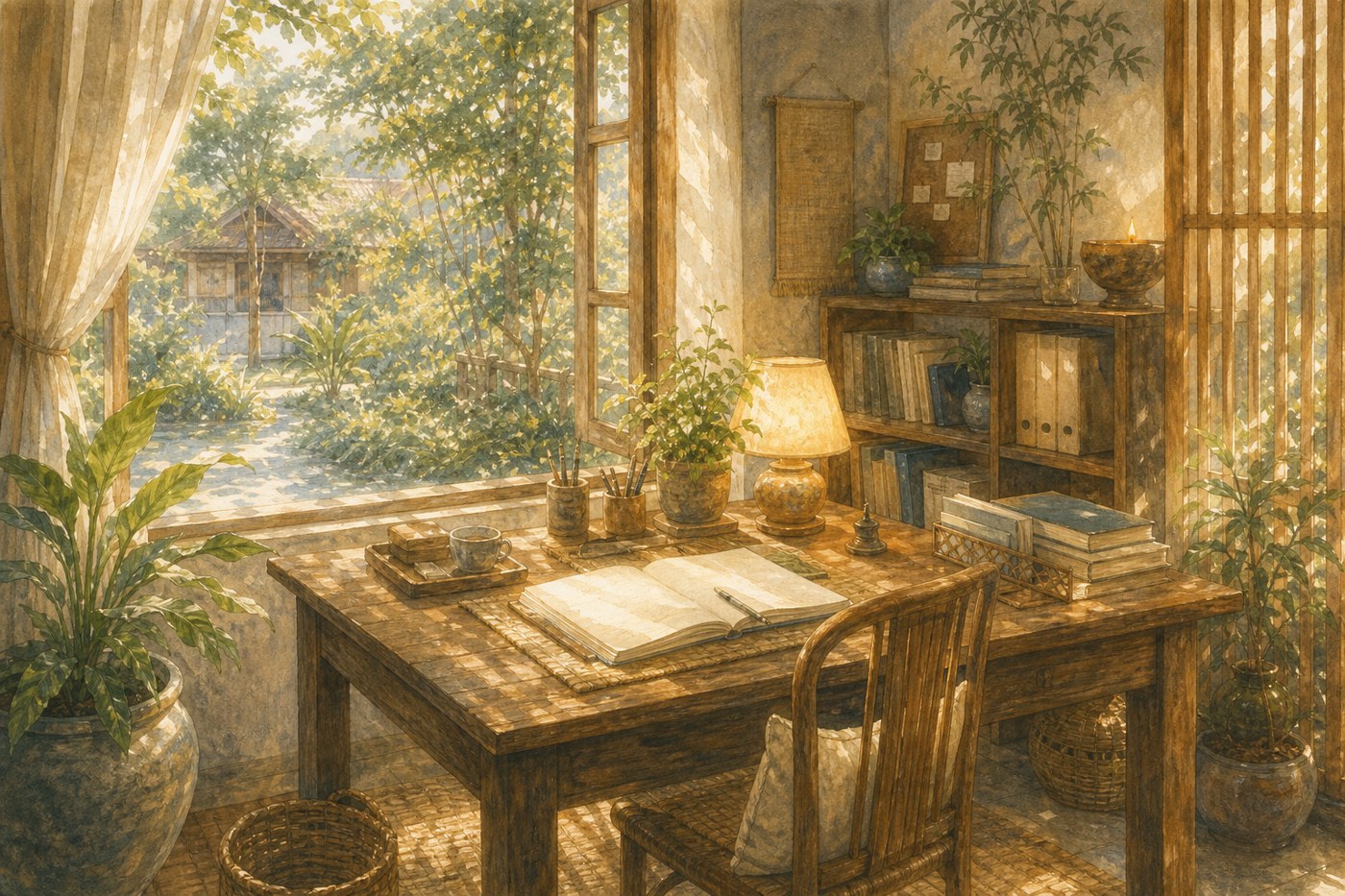
A place that asks for our attention
A desk may occupy only a corner, yet we spend many hours there. Light, noise, temperature, reach and support can affect how easy it is to stay with a task. A useful workspace should support our body as well as our intentions.
We will consider home desks, children's study places and shared offices. The elemental descriptions offer design ideas; they do not establish who can concentrate, work independently or succeed academically.
Three workspace starting points
| Aspect | Wind Type inspiration | Fire Type inspiration | Water Type inspiration |
|---|---|---|---|
| Layout | A clear, manageable boundary | A clear task area with fewer competing demands | Room to vary position and move when appropriate |
| Light | Even, comfortable task light | Glare-controlled light | Adequate daytime brightness |
| Colour | Warm, reassuring accents | Gentle, cool-looking accents | A lively visual point |
| Desktop | A few useful objects in familiar places | Current task materials within reach | A visible, manageable next step |
| Plant option | A steady-looking leaf form | A light-looking plant or flower | A culinary herb or another plant we enjoy tending |
| Break idea | Gentle movement or a quiet pause | A genuine interval away from the task | A short walk or other change of position |
Every column still needs appropriate seating, accessible equipment, enough task light and breaks suited to the person. A desk's size or colour is not a treatment for a concentration disorder.
Wind: a boundary we can return to
A defined work area can reduce the feeling that every object in the room needs attention. A moderate-sized desk, a clear place for the current task and predictable storage may be useful. A large desk can work equally well if its layout is manageable.
Place a lamp so that it illuminates the work without producing glare or a troublesome shadow. A warm-toned desk mat, wooden pencil box or small plant may make the space welcoming, but keep the objects from taking over the working surface.
Time can have a boundary too. A work interval of twenty-five or thirty minutes followed by a short break is one option. Adjust the length to the task, health needs and what actually helps. A timer should support attention, not turn a difficult day into a series of failures.
During a break, gentle stretching, a change of position or a quiet moment may feel appropriate. We do not have to remain seated because Wind is described as needing softness, nor do we need strenuous exercise between tasks.
Fire: clarity without added pressure
If the day already feels demanding, make the work area less demanding where possible. Put away materials unrelated to the current task. Use a layout that makes tools easy to find rather than requiring a perfectly empty desk.
Soft green, pale blue or a small flower may be pleasant. Glare control matters more than a rule against warm-coloured light. Check reflections on a screen and the position of windows.
Manage actual heat and stuffiness. A suitable fan or cooling system can help comfort, while ventilation and filtration serve their own purposes. A cool-looking wall does not compensate for an overheated room.
A break should sometimes mean leaving the task mentally as well as physically. Step outside when conditions suit, look at plants or sit quietly for a few minutes. Moving to another chair while continuing the same argument in our head may not provide the pause we hoped for.
Water: make beginning visible
A bright-enough desk and a clear next action can make work more approachable. A calendar, a small task board or an image connected to something we care about may be useful. Keep the list realistic; a wall of unfinished goals can become discouraging rather than motivating.
Daylight, a yellow or fresh-green accent, or a pleasant view can provide visual interest. These do not cure procrastination. If beginning remains difficult, examine workload, clarity, health and support as well as the room.
A height-adjustable desk or another safe way to vary position may suit some people. Standing all day is not the goal, and standing may not be accessible or comfortable for everyone. Change position within our capacity and arrange equipment so that neither sitting nor standing creates avoidable strain.
A brief walk, seated movement or another active pause can offer variety. Watching another screen may not provide the same change, but genuine rest is also valid. Activity should not become a test of whether Water is moving correctly.
A child's study place
Ask the child what helps and observe without fixing a label. A small, clearly bounded area may suit a child distracted by many visible objects. Another may want a quiet place to work independently. Another may find a clear task card or a modest visual cue useful.
Music helps some tasks and interrupts others. Try it only if the child wants it and the volume is suitable. Make sure the chair, desk and light fit the child, and consider access needs. A child who struggles to concentrate may need educational or clinical support, not a different elemental colour.
The study corner belongs to the child's learning, rather than to an adult's image of a perfect room. Leave room for changes as the child grows.
Sharing a work area
Where several people work together, simple zones can protect attention. A shelf, screen or furniture arrangement may mark a boundary without blocking ventilation, light or an accessible route.
Agree on quiet periods and times when conversation is welcome. Headphones are one option, used at safe volume, but should not be the only solution for someone repeatedly exposed to noise. The person who needs quiet should not have to defend a type to request it.
Portable lamps, a small personal storage tray and movable equipment can help when the same desk is used at different times. In an office, discuss practical adjustments through the appropriate workplace process rather than expecting personal decoration to solve every problem.
Try this · Change one work condition
Improve a lamp position, clear one part of the desk, make the next task visible or plan a suitable movement break. We do not need to discard half our belongings or buy a standing desk. Observe comfort and ease of work over several days, then keep what helps.
Next we leave the desk and explore the garden, balcony and other ways to connect with the outdoors.
ENVIRONMENT BY THE ELEMENTS
12 · Gardens, Balconies and Outdoor Places
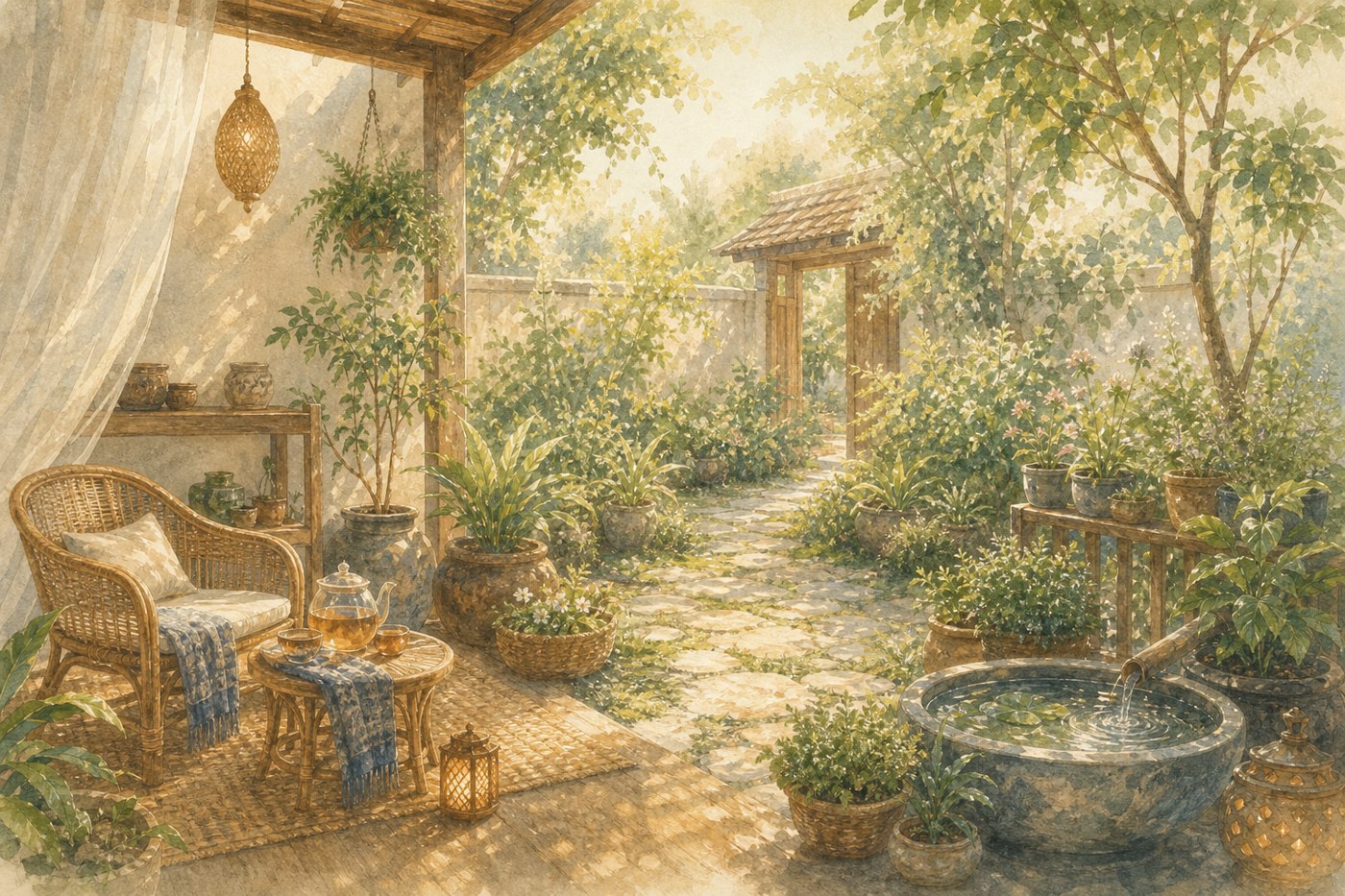
An opening beyond the room
A garden offers several experiences at once: light, moving air, birds, leaves, scent and room to move. A balcony or a window view may offer a smaller version. These places can bring interest and pleasure into the day without having to prove that they reset a nervous system.
Access differs. Heat, pollution, weather, mobility and personal safety can affect whether being outside is suitable. We can value nature without making an inaccessible outing another obligation.
Outdoor possibilities
| Aspect | Wind Type inspiration | Fire Type inspiration | Water Type inspiration |
|---|---|---|---|
| Place | A comfortable, sheltered seat | Shade and suitable air movement | A clear area inviting activity |
| Plants | Substantial leaf shapes, warm-coloured flowers | Soft-looking foliage, ferns, pale flowers | Herbs, vegetables or plants with a small daily task |
| Light and air | Gentle light with shelter from strong wind | Shade without oppressive stillness | Daylight at a comfortable time, often morning |
| Water feature, if safe | A small, quiet fountain | A view of water or a shaded pond | A modest moving-water feature |
| Activity | Reading, tea, quiet attention, a short walk | Rest in shade or light gardening | Walking, adapted exercise, tending a plant |
These are options rather than conditions each type must seek. Sun protection, safe access and protection from heat apply to everyone. [10]
Wind: a place with some shelter
A partly enclosed veranda, a seat beside a hedge or a sheltered corner can make it easier to enjoy the outdoors without feeling exposed. Look for comfortable support and a route that is easy to use. A cushion can help if it stays dry and secure.
Thick green leaves, upright forms, a substantial shrub, marigolds or zinnias may provide a steady or warm visual impression. Choose plants that suit the actual climate and space. A plant that continually struggles in the wrong conditions may create more work than pleasure.
If there is a water feature, a small, gentle sound may be enough. Loud splashing is not required. Sitting with a warm drink, reading, practising a little quiet attention or walking a familiar short route can all belong in this corner.
Fire: shade and room for air
A tree canopy, a veranda facing away from strong sun or a shaded garden shelter may offer relief from heat. Seating should remain comfortable rather than trapping warmth. Arrange planting to provide shade without making the space completely still and enclosed.
Ferns, pale flowers, water plants or lotus may create a cool-looking scene. A cactus garden may appeal to someone else; its appearance does not literally increase internal Fire. The practical issue is whether the place provides comfortable conditions.
A pond or fountain can be enjoyable to look at and hear. Water is not a substitute for actual cooling or treatment of heat illness. A view of water can serve the same aesthetic purpose when installing a pond is unsuitable.
Light gardening in a cooler part of the day may be preferable to strenuous work in midday heat. Take breaks and follow any health advice relevant to outdoor activity.
Water: a reason to step outside
An open, usable route, a clear balcony space or a place to tend herbs can invite activity. Morning may be comfortable, but weather and the person's schedule decide. Sweating is not the measure of a successful outing.
Rosemary, mint, lemongrass, ginger, chilli and holy basil are examples of plants that connect tending with cooking. Check their growing needs and choose one manageable plant rather than a collection that becomes burdensome.
A small vegetable garden can combine movement, attention and a tangible task. We might water, check a leaf or harvest something modest. Choose a task that feels manageable and rewarding.
A moving-water sound may make the area feel lively if welcome. It should not be so loud that it disturbs neighbours or other household members. Still water is not emotionally harmful because of an elemental description.
A garden for several people
Use the natural differences already present. A shaded area may suit resting; a partly sheltered seat may suit reading; a clear route or herb corner may invite activity. No one needs to remain in the place associated with their type.
Varied planting can offer different shapes, colours and tasks. Shared gardening can also provide time together, provided the work is shared fairly. One person should not acquire an entire garden's maintenance because others enjoy the view.
Water features need particular care: prevent unsupervised child access, avoid slippery edges and manage standing water and mosquitoes. Containers, tools and any garden chemicals need suitable storage. A simple plant arrangement may be a better choice than a pond where these needs cannot be met.
A small urban opening still counts
A balcony can hold one safe plant and a place to sit. Check railings, building rules, weight limits and the risk of falling objects. Keep furniture from becoming a climbing route for a child.
Without a balcony, a window view can still offer changing light and a connection with the day. Open a window only when outdoor conditions and fall safety allow. During pollution episodes, looking out through a closed window may be the better option.
A morning drink near a view is a possibility, not a required coffee ritual. Choose what suits our health and preference.
Going beyond the home
A nearby park, riverside path, woodland, coast or other outdoor place may offer a welcome change. Start with an accessible, affordable option close by. A regular park visit may be more sustainable than planning frequent long trips.
A monthly coast visit or an occasional journey into the countryside can be enjoyable if time, money and access allow. They are not necessary to obtain a legitimate relationship with nature. There is no need to claim that outdoor experience has a unique biological effect unavailable anywhere indoors.
Try this · One living presence
Add or tend one suitable plant: a substantial leaf form near a resting place, a flower we enjoy or a culinary herb near the kitchen. Check safety for children and pets and the work it requires. If a plant is not practical, choose a nearby view or accessible outdoor place instead.
We next return to the home and consider children—not as smaller adults, but as people whose safety, development and changing preferences need their own attention.
ENVIRONMENT BY THE ELEMENTS
13 · Children's Spaces
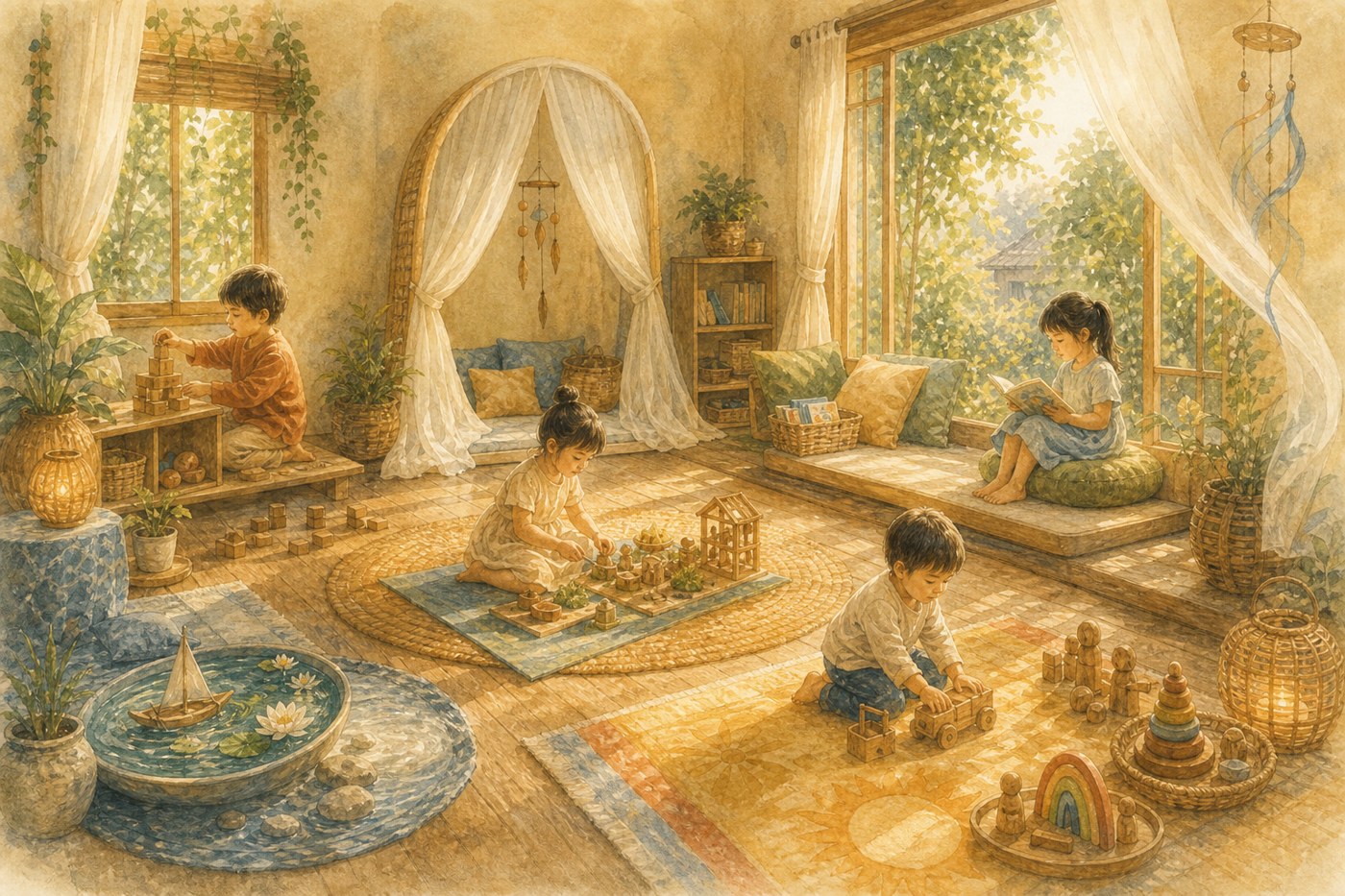
A room seen from a child's height
Children spend time playing, sleeping, learning and finding little places of their own. A room arranged mainly for an adult's taste may miss what makes those activities comfortable. Sitting at a child's height can reveal a bright light, an unreachable shelf or a corner that feels much less welcoming than it looks from the doorway.
Elemental imagery can prompt us to notice differences, but a room does not determine a child's constitution or explain their development. Observe the child, ask when they can answer and allow preferences to change. Age, safety, disability, sensory needs and sleep requirements come before a type label.
Possibilities for older children's spaces
| Aspect | Wind-inspired option | Fire-inspired option | Water-inspired option |
|---|---|---|---|
| Colour | Warm and gentle | Soft, cool-looking colours | Lively accents the child enjoys |
| Light | Comfortable light; a dim night light if needed | Enough light without glare | Daytime brightness and access to light after waking |
| Play materials | Hands-on building, modelling or suitable natural materials | Puzzles, books and construction activities | Age-appropriate movement play and simple instruments |
| Bedding | Comfortable warmth without overheating | Comfortable, breathable bedding | Comfortable bedding and adequate sleep |
| Storage | Predictable categories | Clear places for objects | Manageable choices, reviewed together |
| Personal space | A safe, supervised cosy corner | Some uninterrupted time | Clear room for activity as well as rest |
These are options for exploration, not restrictions on what a child may enjoy. Every child can build, imagine, move, make music and seek quiet.
Infant sleep is different
Do not apply suggestions about thick blankets, soft nests, cushions or enclosed play corners to a baby's sleep space. Place a baby on their back for sleep on a separate, firm, flat, level surface designed for infant sleep, with no pillows, loose blankets, toys or other soft objects. Avoid overheating and weighted sleep products. Follow current infant safe-sleep guidance rather than an elemental bedding table. [11]
Wind: a welcoming place to settle
For a child who is easily overwhelmed, a warm-looking, less crowded corner may feel reassuring. Cream, peach or muted terracotta are possible choices. Use comfortable light rather than making the whole room dark.
If an older child fears darkness, a dim night light may help. Position it so that it offers reassurance or a safe route without shining into the face. Bright white or blue-rich light near bedtime may be less suitable than a modest warm-looking light, but intensity and timing matter as well as colour.
Hands-on materials—blocks, modelling clay, suitable wooden toys or carefully selected household materials—can offer focused play. Check age suitability, small parts, sharp edges and cleanliness. Natural or recycled does not automatically mean safe.
Predictable storage can help the child find and return things. A cosy reading corner may also be welcome, but avoid makeshift enclosures with entrapment, choking or strangulation risks. Loose cords, draped fabric and furniture that can tip need attention. A bunk bed must meet applicable safety guidance and age limits; it should not be introduced simply to create a cave-like space.
Quiet, a gentle song or a low natural sound may suit the moment. Watch the child's response rather than assuming that a certain recording will make them calm.
Fire: autonomy without pressure
A child who enjoys deciding and concentrating may appreciate some uninterrupted space. Pale blue, green, lavender or a gentle white can be offered as choices, along with other colours the child likes.
Puzzles, construction games, books and thinking challenges can support an interest. They are not exclusive to Fire, and enjoying them does not mean the child should play alone all the time.
Clear storage and a usable work surface may reduce frustration. Privacy can be respected in an age-appropriate way while adults remain available and maintain necessary supervision. A child needs connection as well as independence.
Emotional safety matters in every room. Avoid harsh humiliation or treating a child's bedroom as a place where they must defend themselves. Boundaries can be clear and respectful. This care belongs to all children, not only those described as intense.
Water: an invitation to participate
A child who takes time to begin may enjoy a bright accent, a clear invitation to play or a familiar morning song. Allow time to begin, and notice sleep, health, temperament and developmental needs.
Open curtains at an appropriate waking time rather than using constant brightness or inadequate bedding to prevent sleep. Every child needs sufficient rest.
Offer age-appropriate movement toys, building activities and simple instruments. A drum, a movement game or a task involving carrying and arranging suitable objects may invite participation. Keep sound at a safe level and allow quiet play too.
Review toys with the child instead of suddenly removing treasured objects. A small rotation can keep choices manageable while preserving a sense of continuity. Clear floor space gives room to move without demanding that the child be active all the time.
Siblings sharing a room
A shared room can still include personal areas. Separate storage, bedding chosen for each child's comfort and a small display area may be enough. A broadly agreeable wall colour can support individual accents through safe furnishings or pictures.
Task lights can be adjusted separately, provided cords, fittings and placement are suitable. Keep beds and climbable furniture away from windows and window-covering cords; cordless coverings are the safer choice around young children. Anchor furniture that could tip. [12]
Discuss sound and light at the times they affect both children. One sibling may want to read while another needs sleep. The solution may involve timing or another reading place, not a demand that either child accept discomfort because of their type.
Explain differences in ordinary language: “Your sister needs quiet now,” or “This light helps you see your book.” Children can learn consideration without learning that a label decides everyone's needs permanently.
Notice when the room reflects us more than the child
A parent who loves stillness may create a dim, quiet room for a child who wants a clearer invitation to play. A parent who values order may make the room so controlled that exploration becomes difficult. A parent who loves variety may fill it with more colours and objects than the child enjoys.
These situations do not mean the parent has failed. They offer a chance to ask again. The relationships volume includes tools for noticing a child's tendencies, but the child's actual response remains essential. Do not infer a diagnosis or fixed constitution from a room preference.
Try this · See the room from the child's place
Sit at the child's eye level and look around. What can they reach? What shines into their eyes? Where can they move, rest and feel included? Ask the child where possible, then change one practical feature. Observe over the following week without expecting a single design change to explain every shift in behaviour.
The final main chapter brings all these rooms together into a home shared by people with different needs.
ENVIRONMENT BY THE ELEMENTS
14 · A Home for Different Elements
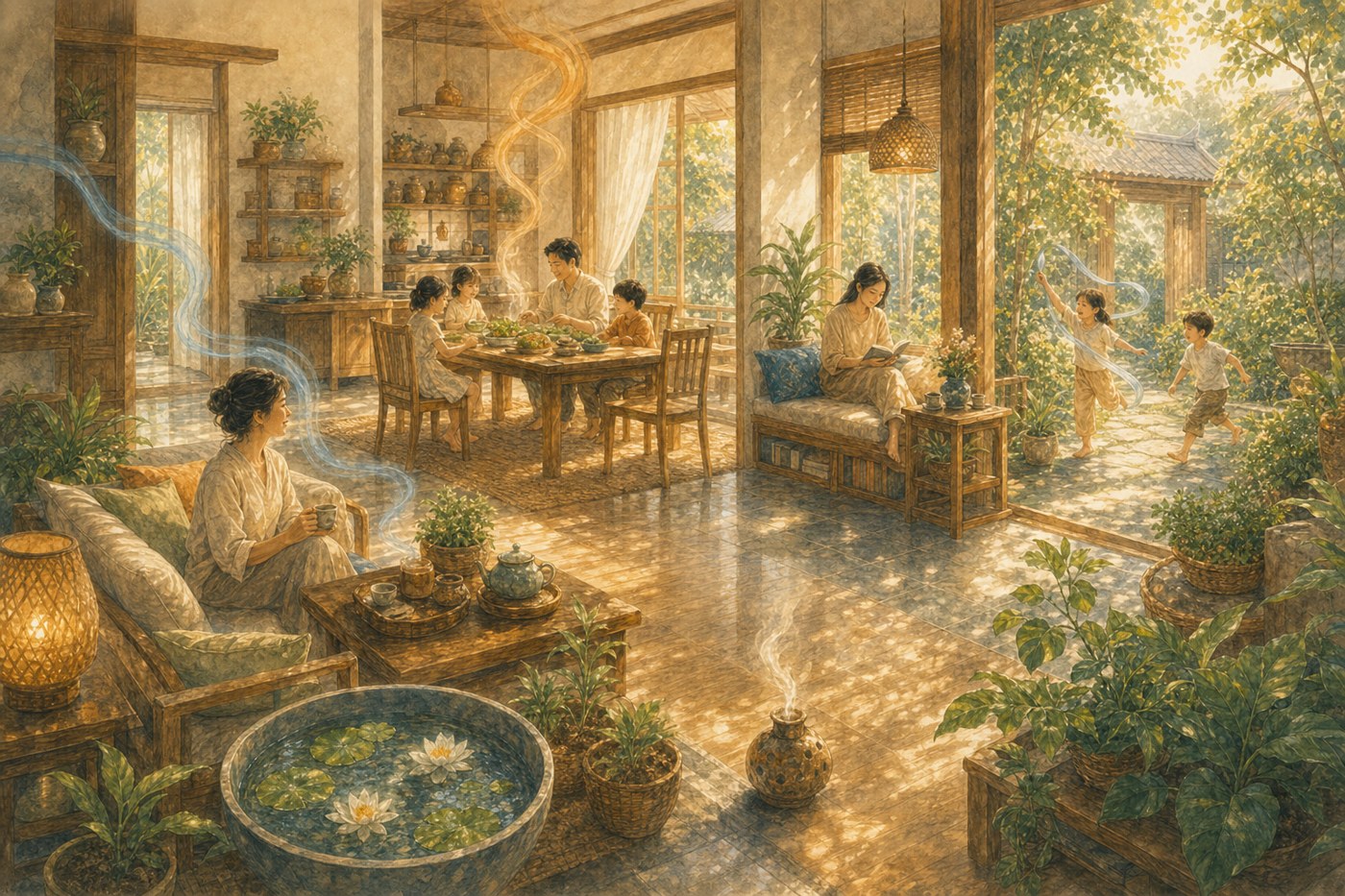
Bringing the whole household into view
We have moved through dimensions and rooms one at a time. Now we bring them together in the situation most of us know: a home with more than one person, more than one preference and more than one idea of comfort.
Parents may want different temperatures. Children may use the same room in different ways. An older relative may need a safer route or quieter rest. A partner may love a change that makes us feel unsettled. A workable home has to make room for these differences in practice.
Three foundations for sharing
Give personal space a personal voice. A bedroom, desk or small private corner should reflect the user where possible. This does not override safety, cost or the needs of someone sharing the space. It means that the person is consulted rather than decorated around.
Build a shared base with options. Living areas, dining spaces, a shared bathroom and garden need conditions that people can reasonably accept. Movable lamps, different seat textures, a throw or a brighter activity spot can provide choice within that base.
Negotiate what changes each day. Air-conditioning settings, music, light and windows affect everyone present. A fair agreement considers need, not simply who controls the switch. Health and access requirements deserve particular weight.
Step one: draw a household map
Write down who lives in the home and what each person notices. We may include a self-recognised Wind, Fire, Water or mixed pattern, but add concrete needs beside it: “cold at the table,” “glare on the screen,” “needs a quiet hour after work.” Ask rather than assign.
Consider an imaginary family of four: a father who identifies with Fire, a mother who identifies with Water, an older child whose tendencies are described as Wind and a younger child described as Water. The labels provide a first sketch. Their actual ages, health, schedules and preferences complete it.
A mixed pattern can be recorded with both tendencies if useful. We do not need a precise classification before improving a lamp or making a walkway safer.
Step two: consider personal spaces
For the father, the family might explore a soft blue or green accent, breathable bedding, suitable cooling and a quiet sleep period.
For the mother, they might make morning daylight easier to reach and choose bedding that is comfortable and manageable. An alarm away from the bed is considered only if getting up and reaching it is safe.
If the parents share a bedroom, a cream base, separate blankets and an agreed light schedule may work better than trying to make one person's whole-room preference win. Both need adequate sleep. The mother wanting daylight after waking does not require the father to receive unwanted light while still asleep.
For the older child, a warm-looking palette, predictable storage and a safe cosy reading place may appeal. Bedding and any night light follow age-appropriate safety and actual comfort. For the younger child, a lively accent, suitable morning light and age-appropriate movement play may be useful. Infant sleep rules apply if relevant; the family example is not a reason to use loose warm bedding with a baby.
Step three: arrange the shared room
The family chooses a gentle cream, sand or light-brown base they all enjoy.
They then make three options:
- A comfortable seat near family activity, with a soft cushion and warm-looking lamp, offers the older child a place to settle without being isolated.
- A breathable seat near suitable air movement, perhaps with a small flower arrangement, offers the father relief from a hot day.
- A daylight corner with a supportive chair, side table, book or herb plant offers the mother and younger child a place to begin an activity.
Everyone may use every corner. A blanket can be kept nearby and a fan positioned safely. General light plus task lamps gives more flexibility than a single strong ceiling fitting.
Step four: agree on a daily rhythm
Small agreements can prevent the same disagreement from restarting every day.
Morning: open shared-room curtains when appropriate, make the kitchen usable and play music only if it suits those present. Someone sleeping after a night shift may need a different arrangement.
Work and study: agree on quiet periods and let people know when conversation is welcome. Respect a closed task period without making one person responsible for policing it continually.
Evening: reduce unnecessary brightness and noise as the household moves towards rest. Different bedtimes may require local lamps rather than darkness throughout the home.
Shared meals: consider a phone- and television-free interval if it helps connection and does not interfere with necessary access or communication support.
Before sleep: allow each person a suitable wind-down routine. A quieter household atmosphere can support several different routines at once.
These are examples to negotiate, not a timetable every family must follow.
Four familiar situations
1. The air-conditioning battle
One partner feels too hot; another feels too cold. Each change to the remote control seems to undo the other's comfort.
Begin with a setting both can tolerate. In some warm-climate homes, 25–26°C may be a starting trial, not a medical target. A safely positioned personal fan, an extra blanket or socks may help bridge the difference. Actual heat risk, health conditions and the room's humidity matter more than the number alone.
Adding a personal option can be more useful than repeating the same argument. Check again after trying it; compromise should not mean someone remains unwell or unsafe.
2. Quiet parents and an active child
Parents who enjoy stillness may feel overwhelmed by a child who moves, changes activities and explores. They may describe themselves as Water and the child as Wind.
Create a place and time for play rather than expecting the child to sit as quietly as an adult. A clear shared play area and an appropriate personal corner can help. Activity is not necessarily an attempt to annoy anyone, but persistent developmental or behavioural concerns still deserve suitable support.
The parents' need for rest matters too. A predictable rhythm can include both active play and quieter intervals, with responsibilities shared.
3. One partner wants change; another wants continuity
One person wants to move furniture and repaint; another wants the familiar arrangement to remain. The family may recognise a Fire–Water contrast, but the practical needs are novelty and continuity.
Change what is easy to reverse: cushions, a cover, a picture, flowers or the arrangement of small objects. Keep major purchases and structural changes for decisions made together. A predictable review time can help both people know that neither constant upheaval nor permanent refusal is the only option.
4. Siblings with different sleep preferences
An older child wants light after waking; a younger child wants a cosy room and a dim night light. Give each suitable storage, bedding and a personal area. Adjust local light and timing rather than assuming that a window-side bed solves everything.
Any curtain arrangement must be safe, especially around cords and beds. Preserve both children's sleep needs. Teach them to ask before changing shared light or sound, while adults remain responsible for the safe setup.
When everyone uses one room
A rented room, studio or small home may not have separate zones. Time and portable objects become especially useful.
Give each person a modest personal place—a shelf, bedside area or part of a table. Use movable lamps, blankets and storage trays to change a place's function. Scent is less suitable as a personal adjustment because it travels through shared air.
Agree on activity and rest periods, allowing for work shifts and care needs. A bright morning and gentler evening may suit many people, but the agreement belongs to this household. When someone needs to rest, reducing sound and clearing our own belongings can be an act of care.
Let the home respond to the season
In hot weather, lighter-looking covers, shade and suitable cooling may be welcome. In the rainy season, daylight, dry storage and attention to dampness matter; cheerful music or a bright accent may also help the room feel inviting. In cool, dry weather, extra bedding and a warmer-looking lamp may be useful.
Do not automatically add a humidifier in winter or simmer spices throughout the rainy season. Measure conditions and consider air quality, fire safety and scent tolerance. The practical seasonal review asks what has changed in this home, not which element must be corrected every three months.
Begin at a manageable scale
It is tempting to plan a complete transformation after noticing many possibilities. Start with one room or one difficulty instead. A personal sleeping place may be a useful beginning, followed by a shared corner and then another member's space—with their agreement each time.
Small changes can be tested and reversed. A large unfinished renovation can create cost and disruption that no new colour will compensate for.
Try this · A three-step household plan
Together, map the people and their actual needs. Choose one personal space to improve with its user's agreement. Then choose one shared-room option that responds to another person's need. Decide when to review both changes. The aim is a home in which more than one person can feel considered.
The closing pages return to the purpose beneath all the practical details: a home that makes daily life more supportive for the people in it.
ENVIRONMENT BY THE ELEMENTS
Closing · A Home That Supports Everyone Within It
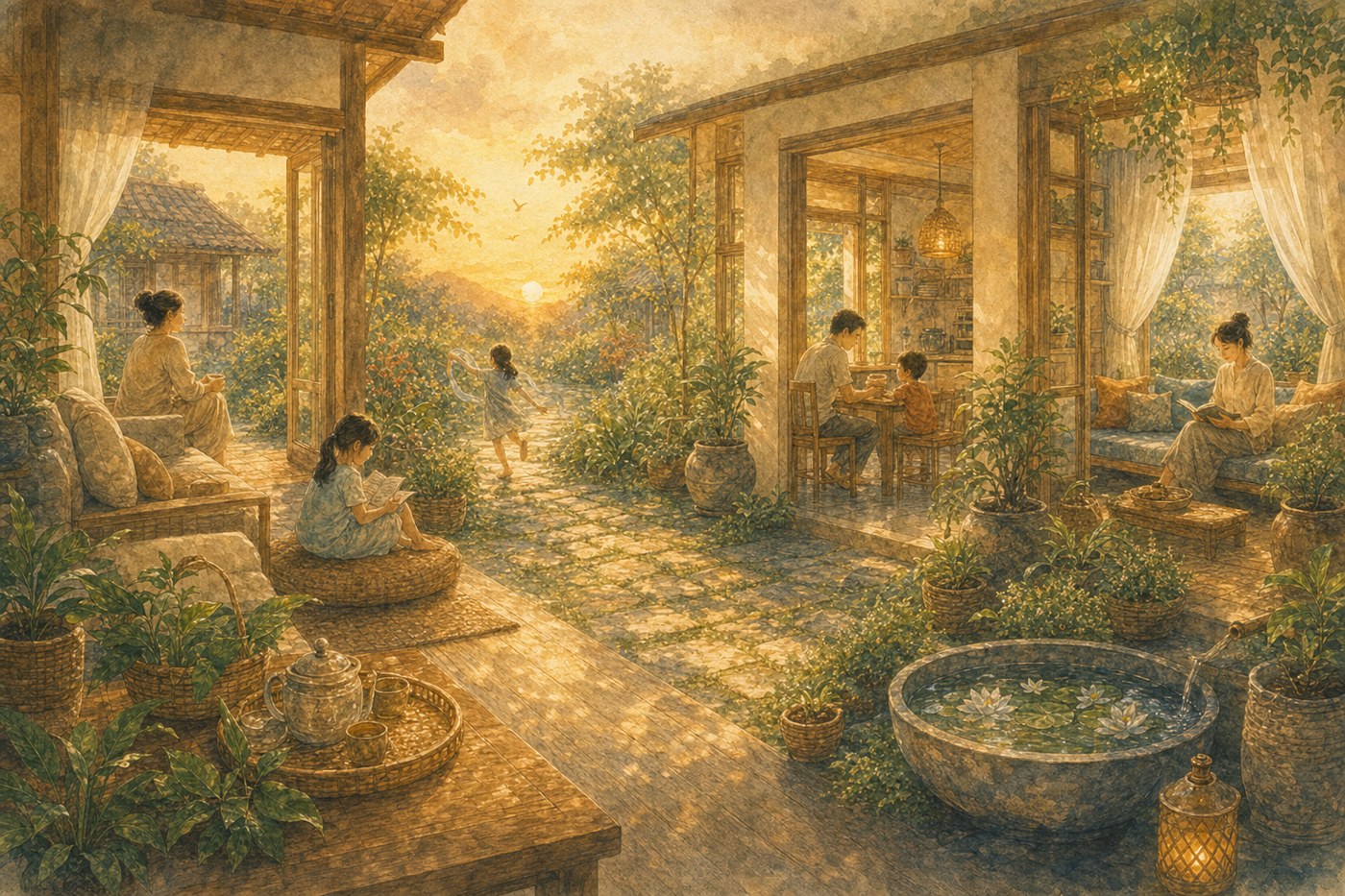
Looking back through the rooms
We began by giving the environment a place alongside food, movement and emotional care. We explored temperature, colour, light, sound, scent and air, and the materials that meet our hands and feet. Then we brought them into bedrooms, shared rooms, kitchens, bathrooms, workspaces, outdoor places and children's spaces.
Finally, we considered the household as a whole. The same home can contain a wish for quiet and a wish for company, a need for warmth and a need for cooler air, a desire for continuity and a desire to try something new.
The useful question has been present throughout: what makes this place easier and more comfortable for the people who actually use it?
More than technical details
Kelvin ranges, curtains, fabrics and furniture can sound technical. They are tools for a more ordinary purpose. We want to come home and find some support for the day we are living.
A well-placed light means we can see what we need. Reachable storage means a simple task does not begin with a search. A safe route means we can move through the room with greater ease. Once arranged, these things can keep helping without requiring a new decision every time.
The home still needs maintenance, and life still brings difficulty. A room cannot work as a twenty-four-hour treatment or protect us from every burden. It can nevertheless remove some unnecessary effort.
A lived-in standard of beauty
A home can be beautiful and supportive. But the image admired by someone outside it is not the only measure. A spare modern room may feel wonderfully clear to one person and unwelcoming to another. A room full of meaningful objects may offer comfort while also needing a clearer path through it.
We can ask for a standard grounded in living: can we rest here, use what we need, move safely and recognise something of ourselves? The answer need not appear in a magazine. It may be visible in the fact that someone now chooses to sit in a place they used to avoid.
A quiet way to show consideration
In a shared home, an adjustment can carry a message. A lamp moved after someone mentions glare, a blanket left within reach or a quieter interval after work can say, “I noticed what helps you.”
The elemental language may help us begin those conversations. The care comes from listening and responding, not from getting another person's classification exactly right. We can love someone without making them fit our explanation of them.
Our state can change
Plearnprai distinguishes enduring constitution from changing current state. The room may support how we feel and what we can do today; it does not need to turn us into another type.
Preferences can change with weather, age, illness, responsibilities and experience. A place that served us last year may need adjustment now. We are allowed to ask again without treating the earlier choice as a failure.
When surroundings make food preparation, movement, rest or connection easier, environmental care joins the other parts of life. It does not replace them.
One small beginning
We can move a lamp, change a familiar cover, care for a suitable plant, open a curtain at the intended waking time or clear a path. Some changes cost nothing. Others may need time, help or a budget, and can wait until those are available.
Not every experiment will have a noticeable effect. We can keep what helps and let go of what does not. The room belongs to the people living in it, not to a checklist.
May our home—large or small, old or new, urban or rural—leave room for different ways of being. May it offer warmth where warmth is welcome, relief where life feels intense, and an invitation where beginning feels difficult.
Thank you for walking through these rooms together. Our constitution is not a verdict, and our home can be more than a place to keep our belongings. With attention and cooperation, it can become a place where each person feels a little more supported in daily life.
ENVIRONMENT BY THE ELEMENTS
Sources and Further Reading
How to read these references
This book is an English editorial adaptation of Plearnprai's Thai volume สิ่งแวดล้อมตามธาตุ (Environment by the Elements). Traditional elemental language, design preferences and health or safety guidance serve different purposes. A reference about light, air or sleep does not validate a type-specific colour, fragrance or room prescription.
The Thai bibliography names the following sources and fields broadly. Where an edition, page or exact study was not supplied, none has been invented. These entries record the background of the book rather than a complete scholarly citation trail.
Thai medical and cultural background
- Tamra Wetthasat Chabap Luang, Rama V, the royal medical collection associated with King Rama V: named for discussion of environmental and seasonal influences. Specific passages and edition were not supplied.
- Khamphi Pathom Chinda: named in connection with climate and bodily conditions. The particular interpretation and passages require specialist verification before scholarly citation.
- Traditional Thai medical textbooks associated with the Department of Thai Traditional and Alternative Medicine, Ministry of Public Health: no particular volume or edition was identified.
- Writing on traditional Thai houses and ways of living in relation to climate and nature: a background category rather than a specified title.
Design and environmental psychology background
Stephen Kellert's work on biophilic design provides a background interest in bringing nature into inhabited places. Christopher Alexander's A Pattern Language is named for its human-centred approach to places. General writing on Chinese feng shui and Indian Vastu Shastra is also listed; these traditions should not be assumed to use the same elemental system as Plearnprai.
Marie Kondo's The Life-Changing Magic of Tidying Up appears as background for organising belongings. General books on biomimicry are named for design inspired by nature. The Thai text did not specify editions or pages for these works.
Further background categories include environmental psychology; indoor lighting and circadian rhythm; aromatherapy; sound environments and stress; indoor air quality; nature exposure and shinrin-yoku; and clinical writing on hospital environments and housing for older people. These broad categories are not presented as verified evidence for every suggestion in the book.
Health and safety references
The following primary organisational resources were checked on 13 October 2026. The bracketed numbers identify the topic-specific sources used in the chapters.
R1 · Light and daily rhythm
US Centers for Disease Control and Prevention, NIOSH, Effects of Light on Circadian Rhythms (archived training page). Used for the role of light timing in sleep and alertness, not for constitution-specific Kelvin requirements. Read.
R2 · Safe listening
National Institute on Deafness and Other Communication Disorders, How Loud Is Too Loud? Used for safe volume and children's listening, not for an elemental hearing profile. Read.
R3 · Aromatherapy
National Center for Complementary and Integrative Health, Aromatherapy. Used to distinguish a practice and its evidence from a guaranteed emotional or type-specific treatment. Read.
R4 · Indoor air
US Environmental Protection Agency, What Can I Do to Improve Indoor Air Quality in My Home? Used for source control, ventilation, filtration and moisture management. Read.
R5 · Humidifiers
US Environmental Protection Agency, Use and Care of Home Humidifiers. Used for cleaning, moisture control and the risks of poorly managed equipment. Read.
R6 · Plants and air-cleaning claims
US Environmental Protection Agency, The Inside Story: A Guide to Indoor Air Quality. Used to distinguish enjoying houseplants from relying on them to remove significant quantities of pollutants in occupied buildings. Read.
R7 · Essential-oil poisoning and misuse
National Capital Poison Center, Essential Oils: Poisonous When Misused. Used for storage, ingestion and misuse cautions. The book gives no home oil dosing regimen. Read.
R8 · Sleep surroundings
National Heart, Lung, and Blood Institute, Sleep Deprivation and Deficiency: Healthy Sleep Habits. Used for general sleep-friendly conditions. Read.
R9 · Electricity near bathing water
US Consumer Product Safety Commission, Don't Use Electric Heaters in Bathrooms, CPSC Cautions. An older official warning retained for the specific electrocution hazard; installations must follow current local requirements. Read.
R10 · Outdoor heat
US Centers for Disease Control and Prevention, About Heat and Your Health. Used for the need to consider heat exposure and individual vulnerability across all types. Read.
R11 · Infant safe sleep
Eunice Kennedy Shriver National Institute of Child Health and Human Development, Safe Sleep Environment, Safe to Sleep campaign. Used to keep adult comfort and cosy-corner advice separate from infant sleep requirements. Read.
R12 · Children's room hazards
US Consumer Product Safety Commission, Window Covering Cords and Childproofing Your Home. Used for cordless window coverings, safe furniture positioning and preventing tip-over and related household hazards. Window coverings · Childproofing guidance.
R13 · Oils around pets
ASPCA Animal Poison Control Center, The Essentials of Essential Oils Around Pets. Used for pet-specific cautions and the need for veterinary advice. Read.
R14 · Dry skin and bathing
American Academy of Dermatology, Dermatologists' Top Tips for Relieving Dry Skin. Used for comfortably warm washing and suitable moisturising rather than a mandatory oil routine. Read.
R15 · Sudden cold exposure
American Heart Association, You're Not a Polar Bear: The Plunge into Cold Water Comes with Risks. Used as a boundary against treating abrupt cold exposure as a harmless circulation or mood prescription. The article concerns cold immersion; it does not establish that an ordinary comfortable shower is dangerous. Read.
Framework and use
The distinction between enduring constitution and changing current state follows Plearnprai Canon 0, Card 01. Companion editorial notes document substantive adaptations, and the coverage record identifies the Thai source chapters.
These are general ideas to adapt to the home, people, budget and conditions actually present. The most useful room is one we can live in comfortably and safely—not one that follows every suggestion.
Caring for one another.