
The Plearnprai Three Elements Series · Book Two
FIRE TYPE
Understanding Yourself and
Caring for Your Well-Being
PLEARNPRAI
First English Edition · 2026
A COMPANION TO EVERYDAY CARE
FIRE TYPE
Understanding Yourself and Caring for Your Well-Being
The Plearnprai Three Elements Series · Book Two
Plearnprai · English editorial adaptation
13 October 2026 · First English Edition
This edition follows the complete fifteen-chapter route of the Thai book คนธาตุไฟ, with its introduction, closing and reference appendix. It uses the agreed concise name Fire Type and the inclusive voice “we”.
It is an adaptation for English readers, with corrections to distinguish traditional interpretation, Plearnprai's current framework and clinical information. The accompanying editorial notes document substantive changes. The original watercolour cover and all seventeen chapter illustrations have been retained.
English edition 1.0 · Published in the Plearnprai Library on 13 October 2026.
Contents
Introduction · A Book for Us4PART ONE · GETTING TO KNOW OUR BODY
1 · The Story of Our Fire72 · Getting to Know Our Body103 · Recognising Our Strengths13PART TWO · GETTING TO KNOW OUR MIND
4 · Our Mind in Balance165 · When Our Mind Feels Overheated196 · The Conversation Between Body and Mind22PART THREE · WHEN BALANCE BECOMES DIFFICULT
7 · Health Concerns and the Limits of a Type258 · A Four-Part Map for Noticing Strain289 · Signals We Should Not Ignore31PART FOUR · CARING FOR THE BODY
10 · Food That Supports Us3411 · Moving With Room to Recover3812 · Rest and Sleep41PART FIVE · CARING FOR THE MIND
13 · Making Room Around Strong Feelings4414 · A Daily Rhythm We Can Live With47PART SIX · APPROACHES TO CARE
15 · Choosing Complementary Approaches50Closing · A Fire We Can Care For53Sources and Further Reading56A Short Glossary60INTRODUCTION
Introduction · A Book for Us

A story that may sound familiar
Some of us arrive at Plearnprai with a familiar story. We work hard, take responsibility seriously and like to see things move forward. Other people may see someone strong and capable. Inside, however, we feel hurried, easily irritated or unable to stop.
Hunger can make a difficult afternoon harder. A demanding week may come with unsettled sleep or digestive discomfort. We may notice that we feel hot easily, or that our skin needs more attention when life becomes pressured. Sometimes we are told simply to relax. That advice can leave us wondering why something apparently so simple feels so difficult.
If any of this sounds familiar, this book offers a place to begin. We do not have to recognise every description. Nor do these experiences, by themselves, tell us our constitution or explain a medical condition. They are invitations to look more closely at our own life.
A capable person can need care
There is no failure in needing rest, support or medical attention. Determination and exhaustion can exist in the same person. We can be good at meeting everyone else's needs while finding it difficult to notice our own.
Plearnprai uses Fire Type as a concise name for a person with a Fire constitution: an enduring pattern of qualities described within our elemental framework. Warmth, intensity, purpose and a readiness to act are central images in that description. A constitution is a way of exploring differences between people, not a medical diagnosis or a judgement of character.
Throughout this book we will meet the image of a warrior or protector. It is a story about courage, decisiveness and responsibility. We use it as a metaphor, not as a claim that today's Fire Types descend from a distinct group of ancient warriors. We do not need that claim in order to value the strengths the image helps us see.
The aim is to care for our energy so that it has a sustainable rhythm: effort, completion, recovery and room to begin again.
Does the Fire description feel familiar?
Read these observations gently. Consider what has been characteristic of us over many years, including when we have been well. Recent symptoms belong in a different conversation.
- We may prefer clear goals and become engaged when there is something meaningful to accomplish.
- We may decide readily, speak directly or feel uncomfortable leaving a problem unresolved.
- We may enjoy challenges and set high standards for our work.
- We may have tended to feel warm or to prefer a comfortably cool environment.
- Regular meals may make a noticeable difference to our comfort and patience.
- We may find it easier to keep working than to give ourselves permission to finish.
These are reflection prompts, not a scored test. Body shape, skin changes, blood pressure, reflux or a particular waking time cannot establish a Fire constitution. If a symptom is new, persistent or troubling, it deserves attention on its own terms.
We all have more than one quality. Some readers may recognise a Mixed Type, such as Wind–Fire or Fire–Water. Others may find only a few useful observations here. There is no need to squeeze a whole person into a single description.
A brief introduction to the elements
Thai traditional medicine describes the body through four elements: Earth, Water, Wind and Fire. Broadly, Earth concerns structure; Water concerns fluidity and nourishment; Wind concerns movement; and Fire concerns warmth and transformation. These are traditional descriptions of functions and qualities, not chemical elements.
Plearnprai's Three Elements Series focuses on Wind, Fire and Water as a practical language for exploring everyday patterns. Earth remains part of the traditional foundation. Our framework also draws comparisons with Ayurveda, whose terms Vata, Pitta and Kapha belong to their own system. The comparisons are useful when their limits remain visible; the traditions are not interchangeable.
The word “energy” sometimes appears in this language. Here it refers to qualities of experience and function within the model. It is not a claim that an elemental force has been measured in a laboratory.
Constitution and current state
One distinction will accompany us from the first chapter to the last.
Constitution describes our enduring pattern within Plearnprai's model. Current state describes how we are doing now. A difficult week, an illness, changes in sleep, medication, climate or workload may affect our present experience without changing our constitution.
Someone who recognises Fire qualities is not destined to remain irritable or exhausted. Someone with a different constitution can feel hot, angry or driven. Care begins with both questions: “What has been characteristic of me over time?” and “What is happening to me now?”
The second question includes circumstances and possible medical causes. An element is a framework for reflection; it is not the cause of every symptom we experience.
From criticism to understanding
The Fire image can help us reconsider traits we have learned to criticise. Decisiveness may help a family through a difficult choice. Determination may carry a community project from an idea into something real. Directness may make it possible to name unfairness that others have been afraid to mention.
Those strengths need room to soften as well as room to act. When everything becomes urgent, directness may become cutting and commitment may become relentless. We can learn to notice those shifts without declaring our whole nature a problem.
We also remain responsible for our actions. “I am a Fire Type” is not an excuse to frighten someone, disregard a boundary or refuse to repair harm. Understanding should make care more possible, including care for the people around us.
Our route through the book
We will travel through six parts. First, we explore the body and the strengths represented by Fire. Next, we consider the mind: how purpose feels when it is well supported, what happens under pressure, and the connections between physical and emotional experience.
The third part turns to health concerns and the limits of self-care. A four-part map helps us notice increasing demands for support; it is not a clinical staging system. We then explore food, movement and sleep, followed by practices for the mind and a workable daily routine. The final part considers complementary approaches and how to choose them thoughtfully.
There are small invitations to reflect or practise throughout. We can read from beginning to end, or return to the chapter that meets today's question. Chapter 9 is worth knowing before using the practical suggestions.
Three agreements
We use “we” because writer and reader are on the same side of the page. This is a shared exploration, not a list of instructions delivered from a distance.
We make room for difference. A suggestion can be useful without being right for everyone. We can set aside what does not fit and pay attention to our own experience without turning it into proof of a theory.
Finally, this book supports learning and everyday care. It does not replace assessment or treatment. Asking for help is one way of taking responsibility for our health.
With those agreements in place, we can begin: with the warmth, courage and capacity to act that the Fire image invites us to understand.
PART ONE · GETTING TO KNOW OUR BODY
1 · The Story of Our Fire

A moment at the edge of the forest
Imagine a group of people resting near a forest as evening gathers. Someone notices danger approaching. While others are still taking in what is happening, one person rises, calls the group together and makes a decision. Their attention narrows to the task. They are ready to act on behalf of others.
This is the opening image of the Thai book: the warrior and protector. In this English edition, we keep the image as a way of recognising courage and purposeful action. It is an imagined scene, not evidence about the ancestry, genes or physiology of people described as Fire Types.
A story can still tell us something useful. Perhaps we recognise the feeling of becoming clear when a decision is needed. Perhaps we are the person others turn to when a plan has stalled. Perhaps our strongest motivation appears when someone needs protection.
The question is not whether we belong to an ancient category. It is how we can use these qualities well in the life we actually have.
A group needs many kinds of strength
No community can depend on one style of person. It needs those who notice possibilities, those who act, those who sustain relationships and those who quietly keep essential work going. These roles overlap. A person can move among them, and circumstances can reveal capacities we did not know we had.
In the imagery of this series, Wind suggests movement and sensitivity, Fire suggests transformation and purposeful action, and Water suggests nourishment and steadiness. None is a higher rank. None gives us exclusive ownership of creativity, leadership or kindness.
The protector image is also open to every gender. A person defending a neighbour, a parent making a difficult decision and a community organiser bringing people together may all express courage. We do not have to be forceful or famous to recognise this quality in ourselves.
Looking again at familiar traits
Quick decisions can be a gift when time is limited. They can also benefit from a pause when the situation is complex. Strong commitment can help us complete work that matters; it can become costly when we treat every request as an obligation. Direct speech can clarify a problem; its value grows when we also consider how another person will receive it.
These are not separate lists of good and bad characteristics. Often they are different expressions of a similar capacity under different conditions. That gives us something more useful than a verdict about personality: a question about context, proportion and choice.
The original warrior story also connects Fire with muscle power, rapid recovery, heat production and a strong inflammatory response. Those connections are not established measurements of a Fire Type. We cannot infer muscle-fibre composition, brown-fat activity, immune function or healing speed from an elemental description. Physical capacities need to be understood through the person, their health, training and circumstances.
We can therefore appreciate feeling strong or energetic without assuming that our body requires less sleep, recovers unusually quickly or is protected against illness.
The modern task that never finishes
There is another part of the warrior story that many of us recognise more immediately. A clear task has an ending. Much of modern work does not.
The messages continue after dinner. A completed project is followed by a larger target. A day off becomes a chance to catch up. The moment when we can finally say “enough for today” keeps moving away.
For someone who values achievement, that open-ended demand can become difficult to question. We may interpret stopping as falling behind. We may feel most useful when we are urgently needed, even when the pattern is becoming exhausting.
This does not mean that modern life causes every symptom through “excess Fire”. It means that workload, expectations, relationships and opportunities for recovery deserve a place in our account of health. Our habits matter, and so do the conditions in which we are trying to maintain them.
A sustainable rhythm may require more than a private relaxation practice. It may require sharing a responsibility, clarifying a role, asking for staffing support or deciding which messages can wait.
Several traditions, several languages
Thai traditional medicine uses Techo dhatu for the Fire element, with descriptions concerned with warmth and transformation. Ayurveda uses Pitta within its own account of constitution and function. Chinese medicine has concepts of heat and patterns assessed within a different diagnostic tradition.
These languages can invite comparison. Similar words do not prove that all three traditions are identifying one biological entity. Their histories, methods and meanings need to remain distinct.
Biomedical terms belong to a further framework. “Mesomorph” is a description associated with body-shape classifications, not a medical diagnosis of Fire. “Type A” is a historical behavioural construct, not another name for a Fire constitution. We should not use an athlete's physique, a leader's reputation or a profession to assign an element to them.
Research has explored associations between Ayurvedic Prakriti classifications and genetic variation. Govindaraj and colleagues' 2015 study is one example. It concerns the classifications and participants studied; it does not establish Plearnprai's Fire Type as a genetic category or validate prediction of individual disease. [1]
The most useful meeting between traditions is careful dialogue. We can preserve the questions each tradition asks without claiming that one has already proved the others.
Strength with an ending
What, then, can we take from the image of the protector? We can take the value of purposeful effort. We can take the courage to act when something matters. We can also imagine the moment after action, when the tools are put away and the person returns to ordinary life.
That last image is especially important. A role need not occupy the whole of us. We can be responsible without being continually available. We can care deeply about work and still have a life beyond its next demand.
A moment to notice
Recall a time when effort felt meaningful rather than consuming. What made the task worth doing? How did we know it was complete? What happened afterwards that allowed us to recover? Then think of one current responsibility whose ending is unclear. Could we define a smaller, realistic point of completion?
In the next chapter we turn from the story to our daily body: what we can notice, what we should not assume, and how observation can lead to kinder, more accurate care.
CHAPTER 02
2 · Getting to Know Our Body

The body we wake up with
We can live with a body for years and still feel uncertain about what it is telling us. We may be familiar with its hunger, warmth or energy while overlooking changes because we are busy. Or we may worry about an ordinary variation because we do not yet know our own usual pattern.
This chapter invites observation rather than diagnosis. The Fire portrait gives us questions to explore. It cannot tell us our blood pressure, the condition of our stomach or the reason our skin has changed.
We begin with what is familiar, then make room for what needs closer attention.
Appearance and physical capacity
Traditional descriptions of a Fire constitution often include a moderately built body, visible muscularity, warmth and a tendency to perspire readily. Some readers will recognise those features; others will not. Body size and shape alone do not determine constitution, fitness or health.
Nor can appearance tell us that someone has a fast metabolism, a strong immune system or a low risk of cardiovascular disease. A person who looks athletic may still need screening and treatment. Someone whose body differs from the traditional portrait may still recognise the behavioural qualities discussed in this book.
The original Thai account also mentions oily skin, flushing, greying hair and hair loss. These are not reliable measures of “inner heat”. If a change concerns us, we can discuss the change itself instead of trying to fit it into an elemental category.
Appetite and the image of digestive fire
“Digestive fire” is traditional language for the work of digestion and transformation. It can be a memorable image for how important food feels in our daily rhythm. It should not be equated directly with stomach-acid quantity.
Some of us notice that long gaps between meals leave us uncomfortable or impatient. Regular, satisfying meals may make the day easier. That observation is useful even without a theory about our constitution. We can ask when we last ate, whether the meal was enough and whether rushing affected the experience.
Heartburn needs a more specific explanation. Reflux involves stomach contents moving back into the oesophagus; it is not proof that an especially powerful digestive fire is burning an empty stomach. Frequent symptoms, difficulty swallowing or persistent vomiting need assessment. [2]
Peptic ulcers also have identifiable medical causes. Common causes include Helicobacter pylori infection and nonsteroidal anti-inflammatory medicines. They should not be attributed simply to hunger, anger or a Fire constitution. [3]
This distinction does not make daily eating habits unimportant. It helps us use those habits alongside the right care, rather than expecting meal timing to answer every digestive question.
Warmth, circulation and measurement
We may feel flushed during an argument, dislike hot weather or notice that a crowded room becomes uncomfortable. Those experiences can prompt simple practical changes: shade, a break, suitable clothing or access to drinking water.
They cannot tell us whether our blood pressure is high. Blood-pressure decisions need actual readings and professional interpretation. Feeling well does not remove the need for appropriate checks, and looking strong is not a substitute for them.
For the same reason, we should not use a Fire label to explain away severe headache, chest discomfort, fainting or sudden breathlessness. Chapter 9 sets out situations in which assessment takes priority over an elemental interpretation.
Skin as information, not a verdict
Skin can be very visible, and changes in it can affect confidence as well as comfort. A flare during a stressful week may feel like yet another thing we have failed to manage. We can respond more kindly.
Notice what has changed: location, discomfort, products used, timing and whether the change is recurring. These details may help a clinician. They do not establish that our whole body is inflamed or that our emotions caused a skin condition.
The image of Fire can remind us to avoid unnecessary irritation and attend to comfort. It should not turn acne, flushing or a rash into a judgement about temperament. Persistent, painful, spreading or otherwise concerning skin problems deserve care in their own right.
Sleep without a type-based assumption
The traditional Fire portrait often includes someone who falls asleep readily but postpones going to bed. If this is familiar, the difficulty may be granting rest enough space. Other readers may have trouble falling asleep, staying asleep or feeling restored.
Waking at two or three in the morning is not a test of Fire imbalance, and the clock alone cannot establish a hormonal cause. The more helpful questions concern the overall pattern: how often it happens, what sleep opportunity we have, and how we feel during the day. We will return to these questions in Chapter 12.
A good night should not be treated as proof that the model is correct, nor a difficult night as proof that we have failed at care.
Energy and the habit of carrying on
Some people who identify with Fire are especially familiar with the thought “I can still do a little more.” It may express enthusiasm. It may also be a learned way of overriding fatigue.
We can notice the difference between wanting to continue and being adequately recovered. Are mistakes increasing? Have we stopped eating regularly? Are we relying on stimulation to get through an ordinary day? Have people close to us noticed that we are less patient or less present?
These questions are not a measure of elemental heat. They help us see the demands being placed on our body and the support available to meet them. Unexplained or persistent fatigue should be assessed rather than assigned to a personality type.
A week of gentle observation
Our usual pattern is a useful reference point, but “usual” does not automatically mean healthy. A symptom we have had for months may still need attention. The purpose of a brief record is to make a conversation clearer, not to replace it.
Try this · Knowing our usual pattern
For one week, note a few details without scoring ourselves:
- When do hunger and meals fit into the day?
- What feels comfortable, and what is new or different?
- How much room do we allow for sleep and recovery?
- Which situations leave us hurried or unable to stop?
- Is there a symptom we have been postponing asking about?
A few lines are enough. Bring relevant observations to a healthcare appointment if one is needed.
Learning to read our body is not a search for a perfect label. It is a way of becoming more responsive to the person who is here today. Next, we give the same attention to strengths that are easy to overlook.
CHAPTER 03
3 · Recognising Our Strengths

The side we forget to see
Ask a person with high standards what they could improve, and the answer may arrive immediately. The unfinished work. The decision that could have been better. The impatient sentence they wish they had not spoken.
Ask what they already do well, and the conversation may become quieter.
Many of us have practised noticing the gap between our work and our ideal. We have had less practice noticing the value of what we bring. This chapter offers a pause for that second kind of attention. We are not trying to convince ourselves that everything is wonderful. We are making the picture more complete.
Capacity that deserves support
Some readers recognise a capacity for concentrated effort. When a task matters, they can gather attention, organise resources and begin. Others recognise an enjoyment of physical activity, a readiness to learn a demanding skill or satisfaction in seeing a practical result.
We can appreciate those capacities without claiming that every Fire Type has exceptional strength, rapid healing or unusual endurance. Actual fitness and recovery vary. Training, rest, health and opportunity all matter. Everyone needs an appropriate warm-up, and being eager to continue is not proof that continuing is safe.
A more useful question than “What should my type be able to do?” is “What can my body do now, and what helps it do that comfortably?” We can take pride in an ability while providing the conditions that sustain it.
Decisiveness
There are moments when a group needs someone to choose a direction. Perhaps everyone sees the problem, but no one feels ready to take responsibility. We may be comfortable saying, “Let us try this, and review what happens.”
Decisiveness is especially useful when it includes a willingness to revise. We do not have to defend yesterday's choice merely because it was ours. A clear decision and an open mind can belong together.
When decisions affect other people, listening is part of the skill. We can still act promptly while asking whose experience has not yet been heard.
Clear thinking and determination
We may enjoy finding the central question in a complicated situation. We may notice the relationship between a plan and its likely consequences, or identify the next practical step when a discussion is becoming abstract.
Determination gives that clarity continuity. It helps us return to a task after the first excitement has faded. Much valuable work is completed through ordinary persistence rather than a single dramatic effort.
Persistence also includes knowing when to change course. A project may need a different method, more support or an honest ending. Continuing indefinitely is not the only form of commitment. Sometimes commitment means protecting what matters from an approach that is no longer serving it.
Leadership, honesty and protection
Leadership can happen in a household, a small team or a neighbourhood. It may look like making a difficult conversation possible, arranging practical help or accepting responsibility when a plan goes wrong. It does not require a title or a particular personality.
The Fire portrait highlights a readiness to step forward. When that readiness is accompanied by respect, other people can feel supported rather than directed. We can help a group move while leaving room for its members to think and contribute.
Directness can also be valuable. Saying clearly what is needed can prevent confusion and resentment. The care lies in how we do it: naming a problem without reducing a person to the problem, and speaking honestly without using honesty as permission to wound.
The protector image brings another question: who benefits from our strength? We may use it to make room for someone with less power, or to name an unfair situation. We can also ask the person affected what support they actually want. Protection works best when it respects the agency of the person being supported.
When a strength becomes overextended
A useful quality can become less useful when there is no room around it. Decisiveness may become impatience. Persistence may become an inability to stop. High standards may narrow our attention until all we can see are faults.
This is an invitation to adjust the expression of a strength. We need not erase determination in order to rest, or abandon honesty in order to speak kindly.
| A strength we value | When pressure narrows it | A way to give it room |
|---|---|---|
| Decisiveness | Answering before understanding | Ask one clarifying question. |
| Commitment | Continuing beyond a workable limit | Define what completion means today. |
| Directness | Speaking in a way that hurts | Name the issue and the next step respectfully. |
| High standards | Treating every imperfection as failure | Agree what is good enough for this task. |
| Protection | Taking over someone else's choices | Ask what kind of help is welcome. |
These shifts can happen to anyone. They are not exclusive to Fire, and they do not make a person permanently one way or another.
Effort and recovery belong together
Imagine a carefully tended hearth. There is enough fuel for its purpose and enough space around it to keep the household safe. Someone notices when it needs attention. Its value lies in what it makes possible, not in burning as fiercely as it can.
That image gives us a gentler measure of strength. Can our effort continue without consuming all the room for meals, sleep, relationships and ordinary enjoyment? Can we finish one task without immediately needing another to justify our place in the world?
Rest can feel unfamiliar when achievement has become the main source of reassurance. We can practise allowing a pause before we feel we have fully earned it. Our needs do not begin only after exceptional work.
Try this · A record of our strengths
Write down three qualities we recognise in ourselves. Beside each, add one concrete occasion when it helped us or someone else. Then write a sentence we would want a friend to hear on a difficult day. Keep that sentence where we can return to it.
We have now considered the body, the Fire story and the capacities it helps us recognise. In the next part we turn towards the mind, beginning with what purposeful energy feels like when it has enough support.
PART TWO · GETTING TO KNOW OUR MIND
4 · Our Mind in Balance

A day with direction
Think of a day when we knew what mattered. There was something worthwhile to do and a realistic way to begin. We could concentrate. Decisions felt clear enough. One piece of work followed another, and at the end there was room to acknowledge what had been done.
The day may not have been easy. It may have required courage or considerable effort. Yet the effort felt connected to a purpose, rather than driven by the fear of never doing enough.
This is one image of Fire in balance: warmth and direction, with room to respond to what is happening. It is a description of experience, not a state we must maintain perfectly.
Courage in ordinary life
The warrior metaphor can become quieter here. Courage may mean speaking honestly in a meeting, admitting uncertainty or beginning something that cannot be completed alone. It may mean hearing feedback without immediately defending ourselves.
A capable mind can face difficulty while remaining receptive. We can stand by a value and still be curious about another person's perspective. We can take responsibility and still share it.
For some of us, the hardest form of courage is allowing others to see that we need help. The image of the protector can expand to include being protected in return.
Qualities we may recognise
The traditional Fire portrait emphasises intention, clarity and a readiness to act. When well supported, these qualities can help us make practical use of our attention.
We may set a goal and stay with it. We may analyse a problem, separate what can be changed from what cannot, and help a group take a first step. We may feel comfortable making a decision while accepting that no choice comes with complete certainty.
The quality of the experience matters as much as the result. Are we able to listen? Can we tolerate a change of plan? Can someone disagree without becoming an opponent? Do we still recognise the people around us as people, rather than obstacles to completion?
A balanced day makes space for those questions. It does not require us to become passive. It allows purposeful activity to coexist with flexibility.
What gives our effort meaning?
Goals can help organise attention. A clear purpose tells us where to place our energy and what we can leave for another time. Many people who identify with Fire find direction reassuring.
Challenge can be engaging too. We may enjoy learning something that asks us to stretch. The useful challenge is one with support and room for recovery, rather than an endless demand to prove ourselves.
A sense of contribution may matter more than recognition. We want to see that a decision, a project or an act of care has improved something real. There can be deep satisfaction in leaving a place or relationship better supported than we found it.
Fairness and quality may also be important values. When something feels careless or unjust, our attention sharpens. That attention can become constructive when we ask what response would actually help, rather than assuming that the intensity of our feeling tells us what to do.
These motivations are not exclusive to a constitution. We explore them here because they form part of the Fire portrait and may help us understand our own choices.
Purpose without continual pressure
A meaningful goal can gradually become a condition we place on our worth. We start with “I would like to do this well” and arrive at “If this is imperfect, I am not good enough.” The task has become much heavier.
We can notice that shift before arguing with ourselves about it. What would doing the work well mean in the actual time and conditions available? What standard is necessary, and what standard are we imposing because uncertainty feels uncomfortable?
Sometimes the most useful change is small. We can distinguish an urgent decision from one that can wait. We can leave time to ask for another view. We can name the end of a working period instead of waiting for the feeling of total completion.
Purpose becomes easier to live with when it has boundaries.
Balance has warmth
Being told to “calm down” can sound as though enthusiasm itself is unwelcome. We may imagine that care requires us to lose our ambition, soften every opinion or stop caring about excellence.
The approach in this book leaves room for vitality. We can enjoy achievement and act with conviction. We can also allow different levels of intensity at different times.
The image is a fire that serves a purpose and then settles. At work, we may bring concentration and decisiveness. At the dinner table, a conversation may need curiosity more than solutions. Before sleep, the day may need an ending rather than a final improvement.
Flexibility is part of that rhythm. A day that contains rest, uncertainty or an unfinished task need not count as a day out of balance.
A moment to notice · A good day
Recall a day when our energy felt both useful and sustainable. What were we doing? What made it meaningful? Who or what supported us? Was there a clear stopping point? Choose one condition from that day that we could make a little more available this week.
This chapter has looked at the mind when purpose has room to breathe. Next we consider what happens when that room becomes smaller: when urgency, frustration and self-criticism begin taking up more of the day.
CHAPTER 05
5 · When Our Mind Feels Overheated

The moment that arrives too quickly
A plan changes. Someone speaks in a way we find dismissive. A task moves more slowly than expected. Before we have considered what we want to say, the words are already out, sharper than we intended.
Later, we may replay the moment and wish we had responded differently. Or the pressure may turn inward: we keep working although we are tired, determined not to be defeated by an ordinary need for rest.
The Fire image describes these experiences as feeling overheated. It is a way to notice intensity, not a diagnosis. The purpose of noticing is to create more choice, not another reason to criticise ourselves.
Signs that our room to respond is shrinking
Irritation may become easier to trigger. Things we would normally let pass seem intolerable. We interrupt sooner, hear criticism in neutral comments or find it difficult to accept another person's pace.
Our attention may begin collecting faults. We see what is late, incomplete or below standard, while work that has gone well barely registers. The same habit can turn towards ourselves, producing a running account of everything we should have done better.
Competition may spread into places where it is not useful. Rest becomes a test of discipline. A conversation becomes something to win. Someone else's success begins to feel like evidence that we are falling behind.
We may also disregard fatigue. The wish to complete a task speaks louder than hunger, discomfort or the need for sleep. Each exception seems small; together they can leave little room for recovery.
These patterns are worth understanding. They can also be influenced by circumstances, illness, medication or mental-health difficulties. A sudden or substantial change deserves more than a personality explanation.
What was happening before the reaction?
Pressure and comparison can make an already difficult day harder. We may feel challenged, misunderstood or afraid that an important responsibility will not be met. When every result seems to reflect our personal worth, a small setback can carry a large emotional weight.
Work without reliable breaks can reduce our sense of choice. So can a situation in which we have responsibility without enough authority, resources or support. A breathing exercise may help us pause; it cannot by itself repair an unfair workload.
Hunger, lack of sleep, physical discomfort and an unpleasantly hot environment may also belong in the picture. We do not have to call them the same process in order to notice that they make the day more difficult.
Finally, our values can be involved. We may be reacting to something unfair or genuinely harmful. Care does not require us to dismiss that concern. It asks how to respond effectively without adding avoidable harm.
The loops we can learn to recognise
One familiar loop begins with a high standard. We work hard, achieve a result and immediately raise the standard. Success provides very little time to recover because it becomes the starting point for the next demand.
Another begins with discomfort. We feel physically unwell and become less patient. A difficult interaction adds tension, and the evening becomes harder to settle. The loop does not tell us the medical cause of the symptom; it shows a place where practical support may help.
Once we can describe a loop, we can look for an opening. Perhaps a task needs a realistic finish line. Perhaps a meal needs protecting. Perhaps a conversation should happen after a break, with enough time for both people to speak.
We do not have to change every part at once. A small opening is still an opening.
Kindness and responsibility
It is understandable to regret an angry response. What often makes matters worse is turning regret into a judgement about our whole self: “I always ruin things. I should be able to control everything.” That judgement adds pressure without telling us how to repair the situation.
A more useful response has two parts. We acknowledge what happened, including its effect on others. Then we identify what we can do now: apologise clearly, correct an action, step away safely or ask for support with a recurring pattern.
Self-compassion does not remove accountability. It makes it easier to remain present long enough to take it. We can say, “I spoke harshly, and I want to repair that,” without deciding that harshness is our permanent nature.
If anger repeatedly frightens someone, crosses boundaries or feels difficult to control, professional support is appropriate. A Fire label should never make harmful behaviour seem inevitable or acceptable.
A pause that fits real life
When we first notice intensity rising, a short pause may be enough to prevent an impulsive message or sentence. We might put the phone down, take a few comfortable breaths or say, “I need a moment before I answer.”
A pause is not a promise that the feeling will disappear. It gives us time to choose what happens next. Sometimes we need a longer break and a clear agreement about when to return to the conversation.
If a situation is unsafe, prioritise safety and help rather than trying to complete a calm discussion. If it is safe but difficult, we can revisit it when there is more room to listen.
Try this · A map of our triggers
Think of two or three recent moments when our response felt stronger than we wanted. Note what happened, what we needed and what we noticed first in our body or behaviour. Then choose one support we could place earlier in the sequence. Keep the record descriptive rather than accusatory.
We are learning a pattern, not passing a test. In the next chapter we look more closely at physical and emotional experience, and how care can begin from either direction.
CHAPTER 06
6 · The Conversation Between Body and Mind
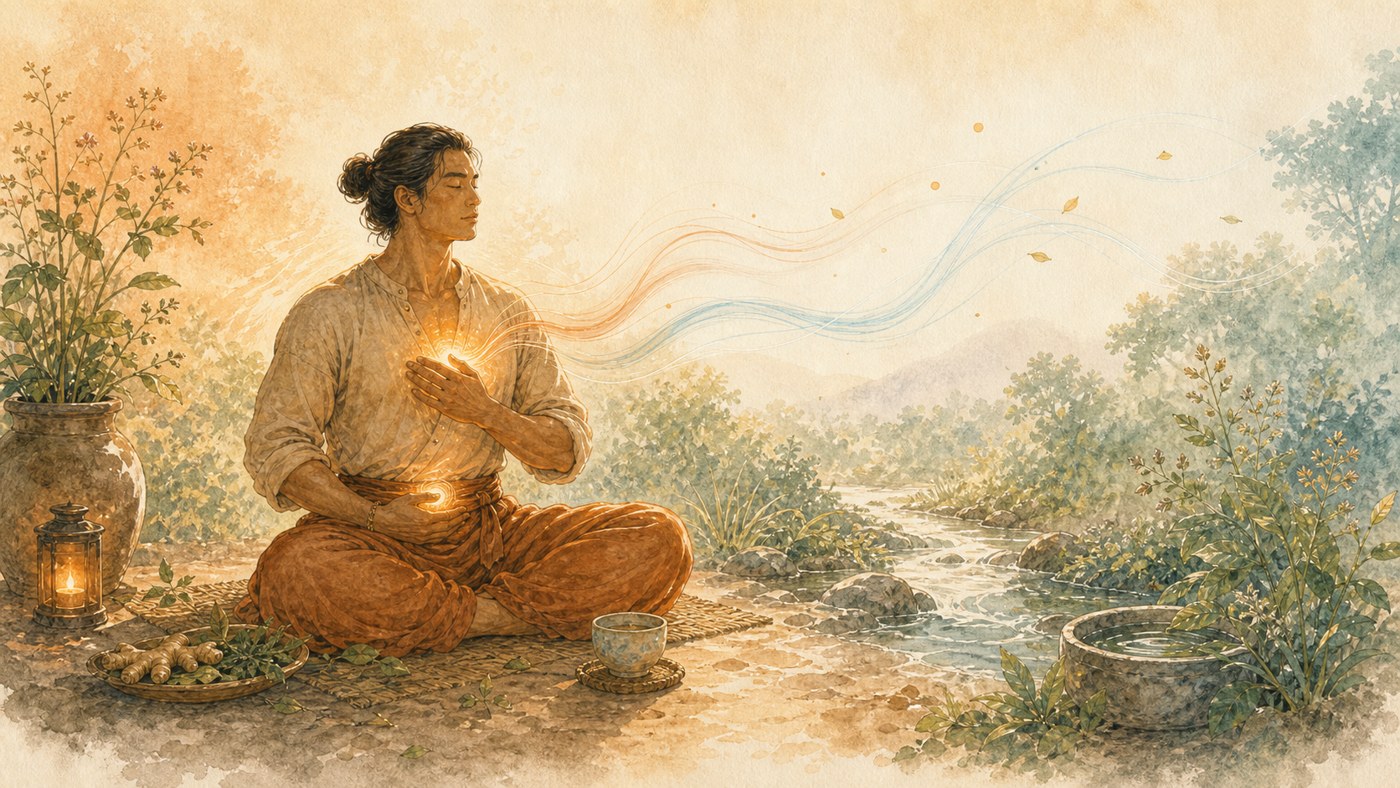
A feeling that involves the whole of us
An argument begins, and we notice our shoulders tighten. An unwelcome message arrives, and our attention becomes fixed on it. Later, when someone listens without rushing us, the same room may feel easier to sit in.
Experiences like these make the connection between body and mind tangible. We do not encounter a stressful day as an isolated thought. We live it through attention, sensation, behaviour and the circumstances around us.
The traditional language of Fire offers one way of describing that whole experience. Modern physiology asks different, more specific questions about the systems involved. We can learn from both while keeping their claims distinct.
One image, several kinds of explanation
Within Plearnprai's introductory model, Fire describes transformation and intensity. In physical experience it may evoke warmth or activity; in emotional experience it may evoke drive, decisiveness or anger. Wind and Water provide other descriptions of movement and nourishment.
Using the same image in two areas does not establish that one measurable substance causes them both. “Fire in the mind” is not a laboratory finding, and “cooling down” emotionally is not necessarily a fall in body temperature.
The value of the image is practical. It reminds us to ask about the whole person. If work is overwhelming, we can ask about meals and sleep as well as thoughts. If there is persistent discomfort, we can ask about its emotional impact while still seeking an appropriate diagnosis.
The nervous system as a bridge
Our nervous system helps coordinate bodily responses to changing circumstances. Stress can involve changes in heart rate, breathing and muscle tension. Over time, stress can affect well-being, but its effects vary and do not explain every symptom. [4]
The sympathetic and parasympathetic branches of the autonomic nervous system are sometimes described as “accelerating” and “settling”. That is a simplified teaching image. They are not two switches we can control perfectly, and neither branch is inherently bad.
We need the capacity to respond to demands. We also need conditions that allow recovery. The question is whether our life provides room for both, and whether a symptom requires medical attention beyond this account.
What we should not infer
The Fire description does not tell us that our stress hormones remain elevated longer than someone else's. It cannot show that we produce more stomach acid, that our skin has a particular immune response or that a disease began with anger.
Those are specific claims requiring specific evidence. The fact that a symptom becomes more noticeable during stress does not establish its cause. A person can be under pressure and also have an illness that needs treatment.
This matters emotionally as well as medically. When we make the mind responsible for every physical problem, we risk leaving a person feeling blamed for being unwell. A more generous account leaves room for biology, circumstances, uncertainty and support.
A loop rather than a single direction
Consider someone working late to finish a difficult task. Their meal is rushed and bedtime moves back. The following day feels harder, and a minor setback prompts a sharper response than usual. The conflict creates another unfinished problem to carry into the evening.
We do not need to decide that every step is caused by Fire. We can simply see how the pieces are affecting one another. There may be several places to intervene: change a deadline, arrange food in advance, ask for assistance or give an important conversation a less pressured time.
Another loop may begin with illness. Discomfort makes concentration harder. We worry about falling behind and push ourselves. Here, treating the health problem and adjusting expectations may matter more than practising calm.
A complete picture can start on either side of the bridge.
Care can also travel in both directions
On a day when thoughts are difficult to interrupt, a concrete action may be easier than an argument with ourselves. We can sit somewhere comfortable, loosen an uncomfortable position, step out of a noisy space or eat a meal that has been delayed.
On another day, naming a worry to someone we trust may make it easier to recognise what our body needs. Neither approach guarantees relief. Each offers an accessible starting point.
Relaxation practices can be helpful for some people, but they are optional tools and should not postpone needed care. If inward attention feels distressing, we can use an external focus, such as noticing the room, or seek guidance. [4], [5]
The small space before a reply
A short pause can be especially useful when our next action might affect someone else. We can notice that we are activated and refrain from sending a message immediately. That moment may give us access to a different sentence.
The aim is not to suppress a justified concern. We are making room to express it in a way that serves the situation. “I want to understand what happened” may take the conversation somewhere different from an accusation.
Try this · Crossing the bridge with a pause
Put down what we are about to send or say. Feel the support beneath our feet or body. If comfortable, take two or three easy breaths without forcing depth or holding the breath. Ask, “What matters here, and what response would help?” If we need longer, name the pause and arrange a time to return.
We have explored the mind in balance, under pressure and in conversation with the body. The next part takes health concerns seriously without treating our elemental description as a diagnosis.
PART THREE · WHEN BALANCE BECOMES DIFFICULT
7 · Health Concerns and the Limits of a Type

When capability hides a need for care
Someone can look energetic, carry considerable responsibility and still be struggling. They may have recurrent heartburn, troubled sleep, uncomfortable skin or fatigue they have been trying to ignore. Achievement does not make those experiences less real.
The Thai source brings these concerns together through the image of Fire. Its intention is to help a reader see a whole life rather than a collection of disconnected problems. We preserve that intention while being clear about its limit: a Fire Type is not an established biomedical risk category.
We cannot infer an individual's likelihood of heart disease, inflammatory bowel disease, autoimmune disease or another condition from this label. Nor should we assume that several symptoms share one cause because the same metaphor can describe them.
Digestive concerns
Burning discomfort and reflux can be unpleasant enough to shape a whole day. They may affect eating, concentration or the confidence to go to sleep. A practical record of timing, symptoms and medicines can help make an appointment more useful.
GERD and peptic ulcers are different conditions. Heartburn is a symptom rather than a constitutional trait. Persistent or recurrent digestive symptoms may require evaluation, and warning signs such as bleeding or difficulty swallowing need particular attention. [2], [3]
Inflammatory bowel disease also should not be treated as another expression of an overheated personality. If we already have a diagnosis, we follow the relevant care plan and discuss changes with our clinician. The habits in this book can support ordinary life around that plan.
Blood pressure and cardiovascular health
A person can be busy, physically active or outwardly fit and still have a reason to monitor cardiovascular health. The useful information comes from measurements, clinical history and assessment, not from temperament or appearance.
If we have been prescribed treatment, we do not stop or alter it because we feel calmer or identify a new elemental pattern. We can ask our clinician how to monitor progress and which changes would require contact.
Very high readings with serious symptoms may be an emergency; Chapter 9 gives a practical boundary. Reassuring ourselves that the problem is “only stress” should not delay that response. [6]
Skin and immune conditions
Acne, facial redness, psoriasis and other skin conditions can have different causes and treatments. A description such as “hot” or “inflamed” may capture how something feels, but it does not make these conditions medically identical.
The same is true of autoimmune illness. It is not a predictable result of a determined personality, and it is not evidence that a person has failed to rest properly. If diagnosed, it needs condition-specific care.
We can tell a clinician when symptoms seem to change with workload, sleep, products or other circumstances. Such observations add context. They do not establish that reducing emotional intensity will treat the underlying condition.
Exhaustion, burnout and mood
The phrase “burning out” is an understandable metaphor when effort feels depleted. In the World Health Organization's ICD-11 description, burnout concerns chronic workplace stress that has not been successfully managed. It is an occupational phenomenon, not a diagnosis covering every form of exhaustion. [7]
Persistent fatigue, loss of interest, major changes in sleep or difficulty functioning deserve assessment. Depression, physical illness and work-related burnout should not be collapsed into one final stage of Fire imbalance.
Sometimes a person needs changes at work, psychological support and medical care at the same time. Recognising those needs broadens the response. It does not make them less capable.
Hot flushes and changing circumstances
The Thai text also mentions hot flushes around menopause. We retain the invitation to notice changing needs, but a Fire label cannot predict their severity or determine treatment. New or troublesome symptoms can be discussed with a healthcare professional.
A changing life stage may affect what is comfortable and practical. That belongs to the question of current state and care. Within Plearnprai's model, it does not mean that our underlying constitution has become a different type.
Shared support without a single explanation
Several difficulties may improve when we have adequate food, more workable demands, better opportunities for sleep and appropriate treatment. These supports can matter across more than one part of life.
Improvement together does not prove a single elemental cause. Different conditions may be responding to different parts of the care plan. We can welcome improvement without turning it into a conclusion that has not been established.
| What we notice | What it cannot tell us alone | A useful next step |
|---|---|---|
| Recurrent burning or reflux | That we have excess digestive Fire | Discuss persistent symptoms and warning signs. |
| Feeling hot or flushed | Our blood pressure or disease risk | Use appropriate assessment and measurements. |
| A recurring skin flare | A single cause shared by all symptoms | Record changes and seek suitable skin care. |
| Deep or persistent exhaustion | That this is simply our Fire burning out | Review physical health, mood and circumstances. |
| Several difficulties together | That one remedy will address them all | Coordinate care and explain the full picture. |
Understanding without a prediction
We do not need a list of diseases assigned to our type in order to care for ourselves. We need to know what is happening, what can be supported safely and when expertise is required.
A moment to notice
Is there a concern we have been describing only through a metaphor? Write it in ordinary terms: what happens, when it began, how often it occurs and how it affects life. Add any treatment or advice already received. This can be the beginning of a clearer conversation.
The next chapter offers a four-part reflection map. Its purpose is to notice the growing need for support, while leaving medical diagnosis where it belongs.
CHAPTER 08
8 · A Four-Part Map for Noticing Strain

A map that helps us pause
It can be easier to notice another person's need for rest than our own. We may keep saying “after this week” until weeks become months. A map can help us stop and ask what kind of support is needed now.
The Thai book describes four phases, moving from increased intensity towards more persistent difficulty and depletion. Here we use those phases as a reflection map, not a validated medical sequence. Illness can begin suddenly, remain silent or follow a very different course. A person does not have to pass through one phase before needing care.
We should never use the map to reassure ourselves that a serious symptom is an early, harmless stage. Chapter 9 takes priority whenever warning signs are present.
1 · Less room to recover
At the first point on the map, we notice that our daily rhythm is narrowing. Work occupies more space. Meals are postponed. Sleep is treated as time we can borrow from. Our patience may be shorter, although we continue functioning and may even be achieving a great deal.
This is an opportunity to look at the pattern before waiting for a crisis. What has become more demanding? What support has disappeared? Are we choosing the pace, or trying to meet expectations that have not been examined?
A response might be to protect a meal, define an end to work or ask for help with a responsibility. We do not need to call this a disease stage in order to take it seriously.
2 · Recurring discomfort
At the second point, there are symptoms or difficulties we keep noticing. Perhaps sleep is less settled, discomfort returns or irritability is affecting conversations. We may still have better days, making it tempting to postpone asking for help.
Recurring symptoms are information. They should not automatically be called “inflammation” or assigned to a Fire pattern. Depending on the symptom, its intensity and our circumstances, assessment may be needed even if it comes and goes.
We can keep a short record, support basic routines and arrange advice where appropriate. An apparent connection with a busy week does not rule out a medical cause. Temporary improvement also does not establish that a condition is harmless.
3 · Difficulty that is affecting life
At the third point, a problem is persistent, has been diagnosed or is interfering with ordinary functioning. We may be changing plans around it, missing work, sleeping poorly or withdrawing from activities we value.
This is a reason for coordinated care. The question becomes larger than which self-care exercise to try. What assessment is needed? Is the treatment plan clear? Who can help with practical demands while we recover or learn to live with an ongoing condition?
A routine can still be supportive. Its role is to make appropriate care more workable, not to compete with it. We may need a simpler plan, fewer obligations and clearer communication about what we can manage.
4 · Depletion and a need for more support
The final image is a person who has very little room left. They may feel exhausted, disconnected from work or unable to carry familiar responsibilities. It is a description of how life can feel, not evidence that stress glands have worn out or that an autoimmune disease is about to appear.
“Adrenal fatigue” is not used as an explanation in this edition. Nor is depression treated as merely another name for depleted Fire. Significant fatigue or mood change needs appropriate assessment.
Where work-related burnout is part of the picture, the circumstances of work matter. Recovery cannot reasonably be assigned entirely to the individual while the same unsustainable demands remain. The WHO description keeps burnout specifically tied to the occupational context. [7]
At this point, asking for help and reducing demands may be more important than adding another practice. A manageable day can be a meaningful aim.
Direction matters more than a score
We may recognise more than one part of the map at once. We may have a stable medical condition and a generally supportive routine, or no diagnosis and a level of distress that deserves prompt attention. The map is deliberately not a score.
It does not predict how quickly someone will improve. Some difficulties respond to modest changes; others require treatment, adaptation or long-term support. Improvement is not always a return to a previous level of output.
The useful question is: “What would make care more appropriate at this point?” That may mean a small daily adjustment, a clinical appointment, a workplace conversation or urgent help.
Hope without a promise
There is room for hope even when recovery is uncertain. We can improve how we are supported, clarify a diagnosis, adjust an environment or find a less punishing way to meet a need. These are meaningful changes even when a symptom does not disappear.
We should not measure progress by how quickly we return to full productivity. The person matters beyond their output. A slower pace, shared responsibility or a different goal may be part of a good outcome.
Try this · Locate the next need
Rather than deciding which phase we are “in”, write three short answers:
- What is becoming harder or changing?
- What support is missing?
- What is the next appropriate action, including healthcare if needed?
If a warning sign is present, act on that sign instead of finishing this exercise.
The map has done its work if it helps us respond sooner and with less self-blame. Next we make the boundary between everyday care and medical help more concrete.
CHAPTER 09
9 · Signals We Should Not Ignore

Listening before we have to stop
“I can still manage” can be a useful expression of confidence. It can also become a way of postponing attention to something important. This chapter helps us recognise when continuing with self-care alone is no longer the right next step.
We do not need to prove that a symptom is serious before asking for advice. And we do not need to decide whether it belongs to Fire, Wind or Water before seeking help.
The guidance below is a practical boundary, not an exhaustive list. If something feels seriously wrong, seek urgent medical advice.
Small changes still deserve attention
Perhaps we are less patient, have allowed work to displace meals or are finding it harder to settle at night. Mild, brief difficulties without warning signs may be a reasonable place to try a modest change and observe what happens.
Observation should have a review point. Is the problem improving, recurring or getting worse? Does it affect our ability to eat, sleep, work or care for ourselves? A symptom that persists or returns deserves advice even if we can keep functioning.
Changes in measured blood pressure should be addressed according to clinical advice. They should not be placed automatically in the category of mild elemental imbalance.
Emergency help now
For the signs below, seek emergency medical help rather than trying food, breathing, massage or another practice first. Contact the local emergency service. If possible, have someone stay with the person and follow the emergency operator's instructions.
- New chest pressure or significant chest pain, especially with pain spreading to an arm, jaw or back, sweating, breathlessness or faintness.
- Sudden or severe difficulty breathing, collapse, loss of consciousness, a seizure or a marked change in alertness.
- Sudden facial droop, weakness or numbness on one side, difficulty speaking, sudden vision changes or a sudden severe headache.
- Vomiting blood, black tar-like stools, coughing blood or serious bleeding that does not stop.
- Sudden severe pain, particularly pain unlike anything experienced before, or severe abdominal pain with a person becoming very unwell.
- A rapidly worsening severe rash with serious illness, or swelling of the lips, tongue or throat with breathing difficulty.
- High fever above 39°C in an adult, following Plearnprai’s conservative referral rule; or confusion, seizure, collapse or other serious deterioration during heat exposure. [15]
These boundaries follow Plearnprai's red-flag source and the distinction between everyday care and urgent assessment. We do not wait to see whether a symptom fits the rest of the book.
Very high blood pressure
For a non-pregnant adult, a reading above 180 systolic and/or 120 diastolic needs immediate attention. With symptoms such as chest pain, breathlessness, weakness, vision change or difficulty speaking, call emergency services without waiting for the reading to settle. If there are no such symptoms, wait at least one minute, repeat the reading and contact a healthcare professional promptly if it remains very high. Pregnancy requires different thresholds and advice. [6]
Immediate danger to ourselves
If we may harm ourselves, have taken steps towards doing so or feel unable to remain safe, seek emergency help now. Tell someone trusted, ask them to stay with us and move to a safer setting with support. A reflection exercise or a promise to cope alone is not the appropriate response.
For thoughts of self-harm even without immediate intent, reach out promptly to a healthcare professional or an available local crisis service. We deserve support before the situation becomes more dangerous. No location-specific crisis number is reproduced here because this English edition may be read in different countries.
Arrange prompt medical assessment
Other changes may not require an emergency response but should not be left to an elemental self-care plan alone:
- Unintentional weight loss, difficulty swallowing, persistent vomiting, a new lump, a non-healing wound or a lasting change in bowel habits.
- Recurrent or worsening digestive symptoms, persistent pain, recurring skin problems or fatigue without a clear explanation.
- Low mood or loss of interest that is sustained and affecting ordinary life; unusually elevated mood with very little sleep, impulsive behaviour or a major change from our usual self.
- Palpitations, dizziness or near-fainting, particularly in an older person.
- Fever lasting several days, new one-sided leg swelling, or swelling associated with breathlessness when lying down.
If symptoms become severe or rapidly worsen, escalate the response. Children, pregnant or breastfeeding people, older adults, and people with chronic illness or reduced immunity may need advice sooner. This book is written for adults; its general suggestions are not a treatment plan for those groups.
Getting help is a practical decision
Some of us delay an appointment because there is always another task. Others worry that asking for help will make them seem less capable. We can treat the decision as we would any other important responsibility: identify what is needed and arrange the right support.
Before an appointment, a short record can help. Note when the problem began, how it has changed, any relevant readings, and the medicines or supplements we use. Include what the symptom is preventing us from doing.
We do not need to arrive with a theory. “This is new, it keeps happening, and I am concerned” is enough to begin a useful conversation.
The place of this book
The book can help us reflect on patterns, make routines more supportive and communicate what we have noticed. It cannot examine us, interpret every symptom or decide that a condition is safe to watch at home.
A symptom improving after rest does not prove that it was harmless. A constitution label does not exclude a medical condition. Appropriate self-care and appropriate healthcare can work together.
Try this · Make asking easier
Identify how we would contact ordinary medical care and emergency help where we live. Keep a current medicine list accessible. Then choose one concern we have been postponing and decide when to ask about it. If any emergency sign is present now, act now.
With these boundaries in place, we can turn towards the practical chapters with greater clarity. We begin with meals and the place they hold in an ordinary day.
PART FOUR · CARING FOR THE BODY
10 · Food That Supports Us
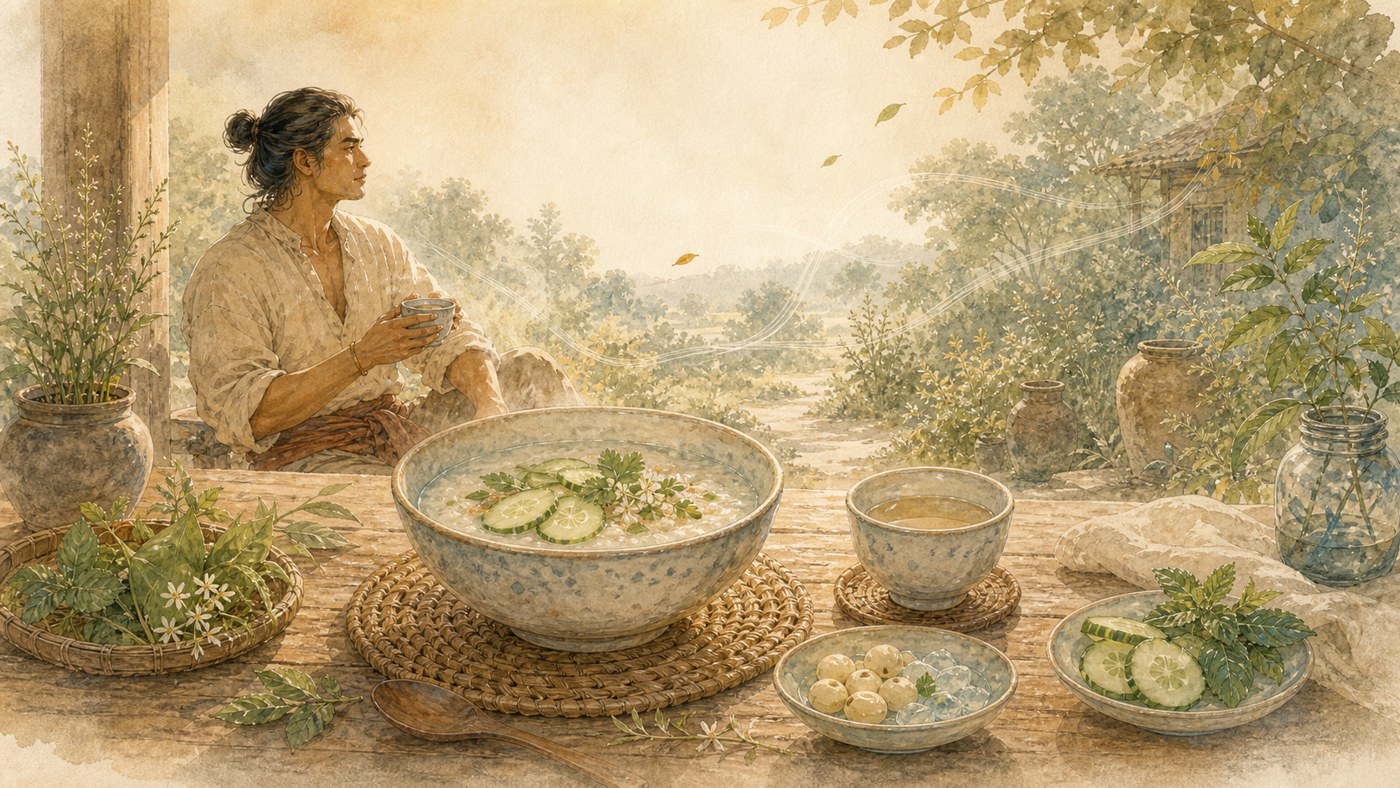
An ordinary opportunity for care
Meals happen in the middle of real life: before work, between appointments, with family or at the end of a tiring day. They are one of the most regular opportunities we have to ask what our body needs.
For a person who tends to keep going, the first useful change may be to give a meal enough space. We can notice hunger before it becomes urgent, sit down when possible and let eating be more than a task fitted around other tasks.
The Thai book summarises its approach for Fire with three ideas: cooling, gentle and regular. We retain those words as a traditional guide to comfort and rhythm, while distinguishing them from clinical nutrition advice.
What “cooling” means here
In traditional food language, “cooling” describes an attributed quality. It does not simply mean food taken from a refrigerator. Nor is it an established measure of a food's effect on inflammation, body temperature or a diagnosed condition.
This distinction leaves us free to use the idea thoughtfully. A mild, satisfying meal may feel more comfortable than a very spicy meal after a demanding day. That is an observation we can make without claiming that the meal is extinguishing a disease process.
Physical temperature is a separate preference and safety question. We can choose food and drink at a comfortable temperature. This edition does not claim that cold water necessarily disrupts digestion or that everyone with a Fire constitution must avoid it.
A varied and satisfying foundation
A generally supportive eating pattern can include a variety of vegetables and fruits, whole grains where suitable, and appropriate sources of protein. The American Heart Association's guidance emphasises an overall pattern, including plant protein sources, fish or other suitable options, rather than a single protective food. [13]
The Thai source includes leafy vegetables, cucumber, melon, rice and cooked legumes among familiar meal choices. We can keep those examples while adapting them to taste, access and individual needs. There is no need to seek unfamiliar ingredients simply to follow a constitutional label.
Rice with vegetables and tofu, beans, fish or another suitable protein can make a practical meal. Oats, bread or another local staple can serve a similar role in a different household. Softly cooked vegetables may be more comfortable than raw ones for some readers.
A meal should nourish as well as fit an image. Fruit alone may not be enough for a person's breakfast, and a “light” evening meal should still provide adequate food. Our needs differ with age, activity, health and circumstances.
Taste is an invitation to observe
The source discusses naturally mild sweetness, bitterness and astringency as traditional balancing tastes for Fire. Those categories belong to traditional interpretation. They do not mean that a sweet food is automatically helpful, that every bitter ingredient is safe or that taste predicts a medical effect.
We can explore variety without turning the tastes into a prescription. We can also set aside an ingredient that makes symptoms worse, even if a traditional list places it in a desirable category.
Green tea, sour fruit and concentrated spices are examples of foods or drinks whose suitability cannot be decided by one label. The amount, preparation, timing, caffeine content and individual response all matter. Concentrated herbal products require a different level of care from ordinary culinary use.
When reflux is part of the picture
For reflux symptoms, a useful approach is to identify foods and drinks that actually worsen our own symptoms rather than remove everything on a long list. Some people find particular spicy or acidic foods, high-fat foods, coffee or alcohol troublesome. For night-time symptoms, leaving at least three hours between a meal and lying down may help. [12]
These are symptom-management considerations, not a Fire-only diet. Persistent or recurrent reflux deserves appropriate assessment. We should not compensate for untreated symptoms by making our food choices increasingly restrictive.
If a clinician or dietitian has provided a plan, that plan takes priority over a general example in this chapter.
Regularity without a rigid rule
If long gaps between meals leave us uncomfortable, irritable or likely to eat hurriedly later, a more dependable rhythm may be useful. The practical question is when and how to make satisfying food available.
We might prepare something simple the night before, protect a lunch break or keep an appropriate snack available when plans change. None of these choices requires an exact schedule every day.
The original text explains prolonged fasting as digestive acid burning an empty stomach. We do not use that explanation here. Ulcers should not be attributed simply to missing a meal. [3] Whether fasting is appropriate depends on more than constitution, including health conditions, medicines and nutritional needs. If it causes symptoms or conflicts with a care plan, seek individual advice rather than trying to endure it.
How we arrive at a meal
A meal can become another place where urgency continues. We answer messages, plan the next task and scarcely notice what we are eating. If possible, try a small transition: finish the message, put the screen aside and take a moment to notice the food.
We do not have to achieve perfect calm before eating. Waiting for a difficult feeling to disappear can simply delay a needed meal. The aim is to reduce avoidable rushing, not add an emotional condition we must meet before nourishment is allowed.
Chew comfortably, pause when useful and notice satisfaction. A shared meal may also be a chance to reconnect with someone without using the time to solve another problem.
Drinks, heat and individual needs
Make drinking water accessible and adjust to the day, activity and any individual advice. A person with a prescribed fluid restriction should follow that plan. Coconut water or a herbal drink is not necessary to “cool Fire” and is not automatically suitable for every medical condition.
Hot weather or a demanding day may call for practical adjustments: shade, access to food and drink, and less time spent rushing. These changes respond to circumstances. They do not establish that our constitution has changed.
A day of simple meals
| Time | A flexible example | What we are attending to |
|---|---|---|
| Morning | Rice porridge with a suitable protein, or another familiar balanced breakfast | Enough nourishment and a manageable start. |
| Midday | A staple, vegetables and a suitable protein; seasoning to comfort | A protected meal rather than an afterthought. |
| Evening | A satisfying meal that is not rushed or excessively late | Room to settle before sleep. |
| Between meals | Water and, if needed, a suitable snack | Our actual needs, activity and care plan. |
Try this · Change one thing for a week
Choose one practical adjustment: protect lunch, make breakfast easier, change a meal that repeatedly causes discomfort, or create a little more time before lying down. Notice comfort and practicality. If symptoms persist, seek advice rather than adding more restrictions.
Food is a daily support, not a test of elemental purity. In the next chapter we explore movement with the same spirit of usefulness, flexibility and care.
CHAPTER 11
11 · Moving With Room to Recover
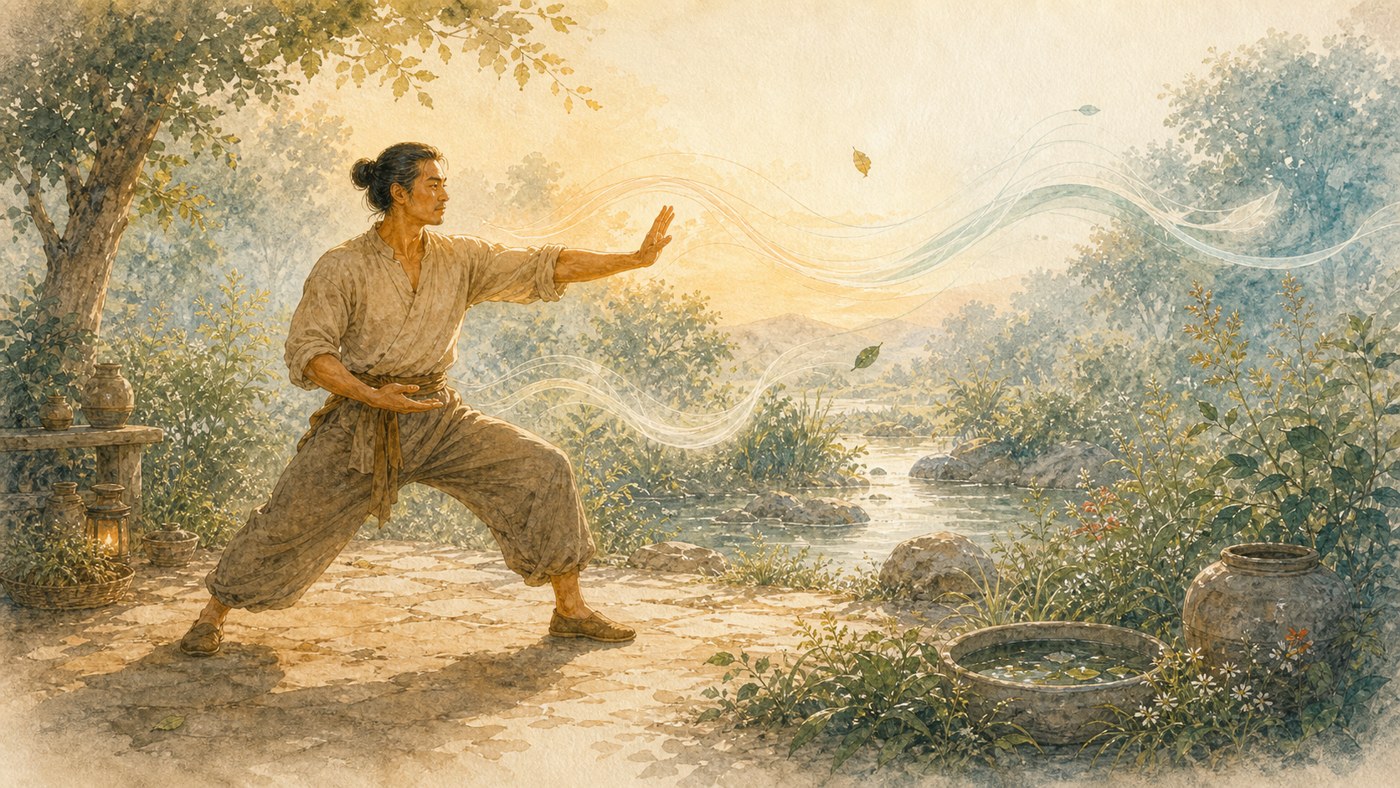
A body that wants to move
After a day of sitting, concentrating or carrying responsibility, movement can offer a different kind of attention. We stop looking at the next message and notice our steps, the air or the space around us.
The Thai book describes this as allowing Fire an outlet. We can keep that image without assuming that exercise literally removes an elemental substance. The practical aim is movement that fits our capacity and leaves room for recovery.
For some of us, the challenge is beginning. For others, it is allowing an ordinary session to be enough.
When exercise becomes another obligation to win
A person who values achievement may bring the same standards to movement that they bring to work. We compare distances, chase a score or feel that a session only counts if it is exhausting.
Competition can be enjoyable. The question is whether we are choosing it and recovering from it, or whether every activity has become another demand. We can enjoy improvement without needing to prove our worth each time we move.
The Fire description is not evidence that vigorous activity or interval training is inherently unsuitable. Exercise choices depend on fitness, health, experience, environment and recovery. We should not infer elevated baseline inflammation from a type label and use it to prescribe or prohibit an intensity.
A broad foundation
WHO guidance for adults includes 150–300 minutes of moderate aerobic activity a week, or 75–150 minutes of vigorous activity, or an equivalent combination, with muscle-strengthening activity on at least two days. Some activity is better than none, and an inactive person can begin with smaller amounts. These are general guidelines, not a personalised Fire prescription. [8]
A suitable plan should reflect our current ability and any medical advice. Someone returning after illness, managing a health condition or unsure about symptoms may need individual guidance before increasing activity.
We do not have to reach a population guideline immediately to make a useful start.
Choices that may feel welcoming
Walking is accessible for many people and can be adjusted in pace and duration. A shaded route or an indoor space may make it more comfortable. We can choose a walk whose purpose is simply to leave the desk and experience a different setting.
Swimming or water-based movement may appeal to some readers. It still requires suitable conditions, safe access and attention to our ability. Water does not remove the need for pacing or recovery, and a Fire label does not make strenuous swimming safe.
Cycling, adapted movement, gentle strengthening and non-heated yoga are further options. Yoga has many forms; a qualified instructor can help adapt a practice, and injuries are possible. [10] The name of the activity alone tells us little about its intensity.
The best starting choice may be the one we enjoy enough to repeat and can do safely in our actual circumstances.
A comfortably cool setting
The source places particular emphasis on avoiding unnecessary heat. This is a sensible practical concern when weather or a heated room makes activity uncomfortable, but it applies across constitutions.
Plan for conditions rather than pride. Adjust the time, location, clothing, pace or duration. Do not treat heat, dizziness or feeling unwell as something to overcome in order to complete a target. Confusion, collapse or serious deterioration during heat exposure requires emergency attention. [15]
We can choose a cooler setting without assuming that the temperature is diagnosing or treating our constitution.
Recovery is part of the plan
A session has a beginning, an active period and an ending. Allowing a gradual transition can help us notice how we feel instead of moving directly from physical effort into another demand.
Recovery also includes the rest of the day: food, sleep and the amount of activity we are asking our body to manage overall. A demanding job, caregiving or illness may change what is realistic, even when the exercise plan has not changed.
A record can be simple. How did the session feel? How were we later, and the following day? Are pain or fatigue becoming persistent? If a problem keeps returning, seek advice rather than repeatedly pushing through it.
Feeling good is useful information, but it is not a complete safety test. We also respect known conditions, precautions and professional guidance.
Release, enjoyment and companionship
We can experiment with a session that has no score. Walk with someone whose company we enjoy. Move to music. Explore a familiar route without measuring how quickly it is completed. Choose a class where adaptation is welcomed.
This does not require us to abandon goals. It widens our reasons for moving. Movement can belong to pleasure, companionship and attention as well as performance.
A person who has always been rewarded for intensity may initially find this unfamiliar. We can begin briefly and notice whether the experience gives us something our usual routine does not.
A week that can actually happen
Instead of designing an ideal schedule, look at the week ahead. Where is there a realistic opening? Which days already involve physical demands? What is the smallest version that would still be worthwhile if the day changes?
A short walk may fit one day; a longer activity may fit another. We can plan strength work appropriate to our ability and leave space for rest. We can also revise the plan when symptoms, weather or responsibilities change.
Try this · One session without a score
Choose a safe activity and a comfortable setting. Decide its length in advance, allowing room to stop sooner if needed. Put performance tracking aside for this session if that feels helpful. Afterwards, note what the movement offered besides achievement.
Movement need not compete with the rest of our care. The next chapter considers a companion skill that can be more difficult for a determined person: allowing the day to end.
CHAPTER 12
12 · Rest and Sleep
Putting the tools down
There is always something else we could do. One more reply, one more improvement, one more problem that might be easier to solve tonight than tomorrow. The day has reached its practical end, but our attention has not.
The Thai book calls this the warrior who will not put down the sword. In ordinary life, the object in our hand may be a phone or a list of unfinished tasks. The image asks a useful question: what helps us recognise that today's effort is enough?
For some readers, sleep itself comes readily once they make room for it. Others have difficulty sleeping despite giving it time. These are different problems, and neither can be assumed from a Fire label.
Why stopping may feel uncomfortable
If usefulness has become closely tied to achievement, a pause can feel empty. We may wonder what we are contributing when we are not solving something. Rest can bring us into contact with worries that activity has kept at a distance.
There may also be practical reasons. Work extends into the evening. Family care continues after paid work ends. A shared home may not be quiet. We cannot address all of these difficulties by telling ourselves to be more disciplined.
The first step is to name the actual barrier. Is it a belief, a habit, a health concern or a condition we need help to change? A more accurate description makes a workable response more likely.
Rest as an ordinary need
The hearth image returns here. A useful fire has intervals of attention and quieter periods. A life can have those intervals too. We can work with concentration and still stop before every possible task is complete.
Rest does not have to be justified by promising greater productivity tomorrow. It belongs to a person's life in its own right. We can have time in which nothing is being improved, measured or produced.
For someone accustomed to continual effort, that permission may need practice. A short, dependable pause can be a beginning. We do not need to wait until we feel entirely comfortable with resting before making space for it.
An earlier evening, without a universal deadline
The Thai source encourages going to bed before about ten o'clock. The underlying intention is to protect sleep from late work and stimulation. This English edition keeps that intention without presenting 10 p.m. as a special medical deadline for all Fire Types.
A workable schedule depends on sleep needs, obligations, circadian timing and health. Consistency and sufficient opportunity matter more than obeying one clock time. Shift workers and caregivers may need an adapted plan rather than a rule that does not fit their lives.
If bedtime has moved later than we intend, we can choose a realistic time to start winding down and make a small adjustment. We need not turn the change into another demanding project.
When we wake during the night
Waking at a particular hour does not identify excess Fire or a specific stress-hormone problem. Notice the pattern over time and its effects during the day rather than treating a single clock reading as a diagnosis.
If awake, we can avoid turning the moment into a work session or repeatedly checking the time. If we remain awake and frustrated, a quiet, low-stimulation activity out of bed, returning when sleepy, may be useful as part of appropriate insomnia care. Persistent insomnia may benefit from cognitive behavioural therapy for insomnia, or CBT-I, which goes beyond general sleep tips. [9]
The point is not to force sleep through perfect technique. If sleep has become a recurring struggle, getting help is more useful than adding more pressure to the night.
A transition into evening
An ending can be made visible. We might write down tomorrow's first step, close the work materials and leave a task in a state that can be resumed. This is different from trying to remove every unfinished thought.
Then choose something simple that signals a different part of the day. A comfortable wash, gentle music, a quiet conversation or reading for enjoyment may fit. A pleasantly cool bedroom may be helpful if heat is uncomfortable; comfort need not mean extreme cold.
If screens bring work, argument or excitement back into the evening, change what we use them for or when we set them aside. The aim is a transition that fits the actual source of stimulation, not a perfect ritual performed under pressure.
Where night-time reflux is a problem, consider meal timing with the advice in Chapter 10. [12] Where another symptom disrupts sleep, address that symptom rather than assuming that a relaxation routine will solve it.
Small recoveries during the day
Rest is not confined to bedtime. We can have brief moments that interrupt continual demand: step away from a task, look beyond the screen, sit comfortably or walk somewhere without hurrying.
Some pauses involve gentle movement. Others involve stillness. The useful question is what the pause is offering us, rather than whether it belongs to the correct category.
A particularly valuable experiment for a goal-oriented person is an activity with no result to defend. Draw without keeping the picture. Tend a plant without turning the activity into a project. Spend time with someone without an agenda. Allow enjoyment to be sufficient.
When rest is not enough
Persistent daytime sleepiness, repeated difficulty sleeping or ongoing exhaustion deserve assessment. Breathing interruptions noticed during sleep, dangerous drowsiness or a major change in functioning should not be treated as a minor Fire pattern.
General habits can support a treatment plan, but they are not a substitute for one. We also need not wait until we are completely unable to function before discussing sleep with a professional.
The question “Have I tried hard enough?” is often less useful than “What kind of help would fit this problem?”
Try this · An evening with an ending
Choose a realistic point at which work will pause. Write tomorrow's next step in one sentence. Set aside the materials and choose one quiet activity that requires no achievement. Review after a week: did the transition make the evening easier, and what practical obstacle still needs attention?
We have explored food, movement and rest. The next part approaches care from the mind directly, with practices that create room around strong feelings and high expectations.
PART FIVE · CARING FOR THE MIND
13 · Making Room Around Strong Feelings

Care from the other side of the bridge
Food, movement and rest already affect how our days feel. This chapter approaches the same life through attention, emotion and relationships.
The aim is not to become someone who never feels anger or disappointment. Nor is mental practice a way to prove that physical symptoms began in the mind. We are learning ways to respond to experience with more room and less avoidable harm.
Three themes from the Thai source guide us: reduce unnecessary urgency, make space for calm, and allow safe expression. Choose what feels workable. We do not need to turn all the tools into a new daily requirement.
Tool one · Pause before responding
A feeling can arrive before we have language for it. We may notice a tightening jaw, an urge to interrupt or the sudden certainty that we must send a reply immediately.
The first practice is to recognise one of those early signals. Instead of demanding that the feeling stop, postpone the action it is urging. Put down the phone. Leave a little silence. Say that we need a moment.
If comfortable, a few easy breaths can accompany the pause. There is no need to force a deep breath, hold it or follow a demanding count. If breath-focused attention makes us more distressed, keep attention on the room or the support beneath our feet.
Then ask a concrete question: “What do I want this response to make possible?” We may still need to express disagreement. We can choose words that address the concern without humiliating another person.
A pause can be brief or longer. If we leave a difficult conversation, say when we can return when it is safe to do so. That helps make the pause a form of care rather than a way of abandoning the other person.
Tool two · Give the feeling a safe form
Some feelings need words before they become easier to understand. Writing privately can help us name what happened, what we felt and what mattered. We can also speak with someone able to listen without immediately taking sides or offering a solution.
The useful aim is understanding and expression. It is not a requirement to discharge anger physically or repeatedly rehearse an accusation. If writing leaves us more agitated, we can stop, change focus or seek support.
A simple page might begin with four sentences: “This happened. I felt this. I needed this. The next action I can take is this.” The final sentence can be small. It may be to ask for clarification, set a boundary or return to the matter tomorrow.
Ordinary creative activity can provide another form. Drawing, making music or moving gently may offer space for experience without requiring a polished result. Formal art therapy is a professional practice; an enjoyable creative activity at home does not need that label to be worthwhile.
Tool three · Loosen the conditions on our worth
High standards can become so familiar that we stop hearing their tone. “Do this carefully” becomes “Never make a mistake.” “Contribute well” becomes “Always be useful.” The instruction has lost its endpoint.
We can ask what we would say to a respected friend in the same circumstances. Would we acknowledge the effort, the limits and the need for help? Would we expect them to keep going indefinitely? The comparison may reveal a kindness we allow others but withhold from ourselves.
Try using that same tone inwardly. We can acknowledge a mistake without turning it into a complete account of who we are. We can make a repair and still eat dinner, sleep and belong among other people.
Another practice is to do something without measuring improvement. Enjoy a small piece of music. Sit with a plant. Draw without deciding whether we are talented. These moments can remind us that a life contains more than evidence of performance.
Tool four · Allow a quiet interval
Quiet does not have to mean sitting with closed eyes. We might notice the shade beneath a tree, the sound of rain or the feeling of a chair supporting us. A minute can be enough for an experiment.
Meditation and mindfulness may help some people with certain difficulties, but they do not suit everyone in every form. Distressing experiences can occur, and professional guidance may be appropriate. [5] We can keep our eyes open, shorten a practice or choose another approach.
The purpose here is to become more aware of what is happening, not to empty the mind or force ourselves into calm. If a practice becomes another arena in which we criticise our performance, simplify it.
When anger is already strong
Acknowledge the feeling in ordinary language: “I am angry,” or “This has affected me more than I expected.” That can be more useful than immediately deciding that the feeling is justified or unacceptable.
Next, attend to the situation. Is everyone safe? Do we need distance, practical help or a boundary? If we can safely pause, do so before making a significant decision or sending a message that cannot easily be withdrawn.
When the intensity has reduced enough, return to the issue. What happened? What needs to be said? Is there harm to repair? What would make the pattern less likely to repeat?
Some anger carries information about unfairness. Some becomes part of a recurring difficulty we need help with. Neither requires us to handle everything alone. If we fear we may hurt ourselves or someone else, seek urgent help and prioritise safety.
Warmth in our relationships
Directness and high expectations can be valuable, but their effect depends on how they meet another person. We can ask for feedback about that effect without demanding reassurance.
Practise noticing what has gone well as readily as what needs correction. A specific appreciation is often more meaningful than general praise: “You made time to listen,” or “That detail helped the whole group.”
Leave room for another person's method. A task may be completed well in a way different from the one we would choose. We can distinguish a necessary standard from a personal preference.
When we make a mistake, an apology can be clear and unqualified. “I spoke harshly. That was not fair to you. I will take a pause next time” says more than explaining that our Fire was strong.
Try this · One tool, one week
Choose a single practice: a pause before replying, a short private note, an activity without a score, or a quiet interval. Attach it to a familiar moment. At the end of the week, ask whether it created more choice or became another pressure. Adjust accordingly.
The next chapter brings the practical tools together into a daily rhythm that can support us without becoming a timetable we have to defeat.
CHAPTER 14
14 · A Daily Rhythm We Can Live With

A hearth for our effort
A fire is easier to tend when there is a place designed to hold it. In the same way, a few dependable points in the day can give our effort a shape. We know when nourishment, a pause and an ending are likely to come.
Ayurveda uses the term dinacharya for daily practices or routine. In this book, we draw on the invitation to make care part of ordinary life. We are not presenting one schedule as a medical treatment or as the correct routine for every Fire Type.
The useful routine is one that can survive contact with the life we actually have.
A few anchors, not a minute-by-minute test
People with high standards can turn a helpful routine into another source of pressure. A missed practice becomes failure. A late meal means the day is ruined. The plan begins to consume the ease it was meant to provide.
We can design something less brittle. Choose a few anchors: moments we try to protect within a reasonable range. Let the space between them remain flexible.
An anchor may be a regular meal, a brief break after a demanding task, or a time when work is put away. It is a practical reminder, not a measure of whether our constitution is balanced.
Morning · Arrive before accelerating
If our habit is to open messages the moment we wake, try a small interval before doing so. Notice how we feel, take care of an ordinary need and identify what matters most today.
A morning does not have to be elaborate to begin kindly. There may be children to prepare, a shift to start or transport to catch. A drink, a manageable breakfast where appropriate and a moment to look beyond the screen may be enough.
Choose a realistic priority. A list containing everything we could possibly do is not a plan for one day. We can identify what needs our attention and what can reasonably wait.
Daytime · Work with intervals
Concentrated work can be satisfying. It becomes more sustainable when a task has a boundary. Decide what a useful period of effort will cover, then include a brief transition before the next demand.
The pause can be ordinary: stand or change position, get water, look away from the screen or take a short walk if practical. We need not wait until we are completely exhausted to permit it.
Protecting a meal is another way to give the day structure. If work routinely makes that impossible, the obstacle deserves attention. We may need practical preparation, a conversation about cover or a shared agreement with others.
A routine is easier when it is supported by the environment rather than carried entirely by willpower.
Evening · Make the change of pace visible
The transition out of work may not happen automatically. We can help it happen by closing a task, writing tomorrow's next step and putting away the materials that keep calling us back.
If work must continue later, define the exception rather than allowing it to occupy the whole evening. What is necessary tonight? What is its endpoint? Who else needs to know the plan?
Then allow some activity with a different purpose: an unhurried meal, a comfortable walk, time with someone close or a small creative interest. We are making room for a life outside the next result.
Before sleep · Let the day remain unfinished
Some tasks will still be incomplete. A workable evening includes that fact. We can have a place to resume them without carrying out the next step now.
Use the ideas in Chapter 12 to create a comfortable transition: less demanding activity, a suitable environment and enough opportunity for sleep. Choose timing that fits our responsibilities and any individual advice.
We are not trying to achieve perfect relaxation before bed. We are reducing avoidable demands and making rest more possible.
Three anchors to remember
If the details feel like too much, return to three simple intentions.
Make nourishment dependable. Choose a meal pattern that suits our needs and care plan, rather than repeatedly postponing food until the day becomes uncomfortable.
Protect sleep and recovery. Give the day a realistic ending. Where responsibilities interfere, ask what support or adjustment could help.
Allow one interval without pressure. It might be a pause, a quiet activity, a conversation or time outdoors. It need not be impressive or lengthy.
These intentions are flexible. Someone caring for a baby, working nights or living with illness may need a very different arrangement from someone with a predictable daytime schedule.
A possible day
| Part of the day | A small anchor | A flexible version for a difficult day |
|---|---|---|
| Morning | Attend to basic needs before messages | One brief pause before the first task. |
| Midday | A protected meal and a change of position | An available, suitable meal and a shorter break. |
| Late afternoon | Review what can reasonably finish today | Identify one task that can wait. |
| Evening | Put work away and change pace | Define a clear endpoint for necessary work. |
| Before sleep | A quiet transition and sleep opportunity | Simplify the routine rather than abandon rest. |
The flexible version is not a lesser moral achievement. It is a plan that recognises conditions as they are.
Begin with one anchor
The wish to redesign everything at once is understandable. It offers an appealing picture of a new life. Yet a large plan can make it difficult to see which change is actually helpful.
Choose one anchor and make it easier to repeat. Put the needed item within reach. Agree on a time with someone whose cooperation matters. Remove an avoidable step. Try the change long enough to learn about it, then review.
A missed day is information. What interrupted the plan? Was it unrealistic, unsupported or simply overtaken by an unusual event? We can revise without starting the story again as a failure.
Try this · Sketch our own day
Write morning, daytime, evening and before sleep on one page. Add the responsibilities that are already there. Now choose one place where care could be made more dependable. Write both the usual version and a smaller version for a difficult day. Begin there.
We now have the foundations of an everyday plan. The final part explores additional approaches, asking how to choose them without making care more complicated than it needs to be.
PART SIX · APPROACHES TO CARE
15 · Choosing Complementary Approaches
A wider set of possibilities
The practical chapters have focused on ordinary foundations: nourishment, movement, rest, emotional support and a workable routine. These remain important when we explore additional approaches.
Plearnprai's wider teaching collection groups practices across five dimensions of care. We use those groupings here as a way to organise questions. They are not separate physical layers in the body, and the categories do not prove that a practice treats a disease or works specifically for Fire Types.
A useful starting question is: what do we want support with? Comfort, movement, sleep, emotional expression and a diagnosed condition are different aims. Naming the aim helps us choose a suitable level of advice.
Choosing for comfort, context and safety
The Thai book favours approaches described as cooling, calming and allowing safe expression. In everyday language, that may mean a setting without unnecessary heat, a pace that does not encourage competition, and an experience in which we feel able to stop or ask for changes.
Those preferences are useful, but they are not enough to establish safety or effectiveness. A pleasant experience can still be unsuitable for a medical condition. Evidence, practitioner competence, medicines and individual circumstances also matter. [17]
We can begin simply. We do not need a large collection of practices in order to care well for ourselves.
Movement, breath and the circulation image
Gentle qigong or an adapted yoga practice may provide a structured way to move with attention. A qualified instructor can help match the activity to our ability. The description “gentle” should be reflected in what actually happens, including permission to modify or stop.
Breathing practices vary widely. The simple pauses in this book use comfortable, unforced breathing. Forceful techniques or long breath holds are different practices and should not be assumed suitable because they are called balancing or cooling. [10]
The source also mentions acupressure. We do not prescribe points in this edition. If seeking a specific technique, ask an appropriately qualified practitioner about its purpose, precautions and suitability. An unfamiliar symptom should be assessed rather than treated through a point selected from an elemental label.
Structure, touch and physical comfort
Some people find massage relaxing or helpful for certain kinds of discomfort. Evidence and suitability depend on the condition and the technique. Tell the practitioner about relevant diagnoses, medicines, injuries and pregnancy, and discuss concerns with a healthcare professional when needed. [14]
A treatment does not have to be painful to count. We can ask for lighter pressure, change position or stop. Avoid treating inflamed, injured or otherwise concerning areas without appropriate advice.
The Thai source includes a foot bath as an evening comfort practice. It is optional and should not be described as drawing systemic heat out of the body. People with diabetes, reduced sensation, circulation problems, wounds or skin problems should obtain appropriate advice rather than begin soaking as a routine. In particular, diabetes foot-care guidance advises against soaking the feet. [18]
Hot compresses, steam and heated treatments need their own precautions. Choosing or avoiding them should depend on the person and procedure, not solely on whether they identify as Fire.
Sensory experience and creative space
Time in a pleasant natural setting may provide an opportunity for quiet attention. A nearby shaded place can be enough; no special trip or named treatment is required. Consider access, weather, mobility and other practical needs.
Aroma is optional. Some people enjoy a mild scent, while others find it irritating or associate it with discomfort. Evidence for lavender aromatherapy across several claimed benefits remains uncertain, and headache or coughing can occur. [16] We do not recommend swallowing essential oils or applying undiluted oils to skin. Children, pregnancy, asthma and other sensitivities warrant particular care and suitable advice.
Creative activity can be another space without a score. Drawing, colour, music or making something with our hands may help us engage with experience in a different way. We can call this ordinary creative activity. Art therapy is a distinct professional service and should not be used as a label for every activity involving art.
We do not have to produce a beautiful object for the time to be worthwhile.
Attention, kindness and relationships
The mind-focused practices in Chapter 13 can be used in small, flexible ways. A quiet interval, a kind sentence or a pause before responding may fit into ordinary life. Meditation is one option, with benefits and difficulties that vary between people. [5]
Loving-kindness practice invites an intention of care towards ourselves and others. It should not require us to deny hurt, forgive before we are ready or remain in an unsafe relationship. Kindness can include a boundary.
Giving and volunteering can offer meaningful participation. For someone already carrying too much, however, another commitment may increase strain. Choose a role with limits and support. Helping is more sustainable when it includes an honest account of what we can offer.
Listening matters in both directions. We may need someone who can hear us without rushing to solve the problem. We can also practise listening without turning another person's experience into a task to manage.
Nourishment and medicinal products
The food chapter provides the starting point for ordinary nourishment. A varied, adequate diet does not need to be replaced by antioxidant products or concentrated preparations because someone describes our Fire as strong.
Herbal medicines are a different decision from ingredients used in normal food amounts. A product described as natural or cooling may still have adverse effects, interact with medicines or be unsuitable for a particular person. Some Ayurvedic products have also raised concerns about toxic metals. [11]
Before using a medicinal product, seek advice from an appropriately qualified clinician or pharmacist, disclose medicines and supplements, and consider quality and sourcing. We do not provide herbal doses in this book or suggest replacing prescribed treatment.
Putting approaches together
Choose one addition at a time when practical. Be clear about what we are hoping it will help with and what would lead us to stop. Note both comfort and any unwanted effects.
A practitioner's willingness to discuss limits is useful. We can ask what evidence supports the approach for our concern, whether there are precautions and how it fits with existing care. Claims that one treatment explains or cures all our symptoms are a reason to ask more questions.
Subjective improvement matters, but it is not the sole test of safety. We continue appropriate monitoring and medical care even when a practice feels pleasant. Complementary approaches work alongside care; they should not delay it.
Try this · One considered addition
Name one aim, choose one modest practice and identify any advice needed before starting. Make it easy to stop or adapt. After a short trial, ask whether it was useful, comfortable and practical. Keeping it, changing it or leaving it behind are all legitimate outcomes.
We have reached the end of the main chapters. The final pages return to the person at the centre of every choice: someone whose energy deserves both purpose and care.
CLOSING
Closing · A Fire We Can Care For

Returning to the first story
At the beginning, we met a person who could do a great deal yet found it difficult to stop. Someone others relied on. Someone who sometimes wondered why their own intensity felt so hard to live with.
We have not tried to turn that person into someone else. We have looked for a more complete understanding: strengths as well as strain, circumstances as well as habits, and support as well as individual effort.
The Fire image can be a companion in that exploration. Its value lies in the questions it opens and the care it makes more possible.
The journey we have made
In the first part, we considered the warrior and protector as a metaphor. We recognised decisiveness, courage and purposeful action while leaving claims about ancestry and biology open to the evidence they would require.
In the second part, we explored the mind in balance and under pressure. We looked at the conversation between physical and emotional experience without making one responsible for every difficulty in the other.
The third part placed clear boundaries around self-care. A type does not predict a disease. A reflection map does not replace diagnosis. Serious symptoms deserve an appropriate response, however capable we usually feel.
The practical chapters then brought care into ordinary life: meals with room around them, movement that fits our capacity, an ending to the day, safe expression and a few dependable anchors. The final chapter considered additional approaches with their purposes and limits in view.
The route has been from a broad image towards concrete choices.
What can change
Within Plearnprai's current model, constitution is understood as enduring. Our current state, routines, circumstances and ways of responding can change. We keep those ideas separate.
A period of exhaustion does not erase our strengths. A calmer week does not mean we have lost our Fire. A difficult life stage may ask for a different kind of care without changing who we understand ourselves to be within the framework.
We also need not remain attached to a label that stops helping us ask good questions. A living person is larger than a description. Our observations, relationships and appropriate healthcare remain more important than defending a category.
Purpose with room to live
We can keep our interest in meaningful work. We can act when something matters, stand up for another person and take pride in a task completed carefully.
Alongside those capacities, we can make room for a meal that is not rushed, a conversation without an agenda and a night in which some work remains unfinished. These are not interruptions to a worthwhile life. They are part of it.
The fire in the hearth is valued because it serves the household. It does not have to burn at its greatest intensity at every moment. We can carry that image into the decisions we make about our own effort.
Three things to take with us
First, kindness. There will be days when we react more sharply than intended or ask too much of ourselves. We can acknowledge the effect, repair what we can and make a more supportive next choice. Self-criticism need not be the main voice guiding us.
Second, a small beginning. We do not have to implement a whole book. One dependable meal, one clearer boundary or one appropriate request for help can be a meaningful start. The next step can be chosen after we learn from that one.
Third, permission to return. A routine can be interrupted. A practice can stop fitting. A symptom can change. We can revisit our plan without declaring the earlier effort wasted. Seeking new advice is part of responding to new information.
If we want to explore further
An optional Plearnprai reflection or assessment may help organise questions about constitution and current state. It is an educational aid, not a diagnostic test, and it cannot replace evaluation of symptoms.
We do not need to complete an assessment before making ordinary supportive changes or seeking medical help. This book stands on its own as a companion to reflection and everyday care.
If we continue into other books in the series, we can carry the same openness with us. Different descriptions may help us understand people close to us, but they should not become labels we impose on them.
A final invitation
Before closing the book, choose one sentence we would like to remember. It may concern rest, a boundary, a strength we had overlooked or a concern we are ready to ask about.
Let it be a sentence that makes life a little more possible, rather than another demand.
Thank you for travelling through these pages with Plearnprai. May the energy we bring to our lives have purpose, companionship and enough room to recover. May we be able to care for what matters, including the person doing the caring.
REFERENCE
Sources and Further Reading
How to read the references
This English edition is an editorial adaptation of Plearnprai's Thai book คนธาตุไฟ. It retains the introduction, fifteen main chapters, closing and source appendix, with a glossary added for English readers. It does not present the elemental framework as an established biomedical classification.
The numbered sources below support specific clinical distinctions and safety boundaries. A reference about reflux, sleep or exercise does not validate a Fire constitution or a type-specific treatment. Online sources were checked during preparation on 13 October 2026.
The Thai foundation
The source book names the royal medical compilation from the reign of Rama V; the Dhatu Vibhanga and Roga Nidana texts; teaching materials from Thailand's Department of Thai Traditional and Alternative Medicine; and course materials concerning traditional elemental assessment. The English forms of the traditional titles are descriptive transliterations.
The Thai appendix does not supply complete edition, publisher and page details for these items. They are retained here as the source's stated intellectual background, not as independently checked references for every historical claim. Publication-grade bibliographic details remain an editorial task before a scholarly edition.
The source also names Friedman and Rosenman's historical Type A work, Brené Brown's Dare to Lead and Daniel Goleman's Emotional Intelligence as general background. These works are not used here to diagnose a Fire Type or establish a disease risk.
Plearnprai's current distinction between constitution and current state follows Canon 0, Card 01, with supporting context from Canon 2. Red-flag and procedure boundaries were checked against the project's shared safety files. Detailed local source paths and file hashes are kept in the accompanying source manifest.
R1 · Research on Ayurvedic Prakriti
Govindaraj, P., and colleagues. (2015). Genome-wide analysis correlates Ayurveda Prakriti. Scientific Reports, 5, 15786. Original research article.
Used to describe an exploratory research direction. It does not validate Plearnprai's categories or individual disease prediction.
R2 · Reflux symptoms and causes
National Institute of Diabetes and Digestive and Kidney Diseases. Symptoms & Causes of GER & GERD.
Supports distinguishing a digestive symptom or medical condition from a constitutional description.
R3 · Peptic-ulcer causes and warning signs
National Institute of Diabetes and Digestive and Kidney Diseases. Symptoms & Causes of Peptic Ulcers.
Supports the correction to the claim that missing meals or anger directly explains ulcer formation.
R4 · Stress and relaxation
National Center for Complementary and Integrative Health. Stress and Relaxation Techniques: What You Need To Know.
General context for mind–body responses and optional relaxation practices. These are not Fire-specific mechanisms or guarantees of benefit.
R5 · Meditation and mindfulness
National Center for Complementary and Integrative Health. Meditation and Mindfulness: Effectiveness and Safety.
Supports recognising both possible benefits and the need to consider adverse experiences and suitability.
R6 · Very high blood pressure
American Heart Association. When To Call 911 About High Blood Pressure.
The source is US-based. This edition directs readers to their local emergency service rather than assuming that the source's telephone number applies everywhere.
R7 · Burnout and its scope
World Health Organization. Burn-out an occupational phenomenon.
Supports keeping occupational burnout distinct from a diagnosis of all fatigue, depression or a final stage of elemental illness.
R8 · Physical activity
World Health Organization, Regional Office for Europe. Physical activity.
Population guidance for adults, including aerobic activity and strengthening. Individual plans depend on ability, circumstances and clinical needs.
R9 · Insomnia care
National Heart, Lung, and Blood Institute. Insomnia: Treatment.
Supports the distinction between general habits and structured insomnia treatment, including CBT-I.
R10 · Yoga and adaptation
National Center for Complementary and Integrative Health. Yoga: Effectiveness and Safety.
Supports adapting movement practices and considering injury risk and individual circumstances.
R11 · Ayurvedic products
National Center for Complementary and Integrative Health. Ayurvedic Medicine: In Depth.
Supports caution about medicinal products, including quality and possible toxic-metal content. It does not imply that all products carry identical risks.
R12 · Food and reflux
National Institute of Diabetes and Digestive and Kidney Diseases. Eating, Diet, & Nutrition for GER & GERD.
Supports attention to individual symptom triggers and meal timing for night-time reflux.
R13 · An overall eating pattern
American Heart Association. Suggested Servings From Each Food Group.
Used for the broad emphasis on variety and suitable food groups, not a calorie target or a personalised elemental diet.
R14 · Massage
National Center for Complementary and Integrative Health. Massage Therapy: What You Need To Know.
Supports considering the specific technique, condition and practitioner, rather than assuming that all massage is suitable.
R15 · Heat-related illness
Centers for Disease Control and Prevention, NIOSH. Heat-related Illnesses.
Supports treating serious deterioration during heat exposure as a medical issue, not an elemental self-care exercise.
R16 · Lavender and aroma
National Center for Complementary and Integrative Health. Lavender: Usefulness and Safety.
Supports the limits of the evidence and attention to unwanted effects. Aroma is optional in this edition.
R17 · Complementary-care safety
National Center for Complementary and Integrative Health. Safe Use of Complementary Health Products and Practices.
Supports evaluating each practice or product in context and coordinating it with healthcare.
R18 · Foot care in diabetes
National Institute of Diabetes and Digestive and Kidney Diseases. Diabetes & Foot Problems.
Supports the precaution concerning foot soaking and the need for individual advice when sensation, circulation or skin integrity is affected.
The role of this edition
This is an English edition for learning and everyday care. It is not a clinical guideline or a substitute for diagnosis and treatment. The accompanying editorial notes identify substantive changes from the Thai text and the items still requiring author or specialist review before public release.
REFERENCE
A Short Glossary
| Term | Meaning in this book |
|---|---|
| Fire Type | The concise name for a person with a Fire constitution in Plearnprai's framework. It is not a biomedical diagnosis. |
| Wind Type / Water Type | The corresponding concise names for Wind and Water constitutions. |
| Mixed Type | A combined constitutional pattern; a specific pair can be named when relevant. |
| Wind–Fire Type / Wind–Water Type / Fire–Water Type | The approved names for paired types in this series. |
| Constitution | An enduring pattern within Plearnprai's current model, considered through longstanding characteristics rather than recent symptoms. |
| Current state | How we are doing now; it may change with circumstances, illness, habits and care. |
| Element | A traditional or model-based description of qualities and functions, not a chemical element or a diagnosis. |
| Wind / Fire / Water | Broad introductory images of movement / transformation / nourishment. |
| Earth | The fourth element in the Thai traditional foundation, broadly associated with structure. |
| Techo dhatu | A transliteration of the traditional Fire element. |
| Vata / Pitta / Kapha | Ayurvedic terms belonging to their own framework; comparisons with Plearnprai's types are not interchangeable definitions. |
| Prakriti | Ayurveda's term for constitution; research using it should be distinguished from Plearnprai's classification. |
| Balance / imbalance | Framework language for patterns of comfort or difficulty; not a substitute for assessment. |
| Cooling | A traditional quality or an everyday image of settling, depending on context; not automatically a physical temperature change or an anti-inflammatory effect. |
| Digestive fire | Traditional language about digestion and transformation, not a direct measure of stomach acid. |
| Autonomic nervous system | Neural regulation of bodily functions that do not require continuous conscious direction. |
| Reflux / GERD | Reflux is the return of stomach contents into the oesophagus; GERD is a medical condition that can involve recurrent troublesome reflux. |
| Burnout | In the WHO description used here, a phenomenon related to chronic workplace stress, not a name for every form of exhaustion. |
| CBT-I | Cognitive behavioural therapy for insomnia, a structured treatment beyond general sleep tips. |
| Dinacharya | An Ayurvedic term for daily practices or routine. |
| Daily anchor | An informal name for a dependable point in an ordinary routine. |
| Complementary approach | A practice used alongside appropriate healthcare, not in place of necessary assessment or treatment. |
Words that make room
We use “Fire Type” to keep the title and discussion concise. We use “we” to place writer and reader together in the exploration. Neither choice requires everyone to fit the same description.
A word can help us begin a question. The person remains larger than the word.
Caring for one another.