The Plearnprai Three Elements Series · Book 4
MIXED TYPE
Understanding Yourself and Caring for Your Well-Being
PLEARNPRAI
First English Edition · 2026
A COMPANION TO EVERYDAY CARE
MIXED TYPE
Understanding Yourself and Caring for Your Well-Being
The Plearnprai Three Elements Series · Book 4
Plearnprai · English editorial adaptation
13 October 2026 · First English Edition
This edition follows the chapter route of the Thai source, retaining its practical examples, reflections and original illustrations. It uses the agreed concise type names and the inclusive voice “we”.
Traditional interpretations, Plearnprai's current framework and clinical information are distinguished where needed. Substantive adaptations are documented in the accompanying editorial notes. Constitution and current state are treated as distinct concepts.
English edition 1.0 · Published in the Plearnprai Library on 13 October 2026.
Contents
Introduction — A Companion for Our Mixed Type4Chapter 1 — How Mixed Qualities Work Together7Chapter 2 — Reading Our Own Pattern10Chapter 3 — Wind–Fire Type14Chapter 4 — Wind–Water Type18Chapter 5 — Fire–Water Type22Chapter 6 — When All Three Portraits Feel Familiar26Chapter 7 — Using the Three Books Together29Closing — Our Care Can Change32Sources and Reading Notes35MIXED TYPE
Introduction — A Companion for Our Mixed Type
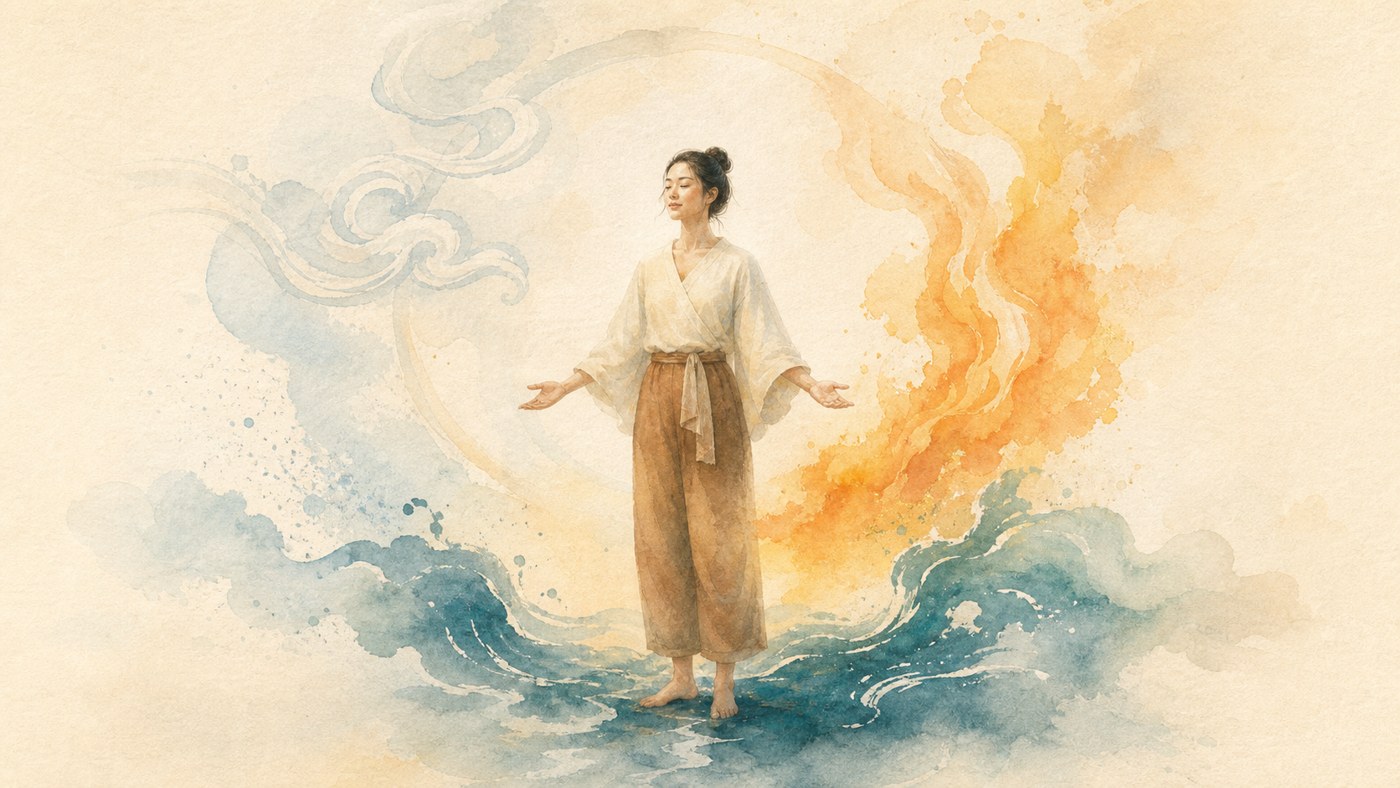
When more than one book sounds like us
Some of us recognise a familiar experience as we read The Plearnprai Three Elements Series.
We open Wind Type and nod. Quick thoughts, sensitivity, a mind that can be difficult to settle: there is something of us here. Then we open Fire Type and nod again. Determination, impatience, the wish to do things properly and see them through: that sounds familiar too. Or we read Water Type and recognise its steadiness, patience and care for others.
A question follows: “Which type are we, then?”
We do not have to assume that we have read badly or failed to understand ourselves. A single description may not hold everything we recognise. Within Plearnprai's framework, the name Mixed Type gives us a way to explore a combination of qualities without forcing ourselves into one narrow portrait.
Recognition is a starting point, however, not a diagnosis or a result we must accept. Several descriptions may feel familiar because people have many sides, because circumstances change, or because a passage describes a widely shared experience. This book helps us investigate patiently.
More than one quality belongs here
It is easy to approach a book of types as though everyone must be entirely Wind, entirely Fire or entirely Water. That is not how this series asks us to read ourselves.
Traditional constitutional approaches, including Ayurveda, describe mixed patterns as well as patterns with one pronounced emphasis. Plearnprai uses this idea in its own arrangement of three single types, three paired types and a balanced pattern. These are categories within the framework, not measurements of substances inside the body.
We do not yet have population evidence establishing how common Plearnprai's categories are. We do not need a numerical claim to make room for our experience. Recognising more than one set of qualities is a valid subject for reflection, whether or not we fit a particular category neatly.
Thai traditional medicine and Ayurveda also have distinct histories and classifications. Their terms can help us compare ideas; they are not interchangeable systems, and neither comparison establishes a biomedical diagnosis. The sources appendix explains these boundaries.
What this companion helps us do
Wind Type, Fire Type and Water Type explore the three individual portraits in depth. They remain our main companions for food, movement, rest, emotions and daily rhythm.
This book has another task: to explore how we use more than one portrait together. Being a Mixed Type is not simply taking half the advice from one book and half from another. Two useful tendencies can support one another, pull in different directions or become more noticeable in different circumstances.
We will work through three questions:
- How does the framework describe mixed qualities?
- How do we distinguish our longstanding constitution from what is happening now?
- How can we use the three main books together without turning self-care into a complicated set of rules?
For example, quick imagination and decisive action may work beautifully together when we begin a project. The same combination may make it difficult to stop working. Patience and sensitivity may help us listen well, while making it harder to say that we ourselves need support. The task is to notice the situation, not to condemn the qualities.
Reading alongside the three main books
We may begin here and then choose the main book that feels most relevant. Or we may arrive after reading one or more of the others and wondering why our experience crosses their boundaries. Both routes are welcome.
Chapters 1 and 2 establish the shared method. Chapters 3, 4 and 5 explore Wind–Fire Type, Wind–Water Type and Fire–Water Type, including different emphases within each pair. Chapter 6 considers the balanced pattern, where no single portrait seems to lead. Chapter 7 brings the books together in everyday use.
There is no need to read all the paired portraits as personal instructions. We can give our own likely combination careful attention and read the others to understand the wider picture. If no portrait fits, we can keep that uncertainty. Understanding ourselves matters more than completing a classification.
A distinction we will keep throughout
In Plearnprai's current framework, constitution means the enduring pattern we explore through longstanding characteristics, including those present from early life. Current state means how we are doing now. Sleep, stress, work, illness, the weather and many other circumstances can change our current state without changing our constitutional type.
A tired week does not make us a new person. A calmer month does not erase our history. We can develop skills and feel much better while keeping the same constitutional description. This distinction corrects older wording that sometimes called every change a change of “element.”
The framework helps us organise questions about care. It does not establish why a symptom has occurred. Medical causes still need to be considered on their own terms.
Three agreements between us
First, we will use we. Writer and reader are learning alongside one another, not dividing into someone who knows and someone who must obey.
Second, having several recognisable sides is not a defect. We will not use a type to judge ourselves or someone else. Neither will we assume that every dramatic change in mood, energy or behaviour is harmless because we can describe it with elemental language.
Third, this is a companion to everyday self-care, not a replacement for assessment or treatment. New, persistent, worsening or severe symptoms deserve appropriate attention. Seeking help is part of caring for ourselves.
With these agreements in place, we can begin with the first question: when more than one set of qualities feels like us, how might we understand the relationship between them?
MIXED TYPE
Chapter 1 — How Mixed Qualities Work Together
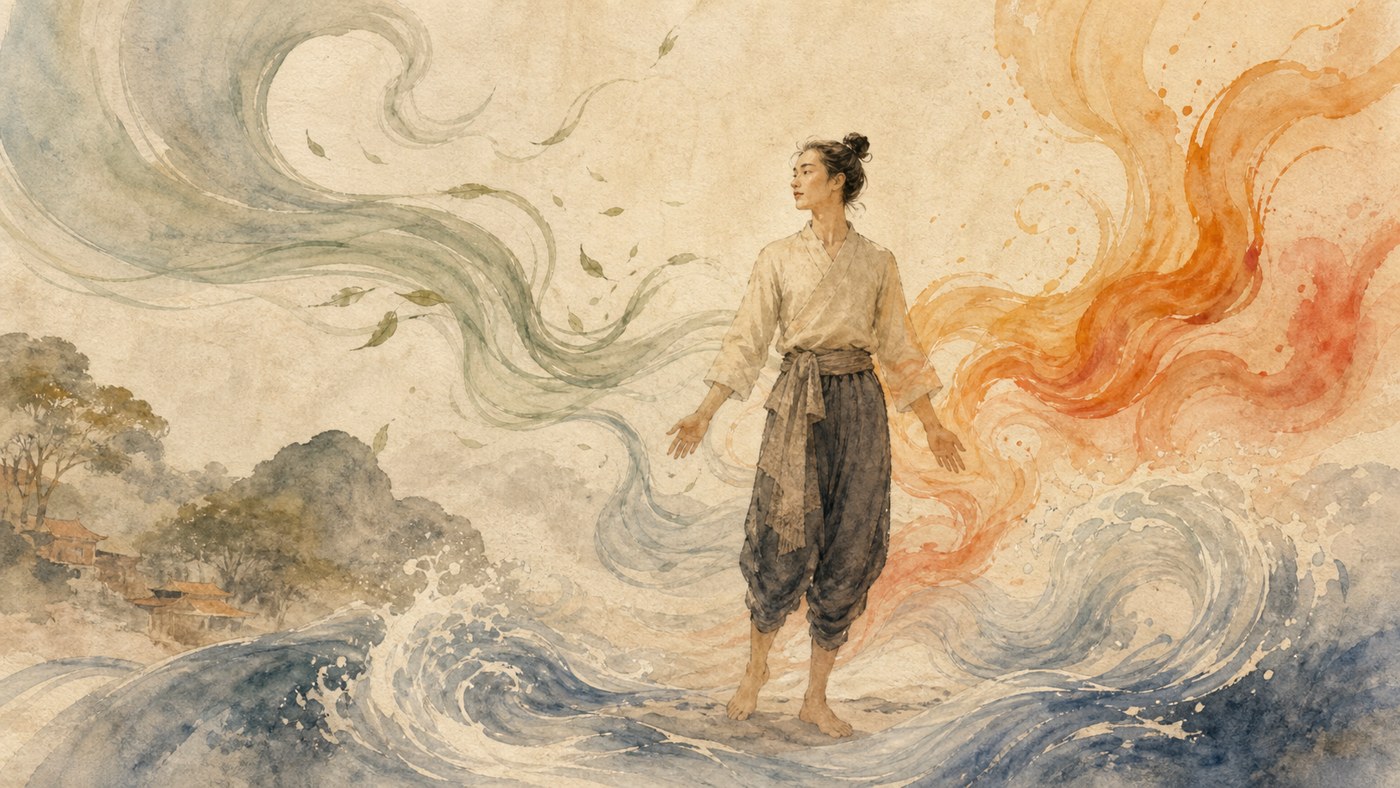
More than an average
When we hear “Mixed Type,” we may picture a midpoint: a Wind–Fire Type must be moderately quick, moderately warm and somewhere between the two individual portraits.
That is not the idea this book is trying to convey. Averages can conceal the situations in which different qualities become visible. We may be imaginative and hesitant while considering possibilities, then direct and decisive once a choice matters. Those experiences do not have to blend into one permanently moderate personality.
Within the framework, we describe this as different qualities coming to the foreground. Someone who recognises a Wind–Fire pattern might sometimes be preoccupied and worried, and at another time impatient or determined. The practical question is not simply “What label fits?” It is “What is happening, and what kind of support would help now?”
This is descriptive language, not a claim that two physical elements take turns controlling the nervous system. People can vary across situations for many reasons. A useful portrait gives us questions to explore, rather than supplying an explanation before we have looked.
A stronger emphasis and a secondary emphasis
Two qualities need not seem equally prominent. In an informal reading of the paired portraits, one may feel more familiar across our life, while the other becomes especially noticeable in certain situations.
We call these a primary emphasis and a secondary emphasis. These phrases are aids to reading the books, not precise ratios or a separate medical classification. In Plearnprai's wheel, a paired type occupies its own place; describing an emphasis does not require moving that constitutional position every time our mood changes.
Consider a Fire–Water pattern with a stronger Fire emphasis. We may recognise a longstanding wish to act, decide and carry a task forward, together with Water-like patience and steadiness. During a long spell at a desk, heaviness or a loss of momentum may become noticeable. We should explore the work pattern and symptoms themselves, not assume that a secondary element caused them.
Or consider a Wind–Fire pattern with a stronger Wind emphasis. Ideas arrive quickly and we enjoy possibilities. A demanding deadline brings a sharper, more forceful side forward. We work quickly and intensely, perhaps overlooking the need to stop. Knowing this pattern can help us prepare a break before the pressure rises.
The purpose of noticing emphasis is practical: which habits usually support us, and which situations deserve extra care? Chapter 2 will help us separate that question from the different question of our current state.
Qualities that reinforce or pull against one another
The paired portraits have different inner contrasts. In the book's traditional descriptive language, Wind is associated with lightness, dryness and movement; Fire with heat and intensity; Water with heaviness, moisture and steadiness. “Cool,” “warm,” “light” and “heavy” here are framework terms. They are not laboratory measurements or proof of disease.
| Pair | Relationship explored in this book | Practical question |
|---|---|---|
| Wind–Fire Type | Quick ideas and forceful action can encourage one another. | Are we leaving room to slow down and recover? |
| Wind–Water Type | Movement and stillness may pull in different directions; the portrait also shares a theme of coolness. | Do we need settling, gentle activation, or assessment of a new symptom? |
| Fire–Water Type | Intensity and steadiness coexist, with contrasting warm and cool imagery. | Are movement and safe expression missing from our routine? |
The current wheel names the paired positions Light for Wind–Fire, Cool for Wind–Water and Moist for Fire–Water. The chapter stories are ways to explore these positions, not substitutes for the wheel or statements that every person in a pair behaves alike.
Chapters 3 to 6 will make the portraits more concrete. For now, the useful insight is that apparent contradictions do not necessarily mean that our observations are wrong. We can be both sensitive and patient, both decisive and thoughtful, or both sociable and in need of quiet.
Different rhythms in different situations
Some of us know the feeling of being quite different from one week to another, or even within a day. We may feel alert and engaged at work, then withdrawn at home. We may be calm when there is time and impatient when we feel rushed.
Ordinary variation is not something we must eliminate. We can learn to notice it and respond with more care. But a type does not tell us that all variation is normal. A major change from our usual sleep, energy, mood or behaviour, particularly when it disrupts life or creates risk, deserves professional attention rather than an elemental explanation. [1]
Take the Wind–Water example. On a day when thoughts are busy and we feel unsettled, a quieter evening and a predictable routine may be welcome. On another day, when we have been sitting for hours and feel flat, a short walk or some company may be more useful than another hour alone in the same chair.
These are small adjustments, not opposite treatment regimes. Fatigue can be a genuine need for rest or a symptom of illness. We should not force activity because we have called it “Water,” any more than we should keep withdrawing because we have called ourselves “Wind.”
The skill is to describe the experience plainly, consider the context and choose an appropriate response. We can use more than one tool without constantly changing our identity.
The possibilities within a mixed portrait
The Thai book presents mixed qualities as a gift. There is a useful kindness in that thought. Instead of treating our complexity as a problem, we can notice what it allows.
A Fire–Water portrait may help us appreciate determination alongside patience. A Wind–Fire portrait may help us recognise imagination alongside the courage to begin. A Wind–Water portrait may bring attention to sensitivity alongside the ability to stay with another person.
These strengths are possibilities, not guarantees supplied by a type. Nor does having two qualities automatically protect us against exhaustion or illness. They become resources when we can use them thoughtfully, recognise our limits and accept support.
We are allowed to have more than one way of meeting a situation. Learning which response serves us is a skill, and skills can grow.
A moment of reflection
Think back over the past month. When did we seem especially quick, quiet, determined or tired? What else was happening: workload, sleep, relationships, health, medication or a change of routine? Write down two situations in ordinary words before adding a type description. Notice whether the portrait helps us understand our choices. It is a clue to explore, not proof of our constitution.
Before we continue
Mixed qualities need not produce a bland midpoint. The portraits help us see how different tendencies appear together and across situations. We have introduced emphasis, reinforcement, contrast and the importance of noticing our current rhythm.
Next we will practise the distinction that makes this method useful: the enduring constitution we are exploring, and the current state that may need attention today.
MIXED TYPE
Chapter 2 — Reading Our Own Pattern

Two questions to keep separate
There are two different questions in this work.
The first is: “Which longstanding pattern feels most like us?” We are exploring constitution: characteristics that have been familiar over time, especially since early life. In Plearnprai's present framework, this is the enduring pattern, not a description that changes with every difficult week.
The second is: “What has changed, and what needs care now?” We are exploring current state. Our experience can change with sleep, work, weather, relationships, illness and treatment, among many other influences.
The distinction matters for every type, not only mixed ones. The constitutional portrait may suggest a useful starting routine. The current state helps us decide what deserves attention today. Neither replaces a medical history or assessment.
Imagine that we have always been fairly steady but have recently become restless and unable to sleep. It would be unhelpful to reclassify ourselves immediately and ignore what changed. We need to ask about the recent experience directly.
First question: which combination is familiar across our life?
Begin with an unhurried view of ourselves. What was familiar before the present illness, demanding job or stressful month? Which patterns have others who know us well noticed? We can consider body characteristics, ordinary energy, responses to everyday demands and ways of relating to people, without treating any single feature as decisive.
The short portraits below preserve the Thai book's route into self-reflection. They are traditional descriptions, not validated diagnostic criteria. Body size does not reveal metabolic rate, and sweating, appetite, skin symptoms or mucus cannot identify a type or its medical cause.
Wind. The portrait evokes a light build, quick movement, sensitivity, dry skin or a preference for warmth. Energy and appetite may feel variable. We may recognise creativity and adaptability alongside a tendency to become mentally busy. Some readers relate to light or interrupted sleep. None of these experiences is exclusive to Wind.
Fire. The portrait evokes an active, purposeful manner, a sense of warmth and a clear appetite. We may recognise decisiveness, commitment and competitiveness, with impatience when events resist our plans. The traditional portrait also includes sweating, oily skin and redness. Such physical observations should remain observations; they do not establish Fire or prove that digestion is unusually strong.
Water. The portrait evokes a substantial or steady presence, patience, gentleness and a capacity to stay with things. We may recognise a preference for familiar rhythms, deep rest or difficulty getting started. Its traditional associations include moist skin, thick hair, weight gain and mucus. These are neither requirements nor explanations for weight or respiratory symptoms.
Read slowly. Which portrait feels familiar in several areas of our longstanding life? Does a second portrait also fit meaningfully? We can note a possible primary and secondary emphasis without calculating a score from this short list.
The fuller introductions to Wind Type, Fire Type and Water Type offer more room for exploration. A trusted person may help us recall early patterns. If the picture remains unclear, we can leave it open rather than force a result. The Plearnprai screening framework is a reflective aid; its categories should not be presented as clinically validated measurements.
If a secondary emphasis is not clear
Some readers recognise one portrait strongly and see only scattered similarities in the other two. In that case, one main book may be the most useful starting companion.
Others recognise two portraits consistently, whether with similar emphasis or one more pronounced than the other. The paired chapters may then be helpful. Readers who recognise something in all three can explore Chapter 6.
These are reading choices, not a test we can fail. We do not become more complex, healthier or more interesting by selecting a mixed pattern. No label is a rank, and no label is required to use an ordinary helpful habit.
Second question: what is happening now?
For current state, look for something different from our usual experience. Write the change in plain language first. “I have slept poorly for five nights” gives more useful information than “Wind is high.” “I have new swelling” tells us something that “Water is accumulating” does not.
We can group these experiences into three broad sets. We can keep these as memory aids while remembering that symptoms overlap and have many possible causes.
| Framework language | Experiences we may notice | A useful first question |
|---|---|---|
| Wind-like | Busy or repetitive thoughts, uneasiness, restlessness, disrupted sleep, dryness, bloating or unsettled digestion | What changed in our routine, health or circumstances? |
| Fire-like | Irritability, impatience, feeling under pressure, feeling hot, heartburn or red and irritated skin | Is this an ordinary strain, a recurring symptom, or something needing assessment? |
| Water-like | Heaviness, difficulty getting started, sleepiness, low motivation, congestion or a change in weight | Do we need rest, gentle activity, support, or a medical review? |
We do not infer a type from the time we wake at night. In particular, waking between two and four in the morning is not a diagnostic marker of Fire. Likewise, a current symptom does not have to belong to our presumed constitutional pair. A Wind–Fire reader can develop swelling; a Water reader can develop insomnia.
Heartburn should not automatically be called heat in the body. Reflux has recognised medical explanations, and persistent symptoms need appropriate care. [2] New or marked changes in mood and activity should not be dismissed as a normal switch between types. [1]
If symptoms are severe, sudden or worrying, we do not need to finish this exercise first. Chest pain, severe breathlessness or a major change in consciousness calls for urgent help. Persistent low mood, exhaustion or sleep problems also deserves attention, even when it fits a familiar description.
Bringing the two answers together
Our provisional constitutional portrait helps us choose a chapter and a comfortable baseline. Our current observations help us decide what, if anything, to adjust.
If we are mentally overextended, we might simplify the evening and restore a steady meal or sleep routine. If we feel pressed and irritable, we might reduce unnecessary demands and make space to discuss them. If we have become sedentary and flat, we might try a small, manageable movement break. These are examples of support, not treatments selected by type.
The Thai book offers a useful image: constitution is a map, while our current state is a daily compass. We can keep that image as long as we remember that neither is a medical examination. A compass helps us notice a direction; it does not tell us why every obstacle is there.
Try a two-part note
First line: “The longstanding portrait I am exploring is _ with a possible _ emphasis. I recognise it in ____.”
Second line: “Recently I have noticed _. It began _. Relevant changes may include ____.”
Revisit the second line each week. Add one manageable action and a point at which we will seek help if the problem continues. We may revise our understanding of a type without claiming that our constitution changed.
Before we continue
We now have two questions rather than one crowded label. The next four chapters explore the three paired portraits and the balanced pattern. Read our likely pair carefully, but keep our own observations in view. A book should make it easier to hear our experience, not overwrite it.
MIXED TYPE
Chapter 3 — Wind–Fire Type

When quickness meets intensity
Imagine someone whose mind is full of ideas. They notice possibilities quickly and, once a possibility matters, move decisively. They can get a great deal done and often help a project become real.
Yet stopping may be difficult. One thought opens the door to another. Even when work has ended, the mind is still planning. Eventually the pace begins to feel faster than the body can comfortably sustain.
If we recognise this picture, Wind–Fire may be a useful portrait to explore. We need not assume that every detail applies or that the portrait explains a symptom.
The explorer carrying a warrior's sword
The series uses stories to make its qualities memorable. Wind appears as an early hunter or explorer: alert, observant and adaptable. Fire appears as a warrior or leader: courageous, decisive and ready to act.
Wind–Fire brings these images together. The explorer notices a path; the warrior helps us take the first step. Imagination and action meet in the same person.
These are storytelling images, not an account of genetic ancestry or proof that modern personalities descend from particular prehistoric roles. We can enjoy the image without treating it as evolutionary science.
Its value is in what it invites us to appreciate. Perhaps we are good at seeing an opportunity and then doing something with it. Perhaps we help a group move beyond discussion. Those abilities deserve room, but they also need a rhythm that allows recovery.
Two tendencies that can keep the pace high
In this portrait, quick thought and strong drive can reinforce one another. We may think of the next task while finishing the present one. A new idea brings excitement, and a strong sense of responsibility makes it difficult to leave the idea alone.
We might call this “leaving the engine running”: we continue checking, planning or working when we intended to stop.
We should not assume that people with a different type always stop more easily, or that a Wind–Fire nervous system has a special mechanism that makes rest impossible. The question is personal: what keeps our own engine running? Expectations, financial pressure, uncertainty, habit and the design of our working day may all matter.
Naming the pattern allows us to make room for a pause before exhaustion becomes our only reason to stop.
Two emphases within the pair
Imagine a familiar primary emphasis as a host, and a less constant secondary emphasis as a guest. This is a reading metaphor, not a literal division of the body.
A stronger Wind emphasis: the quick thinker whose drive rises when the stakes are high. We may usually enjoy ideas, movement and possibilities. A deadline or a goal we cannot bear to miss brings sharper intensity. For a while, we work impressively fast.
The difficulty is that we may value this pressured version of ourselves because it produces visible results. We begin creating urgency to summon it again. A guest has effectively been asked to stay indefinitely. Instead, we can recognise productive intensity as something with a cost and arrange recovery around it.
A stronger Fire emphasis: the purposeful person whose thoughts keep moving after the decision. We may usually prefer a clear direction and decisive action. When there are too many variables, an unfinished task or an uncertain outcome, our mind keeps searching. We become confident and worried at the same time.
It can be tempting to work harder to silence the uncertainty. Yet more effort does not necessarily answer a mind that needs to pause. We may need to write down the next step, accept what cannot be settled tonight and return when rested.
Both emphases lead us to the same practical territory. We are learning when to settle busy thought, when to soften unnecessary pressure, and when to ask for support rather than accelerate.
When our usual rhythm becomes difficult
This portrait brings together two clusters of experience. On the Wind side are repetitive thoughts, worry, restlessness, disrupted sleep and unsettled digestion. On the Fire side are irritability, impatience, pressure, feeling hot, heartburn or irritated skin.
These experiences can occur together, separately or for reasons unrelated to type. Their presence does not confirm Wind–Fire. Persistent reflux, a rash or repeated insomnia should be addressed in its own right.
A particularly familiar description is tired but still alert. We feel exhausted but cannot settle. This is a signal to take our condition seriously, not a diagnosis of burnout. Burnout has a specific occupational context; sleep or mood difficulties can also have other explanations. [3]
The everyday circumstances worth observing include irregular meals, late working, few breaks and more stimulation than we can comfortably manage. Caffeine, news, messages and screens may be part of our own pattern. We need not assume that any one item is the universal cause. A short record can show what actually tends to accompany a difficult day.
The heart of care: slow down, soften the pressure, rest
Slowing down, cooling down and resting properly offer three starting points for care. Each can take a practical, moderate form.
Slow down. Leave a little more space than our most ambitious plan allows. A schedule with no room for delay asks us to stay urgent all day. We might place a brief pause between meetings, finish one manageable task before opening another, or establish a time to stop checking work.
Cool down. Reduce the things that feel needlessly pressurising or overstimulating. This may include caffeine that disturbs sleep, an evening of repeated notifications or a habit of turning every activity into a contest. If spicy or rich food repeatedly triggers our heartburn, we can discuss dietary adjustment rather than calling the food harmful for everyone with this type. [8]
Rest in a way that actually feels restorative. Stopping paid work while continuing to rehearse it mentally may not feel like a break. We can try a quiet walk, a simple absorbing activity or a calm conversation. Relaxation is an invitation, not another performance target. Persistent insomnia may require treatment rather than greater effort at relaxing. [4]
Predictable opportunities to eat can also support a demanding day. We can avoid repeatedly working through the meal we intended to have, while respecting our own medical or dietary needs. The point is to notice whether hunger and irregularity make our day harder, not to declare that one timetable suits everyone.
Using the two main books
Our companions are Wind Type and Fire Type.
On an ordinary day, use the routine that fits our longstanding needs. A stronger Wind emphasis may make regularity especially welcome. A stronger Fire emphasis may make the balance between purposeful effort and recovery a useful focus.
When busy thoughts and disrupted sleep are the main difficulty, turn to the rest and mind-care chapters of Wind Type. When pressure and irritability are prominent, the food and mind-care chapters of Fire Type may offer useful questions. A physical symptom still receives its own assessment when needed.
For meals, the shared practical approach may be simple: give ourselves time to eat, choose food we tolerate, and avoid turning hunger into another test of willpower. Warm food can be comforting if we enjoy it; it is not a constitutional requirement. We can adjust without collecting every restriction from both books.
A seven-day observation
When a day feels difficult, write down whether the main experience was busy worry, pressure and irritability, or something else. Note meals, sleep, breaks and stimulation without assuming a cause. Choose one small change for a comparable day. Did it help? If symptoms persist or disrupt life, the useful next step may be professional support rather than more self-monitoring.
Before we continue
Wind–Fire gives us an image of imagination alongside action. Its care question is whether that useful energy has enough space to settle. The next pair explores a different contrast: quickness alongside a wish for steadiness and stillness.
MIXED TYPE
Chapter 4 — Wind–Water Type

When quickness lives alongside stillness
Imagine someone who can be observant, quick-thinking and enthusiastic, yet also longs for quiet and familiar surroundings. Some periods feel active and outward-looking; others feel slower and more withdrawn.
We may wonder why we seem able to do so much in one week and so little in another. People around us may see only the change and describe us as inconsistent. A Wind–Water portrait can offer a kinder way to explore the contrast, provided we do not use it to dismiss a significant change in health.
Having different sides does not make us unreliable. At the same time, being barely able to get out of bed, needing unusually little sleep or experiencing a marked shift in mood is not something this book can explain away as a type. Changes that are substantial, persistent or disruptive call for appropriate assessment. [1]
The explorer and the keeper of the community
Wind's story is the explorer: alert, curious and quick to notice. Water's story is the person who sustains the group: patient, nurturing and able to remain present.
Together, these images suggest someone who can go out to explore and come back to offer a place of rest. Sensitivity and steadiness need not oppose one another. We may notice a detail others missed and also have the patience to listen to what it means for someone.
This portrait invites us to notice gentle listening and thoughtful companionship. We can recognise these as strengths we may have developed, rather than gifts guaranteed by a category. The historical roles remain metaphors, not an explanation of ancestry or biology.
The particular question for this pair is how we respond when movement and stillness seem to ask different things of us.
Two directions rather than one midpoint
Wind–Fire described two tendencies that could keep the pace high. Wind–Water explores contrast: the light, moving quality of Wind and the substantial, steady quality of Water.
The portrait does not ask us to be halfway between restless and still all the time. Instead, we may notice that different contexts draw out different responses. A stimulating conversation wakes our curiosity; a long uncertain week makes familiar surroundings especially attractive.
Care then requires a more specific question than “Should I rest or move?” We need to know what kind of rest, what kind of movement, and what our body can reasonably manage today.
A brief walk after prolonged sitting is different from forcing ourselves through strenuous activity when ill. A quiet evening that restores us is different from withdrawing for weeks because asking for support feels difficult. The label cannot make that distinction for us; careful observation can help.
A shared image of coolness
In this traditional portrait, Wind and Water share a theme of coolness. In Plearnprai's current wheel, Cool is the paired position for Wind–Water.
Some readers may recognise a preference for warmth or discomfort in cold, damp surroundings. Comfortable clothing, a shawl in an air-conditioned room, socks at night or a pleasantly warm shower may be welcome. A warm drink can be chosen because it feels good.
We should not infer poor circulation merely from the type. Nor should we assume warmth is always the right response. The weather, fever, skin sensation, medical conditions and personal preference matter. Avoid excessive heat, and use particular care with hot water when sensation is reduced.
Comfort and a supportive environment matter. Cold drinks need not be forbidden, and cold hands and feet should not automatically be treated as an elemental trait. A new or persistent problem deserves its own attention.
Two emphases within the pair
A stronger Wind emphasis: a quick, sensitive person with a steady side. We may usually notice a great deal and think rapidly. Alongside this is a quieter capacity to care, listen and remain with another person's experience.
After prolonged strain or a monotonous routine, we may feel heavier and less inclined to begin. Before automatically choosing more stillness, we can ask: would a little daylight, movement or company help?
But the answer cannot be assumed. Genuine exhaustion or illness may require rest. We can try a modest change within our capacity, rather than commanding ourselves to move because the day has been labelled “Water.”
A stronger Water emphasis: a steady person whose mind sometimes becomes unexpectedly busy. We may usually be patient and dependable. Sudden change, an unresolved concern or pressure to decide quickly can reveal a much more worried side.
People who know our calm exterior may not realise that we are lying awake. Our ability to tolerate discomfort can make it easy to stay silent. Speaking about what is happening is care, not an imposition on others.
Both emphases use the same basic tools: a supportive rhythm, manageable choices and a willingness to describe our needs. We do not have to preserve a calm appearance at the cost of being understood.
When the contrast becomes uncomfortable
The Wind-like set of experiences includes repetitive thought, worry, restlessness, poor sleep or an unsettled stomach. The Water-like set includes heaviness, sleepiness, low motivation, a wish to withdraw or congestion. They may alternate or occur together, but none identifies a type or rules out illness.
A busy mind may welcome fewer demands. A day of prolonged sitting may welcome a little movement. That does not mean the two states require rigidly opposite care. Regular meals, a workable sleep routine, social support and appropriate health care can matter in either situation.
Noticing the results can help us choose a suitable response. Does another hour on the sofa leave us restored or more isolated? Does a brisk activity leave us comfortably refreshed or more depleted? We can adjust gently, and seek advice when a symptom is unexplained or keeps returning.
Persistent low mood is not simply Water. Insomnia is not simply Wind. We do not need to wait until we can name the pattern confidently before seeking help.
Three supports for everyday care
Comfortable warmth when it suits the situation. Choose an environment and clothing that let us feel at ease. Meals and drinks can be pleasantly warm if that is our preference. The aim is comfort, not forcing a temperature rule on every day.
A rhythm we can return to. A reasonably predictable time to wake, opportunities to eat and space for rest can make the day easier to navigate. Regularity gives a busy mind fewer decisions and gives a reluctant morning a gentle beginning. A routine should also leave room for illness, caregiving, shift work and the realities of our life.
A response fitted to today's need. When mentally crowded, simplify. When stuck in inactivity, consider one achievable step. When genuinely exhausted, rest. When symptoms need attention, get help. The elemental description comes after these concrete questions, not before them.
Movement can be a useful meeting point. A walk at a comfortable pace combines a repeating rhythm with a change of scene. We may build towards a brisker pace if it suits our fitness and health. There is no need to prove anything through intensity. General activity guidance encourages moving more and adapting activity to ability; it is not specific to Wind–Water. [5]
Using the two main books
Our companions are Wind Type and Water Type. Use the routine that best fits our longstanding needs as a starting point, and consult the other book when a different question becomes relevant.
When worry and sleep difficulty are prominent, the rest and mind-care chapters of Wind Type may help us organise supportive habits. When prolonged inactivity or difficulty getting started is the main issue, the movement and mind-care chapters of Water Type may offer a useful entry point.
We do not have to change books with every feeling. The point is flexibility, not constant monitoring. Keep the habits that help and change one thing when there is a clear reason.
A morning check-in
Ask: “Do I mainly feel mentally busy, physically tired, reluctant to begin, or something else?” Add: “What happened yesterday, and what does my health allow today?” Choose one small response: a quieter start, a manageable walk, genuine rest or a conversation about a concern. Check later whether it helped. We are learning our needs, not awarding ourselves a correct type score.
Before we continue
Wind–Water offers a way to appreciate sensitivity alongside steadiness. Its daily skill is to notice what kind of support is actually needed, while keeping routine and comfort available. The next chapter explores determination alongside endurance in Fire–Water Type.
MIXED TYPE
Chapter 5 — Fire–Water Type

When intensity meets steadiness
Imagine someone who can make a decision and remain with the work that follows. They help things move forward, while also giving other people a sense that someone will stay and see the task through.
The Thai book pictures this person as a pillar: purposeful, dependable and able to carry responsibility. Fire–Water may be a useful portrait when we recognise both determination and patience in ourselves.
We do not need a particular body shape or level of physical strength to explore it. The portrait is not a fitness assessment, and appearing capable does not mean that we have unlimited capacity.
The warrior and the keeper of the community
Fire brings the story of courage and decisive action. Water brings the story of sustaining, nourishing and staying present. Together, they suggest a leader who can act without abandoning the people who depend on them.
We may recognise the ability to commit ourselves to a difficult task over time. Perhaps we are willing to make an unpopular decision and also listen afterwards. Perhaps others know that we will still be there when the initial excitement has passed.
These are qualities we can cultivate, not automatic possessions of a type. The warrior and community-keeper are metaphors. They do not establish ancestry, muscle composition or biological resilience.
The central question is how to care for the person who has become accustomed to carrying things.
Contrasting temperature images
Within the book's traditional language, Fire evokes heat, intensity and sharpness. Water evokes coolness, heaviness and steadiness. Imagine a fire and a pool of water in the same person.
We can use this to describe a contrast: feeling driven inside while appearing calm, or wanting progress while also holding firmly to what feels secure. It does not mean that one body region is inflamed because of Fire while another is metabolically congested because of Water.
Likewise, Fire does not medically “create muscle” and Water does not explain a large frame. Plearnprai's present wheel names the Fire–Water paired position Moist. The stories explore the qualities around that position; they are not a physiological mechanism.
There is room for both energy and steadiness. The challenge is noticing when commitment has become unremitting pressure or when staying power has become reluctance to change a difficult situation.
Two emphases within the pair
A stronger Fire emphasis: the person who drives forward on a steady base. We may be purposeful and decisive, with enough patience to sustain a long project. We can keep going for a long time, which makes it easy to overlook what our routine is asking of us.
Consider a period of intense desk work: long hours seated, substantial meals eaten to keep working and little movement between tasks. Feeling able to digest a meal comfortably does not tell us everything about whether our overall eating pattern meets our needs. Nor does having energy to work mean that breaks are unnecessary.
The useful response is to look at the pattern itself. Are meals satisfying and varied? Are we eating while distracted? Do we have chances to move? We do not have to wait for discomfort before making the day more supportive.
A stronger Water emphasis: the quiet mountain with warmth inside. We may be steady, patient and reliable, while carrying a strong sense of purpose that is less visible to others. Repeated pressure or a threat to something we value can bring anger, even if our expression remains calm.
A closed pot warmed from below offers one image. The image helps us notice a feeling that has not been spoken. It does not mean that quiet people will inevitably explode or that anger must be discharged dramatically.
For us, care may involve acknowledging what is happening before resentment grows: “I am upset about this,” “I need help,” or “I cannot keep taking this on.” A clear conversation, a boundary or professional support can be a more useful opening than pretending that nothing matters.
When the pattern becomes strained
In this traditional portrait, irritability, pressure, heartburn and irritated skin belong to a Fire-like cluster; heaviness, low motivation, weight change and congestion belong to a Water-like cluster. These clusters are descriptive, not diagnostic.
In particular, blood pressure, blood glucose and blood lipids cannot be inferred from a Fire–Water label. Feeling hot is not proof of inflammation; heaviness is not proof of metabolic disease. If such concerns arise, they require appropriate history, examination and, where indicated, measurements.
Plan preventive care according to age, medical history, risk factors and local clinical guidance. A type is not a reason to prescribe one testing schedule to every reader.
The emotional question remains valuable. Are we carrying dissatisfaction quietly because we think a dependable person should cope? Do others see our outward steadiness and overlook our effort? We can take that experience seriously without translating it into a bodily disease claim.
A shared direction: movement and expression
At first, the temperature imagery may make care seem contradictory. If one side is described as warm and the other as cool, should we warm ourselves or cool ourselves?
Another route is to look for a practical need the two portraits share. In everyday terms, that means making room for movement and for appropriate expression.
Move regularly within our capacity. A demanding mind can spend the whole day attached to a chair. Breaking up that pattern and finding activity we enjoy may support a more workable routine. Movement is not a method of flushing out elemental heat or accumulated toxins. It is ordinary physical activity, adapted to our health and ability. [5]
Choose meals that support us without unnecessary extremes. Rather than letting rich, fried or very sweet foods dominate our meals, make room for variety, appropriate portions and foods that nourish and satisfy. “Light” need not mean too little food, and fat is not one single harmful substance. We should not turn the portrait into a rigid restrictive diet.
Give feelings a safe place in words and choices. Expression can mean a calm conversation, writing privately, asking for help or setting a limit. It does not require venting anger at someone. We remain responsible for how we speak and act, even when pressure is real.
These supports are not exclusive to Fire–Water. Their value is in whether they fit our situation. Sometimes the most helpful change is not a new personal habit but a fairer division of work.
Using the two main books
Our companions are Fire Type and Water Type. Begin with the daily rhythm that best reflects our usual needs. Keep manageable movement and a supportive meal pattern in view without turning them into another demanding project.
When pressure and irritability are prominent, the mind-care chapters of Fire Type may help us consider expectations, boundaries and recovery. The food chapter can help us think about tolerability and routine; persistent heartburn still needs its own attention. [2]
When inactivity and difficulty beginning are more prominent, the movement and food chapters of Water Type may be useful. A small achievable action can be more sustainable than an ambitious plan that leaves us depleted.
Both books can remind us to find an appropriate intensity: neither remaining seated because it is familiar nor pushing through discomfort to demonstrate strength. If new swelling occurs, we do not call it Water retention and rely on exercise alone. Swelling can have many causes; sudden, painful or unexplained swelling requires medical attention, and associated breathlessness or chest symptoms requires urgent help. [6]
A moment of observation
What is most noticeable lately: pressure, irritability, heaviness, fatigue or something else? How much of the past week was spent sitting? Is there a concern we have not been able to express? Choose one manageable movement opportunity or one safe conversation. Keep physical symptoms in plain language so we can describe them clearly if medical advice is needed.
Before we continue
Fire–Water invites us to appreciate commitment alongside steadiness. Its care question is whether the person who carries responsibility also has room to move, speak and receive support. Next we consider readers who recognise all three portraits without one clear emphasis.
MIXED TYPE
Chapter 6 — When All Three Portraits Feel Familiar

When no single portrait leads
We may read all three main books and find something of ourselves in each. Some Wind qualities feel familiar, some Fire qualities do too, and Water is not absent. Yet none feels like a complete description.
This need not mean that we have read carelessly. Within Plearnprai's framework, there is a balanced pattern, represented at the centre of the wheel, for a constitution without a pronounced single or paired emphasis.
The Thai book calls this the three-element type. We can explore that idea, while keeping an important distinction: a balanced constitutional pattern does not mean that our current health is always in balance. A centre position on a conceptual wheel is not a certificate of health.
Nor does finding several passages familiar prove that we belong at the centre. We may still be learning to distinguish lifelong patterns from recent circumstances. It is reasonable to remain uncertain.
A traditional ideal, not a ranking of people
We do not have population evidence establishing how common this pattern is. The traditional ideal of balance can be meaningful without making one constitutional category better than another.
Ayurveda uses the term tridoshic within its own system. It can be a point of comparison, but it should not be treated as identical to Plearnprai's balanced pattern or as proof of its clinical validity. [7]
We can recognise the appeal of balance without assuming that a reader at the centre has fewer illnesses, recovers faster or is physically more resilient. Health depends on many factors that no type label captures.
The helpful question is simpler: if no single portrait is an obvious guide, how can we choose what is useful?
Strengths the portrait invites us to notice
The portrait invites us to notice access to several kinds of response: Wind-like curiosity and imagination, Fire-like purpose and action, and Water-like patience and steadiness.
Perhaps we can become absorbed in a new idea, decide when a decision is needed, and then stay with the slower work. Perhaps different settings bring different strengths forward. This range can be useful, whether or not we ultimately use the balanced label.
It is not a guarantee. We still practise listening, pacing ourselves and asking for help. Being able to use several approaches does not require us to be good at everything or available to everyone.
We can appreciate a broad repertoire while recognising limits. The aim is flexibility with care, not a perfect personality.
Two practical challenges
There may be no single obvious starting point. A reader with a strong affinity for one main book may know where to begin. If all three are equally interesting, we can spend so long comparing them that we do not choose anything.
The solution is to begin with a real question. Are we trying to improve an irregular evening routine, make movement more manageable, or talk about a difficult feeling? The relevant chapter can be selected by topic without first confirming a type.
We may overlook change when we assume we are doing well. “I am balanced” can become a reason not to notice early difficulty. That is a useful warning for everyone, not a biological trait established for this group.
We do not need constant vigilance. An occasional honest check-in is enough to keep the label from speaking over our actual experience. If a problem is new or persistent, we respond to the problem rather than reassuring ourselves with our position on a wheel.
Three supports for everyday care
Observe without becoming preoccupied. Notice meaningful changes in sleep, energy, mood and daily functioning. The prompts in Chapter 2 may help, but a brief note is often enough. We are not required to track every sensation.
Adjust to real conditions. Hot weather, cold surroundings, travel, deadlines, illness and caregiving can change what is comfortable or feasible. The traditional seasonal images may help us remember to adapt, but they do not predict which illness we will develop. If it is hot, attend to heat; if we are sleep-deprived, attend to sleep.
Keep variety and moderation. A range of enjoyable foods, suitable forms of movement and genuine opportunities to rest can make daily care less rigid. We need not adopt the most restrictive recommendations from all three books at once. More rules do not necessarily mean better care.
These are foundations we can revisit. They are not promises that balance will prevent every problem.
Using all three books
For this reader, the three main books work as a small reference shelf. We can select a chapter that addresses the current question, try a manageable idea and return to our ordinary routine when it no longer needs special attention.
Busy thoughts may lead us to the rest and mind-care chapters of Wind Type. Pressure and perfectionism may lead us to the mind-care chapters of Fire Type. Difficulty beginning a movement routine may lead us to Water Type. The choice is based on the question, not a diagnosis of an element.
Think of the books as a toolbox. These books offer reflective and everyday-care tools; they do not supply medicines or replace treatment.
We are not obliged to use every tool. We can put one down when it is not helpful, and we can seek professional advice when our need lies beyond the book.
A monthly review
Once a month, look back at the prompts in Chapter 2. What changed in sleep, energy, mood or routine? What helped? Is the coming month likely to bring different weather, demands or support needs? Choose one chapter or one habit to revisit. If monitoring itself becomes stressful, simplify it. The purpose is useful attention, not a record of perfect balance.
Before we continue
A balanced constitutional portrait can make room for several qualities without one clear leader. It does not remove the need for care or place us above other types. We have now met the paired portraits and the balanced pattern. The next chapter brings the whole series into practical use.
MIXED TYPE
Chapter 7 — Using the Three Books Together
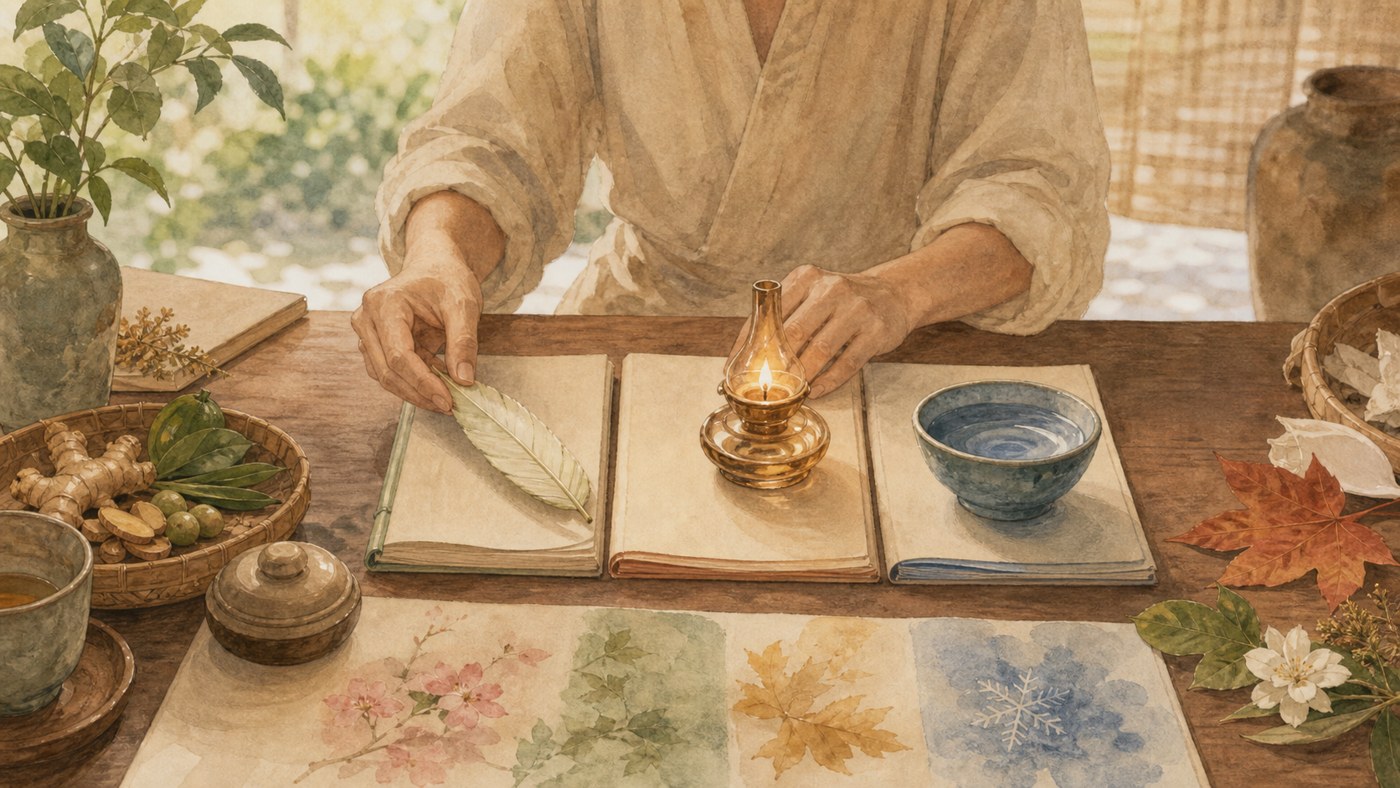
Turning understanding into a workable routine
We have explored mixed qualities, separated constitution from current state, and met the paired portraits. Now we can bring these ideas into daily use.
The image of a map and compass is useful here. Our constitutional portrait is a starting map, while our current observations help us choose a direction today. The three main books provide ideas and questions we can consult along the way.
We do not need to carry the entire library in our head. A practical routine can be small enough to remember and flexible enough to live with.
Begin with a baseline, then make a specific adjustment
There are two parts to the method.
The baseline is an ordinary rhythm that supports our longstanding needs. We might use the book we recognise most strongly to think about regular meals, movement, rest and emotional care. These are suggestions to adapt, not rules that a type imposes.
The adjustment responds to something current and specific. If a concern appears, choose the relevant chapter, consider one suitable change and notice what happens. When the concern settles, we need not keep adding more interventions to our day.
For example, a Wind–Fire reader with a stronger Wind emphasis might use a predictable routine as a comfortable base. During a period of pressure and irritability, the mind-care chapter of Fire Type could help them reconsider expectations or discuss an excessive workload. The constitution has not changed. A current need has received attention.
The same structure works with any pair. It is also useful when we are unsure of our type. We can start with an ordinary concern and choose an appropriate chapter directly.
Adjusting to seasons and surroundings
Thailand's hot, rainy and cool seasons offer one familiar pattern. Wherever we live, it is more useful to observe the actual conditions than to attach a fixed elemental rule to a calendar month.
Hot conditions. In the framework's imagery, heat brings Fire to mind. In practical terms, notice whether the environment makes activity, sleep or work harder. Seek a comfortable setting and adjust exertion appropriately. A type does not protect anyone from heat-related illness.
Wet or changeable conditions. Within this traditional language, dampness is associated with Water and changeability with Wind. We can use this as a reminder to prepare for weather changes, maintain a workable routine and notice what affects our comfort. Damp weather does not itself prove that Water has caused congestion or low mood.
Cold or dry conditions. Within this traditional language, cold and dryness are associated with Wind, alongside the cool quality of Water. Comfortable clothing, suitable indoor conditions and ordinary care for dry skin may be more relevant than changing our identity or diet dramatically.
Traditional seasonal language can encourage us to prepare rather than wait until we are uncomfortable. It should not replace attention to weather warnings, our health conditions or the actual demands of our environment.
We can ask one useful question before a change of season: “What becomes harder for me in these conditions, and what practical support can I arrange?”
Adjusting across stages of life
Ayurvedic teaching traditionally associates childhood with Kapha, the active adult years with Pitta and later life with Vata. The Thai book uses Water, Fire and Wind as a comparison to that sequence.
This is a traditional model, not a biomedical timetable. We should not assume that every older person becomes dry, thin, sleepless or constitutionally Wind, or that every working adult becomes Fire. People age in varied ways, and new symptoms should not be dismissed as an inevitable stage.
Plearnprai's current distinction is important: age and circumstance influence current experience; they do not change the enduring constitution within the framework. A Wind–Water reader may need a different movement routine or more recovery as life changes, without becoming a different type.
The practical lesson is to revisit care as our circumstances change. A habit that fitted student life may not fit shift work, parenthood, a disability or later life. We can adapt without seeing adaptation as a failure of the original map.
Begin with the actual concern
The most direct way to use the books is often to start with a topic. If sleep is difficult, open the rest chapter. If we need help with a meal routine, open the food chapter. If we are struggling to communicate a feeling, open the mind-care chapter.
The traditional portraits associate dryness and busy thoughts with Wind, heat and irritation with Fire, and heaviness and stillness with Water. These associations may help us find a passage. They do not identify the cause of insomnia, inflammation, swelling or any other symptom.
Before choosing self-care, ask whether the concern is new, severe, persistent or worsening. A symptom may need medical assessment rather than a different book. For instance, unexplained swelling should not be treated merely as Water, and chest discomfort should not automatically be called reflux or Fire. [2], [6]
Once the appropriate boundary is clear, the books can function as a reference shelf. We do not have to reread every page. Return to the chapter that answers the question we actually have.
Do not begin everything at once
By now there may seem to be a great deal to remember. We can make the starting point much smaller.
Try a brief morning question: “How am I doing today, and what is one reasonable way to support myself?” We can add elemental language if it helps, but it is not compulsory.
When that feels natural, we might consider seasonal preparation. Later, we might make use of the books by topic. There is no reward for introducing all the tools in the first week.
Small changes also make it easier to learn. If we change meals, exercise, sleep and several other habits at once, we may not know which change helped or which was difficult. A manageable experiment is often more informative than a perfect-looking plan.
A weekly appointment with ourselves
Choose one day for a five-minute review. Ask three questions: “What was difficult this week?” “What circumstances are coming next?” “Which one chapter or habit could help?” Add a fourth when needed: “Is there something I should discuss with a health professional?” A regular point of contact with ourselves can keep care simple and realistic.
Before the closing pages
The shared method is now clear: establish a supportive baseline, notice a current need, make a suitable adjustment and review it. Seasons and life stages give context; symptoms still require their own attention.
The closing pages return to the reason we began: understanding ourselves without making a type into a verdict. Our care and current state can change. We do not have to become a different constitutional type to live with greater ease.
MIXED TYPE
Closing — Our Care Can Change

Looking back at the journey
We began with a familiar question. More than one book seemed to describe us, and we wondered which type we really were.
Perhaps the answer now feels clearer. Perhaps we have found a paired portrait that helps us understand our habits. Or perhaps we are still exploring, but with less pressure to fit ourselves into one complete description. Either can be a worthwhile outcome.
The purpose was never simply to obtain a label. It was to become more skilful and kinder in the way we notice and care for ourselves.
What we have travelled through
We learned that mixed qualities need not form a permanent average. Quickness and intensity can coexist; sensitivity and steadiness can coexist; determination and patience can coexist. We can notice the different contexts in which they appear.
We separated two questions: the enduring constitutional portrait we are exploring, and the current experience that may need care. This distinction helps us avoid changing our identity to match every difficult week.
We met Wind–Fire, with its invitation to slow down and make room for recovery. We met Wind–Water, with its attention to the kind of support a particular day needs. We met Fire–Water, with its questions about movement, expression and the weight of responsibility. We also explored the balanced pattern, without assuming that it guarantees health.
Finally, we practised using the three main books together: a baseline, a specific adjustment and a review. We can consult them by topic and remain attentive to the boundaries of self-care.
The journey has moved from “Which box am I in?” towards “What am I noticing, and how can I respond well?”
Complexity need not be a problem
Some of us have worried that having several sides makes us inconsistent or hard to understand. A mixed portrait offers another possibility: there may be more than one useful response available to us.
We can be sensitive and dependable. We can be decisive and patient. We can enjoy ideas without having to act on all of them. These possibilities are not confined to a type, but the language may help us recognise them.
We need not romanticise every difficulty. A troubling change still deserves attention. Yet we also need not treat ordinary complexity as a defect that must be removed.
The skill is not perfect classification. It is learning to listen carefully, to describe our experience honestly and to choose a proportionate response.
What changes, and what does not
Within the current framework, constitution is enduring. What changes is our present state, the demands around us, the habits available to us and the skills with which we respond. Age and season can influence experience without changing the constitutional position on the wheel.
This is still hopeful. We do not have to become a different type for sleep to improve, for a routine to become kinder or for a difficult conversation to become possible. Neither a label nor our past habits determines every next choice.
Improvement is not always under our control, and illness is not a personal failure to balance ourselves. Support, treatment, relationships and living conditions matter. Our part is to take the next reasonable step, not to claim complete command over health.
Three things to take with us
Kindness towards ourselves. Some days we will misunderstand what we need. We may keep working when we needed a break, withdraw when we needed company, or attempt too much when we were unwell. We can learn without turning the mistake into a judgement of our character.
A small beginning. We do not need every exercise in this book at once. A brief check-in and one manageable habit can be enough to start. We can add detail only when it helps.
Confidence with room for help. We know aspects of our lived experience that no one else can know for us. That knowledge matters. It does not mean we must diagnose ourselves or manage everything alone. A trusted person or a qualified professional may notice something we cannot, and collaboration can make care better.
The book offers language. We bring experience. Other people can bring support and expertise. These contributions can work together.
If we want to explore further
This companion and the three main books offer a route for reflection and everyday-care ideas. They are not sufficient for every health concern.
Plearnprai's screening materials may help organise observations about longstanding characteristics. We can use them as an optional conversation aid, especially when our pair or emphasis is unclear. They should not be presented as an exact measurement of elemental proportions or as a validated diagnosis.
There is no obligation to complete another assessment. We can use a helpful chapter, ask a practical question or make an appropriate appointment without first knowing our type with certainty.
A final word
We began with uncertainty about which portrait fitted. We finish with more than a possible name: a method of noticing, a set of questions and permission to adapt our care.
Having several recognisable qualities is not something we must cure. We can learn when a strength is helping, when a habit has become demanding and when support is needed. We can do so with patience and without asking a book to explain more than it can.
Thank you for travelling through these pages together. May we carry the useful parts into ordinary life: a little more attention, a little less judgement and enough openness to change what can be changed.
Our type is a way of beginning a conversation. Our life remains larger than its name.
MIXED TYPE
Sources and Reading Notes
How to read the sources
This English editorial adaptation follows the complete route of the Thai Mixed Type companion: introduction, seven chapters, closing and source appendix. The illustrations belong to that source edition. The English wording distinguishes traditional descriptions, Plearnprai's current framework and medical information.
A traditional source can explain where an idea comes from without proving its clinical effectiveness. A modern health-information source can support a safety boundary without validating Plearnprai's types. The two kinds of support should not be confused.
Traditional sources identified in the Thai edition
The Thai appendix names the following sources and traditions:
- Royal medical texts compiled during the reign of King Rama V, including discussions of constitutional characteristics. The source does not specify an edition, volume or page range.
- Khamphi That Wiphankha (คัมภีร์ธาตุวิภังค์), referenced for traditional accounts of elements in the body. Exact passages and edition details are not supplied.
- Texts of traditional Thai medicine associated with the Department of Thai Traditional and Alternative Medicine, Ministry of Public Health. No particular publication or page is identified in the source appendix.
- Advice from experienced Thai traditional practitioners concerning people whose characteristics span several descriptions. These are reported practice influences, not a documented clinical study.
These entries are retained as the provenance stated by the Thai author. This edition does not invent missing bibliographic details or claim to have verified a specific historical passage that was not identified.
Ayurvedic comparison
The source uses the Ayurvedic ideas of dual-dosha and tridoshic constitution as comparisons. It names Vasant Lad, Ayurveda: The Science of Self-Healing (1984) in connection with constitutional teaching. The source provides no page references or full edition information.
Ayurvedic doshas, traditional Thai elements and Plearnprai's seven constitutional patterns are not identical classifications. Where the Thai series distinguishes its Thai-element vocabulary from the Ayurvedic term tridosha, this edition preserves that distinction in meaning rather than blending the systems into one.
The comparison is interpretive. It does not establish that an elemental assessment diagnoses disease, predicts metabolic health or determines which treatment will work. For a general account of the limits and safety of Ayurvedic approaches, see R7 below.
General psychological reading named in the source
The Thai appendix also mentions:
- Writings about MBTI subtypes and Big Five profiles, as examples of describing more than one dimension of personality.
- Richard Schwartz, Internal Family Systems Therapy (1995), as a comparison concerning different parts of a person's inner experience.
- Research or articles labelled “Bimodal Personality,” “Trait Variability” and “Mixed Type Constitution.”
The source supplies no authors, article titles, journals, dates or persistent identifiers for these general categories. They are therefore preserved as unverified background leads, not presented as scientific references proving the book's framework. The psychological comparison does not mean that this book provides Internal Family Systems therapy or diagnoses a personality or mood condition.
Plearnprai framework used for this adaptation
The current internal source is Canon 0, Card 01: Constitution (ธาตุประจำตัว). It distinguishes an enduring constitution from a changing current state. Age and season influence the latter; they do not change the constitution within that framework. It also states that the screening approach has not yet undergone validation of accuracy and consistency.
This edition follows those distinctions. It treats primary and secondary emphases as informal reading aids within a paired portrait, not as new quantified categories. The approved English names are Wind Type, Fire Type, Water Type, Mixed Type, Wind–Fire Type, Wind–Water Type and Fire–Water Type. The centre of the wheel is described here as the balanced pattern.
Health and safety references added for the English edition
The following primary institutional sources were checked on 13 October 2026. Bracketed reference codes in the text point to these entries. They support specific medical boundaries and general-care statements; they do not validate elemental typing.
R1 — National Institute of Mental Health. Bipolar Disorder. Used to distinguish ordinary variation from significant changes in mood, sleep, energy and activity that may require assessment. No reader is diagnosed from a type description.
R2 — National Institute of Diabetes and Digestive and Kidney Diseases. Symptoms & Causes of GER & GERD. Used for the boundary between heartburn or reflux symptoms and an elemental interpretation. Persistent or concerning symptoms need appropriate care.
R3 — World Health Organization. Burn-out an Occupational Phenomenon. Used to avoid diagnosing burnout from the experience of being tired but unable to settle.
R4 — National Heart, Lung, and Blood Institute. Insomnia Treatment. Used for the distinction between supportive routines and treatment for persistent insomnia. Relaxation alone is not presented as sufficient treatment for every sleep problem.
R5 — World Health Organization. Physical Activity. Used for the general principle of appropriate activity and reducing sedentary time, adapted to ability and health rather than selected by type.
R6 — National Health Service. Swollen Ankles, Feet and Legs (Oedema). Used to prevent unexplained swelling being dismissed as an elemental feature and to retain appropriate urgency when associated symptoms are concerning.
R7 — National Center for Complementary and Integrative Health. Ayurvedic Medicine: In Depth. Used for the boundary between a traditional comparison and evidence of clinical effectiveness, and the importance of not delaying conventional care.
R8 — National Institute of Diabetes and Digestive and Kidney Diseases. Eating, Diet, & Nutrition for GER & GERD. Used for individual food triggers rather than universal restrictions assigned to a type.
A note on scope
This is an English edition, not a medical textbook or a validation study. It does not prescribe herbs, recommend stopping medicines or replace advice from a qualified professional. Substantive corrections and unresolved source details are recorded in the accompanying editorial notes.
A useful framework should help us ask clearer questions. When our question concerns illness, safety or treatment, we take it to the appropriate professional as well.
Caring for one another.