
The Plearnprai Three Elements Series · Book 13
MOVEMENT BY THE ELEMENTS
Finding a Rhythm That Fits Our Body and Life
First English Edition · 2026
A COMPANION TO EVERYDAY CARE
MOVEMENT BY THE ELEMENTS
Finding a Rhythm That Fits Our Body and Life
The Plearnprai Three Elements Series · Book 13
Plearnprai · English editorial adaptation
13 October 2026 · First English Edition
This edition follows the chapter route of the Thai source, retaining its practical examples, reflections and original illustrations. It uses the agreed concise type names and the inclusive voice “we”.
Traditional interpretations, Plearnprai's current framework and clinical information are distinguished where needed. Constitution and current state are treated as distinct concepts.
Published in the Plearnprai Library · 13 October 2026.
Contents
Introduction — Movement Belongs to Everyday Life4Chapter 1 — Why Movement Needs to Fit the Person8Chapter 2 — Movement Through Three Traditions13Chapter 3 — Knowing Our Pattern and Today's Capacity18Chapter 4 — Wind Type: Finding a Steadier Rhythm24Chapter 5 — Activities and Movements for Wind Type28Chapter 6 — Fire Type: Making Room for Ease33Chapter 7 — Activities and Movements for Fire Type37Chapter 8 — Water Type: A Supported Beginning41Chapter 9 — Activities and Movements for Water Type45Chapter 10 — Mixed Type: Choosing When Several Qualities Meet50Chapter 11 — Movement Across the Life Course54Chapter 12 — Moving with the Seasons and the Day59Chapter 13 — Thai and Other Asian Movement Traditions66Chapter 14 — Movement When Body and Mind Are Struggling73Chapter 15 — Movement as a Way of Life82Closing Reflection — Movement as an Act of Care89Glossary93References, Further Reading and Safety Index97MOVEMENT BY THE ELEMENTS
Introduction — Movement Belongs to Everyday Life
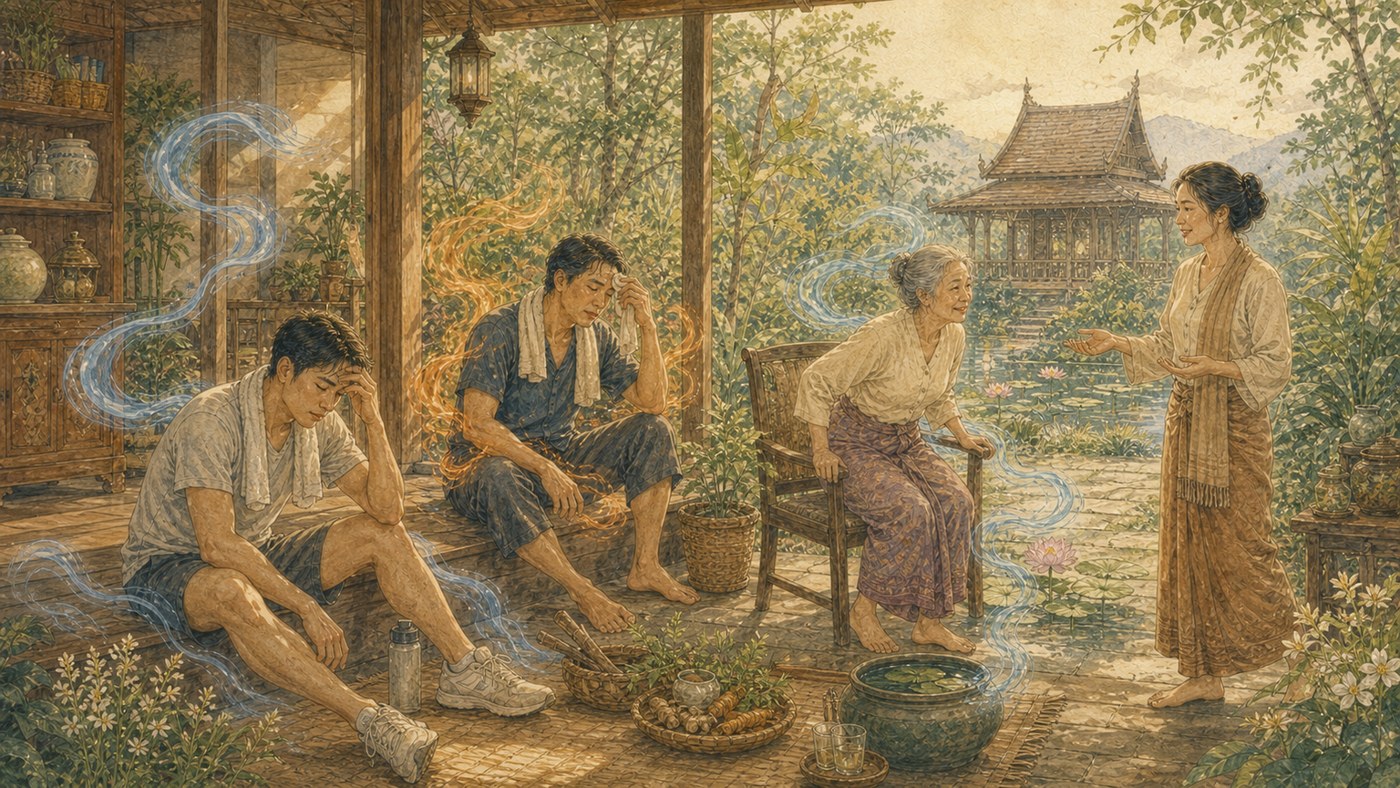
Four people in one room
One evening, four people sit together in a living room, talking about something each has tried and struggled to sustain: exercise.
New, a 31-year-old graphic designer, has just abandoned a paid five-kilometre running course after three sessions. On the first day, the knees felt tight. After the second, sleep was difficult. During the third, dizziness brought New to a stop beside the path. Looking in the mirror afterwards, New thought, “Perhaps I am simply lazy. Perhaps I have no discipline.”
Korn, 45, has returned from an hour on the gym treadmill. It has become a daily practice during a stressful month at work. A rash has appeared around the neck again; there are occasional palpitations and restless nights. “Exercise is good,” Korn tells his wife. “The more I do, the better I will cope with work.”
Grandmother, 72, sits in the favourite chair that has occupied most of the last three months. Trips to the bathroom and meals are almost the only reasons to get up. “I am old and tired. Staying home is easier.” Yet standing from the chair now takes both hands, and the legs feel weaker.
Then there is Ou, 38, a mother of two children aged six and three. Ou recognises a Wind–Fire pattern. Studio yoga, park running, high-intensity interval training from an online video—each attempt lasts less than a month. A child becomes ill, household work takes over, and restarting brings guilt. “Perhaps I am just not someone who exercises.”
All four want to care for themselves. All four have made an effort. Their difficulties deserve more curiosity than a verdict about laziness, age or willpower. The activity, dose, setting, recovery time or demands of daily life may not have fitted them. Symptoms such as exertional dizziness, palpitations and progressive weakness also deserve clinical attention; an elemental label cannot explain them away.
In Plearnprai's language, New's experience invites a steadier, more settling approach to Wind. Korn's experience invites less heat and competition around Fire. Grandmother's experience invites supported movement and renewed engagement around Water. Ou needs a practice that can change with a busy life and a mixed pattern. These are ways to frame a conversation, not diagnoses of nervous-system function, inflammation or fluid retention.
The four people have followed familiar advice: exercise, run, walk. What they have not been helped to ask is, “What form of movement, at what amount, fits this person today?” A useful activity for one person may need considerable adaptation for another.
This book is for those four people, and for any of us who recognise ourselves in their stories. They are teaching stories, not evidence that a particular practice cures symptoms.
Why this book?
Health apps often give us similar messages: move more, exercise regularly, strengthen our muscles and sleep enough. Population guidelines offer useful health goals, but our starting points differ. Ten thousand steps is not a universal medical requirement; the formal activity recommendations in the appendix are a different kind of guidance.
We each bring a body, a history, a working day, an age, a season and a changing level of capacity. Movement by the Elements asks how movement can fit those realities. Its setting is contemporary Thai life, but the questions travel: how do we begin, adapt, recover and find a practice we can return to?
What we hope to do
Thai traditional medicine and Ayurveda offer longstanding ways to notice individual qualities. Plearnprai uses Wind, Fire and Water as accessible portraits: settling when we feel scattered; easing unnecessary heat and intensity when we feel driven; encouraging movement when we feel heavy and stuck. Modern exercise care also adapts activity to the person. Its clinical measures and evidence are distinct from these traditional portraits.
This book builds two bridges. One connects elemental language with familiar activities: rue-si dat-ton, Thai dance and wai khru ram muay; yoga, tai chi and qigong; walking, running, swimming and resistance exercise. The other connects these activities with the life we actually have: a hurried morning, a seated working day, a tired evening or a weekend when rest matters.
We will not measure the worth of a day by a step count. We will learn to select and adjust movement. On a difficult day, five gentle minutes can still be an act of care.
Our promises to the reader
Room to choose. This is not a “no pain, no gain” programme. Pain, exhaustion and guilt are poor foundations for a lasting relationship with movement.
Numbers as tools. Timings, repetitions and sample weeks help us understand a practice; they are not tests of character. We can shorten, adapt or stop. Warmth and an easy sense of effort may be useful observations, but sweating alone does not measure a safe or effective session.
Respect for different bodies. Children, adolescents, working adults, new parents, older people, people with disabilities and people recovering from illness all belong in this conversation. Some will need an individual plan. No body has to earn the right to be cared for.
A welcome when we return. We may have left a course, missed a target or stopped for years. We can begin again. Returning is already a meaningful step.
Who is this book for?
We may have tried and felt that we failed. We may never have exercised regularly and want somewhere manageable to start. We may already train but feel increasingly tired, tense or unhappy. We may be supporting parents, children or a partner whose preferences differ from ours.
We may want to preserve strength as we age, or use movement as one companion during stress, sadness or emotional fatigue. Movement can support well-being; it does not replace treatment for a physical or mental health condition.
Useful reading before we begin
The foundation books—Wind Type, Fire Type, Water Type and Mixed Type—introduce Plearnprai's three-element framework. Their opening chapters can help us understand the language used here.
We do not need to settle on a label before moving. Chapter 3 offers a way to observe present needs. Our constitution is understood as enduring within this framework; our current state changes. Safety, capacity and how we respond matter more than choosing a perfect category.
Our route through the book
Part One, Chapters 1–3: foundations. We explore individual differences, movement in three medical traditions, and the distinction between constitution and today's state.
Part Two, Chapters 4–9: three approaches to movement. Each type has a chapter on rhythm, effort and setting, followed by activities and a sample week. These are starting points to adapt, not fixed prescriptions.
Part Three, Chapters 10–12: mixed patterns, age and season. We consider more than one elemental quality, movement across the life course, and adjustments for weather and time of day.
Part Four, Chapters 13–14: traditions and changing health. We visit Thai and other Asian movement practices, then consider stress, sleeplessness, persistent pain, weight concerns and circumstances that need professional guidance.
Part Five, Chapter 15: a lasting habit. We build a kindly form of discipline that can live beyond the first enthusiastic month.
The closing chapter brings these threads together. A glossary and references support further reading.
Our agreement
This is a companion to everyday care, not a sports-medicine prescription. If we have heart or lung disease, osteoporosis, arthritis, diabetes, high blood pressure or another condition affecting exercise, we can ask our care team how to begin or change activity safely. The appropriate assessment depends on the individual.
Movement also belongs to culture, family, memory, opportunity and enjoyment. An evening walk with a child can matter in ways a fitness app never records.
On a day of illness, exhaustion or family difficulty, a smaller practice—or rest—may be the right choice. We do not owe the plan an apology. Pregnancy, the postpartum period, recent surgery, difficulty with balance and a child's particular developmental or medical needs call for suitable adaptations and advice.
Stop exercise if we develop chest pain, faintness, unusual breathlessness or a concerning change in heartbeat. Severe or persistent symptoms need urgent care. We will return to these boundaries in Chapter 14.
An invitation
Read at an easy pace. This is a companion beside us while we choose today's movement, return after a long pause or decide whether a new class is a good fit.
Movement is a conversation with our body. We can learn its rhythm without turning the conversation into a test.
May these pages make everyday movement lighter, more meaningful and more attentive to both body and mind. We will take the next fifteen chapters together.
MOVEMENT BY THE ELEMENTS
Chapter 1 — Why Movement Needs to Fit the Person
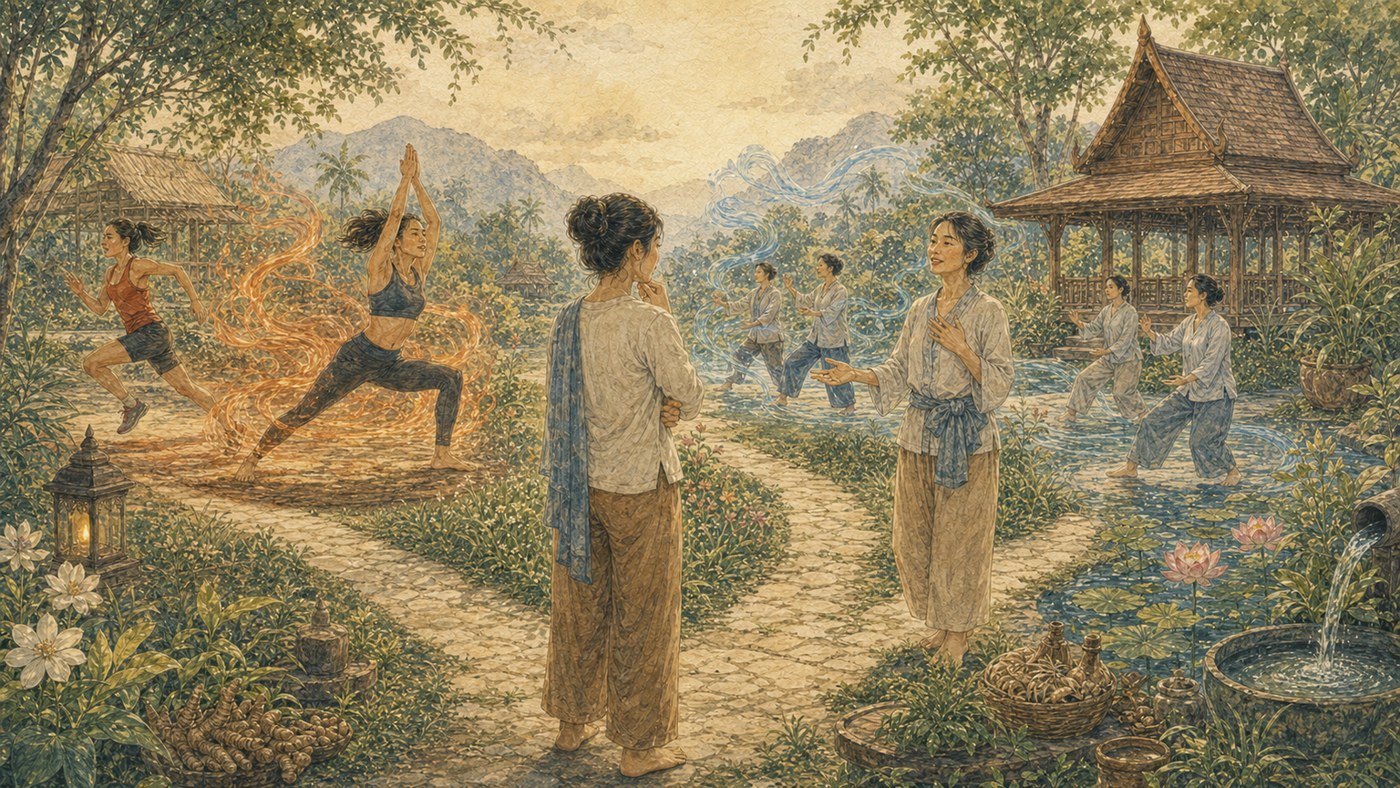
New's hot-yoga class
New, 31, works at a screen for about ten hours a day. Towards the end of the year, the neck and shoulders become stiff, sleep grows difficult and the mind feels scattered. A friend recommends hot yoga: a very warm room, demanding postures and plenty of sweat. “I feel wonderfully clear afterwards.”
New buys a ten-session course. The first class feels relaxing. During the second, dizziness appears. After the third comes a sleepless night; after the fourth, occasional palpitations at work. By the fifth morning, New feels tired all day.
Doing what a friend enjoys does not guarantee the same response. Heat, dehydration, intensity, existing health problems and recovery all matter. New needs to stop the provoking activity and have concerning symptoms assessed, rather than finish the course to prove determination. A friend who identifies as Water Type is not automatically protected from hot yoga's risks.
Within the elemental framework, we might describe New as needing steadiness rather than more stimulation. That is a useful question about practice. It is not a medical explanation for dizziness or palpitations.
Movement as everyday medicine
Ayurveda calls physical exercise vyayama and places it within dinacharya, the daily routine. Alongside food, sleep and washing, movement belongs to ordinary care, not only to a special appointment at the gym.
Calling movement “medicine” is a metaphor with a useful lesson: amount and suitability matter. A movement can feel warming or cooling, brisk or settling, light or effortful. The same activity changes character when we alter the pace, duration, surroundings or attitude. We can ask what it gives us, what it asks of us and whether that exchange is appropriate today.
Qualities and the principle of balancing opposites
Ayurveda uses guna, or qualities, to describe patterns. In the comparison used here:
- Wind/Vata is associated with cold, dryness, lightness, roughness, subtlety and mobility.
- Fire/Pitta is associated with heat, sharpness, fluidity and an active, penetrating quality.
- Water/Kapha is associated with coolness, moisture, heaviness, steadiness, smoothness and cohesion. Kapha includes earth and water in Ayurveda; Plearnprai's “Water” is a simplified name, not an exact replacement for the traditional system.
“Opposites balance” invites us to consider warmth and a slower pace when we feel cold and hurried; ease and a cooler setting when we feel overheated and competitive; a manageable degree of activation when we feel heavy and still.
Our preferences sometimes reinforce the state we are already in. A hurried person may choose another fast class. A competitive person may turn every run into a race. Someone reluctant to begin may choose only practices that require little movement. These patterns are possibilities, not personality rules. Enjoying a vigorous sport is not itself a sign of imbalance, and quiet practice has value for every type.
The useful question is whether our choice supports us over time, including recovery, rather than simply matching the mood of the moment.
When a practice is not fitting well
We can notice changes over the first week or two, while remembering that no particular timetable or cluster diagnoses a “wrong element.” Symptoms may have many causes.
In a Wind-like pattern, we may notice difficulty sleeping, greater anxiety or restlessness, joint pain, persistent fatigue, unintentional weight loss, dryness and constipation. In a Fire-like pattern, it draws attention to heat discomfort, irritability, rashes, muscle pain that does not settle, digestive burning or diarrhoea, excessive thirst and palpitations. In a Water-like pattern, it draws attention to worsening inactivity, low mood, loss of strength or balance, weight change, congestion and swelling.
These observations can prompt a review of the activity and a conversation with a professional. They do not establish their own cause. We should not wait to collect several symptoms before seeking help. New swelling, unexplained weight change, declining strength, persistent digestive symptoms or a rash need appropriate assessment. Chest discomfort, fainting, marked breathlessness or a sustained abnormal heartbeat need urgent attention.
What a better fit can feel like
A settling practice—perhaps easy walking, gentle yoga, tai chi or swimming in comfortable water—may help a Wind Type feel more present and less rushed. A Fire Type may enjoy swimming, a shaded walk, comfortable indoor cycling or yoga away from heat and competition. A Water Type may enjoy brisk walking, adapted dancing, jogging if suitable or progressive resistance exercise.
We can look for better recovery, a manageable level of effort, enjoyment, confidence and a willingness to return. Sleep or mood may improve, but a particular practice does not guarantee relief from anxiety, a rash, reflux, congestion or another condition. Weight loss is not a necessary sign that movement is helping.
An observation matrix
The table preserves the traditional portraits as a vocabulary for noticing. It is not a diagnostic score or a substitute for assessment.
| Area to observe | Wind-like description | Fire-like description | Water-like description |
|---|---|---|---|
| Sleep | Hard to settle; restless sleep | Interrupted sleep; feeling overheated | Long sleep without feeling refreshed |
| Mood | Worried or scattered | Irritable or driven | Low, disengaged or reluctant to begin |
| Skin and comfort | Dryness or itching | Heat or a rash | Puffiness or a heavy feeling |
| Weight | Unintentional loss | May appear unchanged | Unexplained gain |
| Digestion | Constipation or bloating | Burning or loose stools | Fullness or sluggish digestion |
| Muscles and joints | Pain or instability | Soreness that persists | Weakness or swelling |
| After activity | Drained, slow to recover | Overheated or unusually thirsty | Still disengaged or without a useful challenge |
Rather than counting three signs to decide our type, we can ask: What has changed? How severe is it? Does it occur during exertion? Does it settle with appropriate rest? What needs medical attention?
Learning our body's language
Some of us first notice strain as restlessness, coldness or difficulty settling. Others notice irritability, heat or a drive to keep pushing. Others slowly withdraw, move less and feel heavier. Knowing our usual pattern can help us notice a change earlier.
Listening is a skill, and it has limits. Some health conditions produce few symptoms; some symptoms are hard to interpret. Body awareness works best alongside appropriate care, not in place of it. A watch can count steps but cannot fully describe our experience. Our feelings can describe that experience but cannot replace a clinical examination when one is needed.
Korn changes the pattern
During a stressful month, Korn starts running for an hour every morning at 5.30. The effort feels like release. Three weeks later, a neck rash returns, sleep becomes difficult, palpitations occur during meetings and the first coffee brings stomach discomfort.
“Why do I feel worse when I am exercising?” is a reasonable question. The answer needs more than an elemental label. Korn discusses the symptoms with the treating clinician and reviews training, caffeine, sleep, stress and other possible causes. In the story, a less demanding programme becomes part of the plan: a comfortable swim in the evening instead of an hour of hard treadmill running, with enough recovery.
Over the following weeks, Korn feels better. The story illustrates adjustment and follow-up; it cannot show that “cooling Fire” cured the symptoms. The transferable lesson is that doing more is not always the next step. Sometimes we need a different dose, a different setting or professional help.
Individual responses: a scientific perspective
People do respond differently to the same programme. Baseline fitness, health conditions, medicines, previous training, sleep, nutrition, recovery, environment and the way a programme is delivered all influence what happens. Modern exercise care takes these differences seriously.
An elemental portrait cannot tell us our cortisol level, testosterone level, bone density, insulin sensitivity, inflammatory markers or resting metabolic rate. A Wind Type does not automatically have “sympathetic dominance”; a Fire Type is not necessarily more inflamed; a Water Type is not necessarily insulin-resistant. Those are different kinds of claims requiring their own evidence and, where indicated, clinical assessment.
Traditional descriptions can help us articulate preference and experience. Scientific evidence can help us judge benefits, risks and appropriate progression. The two can inform a thoughtful conversation without being treated as interchangeable proof.
Try it: seven questions before a new activity
Before buying equipment or joining a course, pause over these questions:
- What is most noticeable today: hurry and restlessness, heat and intensity, heaviness and reluctance—or something else?
- Will this activity warm, settle or stimulate us? Can we change its dose?
- Does its atmosphere support ease, or add pressure?
- Where will we do it: indoors, in sun, near water, among trees? Is the setting safe?
- When does it fit our day and our available energy?
- How much effort does it ask for, relative to our present capacity?
- How do we expect to feel afterwards? We can compare that expectation with our actual response later that day and the next morning.
A manageable trial is more informative than a confident label. Begin below our maximum, watch the response and adjust. If symptoms or health concerns make the answer uncertain, seek suitable guidance first.
What needs care
Popularity is not a prescription. A friend's enthusiasm can introduce an option; it cannot establish that option's safety for us.
Progress gradually. Even an enjoyable activity can cause harm when the first dose is too much. Training history and recovery matter for every type.
Use more than one source of feedback. We can combine bodily experience, functional progress and appropriate clinical advice. Concerning symptoms are not something to train through.
Signs that we are finding our way
Over time, we may wake feeling more rested, have steadier daytime energy, recover without lingering exhaustion and approach the next session with less dread. We may become more confident about reducing a session when needed and increasing it when ready.
These changes need not appear within a fixed number of days. The most encouraging sign is a sustainable relationship with movement, not constant enthusiasm or a perfect record.
Before we continue
Movement needs to fit the person and the day. The traditional language of qualities offers one way to ask what might balance an excessive pattern. It works best when we remain curious and keep clinical boundaries clear.
New, Korn and the others can begin again without calling themselves failures. In the next chapter, we explore what Thai traditional medicine, Ayurveda and modern exercise care each contribute—and where their explanations remain different.
MOVEMENT BY THE ELEMENTS
Chapter 2 — Movement Through Three Traditions
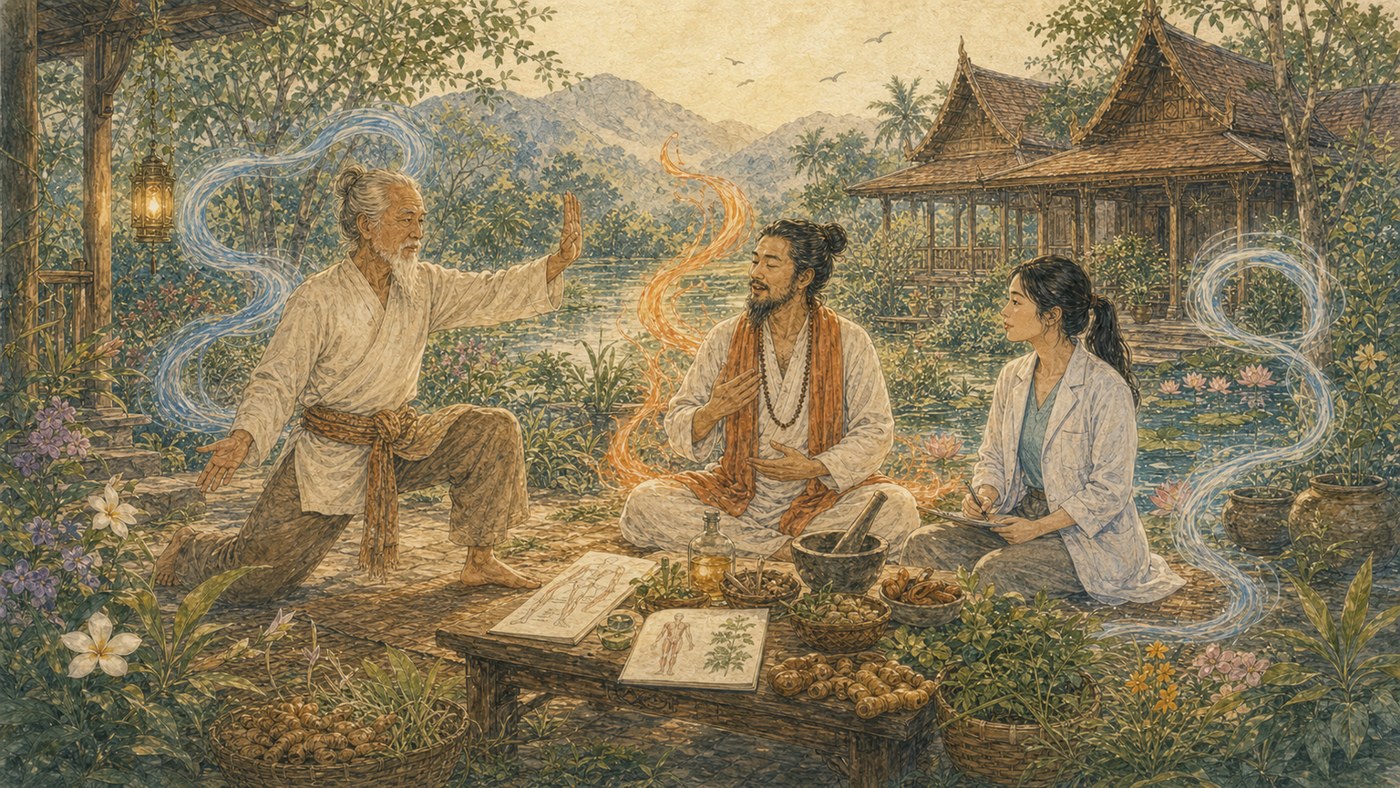
Three ways of approaching the same person
Imagine a traditional teacher inviting a student to finish practice with strength still available; a Thai teacher demonstrating a slow self-stretch with an easy breath; and an exercise professional adjusting a programme to a person's health and recovery. These are illustrative scenes, not historical quotations. Their explanations differ, but each can draw our attention to the person doing the movement.
Ayurveda, Thai traditional medicine and modern exercise care offer different kinds of knowledge. We can appreciate their contributions without claiming that they say exactly the same thing, or that research on one practice proves an entire traditional system.
Ayurveda: vyayama within dinacharya
Ayurvedic daily-care teaching places vyayama, exercise, within dinacharya, a regular way of living. Moving belongs beside eating, sleeping, washing and other ordinary acts of care.
One traditional principle is ardha shakti, often translated as exercising to half one's capacity. The practical invitation is to retain a reserve rather than repeatedly finish exhausted. Traditional descriptions mention the onset of sweating and changes in breathing as signs to ease off. These are historical guides, not a measured percentage of maximum heart rate: temperature, medicines, illness and fitness all change how we sweat and breathe.
Ayurveda describes excessive effort as depleting ojas, a concept of vitality and resilience. Ojas is not a laboratory measurement. We can understand the passage as a caution about depletion while using present-day assessment for actual fatigue or illness.
| Traditional portrait | Quality to explore | Examples to adapt |
|---|---|---|
| Wind/Vata | Gentle, steady, comfortably warm | Easy yoga, walking, tai chi |
| Fire/Pitta | Less heat and competition | Comfortable swimming, shaded walks, gentle outdoor yoga |
| Water/Kapha | Manageable activation and variety | Brisk walking, dancing, suitable jogging |
Ayurveda also describes a repeating daily cycle: Kapha from 6–10, Pitta from 10–2 and Vata from 2–6, in both halves of the day. In this book, that traditional clock can prompt us to consider a more active morning, shelter from midday heat and a quieter evening. It does not establish a medically required exercise hour. Daylight, climate, shift work, sleep, medicines and personal response come first. We do not need to rise before dawn to be well.
Thai traditional medicine: movement within life
Rue-si dat-ton is the Thai tradition of self-stretching and self-care postures associated with hermit figures. Wat Pho preserves an important historical record. Different collections count figures and postures differently; we need not settle a historical count to learn a suitable beginner practice. Traditional descriptions refer to Wind in particular body regions. Those terms belong to their own explanatory system, not to a modern anatomical diagnosis.
The movements can be slow, coordinated with breathing and selected with a teacher's help. “A posture for back discomfort” does not mean that every back condition should receive that posture.
Wai khru ram muay, the ceremonial movement associated with Muay Thai, offers rhythm, coordination and cultural meaning. It differs from contact fighting and strenuous kickboxing. In Plearnprai's interpretation, its measured expression may appeal to a Fire Type who wants movement without a contest.
Thai dance combines repeated steps, coordination, balance and expressive hand movements. Its grace does not mean that it requires no effort. A simplified version can be one enjoyable way for a Water Type—or anyone—to become more active.
Walking meditation brings attention to stepping. It can be slow and grounding for a restless day. A clear, level route and ordinary walking are equally acceptable if a formal practice does not suit us.
Gardening, walking to the market, carrying manageable objects and household work also involve movement. Earlier generations did not always call these activities exercise. Their place in daily life is worth remembering, without idealising hard labour or claiming that it alone explained longevity.
Modern exercise care: FITT-VP
A practical programme can be described through six questions:
- Frequency: how often do we practise?
- Intensity: how much effort is involved, relative to our capacity?
- Time: how long is each session?
- Type: aerobic activity, strength, mobility, balance—or a combination?
- Volume: what is the overall amount across the week?
- Progression: how will we increase that amount safely over time?
For adults, WHO's 2020 guidance recommends 150–300 minutes of moderate aerobic activity a week, or 75–150 minutes of vigorous activity, or an equivalent combination, alongside muscle strengthening on at least two days. These are health recommendations to work towards, not an instruction to begin at the full amount. Some activity is better than none; starting small and progressing matters. [1]
The same guidance encourages less sedentary time. Breaking up a long seated day is useful. A reminder every half-hour or hour can be a practical personal cue, but it is not a universal WHO-prescribed interval and does not replace an appropriate activity programme.
Researchers study recovery, heart-rate variability, inflammation, glucose regulation and responses to different training doses. HRV varies with many influences and is not an elemental balance score. A temporary exercise-related inflammatory response is not the same as chronic inflammatory disease. Benefits of interval exercise do not establish that Water Types require it. Clinical findings need to be read for the people, intervention and outcome actually studied.
Points of conversation
| Theme | Ayurvedic language | Thai traditional practice | Modern exercise care |
|---|---|---|---|
| Respecting capacity | Ardha shakti; retaining reserve | Avoiding excessive strain | Appropriate dose and recovery |
| Regularity | Dinacharya | Movement within daily life | Sustainable repeated practice |
| Individual needs | Constitution and current qualities | Person, symptoms and traditional assessment | Health, function, goals and preferences |
| Breathing | Pranayama | Breath coordinated with movement | Avoiding unnecessary strain; adapting effort |
| Body and mind | Dosha balance | Four-element interpretation | Physical and psychological outcomes |
| Variety | Several forms of practice | Stretching, walking, dance | Aerobic, strength, mobility and balance work |
These are points of comparison, not equivalences. Severe or persistent fatigue should not be dismissed as a traditional imbalance; it may need investigation. Integration means retaining the ability to ask what each approach can and cannot tell us.
Why return to the breath?
Ayurveda speaks of pranayama and prana, traditionally understood as regulation of vital breath or energy. Thai movement traditions often coordinate inhalation and exhalation with a posture. Modern practice can use breathing as a practical guide to effort and as part of relaxation.
For an easy movement session, let breathing remain comfortable. We may inhale through the nose if that feels natural and exhale through the nose or mouth. We need not force nasal breathing, make each breath very large or hold it. During resistance work, breathing out through the effort often helps us avoid straining.
Quiet breathing does not mean an activity is useless. Unusual breathlessness, air hunger, dizziness or chest discomfort is a reason to stop and assess the situation. Slow breathing can feel calming, but we should not promise that it will lower a particular hormone or correct an autonomic disorder.
Ou makes a practice that fits home
Ou, 38, is caring for children aged six and three. A studio timetable is difficult to keep; expensive equipment has been used only a few times. Occasional palpitations during running have been discussed with the treating clinician.
Ou builds a more flexible routine. From Ayurvedic teaching comes a preference for regularity and leaving some strength in reserve. A short practice before the children wake is easier than an evening class. From Thai tradition come five suitable self-stretching movements for the waist, shoulders and neck, ten minutes of walking meditation in the living room and fifteen minutes of gardening with the children when the day allows. From modern exercise care comes progressive resistance work with a band twice a week, fitted around rest and childcare.
Not every item happens every day. Across a typical day, movement may total roughly thirty to forty minutes in small portions. The point is that the routine fits Ou's circumstances and can be adjusted. In the teaching story, it lasts longer than previous attempts and strength and sleep improve. That is an illustration of adherence, not a claim that this combination cures palpitations.
Different knowledge, complementary tools
Ayurveda contributes language for qualities, daily routine, season, breath and traditional vitality. Thai practice contributes culturally rooted movements, ordinary activity and walking meditation. Modern care contributes anatomy, physiology, evidence, assessment, rehabilitation and ways to measure function and health.
These areas overlap, and they can also disagree. A clinically important restriction takes priority over an elemental preference. Herbs sometimes accompany traditional care, but this movement book does not prescribe them; natural products also have interactions and risks.
Try it: a gentle five-minute introduction
Choose a clear space and a stable chair nearby. Omit anything that is unsuitable for our joints, balance or care plan.
First minute: stand comfortably, feet slightly apart, or sit. Raise the arms within an easy range while breathing in; lower them while breathing out. Repeat about three times. There is no need to reach overhead if that hurts.
Next two minutes: sit on a chair or supported cushion. Let the breath settle. If comfortable, count up to four in and four out for about eight to ten cycles. Use a shorter count or ordinary breathing whenever needed. No breath holding and no forced deep breaths.
Final two minutes: with a stable support, try a few shallow squats or chair sit-to-stands. We might work towards ten, but one comfortable repetition may be the starting point. Keep the knees and feet comfortably aligned, breathe throughout and stop before pain or loss of form.
Afterwards, notice warmth, ease, effort and any discomfort. This small sequence combines stretching, attention to breath and resistance; no single movement belongs exclusively to one medical tradition.
What needs care
First, begin with practices we understand and can adapt. An elemental label is not required to take a safe short walk.
Second, involve the care team when a health condition affects exercise. Combining traditions does not remove that need.
Third, allow time without promising a result by week two or four. Persistent or worsening symptoms deserve attention, not a longer experiment.
Signs that we are finding our way
We may become better at choosing a practice for a particular day, notice strain earlier and find more than one way to move. A shorter, realistic routine may be easier to sustain. We may begin because we value the experience, rather than because we fear missing a target.
Before we continue
We can bring cultural meaning, traditional reflection and clinical safety into the same plan while keeping their explanations clear. Next we will distinguish our longer-term constitution, today's state and the capacity available to us now.
MOVEMENT BY THE ELEMENTS
Chapter 3 — Knowing Our Pattern and Today's Capacity
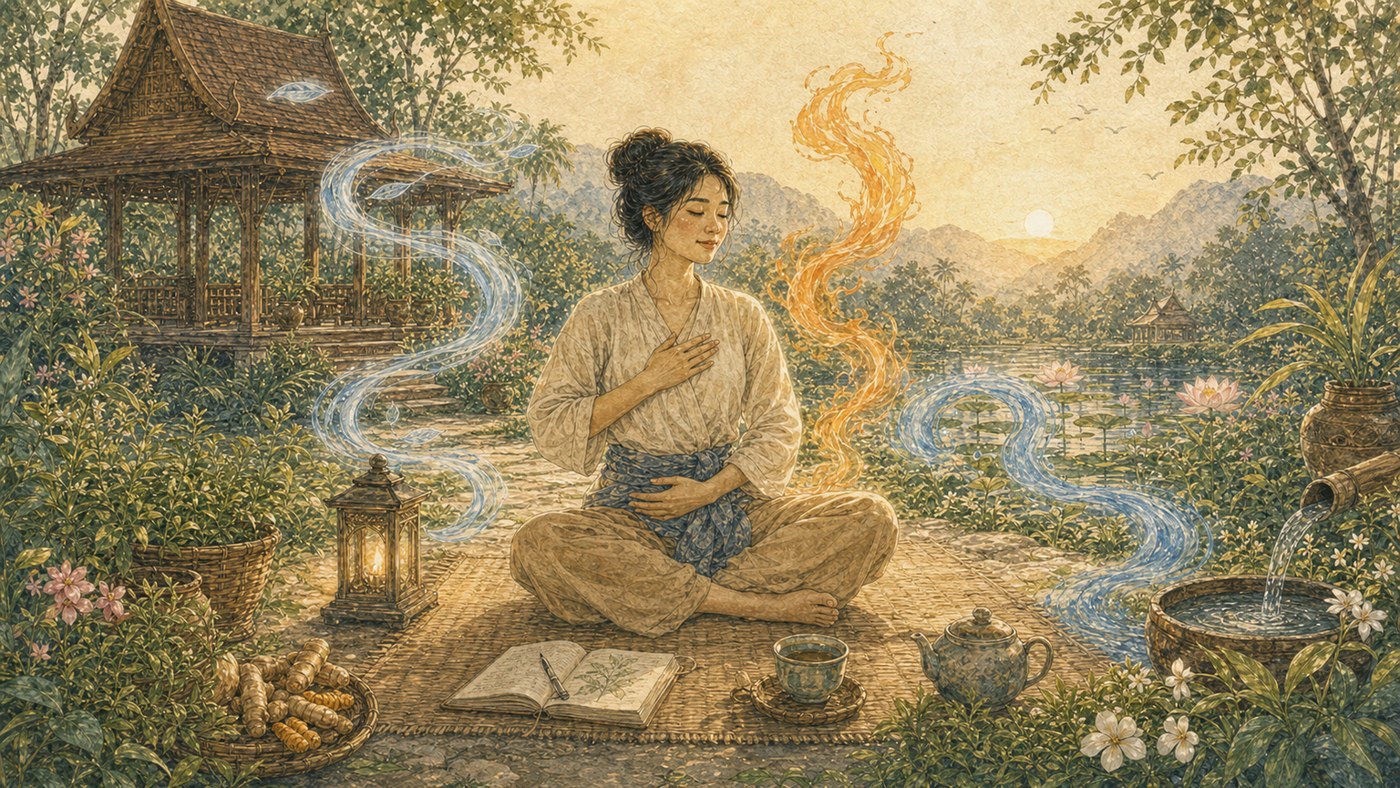
Before choosing a posture
Grandmother, 72, wakes on a cool morning feeling unusually light. A note prepared by the family says, “Water Type: brisk walking and jogging.” Should that note decide the morning?
Her balance, strength, usual activity, symptoms and surroundings matter more than the label. A gentle warm-up indoors, followed by an appropriately supported walk if suitable, may be a better beginning. Age or cool weather does not automatically diagnose “excess Wind,” but it can remind us to look again instead of following a fixed plan.
Three Ayurvedic concepts help organise this reflection: prakriti, constitution; vikriti, the present pattern of disturbance or imbalance; and bala, strength or capacity. We use them as a traditional framework, not as a validated exercise-screening test.
Constitution and current state
Prakriti refers to an enduring constitution in Ayurveda. In Plearnprai's accessible vocabulary, we may recognise Wind, Fire, Water or a mixed portrait. It is a background for understanding tendencies, not a guarantee of particular bones, hormones, organs or personality traits. Having moles, thin bones or a strong appetite does not by itself establish a constitution.
Vikriti describes the present departure from balance in Ayurvedic assessment. In everyday reflection here, we ask what is happening now: coldness, heat, hurry, heaviness, fatigue, irritation or ease. Weather, sleep, work, food, illness, medicines and life events can change our experience. They do not turn us into a new person or rewrite our constitution.
Plearnprai uses “Water” as an accessible comparison with Kapha. Traditional Kapha includes earth and water, with qualities such as heaviness, cohesion and stability. The names should not be treated as completely interchangeable systems.
New may identify as Wind Type while experiencing both restlessness and irritability during a period of late nights and heavy coffee use. Korn may identify as Fire Type yet need warmth and a gentler pace after a tiring journey in cold weather. Grandmother may identify as Water Type and still need the stability and support appropriate to her current function.
For a long-term plan, we can remember familiar preferences. For today's session, we give greater weight to current capacity, symptoms, conditions and response. A constitution never overrides a medical restriction.
Seven areas to notice this morning
These questions help us notice the present day. We do not total the answers to diagnose a dosha or clear ourselves for strenuous activity.
1. Skin and lips
Are they dry or cracked, unusually hot or red, or puffy? The traditional vocabulary associates these observations with Wind, Fire and Water respectively. A rash or swelling still needs its own explanation when persistent, new or concerning.
2. Digestion and bowel movements
Have bowel movements been hard or difficult, loose or frequent, or slow with a sense of fullness? Notice changes without assigning their cause from the pattern alone. Significant pain, dehydration or persistent changes require appropriate care.
3. Energy on waking
Do we wake with racing thoughts, strong hunger and urgency, or prolonged sleepiness? What was last night's sleep actually like? A busy mind and daytime fatigue can coexist.
4. Mood
Are we worried and uncertain, impatient and driven, or reluctant and low? Is that usual for us, or a noticeable change? The answer helps set the atmosphere of a session; it is not a mental health diagnosis.
5. Physical discomfort
Where does it hurt, how did it start and what makes it worse? Traditional descriptions distinguish moving aches, burning discomfort and heaviness. We do not use those descriptions to diagnose an injury or choose a posture through pain.
6. Temperature and thirst
Do our hands feel cold, are we uncomfortably hot, or do we feel comfortable? Are we drinking enough for the circumstances? Little thirst does not guarantee adequate hydration.
7. Breathing
Is breathing comfortable at rest? Does it feel hurried, strained or unusually difficult? Breathlessness at rest is not a “type” to exercise away. New or severe difficulty requires urgent assessment.
If we notice a generally unsettled pattern, we can explore a steady, comfortably warm practice. If we feel overheated, we can reduce heat and effort. If we feel well but reluctant to move, a small active beginning may help. When the picture is mixed, an easy walk or gentle supported mobility may be a useful option. When we are ill, dizzy or unusually weak, rest and assessment may be more appropriate than any of these choices.
Bala: the capacity available today
Traditional teaching describes three aspects of bala:
- Sahaja bala: inherent strength or constitution.
- Kalaja bala: strength considered in relation to time, age and season.
- Yuktikrita bala: strength cultivated through food, activity, rest and other care.
These distinctions invite us to notice both circumstances and what can be supported. They do not mean that a Water Type is always stronger than a Wind Type, that all older people are weak, or that strength cannot change.
Capacity varies within the same person. A rested, nourished day may allow a usual session. A tiring day may call for a shorter or easier one. Illness, recovery or severe emotional strain may call for rest or a specific plan.
Ask three simple questions:
- Sleep: did we have enough restorative sleep for our needs, or are we noticeably sleep-deprived?
- Food and fluids: have we eaten and drunk appropriately, or have meals been missed and intake been inadequate?
- Mind and body: do we feel reasonably settled, strained, or unusually depleted?
Good answers are not permission to train at maximum effort. Mixed answers can prompt a reduction, perhaps half the planned session as a practical experiment. Marked depletion calls for a much smaller practice or rest, and investigation if it persists or is severe. No day requires us to prove our discipline by ignoring illness.
A planning matrix
The times below are examples for someone already able to do the activities. Begin with less when needed; they are not minimum requirements.
| Today's experience | More capacity available | Moderate capacity | Very little capacity |
|---|---|---|---|
| Unsettled or cold, described as Wind-like | Gentle yoga about 30 minutes and an easy 20-minute walk if appropriate | A shorter yoga practice, perhaps 15 minutes | Five minutes of easy mobility, or rest |
| Overheated or driven, described as Fire-like | Comfortable swimming around 30 minutes or a shaded walk | An easy sheltered walk, perhaps 20 minutes | Sit comfortably in shade and let breathing settle, or rest |
| Well but heavy and reluctant, described as Water-like | Brisk walking up to 40 minutes and suitable resistance work | A manageable walk, perhaps 20 minutes | Gentle self-stretching up to ten minutes, or rest |
| Mixed or uncertain | Varied suitable movement around 30 minutes | An easy walk around 20 minutes | Five to ten minutes of comfortable mobility, or rest |
We are not trying to answer correctly. We are making a provisional choice and watching what happens. A person's illness, balance or rehabilitation plan can change every cell of this table.
One minute of listening before we begin
Sit or stand with support as needed. Keep the eyes open if closing them affects balance or comfort. Take about five unforced breaths, then ask:
- Does the body feel comfortably warm, cold or hot?
- Does the mind feel settled, busy or tired?
- Would a steadier, cooler or gently activating practice feel appropriate?
- Are we ready for activity, or is rest or advice needed first?
The plan is allowed to change. Listening does not mean that intuition can identify every illness; it means we give our present experience a place in the decision.
Korn's adaptable week
After discussing the earlier symptoms with the treating clinician, Korn begins to adjust a usual routine rather than repeat it rigidly.
| Day | What Korn notices | A possible adjustment |
|---|---|---|
| Monday | Rested and comfortable | Thirty minutes of suitable evening swimming |
| Tuesday | Poor sleep, work stress and skin discomfort | A gentler twenty-minute walk in a cool garden; review the skin problem as needed |
| Wednesday | Rain, cool weather and reluctance | Twenty minutes of manageable indoor resistance work |
| Thursday | Unusual fatigue and a heavy mood | Rest, with only five minutes of comfortable mobility if wanted |
| Friday | More energy and enough recovery | A suitable swim, perhaps forty minutes, or supervised family paddling with proper safety equipment |
These are options within an individual plan, not five obligations. Over the following months, the story describes a routine that Korn can sustain and better sleep. Changes in rash or palpitations remain matters for follow-up, not evidence that the elemental clock treated them.
What influences today's state?
Some circumstances are outside our control: weather, ageing, hormonal transitions, loss, travel or a change of job. We may still be able to alter clothing, setting, timing or dose. Other supports are partly within reach: regular meals, adequate fluids, sleep, activity, a manageable temperature and help with stress.
Not everyone controls their working hours, housing or access to food. “Care for what we can” is kinder and more realistic than “control everything.”
Traditional seasonal language describes heat as Fire-like, dryness and changeability as Wind-like, and cool damp heaviness as Water-like. We can translate that into practical adjustments: shelter from extreme heat, warm up in the cold, choose a non-slip route in rain and avoid unsafe air quality. Age does not prescribe one activity; actual ability and preferences matter.
Why keep the longer-term portrait?
A familiar constitution can remind us what we usually enjoy and what repeated patterns deserve attention. It may help us design a sustainable starting routine. Today's state then helps us adjust it.
Think of local prevailing winds, today's weather and the capacity of a boat. Knowing the usual wind is useful, but we still check today's conditions and the boat before leaving. The elemental portrait is one part of the conversation, not a navigation certificate.
New: more than a single label
New identifies as Wind Type, but three years of ten-hour screen days, four coffees a day, meals at irregular times and sleep at two in the morning have created a more complicated experience. There is restlessness, irritability and too little recovery.
Gentle yoga, walking and tai chi may provide steadiness. Shade, a comfortable temperature and a less competitive setting can reduce additional strain. Yet exercise cannot compensate for every pressure. Reviewing caffeine, protecting sleep and addressing work demands are also part of the plan. Palpitations or persistent sleep problems need appropriate assessment.
We can retain an enduring self-portrait without saying, “This is simply how I am, so nothing can change.”
Try it: a week of noticing
Spend a few minutes each morning with the seven observation areas and the three capacity questions. Choose a suitable small activity—or rest—and notice the response.
In the evening, record four short lines:
- What was most noticeable today?
- How much capacity seemed available?
- What did we do, and for how long?
- How did we feel afterwards and later in the day?
After seven days, look for patterns. Perhaps poor sleep matters more than the activity label, or a short walk suits a crowded day better than a missed long session. The notes are useful material to share with a professional if concerns arise.
What needs care
Do not decide a lifelong type from one morning. Several days of observation can reveal variation, but the exercise is still reflective rather than diagnostic.
During illness or recovery, do not use temporary symptoms to redefine constitution. Follow the care plan and return gradually.
Do not wait for an arbitrary three-day threshold when depletion is severe or accompanied by other symptoms. Persistent, unexplained fatigue warrants assessment; adding harder exercise is not the solution to every tired day.
Signs that we are finding our way
We may become more able to rest without guilt, adjust a session and recognise the influence of sleep, weather or work. Movement begins to serve our life rather than squeeze it. This makes us a more informed participant in our care, not our own replacement doctor.
Before we continue
Constitution is the enduring portrait, current state is what is happening now, and capacity is what we can safely bring to today's activity. With those distinctions in place, we can explore the three main movement approaches, beginning with Wind.
MOVEMENT BY THE ELEMENTS
Chapter 4 — Wind Type: Finding a Steadier Rhythm
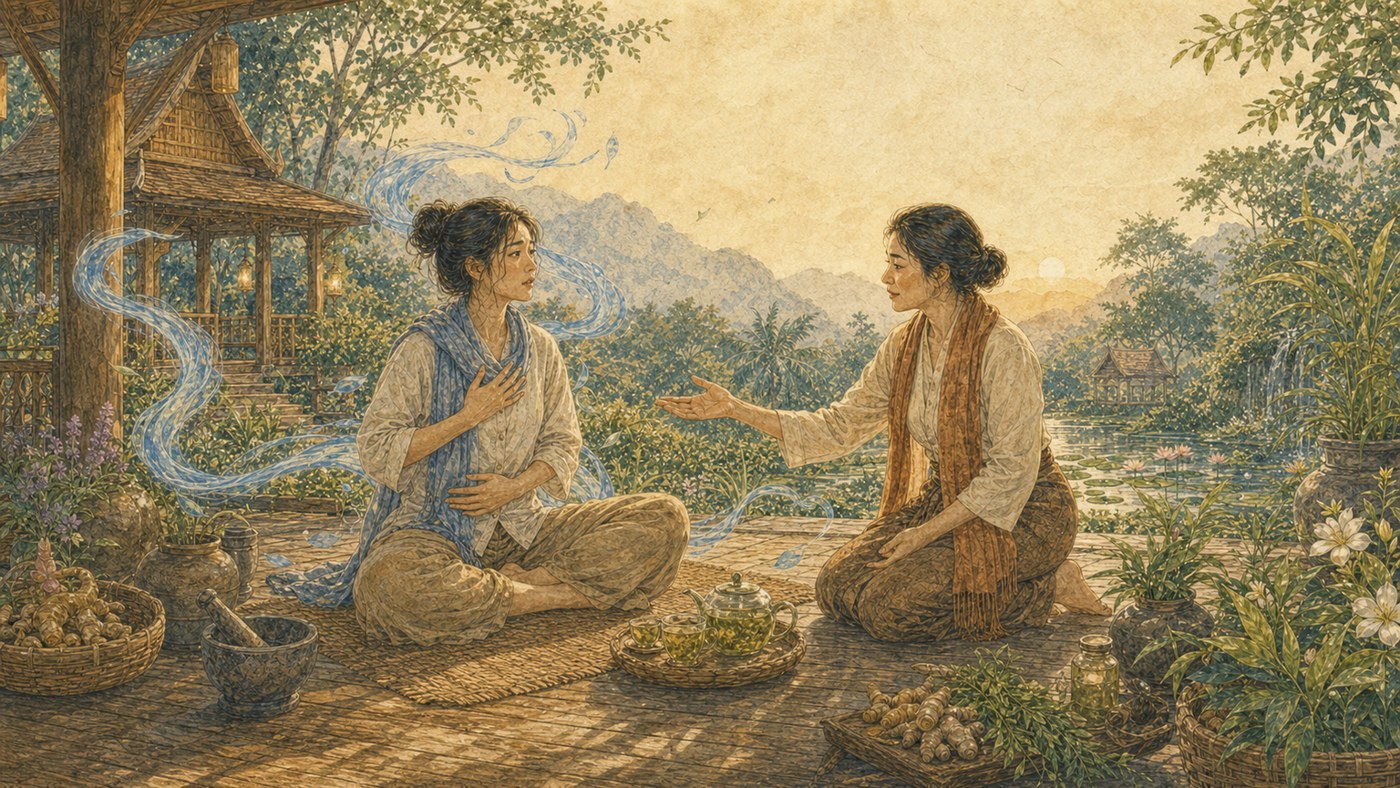
New's fear of being lazy
At 31, New spends long days designing at a computer. A five-kilometre running course becomes ten-kilometre events, followed by evening high-intensity interval training and, eventually, hot yoga. Each new activity seems to promise a better result.
Then come persistent left-knee pain, months of poor sleep, a pounding heartbeat at night and irregular periods. “If I stop running, I will become lazy,” New says, sounding more afraid of the label than of the accumulating symptoms.
These symptoms need medical review. Menstrual changes, in particular, should not be accepted as the normal price of training or explained by Wind. The story asks us to notice another problem too: a fear of stopping can make it difficult to respond to the body in front of us.
This chapter explores rhythm before the next chapter offers specific activities. Slowing a practice can be a deliberate form of care.
The Wind portrait
Ayurvedic descriptions of Vata emphasise coldness, dryness, lightness, subtlety and movement. Plearnprai's Wind portrait includes quick ideas, curiosity, sensitivity to surroundings and a changing sense of energy. Some readers recognise dry skin, cold hands or a tendency to feel unsettled when routines become irregular.
These are descriptions to reflect on, not a package of medical findings. A Wind Type does not necessarily have thin bones, hypermobile joints, rapid metabolism or poor muscle growth. If any of those concerns is present, it should be assessed on its own terms.
Quickness and openness can support creativity and learning. The same person may find a crowded, hurried day tiring. We can value those strengths while asking whether a quieter, more predictable movement routine would help.
Four patterns that can make movement difficult
Doing more than planned
A twenty-minute walk becomes an hour; a new running distance quickly becomes the next target. Enthusiasm can be delightful, but tendons, muscles, skills and recovery need time. We can decide the dose before we begin and resist turning a good day into an unplanned test.
Changing too often
Running, yoga and dance all have value. Trying everything at once can make it hard to learn technique or recognise what is helping. One or two familiar activities give us a base; variety can grow around them.
Catching up after a break
A difficult week interrupts practice, and the first session back becomes an attempt to repay the missed days. There is no exercise debt. Resume at an appropriate level and rebuild.
Choosing by fashion alone
A popular class may be fast, cold, loud or unpredictable. Those qualities may not suit a person who already feels overstimulated. We can consider the actual experience, not only the advertised benefits.
These patterns can occur in any type. The Wind portrait simply offers a useful place to examine them.
Four practical words
Comfortable warmth
Warm up gradually and choose clothing and a setting that let us move without shivering. Warmth can also describe an encouraging atmosphere. It does not mean an overheated room or forced sweating. The goal is comfort, not “adding heat” at any cost.
Regularity
A manageable routine is easier to return to than occasional exhaustion. Fifteen minutes that fits the day can be a better starting point than a two-hour plan that rarely happens. Daily gentle movement may be enjoyable; structured training also needs appropriate recovery and rest days.
A slower pace
Slower can mean smooth and attentive rather than inactive. We can feel a foot settle, complete a movement without jerking and allow breathing to remain comfortable. Tai chi and qigong offer examples of this quality. Strength training can also be controlled and unhurried.
A familiar base
Choose one or two activities we like enough to repeat. Allow a suitable routine time to become familiar. We need not remain with a practice that hurts or does not fit, and we can adjust it sooner. Consistency is not rigidity.
Timing that supports us
A comfortable morning
The Ayurvedic clock describes 6–10 a.m. as Kapha time, associated with steadiness. For some people, a morning routine helps reduce the need to negotiate with themselves later. In a cold setting, waiting for daylight and a comfortable temperature may be sensible; around 7–9 may work in parts of Thailand. It is not a universal prescription. A safe afternoon practice is better than sacrificing necessary sleep for an idealised morning.
Neither uncomfortably hungry nor overfull
A small snack, such as a banana or a little porridge, may suit some people before activity. An interval of thirty to forty-five minutes is one possible starting point, but tolerance, meal size, intensity and a diabetes care plan can change the timing. Do not exercise through shakiness, dizziness or suspected low blood glucose. A large meal may need more time before a demanding session.
Arriving comfortably warm
If bathing before activity, choose a comfortable temperature and allow time to warm up. Avoid prolonged chilling or abrupt temperature exposure that makes us feel unwell.
Protecting sleep
Some people find a demanding late session interferes with sleep; others tolerate evening exercise well. Notice our own response. If late effort leaves us activated, try an earlier session or a gentler evening walk or stretch. There is no blanket rule that all activity between 6 and 10 p.m. is harmful.
How much effort is enough?
For an easy-to-moderate starting practice, we should be able to speak comfortably. The talk test gives a rough guide: being able to talk but not sing often corresponds to moderate effort; only a few words at a time suggests vigorous effort. Easy activity, during which singing is possible, still has value.
Look beyond the session. Are we recovering? Is pain settling appropriately? Do we have energy for ordinary life? Persistent exhaustion, palpitations or pain are reasons to review the plan, not a sign that we have trained successfully.
A setting that helps us settle
Choose a comfortable temperature, shelter from strong wind when needed and a surface suitable for balance and footwear. A quiet class, natural sounds or a less crowded space may feel better than loud music and shouted encouragement.
“Grounding” here means noticing support and contact with the surface beneath us. Bare feet are optional, not a health requirement. Use footwear where there are sharp objects, heat, infection risks, neuropathy or other foot concerns. A stable indoor surface can be as useful as grass; uneven ground may be less safe.
Try it: five questions about our rhythm
- How often do we intentionally move, and what everyday movement already happens?
- Is the usual session easy, moderate or hard for us personally?
- Do we generally feel supported afterwards, or repeatedly depleted?
- How often do we change the main activity?
- When stress rises, do we automatically increase training, stop altogether or adjust thoughtfully?
A pattern of infrequent hard sessions, repeated exhaustion and frequent restarts suggests that the routine needs attention. It does not tell us that we are undisciplined. We can make the next session smaller and more predictable.
What needs care
Stopping and changing are allowed. There is no evidence that suddenly stopping a daily run “shocks the nervous system.” If we are well and changing a routine, a gradual transition may be comfortable. If an activity causes dizziness, palpitations, shakiness or acute pain, stop it and seek appropriate assessment rather than tapering through symptoms.
Do not turn rest into a moral failure. Doing less can be accurate care. People who cannot exercise, or who need complete rest, are not lazy either.
Act on concerning signals. New or severe symptoms deserve timely attention for every type. Do not wait for the body to “speak louder.”
Signs that we are finding our way
Over the following weeks, we may notice better recovery, more comfortable sleep and less pressure around practice. We may look forward to a familiar activity. Warm hands or a change in menstrual timing is not proof that elemental balance has been restored; persistent problems still need care.
Before we continue
Comfortable warmth, regularity, a slower pace and a familiar base can create a useful Wind-oriented starting routine. Next we turn these ideas into a menu of activities, an adaptable week and a seven-minute morning sequence.
MOVEMENT BY THE ELEMENTS
Chapter 5 — Activities and Movements for Wind Type
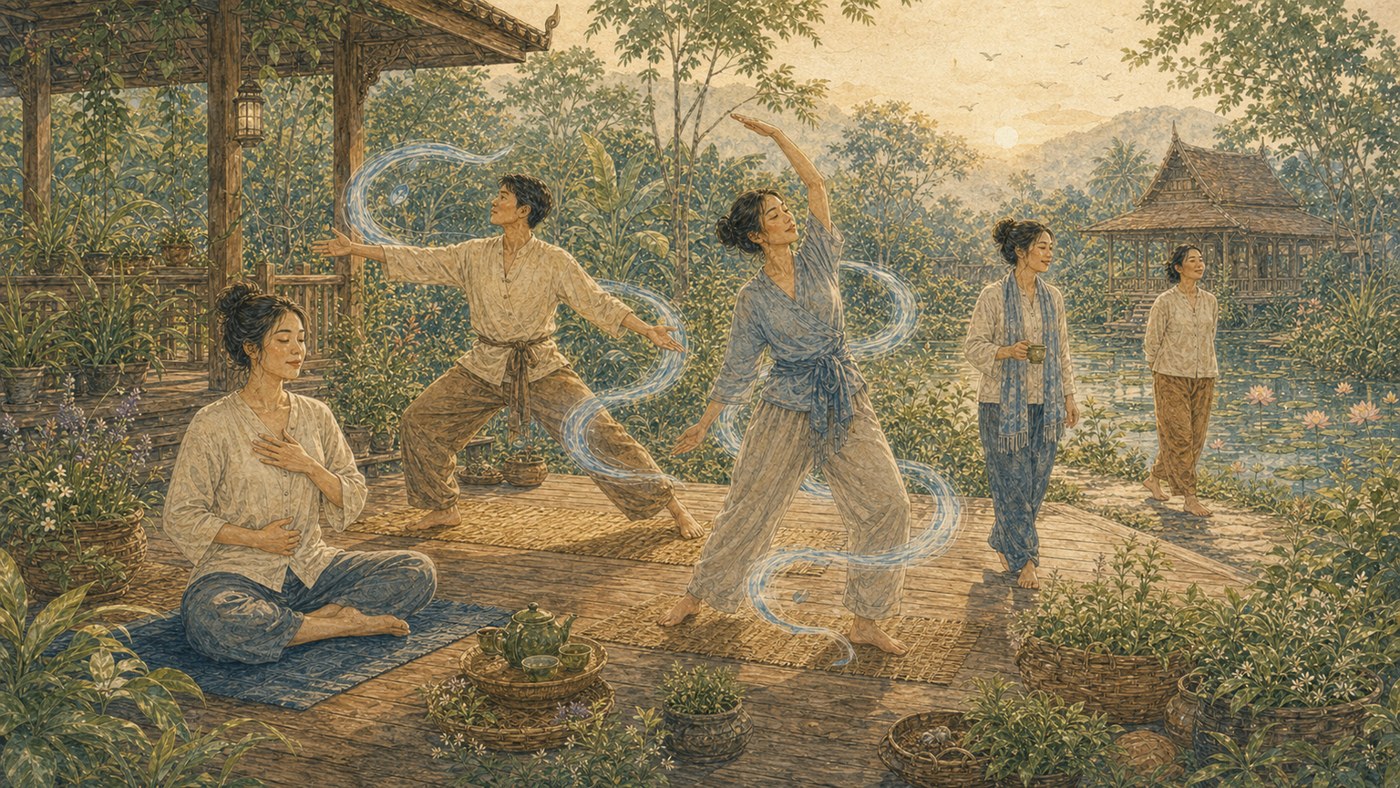
A quieter evening for New
After reviewing the earlier symptoms and plan, New takes a four-week pause from hard running. One evening, a slow half-hour walk in the garden replaces another demanding session. There is time to notice leaves, distant traffic and the ordinary sound of breathing.
In the story, that night brings the first restful sleep in months. One good night does not prove a treatment effect, but it gives New a reason to explore a quieter rhythm. We can hold that possibility without expecting the same response from every reader.
A menu of steady activities
Easy walking
Walk at a conversational pace on a clear, suitable route. A sheltered garden, a familiar street or an indoor path may work. Twenty to thirty minutes is one example; a shorter walk can be enough to begin. We do not have to make it a race or earn a score.
Swimming in comfortable water
A comfortably warm pool may make smooth movement enjoyable. Use a supervised setting, stay within swimming ability and avoid breath-holding challenges or deep diving. The sea is not interchangeable with a pool: currents, waves, water quality and access all matter. If we become cold, dizzy or unusually breathless, get out safely and seek help as needed.
Gentle yoga
A beginner hatha class may offer slower postures and time to learn. Restorative yoga uses cushions, blankets and other support for comfortable rest. Yin yoga often holds positions for several minutes; long passive stretches are not automatically suitable, especially with hypermobility, injury or osteoporosis. We can use a shorter, supported position or choose another practice.
A class name does not tell us its intensity. Ask the instructor about adaptations. Hot yoga carries overheating and dehydration risks; a fast vinyasa or full Ashtanga sequence may be more demanding than a reader currently needs. This is a matter of individual readiness, not a ban based on type. Plearnprai’s Yoga by the Elements companion is a development project; check the library for availability. [2]
Tai chi
Slow weight shifts, turning and attention to foot placement can provide a steady practice. Fifteen to twenty minutes is an example once comfortable. A beginner teacher can adapt stance depth and balance demands; learning a short sequence is more useful than forcing a full twenty-four-form routine from a video.
Qigong
Qigong may use simpler repeated movements coordinated with attention and breathing. Its traditional language concerns qi, or vital energy. We can value the practice without treating qi as a measured biomedical substance. Keep the breath unforced and use support if balance is uncertain.
Manee Vej
This Thai movement approach offers gentle self-care sequences. Learn from a suitably trained teacher and adapt for actual joint or spinal conditions. It should not be presented as a miraculous structural correction, or selected on the assumption that all Wind Types have loose joints or thin bones. The planned Manee Vej by the Elements guide is a development project.
Beginner Pilates
Controlled work on trunk strength and coordination may suit some readers. Both mat and equipment-based Pilates can be gentle or demanding; the instructor's choices matter more than the equipment name. If joints are hypermobile, a physiotherapist or experienced instructor can help us practise control without repeatedly reaching the end of range.
Gardening
Watering, tending soil and collecting leaves can connect movement with an immediate purpose. Vary posture, use suitable tools and avoid prolonged uncomfortable bending. Thirty minutes in a garden may feel settling, but it is not scientifically equivalent to a yoga class.
Cooking by hand
Chopping, mixing, kneading, shaping dumplings or wrapping food can bring attention to a rhythmic task. Thai examples include pounding chilli paste, shaping bua loi rice-flour balls and wrapping khao tom mat. We can choose a manageable task, use safe technique and alternate positions. Ordinary kitchen movement has value without replacing all strength or aerobic work.
More demanding options need individual planning
Distance running: a Wind label does not establish a ten-kilometre danger threshold or a universal three-to-five-kilometre safe distance. Training history, energy intake, injury, menstrual health and recovery matter. If running is something we love, build gradually and seek advice when pain, unusual fatigue or menstrual changes occur.
High-intensity interval training: intervals alternate harder work and recovery. They do not always require maximum effort, but intense versions need suitable preparation. A depleted or symptomatic day is not the time to force them.
CrossFit or similar mixed training: loads, impact, pace and competitive pressure can vary widely. A qualified coach should scale the programme to ability. We are allowed to opt out of a timed contest.
Hot yoga: heat and dehydration risks apply to every type. Dizziness or palpitations are stop signals. Do not use sweating as evidence of detoxification.
Cycling in strong wind: consider traffic, handling, temperature and route safety. Shelter, layers, a helmet and a manageable pace may help; severe conditions may mean staying indoors.
Cold-water swimming: cold can affect breathing and cardiovascular strain. A wetsuit is not a substitute for preparation, supervision and suitable health advice. Choose comfortable water rather than using an elemental label to decide safety.
An adaptable sample week
This is a menu for a person who can already manage the listed activities. We may choose one item, shorten it or rest. The times of day are examples, not requirements.
| Day | Morning | During the day | Evening |
|---|---|---|---|
| Monday | Gentle yoga, 20 minutes | Easy ten-minute walk after a meal if comfortable | Ten minutes of easy stretching |
| Tuesday | Garden walk, 25 minutes | Break up long periods of sitting | Cook a manageable meal by hand |
| Wednesday | Tai chi, 20 minutes | Easy ten-minute walk | Garden activity, 20 minutes |
| Thursday | Suitable supported yoga, up to 25 minutes | Regular movement breaks | Easy stretching, ten minutes |
| Friday | Comfortable-water swimming, 25 minutes | Easy ten-minute walk | Rest or a short walk |
| Saturday | Garden walk, up to 40 minutes | Rest | Suitable Manee Vej or mobility, 15 minutes |
| Sunday | Restorative practice, up to 30 minutes | Rest | Family walk, 20 minutes |
A familiar morning practice can provide a useful anchor, with smaller movement breaks through the day. Complete rest is allowed when needed; we do not require daily exercise to prevent a supposed Wind imbalance. If the whole table is too much, choose a few brief sessions and build from there.
Try it: a seven-minute morning sequence
Use a comfortable room and a stable chair. Breathe naturally through the nose or mouth as needed. Move within an easy range; skip a movement if it is unsuitable for a known condition.
Minute 1 — arrive. Sit on a chair or safely at the bed's edge, feet supported. Take three unforced breaths. Keep the eyes open if that feels better.
Minute 2 — gentle neck movement. Slowly turn the head a little to the right and left, then return to centre. A small comfortable tilt can be added if suitable. Avoid full neck circles, forceful extension or any movement that causes dizziness, pain or tingling.
Minute 3 — shoulders. Roll the shoulders gently up, back and down, then reverse if comfortable. About five small rolls each way is enough; a large circle is unnecessary.
Minute 4 — an easy turn. Sitting tall, turn the trunk slightly to one side without pulling on the knee or forcing the spine. Pause for up to three comfortable breaths, return and repeat. If twisting is restricted—for example by a spinal condition or osteoporosis advice—omit it or use a clinician-approved alternative.
Minute 5 — side length. Raise one arm only as high as comfortable and make a small side bend without collapsing or holding the breath. Pause briefly, then change sides. Keep both sitting bones supported.
Minute 6 — hips or seated weight shifts. Stand with support if safe and make small, comfortable hip circles, perhaps five each way. Otherwise stay seated and gently shift weight from one sitting bone to the other. Stop if balance or pain becomes a concern.
Minute 7 — finish. Stand supported or remain seated. Feel the contact beneath the feet, take three easy breaths and notice how we feel. There is no need to make the breath deeper than comfortable.
Repeating a suitable short sequence can make starting easier. We can also shorten it to one or two movements on a busy morning.
What needs care
Bone health: a type does not diagnose osteoporosis. If we have low bone density or fracture risk, obtain an appropriate strength, balance and impact plan; some spinal bending and twisting movements need modification.
Joint stability: hypermobility can require strength and control rather than more stretching. Avoid forcing an end range simply because we can reach it. Use a controlled, comfortable range and seek individual guidance when a joint feels unstable.
Starting dose: begin conservatively, especially with an unfamiliar practice, and increase according to response. We need not assume that a quiet-looking class is easy for our body.
Signs that we are finding our way
Over time, we may feel more comfortable after movement, recover well, sleep more easily or want to return to familiar practice. These are observations, not guaranteed outcomes within two to six weeks. Warm hands, digestive changes or regular periods should not be used as proof of corrected circulation or hormones.
In New's teaching story, the gentler routine becomes a pleasure. Medical symptoms remain part of appropriate follow-up, while the daily walk offers something the training score did not: a practice that fits.
Before we continue
We have moved from the qualities of a Wind-oriented practice to concrete choices and a short sequence. Next we visit Fire. Even if Wind is our familiar portrait, the next chapters may help us understand a partner—or a day when our own life feels unusually heated and driven.
MOVEMENT BY THE ELEMENTS
Chapter 6 — Fire Type: Making Room for Ease
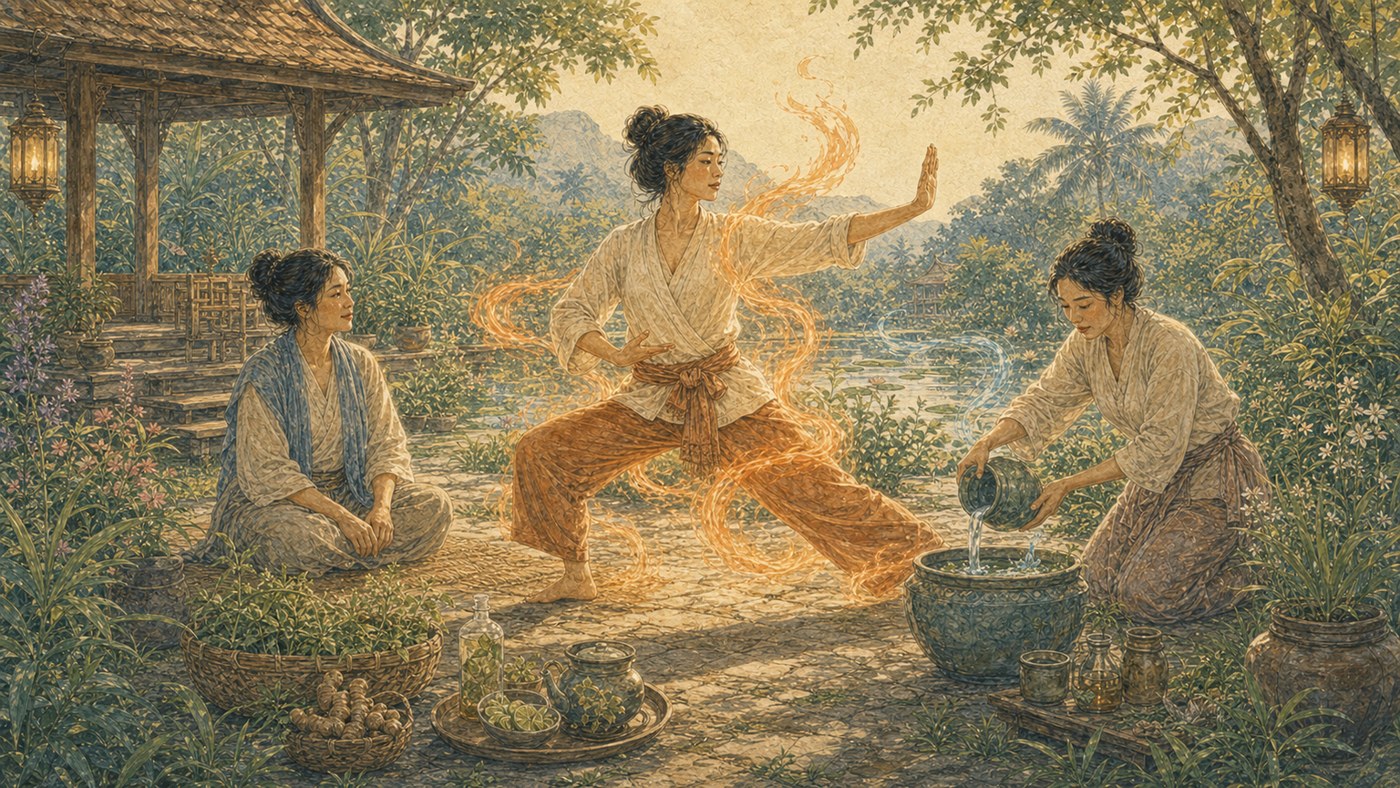
The treadmill that never switches off
Before six on Monday morning, Korn, 45, selects a demanding treadmill programme. A major client may leave; sleep has been poor. “If I run until I am exhausted, the stress will disappear.”
An hour later, Korn steps off soaked in sweat and pleased with the effort. Back upstairs, however, the heart keeps pounding. A rash appears around the neck and chest, hunger feels urgent and irritation spills into a conversation at work. That evening, Korn asks, “Why do I feel more heated when exercise is supposed to help?”
Persistent palpitations after exercise call for assessment, not an elemental explanation. Alongside that care, the story invites a different approach: movement does not have to become another battle. Fire is a metaphor for energy that can be expressed with less pressure.
The Fire portrait
Plearnprai's Fire portrait includes focus, determination, readiness to solve problems and a strong sense of fairness. When these qualities have room, they can support warm leadership and humour. Under strain, the same person may become impatient, sharply self-critical or reluctant to stop.
Some readers also recognise feeling warm, sweating readily or becoming uncomfortable when meals are delayed. These experiences do not establish a particular hormone profile, digestive strength or inflammatory condition. Rashes, hair changes, persistent hunger and heat intolerance can have other causes.
The purpose of the portrait is recognition without confinement. We may identify with part of it and leave the rest.
Five traps around exercise
Everything becomes a contest. We compare with a friend, yesterday's result or the app's leaderboard. Physical effort ends, but the demand to win continues.
Determination overrides readiness. A person can keep going despite poor sleep, pain or inadequate recovery. That ability is not evidence that the session is safe.
The setting adds unnecessary heat. Midday sun, poor ventilation or a hot class can increase heat stress. This matters for everyone, not only Fire Types.
Stop signals are negotiated away. Dizziness, unusual palpitations, marked thirst or feeling unwell become “just one more minute.” We need a plan to respond before that argument begins.
Exercise becomes proof of worth. We train to prove strength, youth or superiority. The same activity may feel different when it is an opportunity to practise a skill, enjoy company or care for ourselves.
None of these traps belongs exclusively to Fire. They are simply useful questions for a person who recognises an intense or competitive pattern.
Four qualities to practise
Comfortable coolness. Choose shade, airflow and suitable clothing. A cooler morning or evening may work better than midday heat. Cooling means avoiding excessive heat, not seeking cold shock.
Less competition. We can hide a leaderboard, leave the stopwatch aside or choose a session without a personal record to beat. If monitoring is part of a clinical plan, keep it; letting go of comparison does not mean abandoning necessary safety information.
Release. Movement can give tension a constructive place to go. “Releasing Fire” describes that experience, not a mechanism by which sweat removes reflux, migraine or inflammation. We can notice whether the session leaves us more able to return to life.
Kindness. Speak inwardly as we would to someone we care about. Rest between efforts. Reduce a session when needed. “Enough for today” can be a skilful decision.
Timing: work with the actual day
Traditional Ayurvedic teaching associates the middle of the day with Pitta. In a hot Thai climate, early morning and late afternoon may also be more comfortable for practical reasons. Before about nine in the morning or around five to seven-thirty in the evening may be convenient, provided the actual conditions are suitable.
These are not rules for every climate or schedule. Check heat, humidity, daylight, air quality and sleep. A noon session in a safe temperature-controlled room can be preferable to a hazardous outdoor dawn route. If conditions are very hot, reduce or postpone activity rather than assuming shade and a drink make the same session safe.
Late exercise affects people differently. If a hard session after eight leaves us too activated to sleep, try moving it earlier or making the evening session gentler. We do not need to forbid all evening movement.
Effort: a dose we can recover from
The FITT-VP framework asks about frequency, intensity, time, type, total volume and progression. For a reader returning from strain, moderate or easy effort may provide a useful starting point. We can use the talk test and our agreed care plan rather than sweat or pride as the measure.
Take breaks before fatigue disrupts technique. Pause for fluids when appropriate and resume only if comfortable. Continuous exercise and intervals can both be valid; choose the pattern that fits our fitness, health and recovery.
Regular physical activity has health benefits, but being a Fire Type does not establish high inflammatory markers. A hard session's temporary physiological response is not proof that Fire has accumulated. The clinical question is whether the programme fits health, goals and recovery.
Duration and frequency
One established routine might involve roughly thirty to forty-five minutes including warm-up and cool-down, perhaps four to six days a week. This is not a type-specific safe limit. A beginner may start with far less; a trained person may appropriately do more.
A twenty-minute morning session and a twenty-minute evening session may fit a day better than one longer block. Keep recovery in the plan. A rest day does not have to become another hard activity under a different name. An easy stroll is optional; genuine rest is allowed.
The atmosphere around us
Water, trees and a comfortable room can make a practice pleasant. A shaded park offers shelter and a change of attention. Water sounds or a pool may feel calming. Neither the sight of water nor a post-exercise shower guarantees that heat illness has been prevented.
Choose ventilation and temperature for comfort. Avoid adding a hot yoga class or sauna to an already demanding hot-weather session. Strong lighting or music is not medically harmful merely because it feels “Fiery,” but if it increases our urge to push, a quieter setting may help. Birdsong, a gentle rhythm or ordinary silence are alternatives.
Try it: a three-minute check before moving
Sit or stand comfortably, with support if needed. Take three ordinary breaths. Eyes may stay open.
How is the mind? Are we entering the session to enjoy movement, or to defeat someone—even ourselves? If anger is driving the plan, choose a lower-risk, less pressured activity.
How is the body? Is there residual fatigue, pain, illness or unusual heat? Do not automatically stretch a painful area. Rest or an appropriate assessment may be needed.
What capacity is available? A private one-to-ten rating can help us notice a change, but no score clears us for maximum exercise. If we feel depleted, shorten the session or rest; if we feel well, stay within a suitable plan.
These minutes are not a guarantee against injury. They give us a chance to make a considered choice before momentum takes over.
What needs care
Recovery cannot be washed off. A shower does not replace rest, food, fluids or sleep. Repeated hard sessions with poor recovery deserve a programme review. A rash, reflux or migraine should not simply be attributed to accumulated heat.
Anger can affect judgement. Heavy lifting, contact sport or fast running may be risky if we are distracted or intent on punishment. A walk, gentle swim or quiet practice may be a safer choice that day; persistent distress may need more support than exercise alone.
Hydration is individual. Drink appropriately for the activity, weather and any clinical fluid advice. A fixed drink every fifteen minutes is not right for everyone, and excessive drinking can also be harmful. Choose a comfortable temperature; water does not need to be warm or cool because of a type. [3]
Signs that we are finding our way
After movement, we may feel able to settle rather than compelled to continue. Through the day, we may notice more patience and enough energy for ordinary tasks. Over time, the practice may become something we want to return to without having to win.
Rash clearance, reduced reflux or migraine relief are not promised milestones. If those problems are present, continue appropriate care and judge their course separately.
Before we continue
A Fire-oriented practice makes room for effort without unnecessary heat or competition. Next we explore swimming, nature walks, cycling, gentle yoga and other ways to put those qualities into practice, together with a breathing exercise that remains optional and unforced.
MOVEMENT BY THE ELEMENTS
Chapter 7 — Activities and Movements for Fire Type
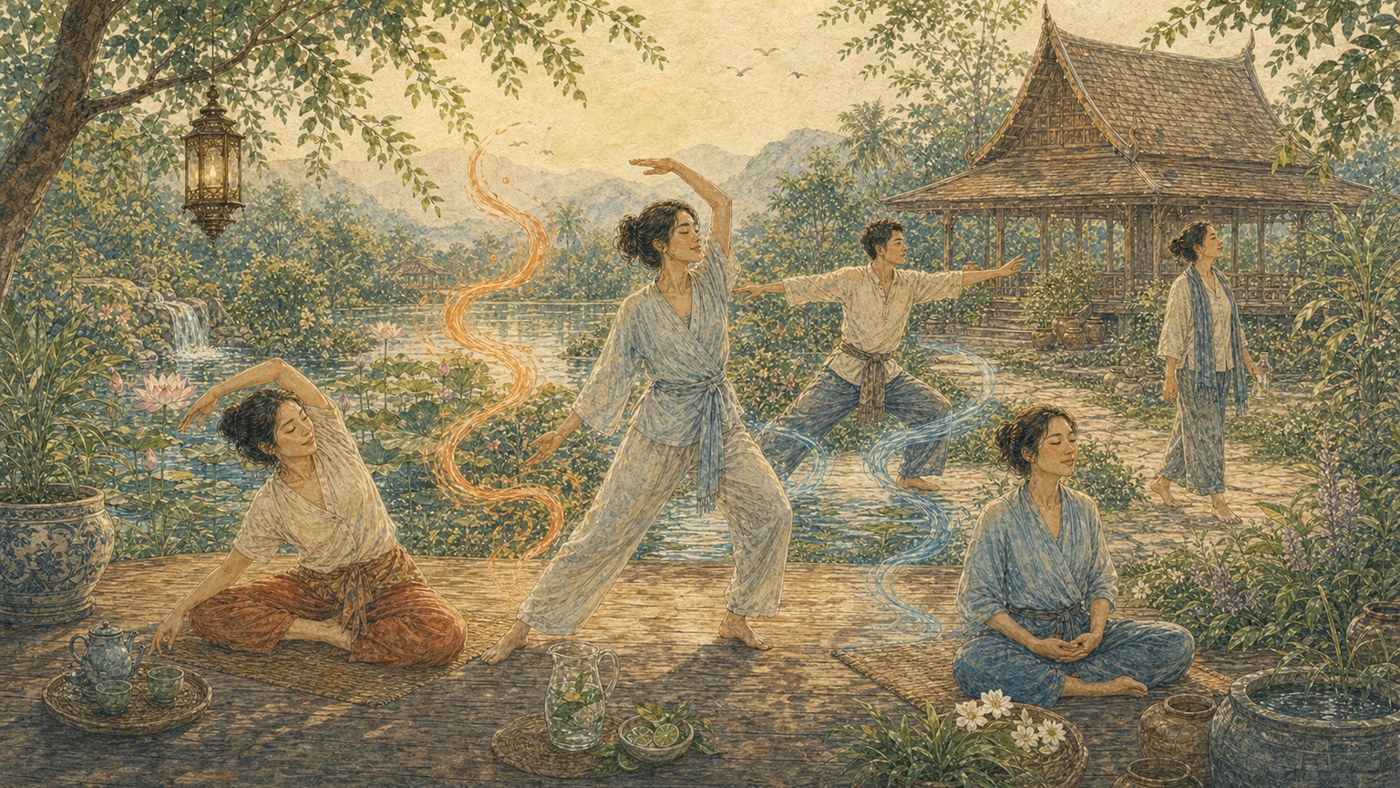
Korn tries a different experiment
Korn gives a revised routine three months. Evening swimming replaces hard morning treadmill sessions. At first, every length is timed. By the fourth or fifth visit, the watch stays aside and attention shifts to technique and the sound of water.
The change is not instant. In the teaching story, Korn gradually feels less irritable after exercise and sleeps more comfortably. A child invites Korn to play table tennis on Saturdays; this time the game is for enjoyment. Skin symptoms and palpitations remain matters for the treating clinician, rather than proof that swimming has treated them.
The experiment offers a simple possibility: we can keep movement and let go of some of the battle around it.
A menu to choose from
Swimming in comfortable water
A pool can make movement feel smooth and less overheated. Choose a supervised setting, suitable water temperature and a dose within our swimming ability. Thirty to forty-five minutes with breaks is an example for an established swimmer; begin with less when appropriate. Rest where we can stand or hold a safe support rather than relying on floating if that is unfamiliar.
We can explore technique instead of speed: an easier stroke, a comfortable breathing pattern or less unnecessary tension. Do not hold the breath for a challenge. Lakes, canals and the sea bring different hazards and are not automatically safe alternatives to a pool.
A shaded nature walk
Choose a clear route suited to our balance and fitness. We can notice leaves, bark and sounds, pause in shade and allow the walk to be more than a timed distance. A twenty-minute park visit may fit a weekday; a longer weekend outing, perhaps forty-five minutes or more with rests, needs appropriate preparation.
Shinrin-yoku, often translated as forest bathing, describes attentive time in nature. It may feel restorative, but it is not a replacement for blood-pressure care or a proven Fire-specific treatment. Uneven ground, insects, heat and access still need consideration.
Cycling under trees
A shaded route or comfortable indoor stationary cycle can reduce unnecessary heat exposure. Wear a helmet outdoors, choose safe traffic conditions and use manageable gears. We need not turn every hill into a test. Strong wind, rain and poor air quality can change the plan.
Gentle yoga and moon salutations
Chandra Namaskar, a moon-salutation sequence, has several modern forms. Some use slower side-to-side movements and a quieter atmosphere than a vigorous sun-salutation class. Learn a version that suits the joints and balance from a qualified instructor; the name alone does not guarantee gentleness.
Supported restorative practice may be another option. Long Yin holds are not automatically appropriate for hypermobility or injury. Hot yoga adds heat and dehydration risks; a Fire label is not needed to decide that an unheated class may be more suitable. [2]
Qigong
A small space can hold a simple sequence of comfortable arm movements, weight shifts and unforced breathing. Ten minutes is one possible beginning. Traditional qi language can guide imagery, but we need not force a sensation of energy or make the breath unusually deep. Plearnprai’s tai chi and qigong guide is a development project.
Tai chi
Tai chi offers continuous sequences, controlled shifts of weight and attention to posture. A beginner class can adapt stance depth, turning and support. Its slower pace may appeal to a reader who habitually rushes. It does not guarantee longevity or make every participant more patient.
Paddling
Kayaking or suitable paddle activities can combine movement with time outdoors. Use a properly fitted buoyancy aid, trained supervision or competent companions, weather checks and a route within ability. Calm-looking water still has hazards. A sheltered pool activity may be a better alternative when balance, swimming skill or access is limited.
Table tennis for pleasure
A casual game can alternate short movements and pauses while keeping us connected to a child, partner or friend. We can leave the score aside, adapt the pace and keep the floor clear. Enjoyment is a legitimate goal.
Other possibilities
A walk near a safely fenced pond, a morning market visit, shaded gardening, gentle indoor badminton or suitable rue-si dat-ton can all fit. Choose one to three activities we can return to rather than trying to complete the whole menu.
Activities that deserve another look
Midday running, long exposed cycling routes and hot yoga can add considerable heat load. A demanding interval class, heavy lifting or contact sport may require more preparation and recovery than we currently have. If a leaderboard or shouted encouragement makes us ignore symptoms, change the environment or the rules of participation.
These are not lifelong prohibitions based on constitution. Nor is fifteen minutes of “light HIIT” once weekly a universal safe dose. Programme design should reflect actual health, skill, fitness and goals. Do not use vigorous exercise as punishment when angry or distressed.
Korn's sample week
This is a worked example for an established participant, not a beginner target. Longer outings include pauses and can be shortened substantially.
| Day | Example time | Activity | Example duration |
|---|---|---|---|
| Monday | Late afternoon | Comfortable pool swim | Up to 40 minutes |
| Tuesday | Morning | Simple qigong and easy walking | About 30 minutes |
| Wednesday | Early evening | Shaded or indoor cycling | Up to 45 minutes |
| Thursday | Early evening | Suitable gentle moon-salutation or supported yoga practice | Up to 50 minutes, including rests |
| Friday | Any time | A genuine rest day; ordinary easy movement if wanted | No scheduled session |
| Saturday | Cool daylight hours | A prepared nature walk | Up to 90 minutes with pauses |
| Sunday | Comfortable afternoon conditions | Casual table tennis and a short swim, or just one | Up to 60 minutes in total |
The pattern includes water-based activity, slower practice, rest, nature and time with family. None is an elemental quota. When we feel ill, unusually fatigued or symptomatic, do not simply swap one demanding activity for another. Rest or advice may be the right adjustment.
Try it: an optional cooling-breath practice
Shitali is a traditional yoga breathing practice associated with a cooling sensation at the mouth. It is not treatment for fever, heat exhaustion or an asthma attack, and it has not been established as a rapid method of cooling the blood or core temperature.
- Sit comfortably on a chair or cushion, shoulders easy and feet supported if on a chair.
- If the tongue naturally curls, gently form a loose tube and extend it a little beyond the lips. If it does not, there is no need to force it. The related sitkari practice allows air through slightly parted teeth; keep the jaw relaxed, without biting the tongue.
- Take a small, slow, comfortable breath through the mouth. Do not pull air in deeply or quickly.
- Close the mouth gently and breathe out comfortably through the nose if clear, or normally if not. Do not hold the breath.
- Try two or three cycles, then return to ordinary breathing. If comfortable and taught appropriately, we may explore a few more—perhaps eight to twelve cycles—without forcing a five-minute session.
- Sit briefly and notice the experience. Stop if dizzy, tingling, breathless, chilled or uncomfortable.
Ordinary quiet breathing is always an alternative. If we have a respiratory condition, recurrent faintness, low blood pressure or another condition affected by breathing exercises, ask for suitable guidance. Skip the practice during an asthma flare, respiratory illness or cold conditions that irritate the airways. Do not substitute it for prescribed treatment.
What needs care
Do not stack demanding sessions without recovery. A hot run, long cycle and hot yoga class in one day may be a poor plan even if the calorie count looks impressive. Review the whole day's load.
Drink appropriately. Water is often sufficient for an ordinary short session. Coconut water or sweet herbal drinks are optional foods, not Fire-specific rehydration treatments; sugar, potassium, kidney conditions and medicines may matter. Follow individual fluid advice when given. [3]
Breathing does not make heat exposure safe. If midday is the only available time, a suitably cooled indoor setting or a shorter easy practice may be preferable. Shitali after exercise does not compensate for overheating.
Signs that we are finding our way
We may recover comfortably, feel less driven to continue, enjoy family activity and sleep well enough to return. These are possibilities to observe over time, not promised changes in an hour, a week or three months. Persistent rash, reflux, migraine or palpitations still needs appropriate care.
Further practice
Plearnprai’s planned guides on tai chi, qigong and breathing by the elements are development projects; check the library for availability. A suitable local instructor can help us learn safely in the meantime.
Before we continue
Water, shade, a manageable effort and a less competitive atmosphere provide many options for a Fire-oriented practice. Next we visit Grandmother and the Water portrait, where the challenge may be finding a supported beginning rather than reducing an already excessive pace.
MOVEMENT BY THE ELEMENTS
Chapter 8 — Water Type: A Supported Beginning
“I am tired. I will stay home.”
On Saturday morning, Grandmother's daughter arrives to invite her to the market. Grandmother, 72, is sitting on the bed with a blanket over the legs. “I am tired. I will stay home.”
Over the past month, outings have become rare. Most movement is between the bedroom, bathroom, kitchen and favourite chair. There is increasing difficulty standing, evening leg swelling and persistent fatigue.
Those changes need assessment. The family cannot know that Grandmother is merely reluctant because she has not visibly done much. Heart, lung, metabolic, medication, sleep, mood and other problems can contribute to fatigue or swelling. We do not respond by insisting on a brisk walk.
Once appropriate care and a safe starting plan are in place, a different question becomes possible: would a small supported outing help Grandmother reconnect with daily life? Inactivity can contribute to loss of function, but the answer is careful, individual movement—not blame.
The Water portrait
In Plearnprai's Water portrait, steadiness, patience, loyalty and a capacity to care for others are central. Some readers recognise a preference for familiar places, an unhurried pace and a body that feels solid or heavy. Under strain, beginning something new may feel difficult and withdrawing may become easier than engaging.
These observations do not diagnose slow metabolism, mucus accumulation, insulin resistance or unusually dense bones. A larger body is not proof of a constitution, and Water Types are not inherently lazy. A person who seems quiet may be in pain, depressed, sleep-deprived or managing an invisible illness.
The useful question is how to make a suitable beginning easier while respecting what the person is experiencing.
Three obstacles to beginning
Comfort can become the only available option
A familiar chair, a predictable television programme and the effort of getting dressed can make an outing feel distant. Instead of arguing about motivation, reduce the practical barriers: a nearby route, suitable shoes, transport, a companion and permission to come home early.
Gentle activity still counts. We do not have to dismiss slow walking or restorative practice to encourage a gradual increase in active movement.
A break can weaken confidence
After time away, a person may worry that previous effort was wasted. Fitness does not reset to zero after two or three missed days, and a Water label does not predict a faster loss. Restart from present capacity without trying to recover all the lost time at once.
Waiting to feel completely ready
On an otherwise well day, a very small action can sometimes make the next action easier. But fatigue is not always a motivational obstacle. If it is severe, unexplained, persistent or worsens markedly after exertion, seek advice rather than testing ourselves with a harder session. Rest can be necessary physical and emotional care.
Four qualities to explore
Manageable activation. Choose a dose that asks the body to participate without overwhelming it. For one person this is brisk walking; for another it is a supported sit-to-stand or a few minutes of seated movement. Sweating is not the goal or a safety certificate.
Continuity. Small repeated opportunities can support a habit. Rest and recovery remain part of it. Missing a day does not erase previous gains.
A change of setting. A market, garden, community hall or a brighter room may invite participation. Access and safety matter; we do not need an expensive outing.
Variety. Walking, dance, suitable strength work and gardening can offer different kinds of interest. Repeating a familiar activity also works. The body does not become unresponsive merely because the route is the same.
A time that makes starting possible
A morning appointment may help us move before the day becomes crowded. Choose safe daylight and comfortable conditions; there is no need to leave within thirty minutes of waking or before six. Older people with balance concerns may need time to sit up, stand gradually, use support and check for dizziness.
Missing a morning does not put metabolism into “storage mode” for the day. An afternoon or early-evening walk with friends can be equally useful. If stimulating late exercise affects sleep, move it earlier or choose a quieter evening practice.
The Ayurvedic clock is a traditional lens, not a rule that overrides medicines, meals, shift work, sleep or an individual care plan.
Effort and intervals
A moderate activity generally makes breathing more noticeable while allowing conversation. Vigorous effort is a different level and is not automatically required by Water Type. Begin according to present fitness and health.
An interval example for an appropriately prepared walker is one minute at a somewhat quicker pace followed by two minutes easy, repeated as tolerated. Six to eight repetitions may suit an established participant. A beginner may try one short change of pace—or no intervals at all. We do not need maximal effort.
Research on interval training does not establish a special treatment for an elemental body type. Grandmother's programme may focus first on function, balance, confidence and safe walking, with professional guidance where needed.
Duration: start where we are
Thirty to sixty minutes including warm-up and cool-down is an example of a developed routine, not a starting requirement. Fifteen to twenty minutes may suit some beginners; others need only a few minutes at a time. All can build gradually.
A pattern of activity on five or six days may be enjoyable for some people, but Water Types do not require more days than everyone else. Strength work needs recovery, illness needs appropriate rest and a care plan may specify different pacing. On a busy day, a short walk may be enough. On a free day, a longer outing is an option only if capacity supports it.
A welcoming atmosphere
A comfortable, well-ventilated, well-lit place can help. Some people enjoy music, colourful clothes and companions; others prefer quiet. Ask rather than assume.
Grandmother may find a market walk with neighbours easier to sustain than an isolated circuit at home. A community dance group may provide both movement and friendship. Indoor walking in a shopping centre can be an excellent accessible option when outdoor heat, rain, pollution or uneven ground is a problem. Air conditioning is not inherently harmful to Water Type.
Try it: three questions at the bedside
Before reaching for the phone, sit safely and ask:
- What do we actually notice—pain, dizziness, illness, ordinary stiffness or reluctance?
- Would a small suitable activity feel possible, or does this morning call for rest or advice?
- What is the smallest safe beginning: getting dressed, walking to the doorway, a few seated movements or a short accompanied walk?
If we feel well enough, choose that small beginning without requiring enthusiasm first. Stand slowly, use a stable support and wear suitable footwear. Do not hurry someone with balance difficulty out of bed. If symptoms appear, stop and reassess.
What needs care
An enthusiastic first week can still be too much. Begin with a repeatable dose, not a dramatic life overhaul.
Protect painful or vulnerable joints. Lower-impact options such as suitable walking, stationary cycling, water exercise and adapted strength work may help. Stairs and brisk walking are not automatically safe alternatives for every knee problem. Ask for an individual plan when pain, instability or marked deconditioning is present. Weight loss is not a prerequisite for receiving movement support.
Take fatigue seriously. We do not tell a tired person that the fatigue is imaginary or caused by an element. If a brief, safe activity leaves us feeling better, that is useful feedback—not proof that all previous fatigue was misinterpreted. Delayed worsening after activity is also important feedback to discuss.
Signs that we are finding our way
We may stand more confidently, walk a familiar distance with less effort, enjoy an outing or feel more connected to others. Progress can occur without a change on the scales. Swelling, persistent sleepiness, breathing symptoms and low mood require their own follow-up; their disappearance is not a promised milestone of Water-oriented movement.
Before we continue
A supported beginning, continuity, an inviting setting and suitable variety can help us re-enter movement. Next we explore specific choices and a sample week, including a carefully adapted introduction to the sun-salutation family of movements.
MOVEMENT BY THE ELEMENTS
Chapter 9 — Activities and Movements for Water Type
Grandmother and the morning market
After the earlier symptoms have been assessed and a suitable plan agreed, Grandmother's daughter offers a small invitation: a market visit with three neighbours, transport provided and permission to rest whenever needed.
The first outing is tiring. Over time, Grandmother becomes more familiar with the route and looks forward to the company. In the second month, a community Thai-dance group becomes another possibility. The important change in the teaching story is not a particular number on the scales: when invited out, Grandmother begins to say, “I will come. Give me a moment.”
Weight, blood pressure, glucose risk and swelling belong in clinical follow-up. A story about walking cannot establish that it prevented diabetes or cured oedema. The everyday achievement is increased participation, supported by appropriate care.
A menu of active choices
Walking at a suitable pace
Walking is accessible to many people, though it may require an aid, a companion or an adapted route. “Brisk” means brisk for the person, not a fixed speed. A conversational effort may be a useful starting guide.
One possible route begins with fifteen minutes, progressing towards thirty to sixty minutes and sometimes adding five minutes in a week. Use those as examples rather than a schedule everyone must follow. Some people need shorter bouts or slower progression. A different route, a market visit or a friend can add interest. Ordinary slow walking still counts.
Jogging and cycling when ready
A prepared person may explore run–walk intervals: for example, one minute of easy jogging and two minutes walking, repeated a few times. Five to eight rounds may suit someone with an established walking routine. Suitability depends on health, symptoms, training and joint tolerance—not simply body weight or a Water label.
Cycling can reduce weight-bearing load, but bike fit, knee comfort, balance and resistance still matter. A stationary cycle may be safer than an outdoor route for some readers. Use a manageable gear rather than deliberately forcing a heavy one.
More active yoga
Surya Namaskar, the sun-salutation family, combines standing, folding, stepping and weight-bearing movements. Vinyasa and power-yoga classes may also be active. None is automatically appropriate for a Water Type, and quiet yoga is not forbidden. Choose the practice for actual skill, joints, health and goals. A supported beginner alternative appears below.
Dancing
A community class, adapted aerobics, Zumba or a favourite song at home can combine rhythm, variety and company. Start with low-impact steps if needed. Keep the floor clear, use suitable shoes and make turning or jumping optional.
Thai dance
Ram wong, folk dance and long-drum dance offer cultural connection as well as movement. The coordination of hands, feet and attention can make a practice meaningful. Community groups at temples or older-person centres may provide companionship. Choose a pace and stance suited to the participant; a graceful-looking movement can still challenge knees and balance.
Ballroom dance and racquet games
Rumba, cha-cha, waltz and other partnered forms can be enjoyable with an understanding partner and adapted turns. Tennis and badminton require quicker changes of direction; a casual, modified game may be more appropriate than a match. The relationship and enjoyment matter as much as the score.
Resistance exercise
Strength supports standing from a chair, carrying groceries and climbing steps. Small weights, bands or body-weight movements can be adapted to current ability. Two or three weekly sessions of twenty to thirty minutes may suit an established routine; a beginner may need much less and instruction first.
Examples include chair sit-to-stands or shallow squats, supported split-stance work, wall push-ups, band rows and suitable overhead lifting. Not every exercise fits every shoulder, knee or spine. Breathe throughout, use a stable setup and allow recovery between sessions for the same muscle groups.
Gardening
Watering, planting, tending soil and pruning can connect movement with caring for something alive. Vary tasks and posture, use tools that reduce strain, avoid excessive heat and take breaks. A raised bed or seated task can make the garden more accessible.
Everyday opportunities
Stairs with a handrail, market visits, a safe temple walk or suitable rue-si dat-ton may fit daily life. Stairs are optional; they are not an obligation for someone with pain, breathlessness or fall risk.
Quiet activities still have a place
Seated meditation, restorative yoga, slow pool movement and easy indoor walking can all be useful. They do not provide the same training stimulus as brisk aerobic or strength work, but they are not harmful simply because they are quiet. We can add suitable active practice without taking away rest or reflection.
A nap does not erase the benefits of exercise. If post-exercise sleepiness is marked or persistent, review the dose, sleep and health rather than banning rest. Cold water has its own risks for every type; comfortable water and supervision remain important.
Grandmother's example week, after gradual progression
The longer outings below describe a developed routine, not the first week for a previously inactive 72-year-old. Market and dance visits include standing, conversation and rests. A care team may replace any item.
| Day | Example timing | Outing or practice | Example duration to adapt |
|---|---|---|---|
| Monday | Safe morning daylight | Market with neighbours | Up to 60 minutes including rests |
| Tuesday | Morning | Supported mobility and a suitable walk | About 30 minutes total |
| Tuesday | Late afternoon | Adapted Thai-dance club | Up to 90 minutes including rests |
| Wednesday | Morning | Market visit and brief strength practice | Around 60 minutes for the outing; strength dose individually chosen |
| Thursday | Morning | Suitable sun-salutation adaptation and garden walk | About 30 minutes |
| Thursday | Late afternoon | Adapted dance club | Up to 90 minutes including rests |
| Friday | Morning | Market visit; optional stationary cycle | Outing around 60 minutes; cycle up to 15 if appropriate |
| Saturday | Comfortable daylight | Family market visit or gardening | Up to two hours as an outing, with substantial pauses |
| Sunday | Morning | A safe temple visit and walk | Up to 60 minutes including rests |
Company, variety and purpose are the themes. We can select a fraction of this schedule. New swelling, increasing weight with breathlessness or unexplained fatigue is a reason for assessment, not an instruction to add another session. Return after illness according to recovery and advice, not a compulsory one- or two-day deadline.
Try it: a supported ten-minute sun-salutation introduction
The full sequence is a skill to learn with a qualified instructor. It is not a universal beginner or older-adult routine. This supported version preserves the pattern of arriving, reaching, hinging, stepping and returning while avoiding a forced floor sequence.
- Arrive: stand with feet comfortably apart beside a stable chair, or sit. Bring the hands together if comfortable and take three ordinary breaths.
- Reach: on an easy inhalation, lift the arms within a comfortable range. Keep the spine long rather than leaning into a backbend.
- Hinge: if appropriate, bend a little at the hips with knees soft and hands supported on a stable chair. Keep the head comfortable; do not aim for the toes or let the back hang. Omit this if spinal flexion is restricted or it provokes reflux or dizziness.
- Step: return upright, hold support and step one foot a short distance back. Keep the movement small and balanced. A seated alternating foot slide is another option.
- Press: return both feet beneath us. With hands on a wall, try a small supported press or simply maintain an upright supported stance. Keep breathing.
- Release: ease away from the press and relax the arms. No breath hold, and no lowering the chest and chin to the floor.
- Open: gently broaden the chest without forcing the shoulders back or arching the lower spine.
- Lengthen: reach the arms forward onto the chair or wall if comfortable, making a small supported lengthening movement. Omit any position that strains shoulders, wrists or back.
- Step on the other side: repeat the small supported backward step with the other foot, or use the seated alternative.
- Return: bring both feet comfortably beneath us and stand or sit tall.
- Reach once more: lift the arms within an easy range while breathing normally.
- Finish: lower the arms, rest and notice the response.
Begin with one round. Add another only if comfortable; there is no need to complete five to seven rounds or fill ten minutes. Keep the eyes open for balance.
For readers learning the traditional floor sequence, its route includes a standing prayer position, an upward reach, forward fold, lunge, plank, knees–chest–chin lowering, cobra, downward-facing dog, a returning lunge, fold, upward reach and closing stance. Learn suitable transitions in person. Plank, deep folding, spinal extension and floor transfers are not made safe merely by calling the sequence “gentle.” Do not hold the breath during the transitions.
Pregnancy, osteoporosis, spinal or joint problems, glaucoma, significant blood-pressure problems, recent surgery or balance difficulty may require different movements. Severe headache, chest symptoms, dizziness or feeling unwell calls for stopping and assessment—not substitution with brisk walking. Pregnancy and postpartum guidance is discussed in Chapter 14. [2][4]
What needs care
Joint comfort and function: use lower-impact or supported options as needed. Pain is a reason to adjust or seek guidance, not a test of commitment.
Reluctance and incapacity are not the same, but neither deserves contempt. On a well day, a small trial can help us begin. Physical illness, depression, severe exhaustion or post-exertional worsening needs care rather than coercion.
Fluids: drink appropriately for the session and any medical advice. Warm water is optional, not a Water-Type requirement. Ginger, lemon or basil drinks are not necessary to “make Water flow”; foods and herbs can also have individual tolerances and interactions.
Signs that we are finding our way
We may walk more confidently, rise from a chair more easily, enjoy company or become more willing to leave home. Fitness may improve over months, but the scale is only one possible measure. Persistent swelling, mucus symptoms or fatigue should not be used as elemental progress markers without assessment.
Further practice
Plearnprai’s planned yoga, tai chi–qigong and breathing companions are development projects. Some yoga traditions include kapalabhati, a forceful breathing practice. It requires qualified guidance and individual precautions; a Water Type label does not establish its suitability. It is not part of the beginner routine taught here.
Before we continue
The three approaches offer steadiness, ease and manageable activation. Real people often recognise more than one quality. Next we look at mixed patterns and how to choose without forcing ourselves into a single box.
MOVEMENT BY THE ELEMENTS
Chapter 10 — Mixed Type: Choosing When Several Qualities Meet
Ou's question after a sleepless night
Ou, 38, works online from home and cares for two children. A Wind–Fire portrait feels familiar: quick ideas and strong determination. This morning follows a night with a sick child. There is fogginess, digestive discomfort and a mind circling unfinished work. A deadline approaches, and irritation joins the restlessness.
“What would help before I open the computer?” An ordinary brisk walk, quiet breathing, sun salutations and swimming all appear to offer something different.
Ou does not need to identify a perfect elemental answer. After little sleep, capacity and safety come first. A short gentle practice, help with childcare, food and rest may be more useful than a demanding session. Mixed patterns invite flexibility; they do not make the body a puzzle that must be solved before we care for it.
Begin with today's experience
Constitution is the enduring portrait. Today's state may include qualities that do not match that portrait. This is true for single and mixed types alike.
We can ask three simple questions:
- Does the mind feel hurried, overheated, heavy—or something else?
- If hurried, is the experience more scattered and uncertain, or more sharp and driven?
- What does the body actually report: comfort, coldness, heat, pain, fatigue, illness or a need for support?
These are reflective prompts, not a diagnostic test. Skin symptoms, digestive problems or swelling do not become safe simply because we have assigned them an element. The aim is to adjust the session while attending to anything that needs care.
Wind–Fire Type: two forms of momentum
The Wind–Fire portrait combines imagination and speed with focus and determination. It can be easy to respond to restlessness with intense exercise, then feel even more activated afterwards; or to respond to irritation with a punishing session and struggle to settle later.
On an ordinary well day, a familiar base of comfortable walking, gentle yoga, tai chi, qigong, suitable Manee Vej or beginner Pilates may offer steadiness. A steady Wind-oriented emphasis can be a starting point, adjusted to the day rather than treated as a universal hierarchy.
On an overheated or highly driven day, reduce pressure and heat. A suitable swim, shaded walk, gentle cycling or a quiet moon-salutation practice may appeal. If symptoms or severe sleep deprivation are present, rest or advice may be better.
On a scattered, cold or unsettled day, shorten and simplify: perhaps a twenty-minute easy walk, a few suitable self-stretching movements and five minutes of ordinary quiet breathing. All times can be reduced.
Ou chooses fifteen gentle minutes in the garden, then a few comfortable breaths. Shitali from Chapter 7 is optional and only appropriate if comfortable; coconut water is an optional drink, not a treatment. The result in the story is a less pressured return to work, not a cure guaranteed by combining three ingredients.
Wind–Water Type: movement and familiarity
The Wind–Water portrait can contain two wishes: try something new, and remain in a familiar comfortable place. A person may make an enthusiastic start, then find it hard to keep returning.
On a well day, try a moderate middle course: a comfortable brisk walk, suitable hatha yoga, level cycling or swimming in comfortable water. The intensity comes from actual ability, not the mixed label.
When unsettled, choose familiar movements, a comfortable temperature and a shorter dose. It may be a poor day to add an unfamiliar difficult class, particularly after travel or inadequate sleep.
When well but reluctant, a small lively beginning may help: a market walk, ten minutes of adapted dance, a suitable sun-salutation variation or stationary cycling. Do not use new swelling, increased mucus or unexplained weight change as a reason to push harder; those may need assessment.
A simple base—perhaps morning walking and evening mobility—can remain while we adjust pace or setting. We do not need to redesign the entire week each morning.
Fire–Water Type: purpose without a contest
The Fire–Water portrait may combine a determined mind with a preference for a slower start. One day the urge to prove something dominates; another day starting feels difficult. A dramatic session followed by a long discouraged pause can become a cycle.
A useful middle course is manageable effort, a gradual warm-up, sufficient time and less comparison.
On a well day, suitable shaded cycling, a gentle hill walk, swimming, moderate dance, an appropriately taught flowing yoga class or a tai chi sequence may fit.
When overheated or irritable, reduce intensity and heat: comfortable swimming, a shaded nature walk, gentle yoga or an easy evening cycle are options. The aim is not to defeat the mood through force.
When well but slow to begin, use a clear small goal: walk to a particular place, do a brief strength session or practise a familiar supported sequence. A forty-minute brisk walk, fifteen minutes of resistance work and four sun-salutation rounds describe a developed routine rather than a beginner package. We can choose one portion.
A weekly easy hill walk may offer purpose, steady effort and time among trees. Terrain, weather, balance and preparation decide whether that option is appropriate.
When all three portraits feel familiar
Traditional language sometimes calls a relatively even three-dosha constitution tridosha. This book does not claim to know how common it is or that such a person is protected from illness or training injury.
Variety can be enjoyable: walking on Monday, gentle yoga Tuesday, swimming Wednesday, tai chi Thursday, strength work Friday, a market visit Saturday and a suitable nature outing Sunday. Rest belongs in the week too. These are choices, not seven required sessions.
If one kind of strain becomes noticeable, adjust one or two sessions rather than overhaul everything. Familiarity and gradual progression matter even when many activities appeal.
Seasons: change the emphasis
In this traditional seasonal interpretation, hot weather invites less added heat, rainy changeability invites steadiness, and cool heavy conditions may invite comfortable activation. Actual weather and safety take priority. A cold dry day and a cool humid day are not the same situation, and climate differs across countries.
| Mixed portrait | Hot conditions | Rainy or changeable conditions | Cool conditions |
|---|---|---|---|
| Wind–Fire | Comfortable swimming, shaded walking, gentle moon-salutation practice | Familiar walking, tai chi or gentle yoga in a dry comfortable space | Warm up gradually; suitable walking, strength or Manee Vej |
| Wind–Water | Early or indoor walking, comfortable-water swimming, moderate yoga | Safe indoor walking, hatha yoga or suitable strength work | Layers, a comfortable active walk, adapted dance or sun-salutation practice |
| Fire–Water | Swimming, shaded cycling or a prepared nature walk | Indoor cycling, a suitable tai chi sequence or sheltered walking | Gradual warm-up, suitable walking and progressive strength work |
| Several portraits | Emphasise avoiding excessive heat | Keep a familiar routine with safe indoor alternatives | Include comfortable activation and adequate recovery |
Three-element readers can change the weekly emphasis with conditions. Several quieter sessions might suit a hot week; more active sessions may fit a comfortable cooler week. Four or five sessions of either kind is an example to adapt, not a physiological requirement.
Try it: a one-minute choice
Sit comfortably and take three ordinary breaths. Ask:
- What is the mind like now?
- What does the body report now?
- How have sleep, meals, stress and yesterday's activity affected today's capacity?
Then choose the smallest suitable adjustment: slower, shorter, cooler, more supported, a little more active—or rest. Do not let the mood answer overrule concerning physical symptoms.
Ou repeats this brief check for a month. The value is not an increasingly certain elemental diagnosis. It is less confusion and an easier way to choose a manageable practice.
What needs care
Do not choose solely by constitution. The enduring portrait cannot account for every illness, injury or tired day.
Do not make flexibility so complicated that no familiar routine remains. Two or three dependable options can reduce decision fatigue.
Do not assume that a popular intensive class was designed for a healthy “three-element person.” Classes vary, and every participant needs appropriate scaling. Heat, intensity and pressure can be a difficult combination regardless of type.
Signs that we are finding our way
We may finish feeling more connected to the body, make clearer choices about food and rest, and maintain a familiar routine with less argument. Improvements in rash, palpitations or insomnia are not required proof of success; those conditions need appropriate follow-up.
Over time, “What should I do today?” can become a kinder, more practical question.
Before we continue
Mixed patterns ask us to keep a stable base while adjusting for current capacity and conditions. Next we add another important dimension: age and stage of life, from a child's play to an older person's independence.
MOVEMENT BY THE ELEMENTS
Chapter 11 — Movement Across the Life Course
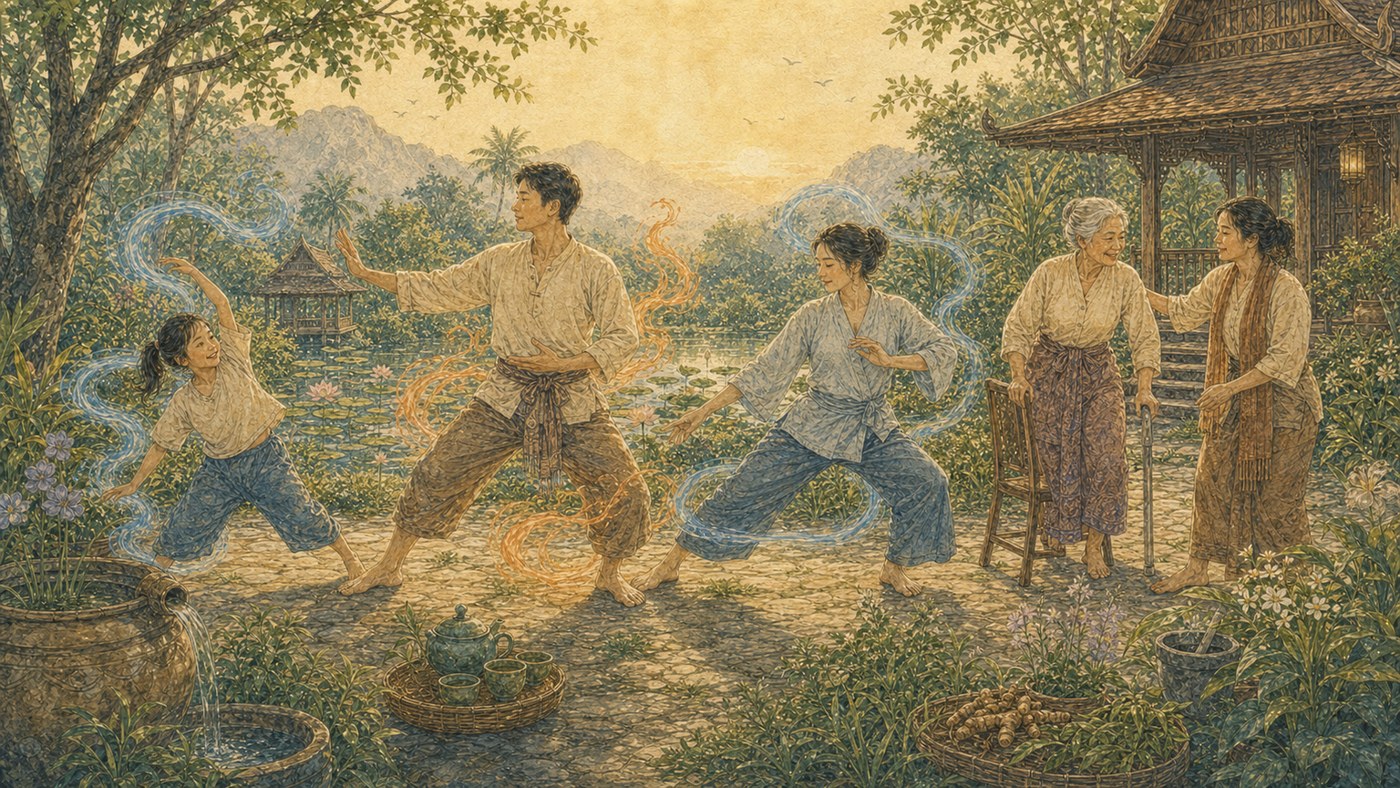
Three imagined versions of New
New is currently 31. For this chapter, imagine the same person at three other ages; these are thought experiments, not biographical facts.
At seven, New runs, climbs, collects leaves and follows butterflies. A compulsory table-tennis lesson brings tears rather than enjoyment.
At sixteen, New tries running, yoga, swimming, cycling and the gym, sometimes following friends and sometimes exploring alone. Changing activities is part of discovering what feels meaningful.
At sixty, New may still have a lively, curious mind while needing a different training plan. Strength, balance and comfortable movement may become more deliberate priorities. A fit sixty-year-old might still enjoy running; age alone does not decide that it must stop.
The enduring portrait is only one part of the picture. Development, health, function, experience and opportunity all influence what movement can ask of us.
Age as a traditional and practical lens
Ayurveda describes broad stages of life associated with Kapha in growth, Pitta in the active middle years and Vata in later life. These are traditional interpretations, not measurements that turn every child into Water or every older adult into Wind.
Muscle, bone, hormones, recovery and function do change across life, with substantial variation between people. We should not apply a fixed yearly muscle-loss percentage to everyone or assume that older adults cannot build strength. Training, nutrition, health and support remain relevant at every age.
The age bands below organise the discussion. They are not medical cut-offs; the 13–25 group includes both adolescents and young adults, who have different guidance and needs.
Childhood, up to twelve: make room for play
Children need enjoyable, varied opportunities to move. Play can include imagination, exploration, climbing, running, throwing and learning with others. Structured sport can also be positive when it is developmentally appropriate, well supervised and not driven by adult pressure. It is not necessary to reject all coaching in order to protect play.
For infants, movement means supervised, age-appropriate interaction and floor play. Non-mobile infants can have tummy time while awake, spread through the day; this is not a sleeping position. Toddlers need many opportunities for active play. Preschool children benefit from a mixture of movements at different intensities. The references appendix links to the age-specific WHO recommendations. [5]
Exploring outdoors: suitable climbing equipment, low safe slopes and imaginative games can support coordination. Adults should judge hazards, supervise appropriately and avoid treating unsupervised tree or rock climbing as a universal recommendation.
Swimming and water skills: qualified age-appropriate lessons can be valuable. A child who has lessons is not drown-proof; close supervision and appropriate water barriers remain essential.
Cycling: a tricycle, balance bike or bicycle can fit different developmental stages. Readiness varies. Use a helmet and a safe area away from traffic rather than a fixed age for moving to two wheels.
Traditional games: Thai examples such as mon son pha, relay games and musical games combine movement and social participation. Adapt rules so children are not repeatedly excluded or shamed.
Avoid treating a child as a small adult athlete. Excessive training, inadequate recovery and pressure to specialise can undermine enjoyment. Properly designed and supervised resistance activity can be appropriate; it is not inherently unsafe simply because a child is still growing. [6]
An elemental portrait can suggest questions about atmosphere—does the child enjoy novelty, challenge or company?—but the child gets to answer. Every type deserves choice, safety and play.
Adolescence and young adulthood, thirteen to twenty-five
This period often includes exploration of identity, friendships and independence. Movement can offer skill, enjoyment, expression and belonging. Team sport, running, dance, cycling, safe martial-arts practice and progressively taught strength work are possible choices.
Young bodies are not injury-proof. Sleep, adequate food, recovery, technique and mental well-being matter. We should not promise that this is the age to use unlimited energy without concern.
Trying different activities can be constructive. A young person need not keep the sport chosen for them at eight. Nor must a change mean failure. We can support continuity through enjoyment rather than insist that only one activity counts.
For someone who recognises Wind, a predictable and encouraging setting may help; do not assume weak muscles or compare the person unfavourably with an athlete. For someone who recognises Fire, practise pacing and recovery alongside challenge. For someone who recognises Water, companions and an inviting activity may help with starting. Invitation is different from dragging or coercion.
Working adulthood, twenty-six to forty-five
Seated work, parenting, caring for older relatives and financial pressure can crowd movement out. The goal is to make activity fit a real day while reducing long uninterrupted periods of sitting.
Movement breaks: an occasional reminder—perhaps every thirty to sixty minutes—can prompt standing, walking or comfortable shoulder and ankle movement. The interval is a practical cue, not a universal prescription. Avoid forcing neck or spinal stretches.
Aerobic activity: suitable walking, cycling or swimming can be built into the week. Thirty to forty-five minutes three or four times weekly is one example, but smaller portions can help us begin and total weekly guidance remains relevant.
Strength: include appropriately progressive muscle work, often on at least two days, with recovery. Bands, weights and body-weight exercises can be used at home when taught and set up safely.
Mobility and balance: yoga, tai chi or other suitable practice can complement the plan. They are options, not uniquely effective cures for occupational tension.
Wind-oriented readers may favour a familiar gentle anchor. Fire-oriented readers may benefit from sessions without another contest. Water-oriented readers may find a short appointment with a friend helpful. These suggestions never mean that a tired person must ignore fatigue. Pregnancy and postpartum adaptations are discussed in Chapter 14.
Midlife, forty-six to sixty-five
Midlife can bring changing responsibilities, menopause, injuries or health conditions. It can also bring new strength and skills. The aim is not merely to preserve what remains: appropriately trained adults can still improve fitness and muscle strength.
Progressive resistance work helps maintain function. Start at a manageable level and increase according to response, rather than assuming that only very light weights are safe.
Appropriate impact depends on joints, bone health and experience. A runner does not automatically need to stop because of age. A softer-looking surface can be uneven and increase fall risk. Suitable walking, cycling or swimming are alternatives when needed.
Balance and mobility support everyday movement. Use stable support for challenging balance work and avoid forcing a range of motion.
Time outdoors can add pleasure and meaning, while an accessible indoor gym may be equally useful for someone else's life. We do not need to rank one setting as universally deeper than another.
For a Wind-oriented reader, consider comfortable warmth and controlled strength work without assuming osteoporosis. For a Fire-oriented reader, review the present dose without automatically halving what was done at thirty-five. For a Water-oriented reader, combine achievable aerobic and strength work without making weight loss the only goal.
Later life, sixty-six and beyond
Everyday function may become a central aim: rising from a chair, carrying a bag, reaching a shelf, walking to a neighbour or using the bathroom safely. Capability varies greatly; the right programme can include meaningful challenge as well as support.
Strength: muscles remain trainable. A small weight, band or chair-based movement may be a beginning, but choose the load for the person rather than automatically prescribing a one-litre bottle.
Balance: appropriately supervised weight shifts, stepping and supported standing can help. Do not test unsupported single-leg standing or insist on rising without the hands when that risks a fall.
Mobility: comfortable movements through the available range can help with daily tasks. A chair-based or supported yoga practice may be accessible, but “chair yoga” is not a blanket guarantee of safety.
Regular activity: keep opportunities to move where possible, with recovery and illness care respected. Muscle loss does not follow a fixed tenfold rate compared with midlife, and missing a week does not justify fear or blame.
Possible activities include a level walk, suitable tai chi or qigong, adapted Thai dance or ceremonial ram muay, seated movement and gardening. Twenty to forty minutes of walking is an example for someone able to manage it, not an expectation for all older adults. A physiotherapist can help when frailty, falls, neurological problems or marked deconditioning are present. [7]
An enduring Wind, Fire or Water portrait remains distinct from age. Comfortable clothing, suitable temperature, company and a less pressured atmosphere can all be adapted. Family members can invite and support rather than prescribe by type.
Try it: a family movement conversation
Ask each person three questions: What stage of life are we in? What preferences or elemental qualities feel familiar? What movement happens now, and what would make the next step easier?
In the Plearnprai teaching family:
- Ou, 38, needs workable breaks from seated work and a routine that can coexist with childcare.
- The six-year-old may need more choice and enjoyment rather than an unwanted sport lesson.
- The three-year-old needs opportunities for supervised active play alongside limits on prolonged screen time.
- Korn, 45, may need a more balanced dose and genuine recovery.
- Grandmother, 72, needs a plan informed by symptoms, function and support, with opportunities for companionship.
- New, 31, may benefit from a familiar base rather than repeated intensive restarts.
A family outing need not mean everyone runs together. One park can hold a short supported walk, play, a longer cycle and a shared rest.
Age and preferences: a planning matrix
| Life stage | Wind-oriented emphasis | Fire-oriented emphasis | Water-oriented emphasis |
|---|---|---|---|
| Childhood | Encouraging play, comfort and adequate food | Enjoyable challenge without pressure | Inviting active play and companionship |
| Adolescence/young adulthood | Exploration with recovery and a familiar base | Learn pacing as well as performance | Find enjoyable peers and varied options |
| Working adulthood | Predictable short practice and movement breaks | Activity without constant comparison | Make the first step convenient; include strength |
| Midlife | Controlled strength, comfort and individual bone-health advice | Review dose and recovery against current needs | Achievable aerobic and strength progression |
| Later life | Suitable strength, warmth and supported balance | Comfortable activity with less pressure to prove ability | Supported participation, walking or adapted alternatives |
Every column still needs the same fundamentals: safety, choice, appropriate challenge and a plan fitted to the person.
What needs care
Do not copy a programme merely because it suits someone of another age—or someone of the same age. Function and health matter as much as the birthday.
Do not overlook strength training in midlife and later life. It supports useful capabilities, not only appearance.
Do not turn regularity into a prohibition on rest. On an ordinary tired day, a short easy walk may help; during illness, severe fatigue or post-exertional worsening, the appropriate choice may be rest and advice.
Signs that we are finding our way
A child may approach play willingly. A teenager may discover an activity that feels their own. A working adult may have more capacity for family life. A midlife adult may notice stronger everyday function. An older person may feel more confident with transfers or a familiar route.
These are individual outcomes, not pass–fail tests. Needing an armrest, walking aid or a pause on stairs does not mean failure. Celebrate the function that matters to the person.
Before we continue
Age changes the questions we ask, but it does not remove the possibility of learning and improvement. Next we look at weather, season and time of day—conditions that can change the same person's experience from one session to the next.
MOVEMENT BY THE ELEMENTS
Chapter 12 — Moving with the Seasons and the Day
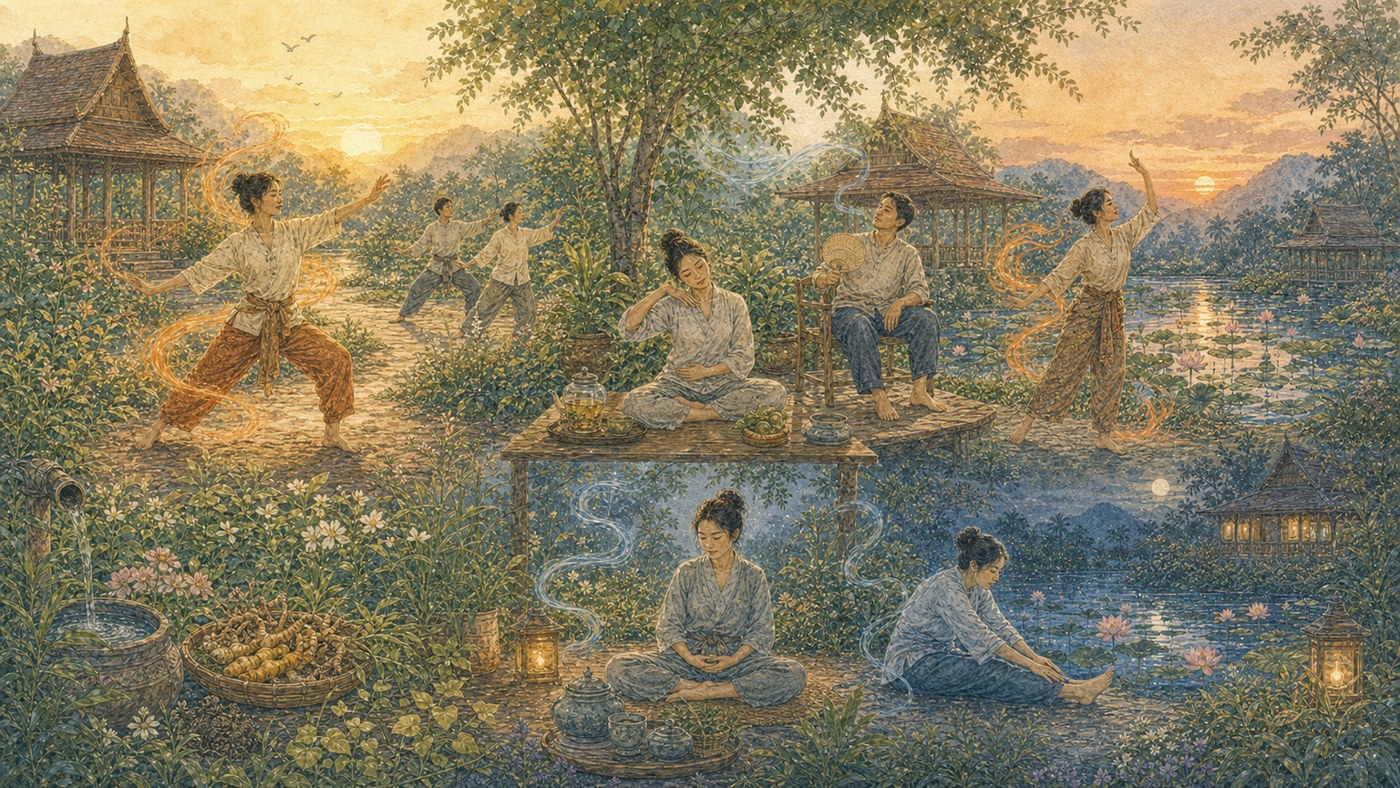
New in a rainy September
Imagine New, thirty-one, waking to another grey September morning. Rain has been falling all week. Her thoughts feel unsettled, while her body seems reluctant to leave the room. She pushes herself out for a run in the rain and returns more tired than she expected.
On a mild December morning, the same person may find getting outside much easier. Light, temperature, sleep, work and the practical conditions around us all affect the experience of movement. A difficult week does not prove that we are weak or lazy. Nor does a season explain every new symptom: exhaustion that is severe, persistent or unusual deserves attention in its own right.
The elemental framework offers a language for noticing these changes. Heat is associated with Fire; changeability with Wind; coolness, dampness and heaviness with Water. These are traditional associations, not a claim that everyone develops the same symptoms in the same weather.
We can let the season inform our choices without asking it to decide everything for us.
Chapter 10 considered mixed patterns and today's needs. Chapter 11 added age and life circumstances. Here we add the environment and the hours of the day. Thailand's familiar hot, rainy and cool seasons provide the setting. They are parts of a tropical annual cycle; their timing varies by region and year. Readers elsewhere can apply the same questions to their own climate.
Three seasons through an elemental lens
In much of Thailand, March to May is the hot season, June to October the rainy season, and November to February the cooler season. Southern and coastal patterns differ. Actual conditions matter more than the month printed on a calendar.
Ayurvedic seasonal reasoning is more detailed than a simple three-season table, and its regional calendars do not map perfectly onto Thailand. In this book we use a practical Thai adaptation:
| Season | Traditional association used here | Practical question |
|---|---|---|
| Hot | Fire / Pitta: heat and intensity | Where can we move without excessive heat exposure? |
| Rainy | Wind / Vata: changeability; Water / Kapha: dampness and heaviness | How can we keep a workable routine in a dry, comfortable place? |
| Cool | Water / Kapha: coolness and a slower start | How can we warm up gradually and make use of comfortable conditions? |
These associations invite observation. They do not predict that rain will make everybody anxious, that cool weather will cause weight gain, or that a rash is an elemental event.
Hot weather: shade, cooler settings and a manageable dose
Heat changes the demands of activity for every Type. Our first task is to reduce exposure and adjust effort, clothing, breaks and fluids to the actual conditions. Being a Water Type does not protect us from heat illness. [3]
Options include:
- Swimming in a well-maintained pool with appropriate supervision, at a comfortable temperature. Pool swimming and open-water swimming require different skills and precautions.
- Walking in a shaded park or woodland, choosing a route we can shorten and avoiding remote terrain when conditions are difficult.
- Gentle yoga in the cooler morning, including a suitable Moon Salutation or supported practice.
- Tai chi or qigong in shade, breathing comfortably rather than taking forced deep breaths.
- Cycling on a genuinely shaded, safe route, or using an indoor bicycle in a ventilated room.
- A short early market walk, before the day becomes very hot.
Avoid strenuous activity in intense heat, hot yoga when overheating is a concern, and hard exercise in an unventilated room. A clock alone cannot make a session safe. Early morning and later afternoon are often more comfortable, but humidity, direct sunlight, the local heat alert and our health still matter. Even after five in the afternoon it can remain dangerously hot.
Imagine Ou trying to squeeze a brisk walk into her April lunch break. She returns uncomfortable and overheated, then finds the evening difficult. A later session in a suitable pool may be a more workable choice. If a rash or sleep problem persists, we investigate it rather than treating improvement after swimming as proof of an elemental cause.
Rainy weather: continuity in a comfortable, dry place
Rain can disrupt travel, reduce daylight and make an outdoor routine inconvenient. We may feel restless because we have been indoors, yet reluctant to begin. The answer need not be a battle with the weather.
Useful alternatives include:
- Yoga, resistance-band exercises, dancing or a short strength session at home.
- Tai chi or qigong in a hall with enough space and a non-slip floor.
- Walking in a shopping centre or covered garden.
- Swimming in a suitable indoor pool, following local storm and pool-safety rules.
- A stationary bicycle indoors.
- Gentle practice under a sheltered roof when the floor is dry and the weather is safe.
Running in rain is not inherently an elemental mistake, but lightning, flooding, poor visibility, slippery surfaces, cold exposure and traffic can make an outing unsafe. Wet clothing does not itself cause a viral infection. Changing into dry clothing is nevertheless a sensible way to stay comfortable and avoid prolonged chilling or skin irritation.
Three habits make a rainy week easier. First, keep a small indoor option ready: five or ten minutes still counts. Rest when ill or when recovery requires it. Second, begin with several minutes of easy movement and increase gradually; static stretching alone is not a guarantee against injury. Third, dry off and change when the session leaves us wet.
New might replace a difficult rainy run with up to thirty minutes of familiar yoga and two short resistance-band sessions during the week. She can start with less. The value lies in having a repeatable alternative, not in a promise that it will prevent illness for the whole season.
Cool weather: make room for a gradual start
A comfortable cool morning can make movement inviting. It may also take us longer to feel ready, particularly if our joints are stiff or our clothes are inadequate for the temperature. We can respond without labelling ourselves lazy.
Options include a brisk walk or an easy jog in gentle daylight; cycling on a manageable route; a park or hill walk suited to our fitness; resistance exercise using bands, weights or body weight; a modified Sun Salutation; dancing, Thai dance or ballroom dance; and familiar Manee Vej movements.
Spend roughly five to ten minutes beginning easily when that is helpful. Warm-up needs vary with the weather, the person and the activity. A cool day does not automatically make every hour suitable: poor air quality, rain, darkness and local terrain still count.
In our family example, Grandmother begins walking to the morning market in November. She moves gently indoors first, wears a comfortable extra layer, and increases her pace gradually over the first part of the walk. Over the following months she may find the routine easier to start. That is a useful observation even if her weight does not change.
The traditional six-part day
Ayurveda describes a repeating daily sequence of Kapha, Pitta and Vata. We can use it as a reflective timetable while recognising that it is not a scientifically established set of compulsory exercise windows. Shift work, caregiving, chronotype, medications, meals, sleep and access may change the best time for us.
6–10 a.m.: an invitation to begin
This is the traditional Kapha period. A walk, cycle, suitable Sun Salutation, strength session or dance can help us enter the day actively. People who find starting difficult may appreciate an appointment with a friend or a small prepared routine.
Missing the morning does not waste the whole day. A Water Type can benefit from afternoon or evening activity too. A Wind Type need not avoid every session before six, and a Fire Type need not stop at ten if the environment and effort remain suitable. We choose according to real conditions.
10 a.m.–2 p.m.: consider heat and workload
The traditional Pitta period often overlaps with stronger sunlight in Thailand. Desk stretches, a walk to lunch, or a short indoor movement break may fit well here.
If this is our only available exercise time, a cool, ventilated indoor setting can be useful: an indoor pool, a suitable studio, or a shaded space where heat conditions are acceptable. Adjust the session to the day. There is no universal requirement to cut every midday workout exactly in half.
2–6 p.m.: reconnect after the working day
The traditional Vata period invites us to notice the effects of accumulated work and fatigue. Gentle yoga, tai chi, qigong, Pilates, Manee Vej or ruesi dat ton may offer a welcome transition.
Some people instead feel strongest in the late afternoon and prefer a more active session. A Water Type's afternoon activity need not be a secondary or inferior choice. The important question is what we can do safely and sustain.
6–10 p.m.: make the transition towards rest
The evening Kapha period is traditionally associated with settling. A gentle post-dinner walk, comfortable stretches, supported restorative yoga or quiet breathing may suit us.
Ou's family might walk around the neighbourhood for fifteen minutes after dinner, using the time to talk. It can become a pleasant shared habit. We need not describe it as a medicine stronger than supplements to value it.
Evening exercise affects people differently. If a demanding late session leaves us too alert to sleep, finish earlier, reduce the intensity, or choose a quieter option. If our evening routine supports activity and good sleep, the elemental clock is not a reason to abandon it.
10 p.m.–2 a.m.: protect the sleep we need
The traditional account calls this another Pitta period and associates it with restoration. Modern sleep and recovery do not depend on a special elemental fire that exercise switches off.
For people following a daytime schedule, this is usually an opportunity to protect sleep rather than fit in more tasks. For shift workers, the appropriate rest period may be elsewhere. We try not to sacrifice adequate sleep to meet an exercise ideal. If a late gym session is our only practical option, observe its effect and discuss persistent sleep difficulty when needed.
2–6 a.m.: do not borrow unnecessarily from sleep
This is traditionally a Vata period. It is not a universal medical ban on movement before five or six. An early start can work if we have slept enough, can see and be seen, are dressed for the conditions, and begin gradually.
People sensitive to cold, those with balance problems and anyone walking alone in darkness may prefer to wait for daylight or start indoors. Warm water or a warm shower is optional preparation, not a prerequisite for a particular Type.
Type × season × time: an adaptable menu
The following table offers possibilities, not a prescription. Choose a familiar activity, an appropriate dose and a safe setting. Warm means comfortably protected from cold, not overheated.
| Type and season | Morning, 6–9 | Afternoon, 2–5 | Evening, 5–8 |
|---|---|---|---|
| Wind × hot | Comfortable indoor walk | Gentle stretching | Suitable indoor pool |
| Wind × rainy | Gentle yoga at home | Sheltered tai chi | Indoor shopping-centre walk |
| Wind × cool | Gradual walk in gentle daylight | Ruesi dat ton | Gentle yoga before settling |
| Fire × hot | Swimming in comfortable conditions | A quiet indoor pause | A genuinely shaded park walk |
| Fire × rainy | Qigong in a hall | Supported yin yoga | Suitable indoor pool |
| Fire × cool | A manageable nature walk | Indoor cycling | Moon Salutation |
| Water × hot | Early park walk at a suitable pace | Indoor stretching | Swimming in comfortable conditions |
| Water × rainy | Modified indoor Sun Salutation | Resistance exercise at home | A brisk indoor walk, if appropriate |
| Water × cool | Brisk walk or easy jog, if suitable | Moderate resistance exercise | Dance or Thai dance indoors |
For example, New in a cool November might choose a seven o'clock park walk with an extra layer, beginning gently. Thirty to forty minutes could suit an established routine; a shorter walk may be enough today. Korn, forty-five, in April might choose a shaded arboretum or park around five, provided it has actually cooled. Forty-five minutes is an option for someone accustomed to it, not an obligation.
Try it: a week of noticing our own day
For seven days, make brief notes in a phone or notebook. We do not need to wake up to complete the night-time entries.
- 6–10 a.m.: Do we feel ready to move, sleepy, clear-headed or slow to begin?
- 10 a.m.–2 p.m.: Are we affected by heat, or working comfortably indoors? New chest tightness is a symptom to assess, not a normal entry under “Fire”.
- 2–6 p.m.: Are we tired, restless or still comfortably energetic?
- 6–10 p.m.: After dinner, do we feel settled, sluggish or fidgety?
- 10 p.m.–2 a.m.: Are we usually asleep during this part of our schedule, or still working and active?
- 2–6 a.m.: From what we remember afterwards, was sleep continuous or interrupted?
At the end of the week, look for a realistic opening. Perhaps we assumed we were a night person because mornings were always rushed, then discovered that a short walk at seven-thirty felt good. Perhaps our best opportunity is after work. Both observations are useful.
Three cautions when planning
Allow the timetable to change. A convenient hour in one season may be uncomfortable in another. Check the forecast and local conditions, rather than treating a fixed clock time as proof of safety.
Protect sleep without rigid rules. If late exercise repeatedly disrupts sleep, adjust it. Do not solve the problem by cutting sleep even shorter for an early session. Persistent insomnia deserves appropriate help.
Reduce demands when conditions change sharply. An unusually hot spell, a return after illness, or a difficult transition in our schedule may call for shorter, easier sessions and more breaks. A fixed twenty- or thirty-per-cent reduction cannot be right for everyone.
Signs that the arrangement is helping
Across seasons, we may find it easier to adapt rather than abandon the routine. Across a day, we may notice a more comfortable start and a better transition to rest. Over a month, choosing a short indoor walk on a wet day may feel practical rather than like failure.
Over several months, we may learn which clothes, settings and times support us. Over a year, the household may develop familiar seasonal rituals: a cool-season market walk, a hot-season pool visit, a rainy-evening dance indoors. None of this guarantees weight stability, clear skin, immunity from illness or waking before an alarm. The useful result is a more responsive relationship with daily life.
Before the next chapter
We now have several questions to bring together: our enduring constitution, today's state, life stage, surroundings and available time. The traditional seasonal and daily maps can prompt those questions; our actual response guides the adjustment.
Next we meet the movement practices themselves more closely: ruesi dat ton, Thai boxing forms and dance, yoga, tai chi, qigong, Manee Vej and walking meditation. We will consider what each offers, how to begin, and how to choose without turning a tradition into a guarantee.
MOVEMENT BY THE ELEMENTS
Chapter 13 — Thai and Other Asian Movement Traditions
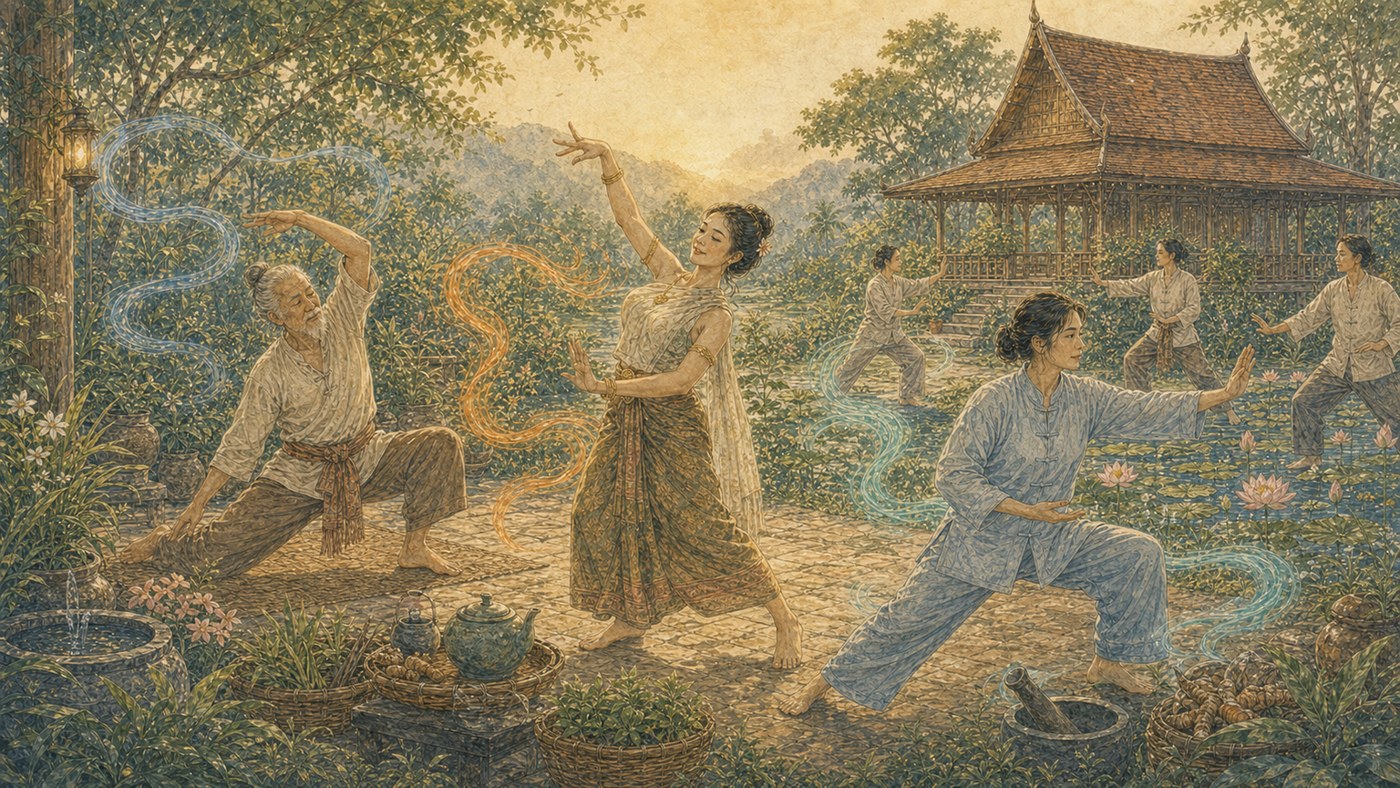
What our grandparents carried into the day
Imagine Grandmother remembering her own mother, who lived into her nineties. Her days included collecting water, preparing food, walking to the temple, watering plants, growing vegetables and stretching under the eaves. Movement was woven into the work of living.
Many of us recognise something of that scene. A basket carried back from the market, a few movements before cooking, a walk to visit a neighbour: such things may have seemed too ordinary to call exercise. Later, faced with memberships, equipment and a crowded schedule, we can forget that a body also moves in the spaces between formal sessions.
A family story does not establish why someone lived a long life, and demanding physical work was not always healthy or freely chosen. We can nevertheless learn from the continuity, variety and social meaning of everyday movement. A gym and a traditional practice can both belong in that life.
Morning ruesi dat ton, walking meditation, Thai boxing forms, community dance, tai chi in a park and qigong in a neighbourhood hall offer different ways to bring attention into movement. Their histories differ; not every modern form is thousands of years old. We need not exaggerate their age to respect what they can offer.
An inherited practice becomes a living one when we can meet it with understanding and adapt it with care.
Ruesi dat ton: a Thai tradition of self-stretching
A heritage we can still practise
Ruesi dat ton is a Thai tradition of postures and self-stretching, often translated as “hermit self-stretching”. Its cultural stories connect it with ascetics preparing their bodies for contemplation. Wat Pho preserves an important historical record: its account describes eighty postures commissioned during the reign of King Rama III. This historical record is distinct from any particular modern teaching sequence. [10]
Traditional descriptions assign different purposes to different movements, including easing discomfort in the back or head and supporting the movement of lom. These are traditional indications, not evidence that the sequence treats every organ or that pain should be self-diagnosed through a posture.
Choosing a small, familiar set
We do not need to perform a large collection every morning. Five or ten familiar, suitable movements—or fewer—may be more useful than trying to master everything at once.
For a Wind Type, the emphasis can be gentle warmth, gradual knee and hip movements, comfortable head turns rather than full neck circles, and a small range of back movement. We take our time and breathe without forcing depth or length.
For a Fire Type, a moderate pace, a comfortable opening across the chest, small side bends and gentle leg movements may support a less competitive approach. A deep backbend is not necessary to “release Fire”.
For a Water Type, supported knee lifts, arm movements and comfortable movements around the hips can make a beginning more lively. Balance, pain and capacity determine the range and pace.
For further study, seek a clearly illustrated teaching resource from a qualified Thai traditional medicine service or an appropriate instructor. The name of an old posture does not tell us whether it suits a spinal condition, joint replacement, pregnancy or recent injury.
Its place in an ordinary morning
A selected gentle set can use little space and no specialist equipment. That makes it approachable. Some traditional postures, however, are demanding. We choose the version that respects our body rather than assuming that every movement is mild because it is traditional.
Traditional Thai boxing forms: strength with rhythm
Practising the form without the impact
Thai boxing traditions include ritual and movement forms associated with martial training. In a non-contact setting, we can explore stance, rhythm, coordinated movement and cultural expression without exchanging blows.
A Fire Type may enjoy this blend of challenge and artistry: a purposeful action followed by a release, music that helps organise attention, and the chance to refine a movement rather than prove toughness. Sweat reflects the body's temperature regulation; it is not evidence that an internal elemental excess has been expelled.
A Water Type may appreciate the lively pace and clear sequence. A Wind Type who is tired or easily overstimulated may prefer a slower, shorter, non-contact version. None of these labels substitutes for actual fitness or a history of injury. All Types can need a gentler beginning.
Some Thai communities and schools teach traditional forms alongside contemporary boxing. Before joining, ask whether the class is non-contact, how it accommodates beginners, and whether the teacher can modify the movements. A family visit can be worthwhile simply as an introduction to the cultural practice; participation need not become competitive training.
Thai dance: coordination, company and grace
Thai dance encompasses social circle dances, regional forms, festive performances and highly trained classical traditions. Their demands vary considerably. Many community forms offer continuous, coordinated movement involving the arms, hands, trunk, knees and feet, supported by music and shared timing.
For a Water Type who finds solitary exercise hard to start, the group may be the most helpful part. For a Fire Type, an unhurried social dance can invite expression without a score. A Wind Type may enjoy a slower form and the steady attention of a hand or arm sequence. Joint range and balance still deserve care; we do not force a wrist, knee or back into an ideal shape.
Imagine Grandmother joining a Wednesday community dance group. At first she needs breaks because the activity is unfamiliar. Later she starts arriving early to meet friends. Her family notices that she seems more engaged, and she may become more confident on the stairs as her broader routine develops. These are possible experiences, not guaranteed results on a three- or six-month deadline.
The class can offer something beyond exercise: friendship, a contribution to the group and the satisfaction of learning.
Yoga: the class matters as much as its name
Yoga has diverse Indian roots and many contemporary teaching styles. A label can help us ask questions, but it cannot tell us the exact pace or demands of a particular class. Qualified instruction and suitable modification matter. [2]
Hatha yoga. In many current class schedules, “hatha” describes a relatively unhurried approach to postures and breathing, although the word has a broader historical meaning. A gentle class may suit a Wind Type seeking predictability. It can also suit other Types. We ask about the actual level rather than assuming that hatha always means easy.
Vinyasa yoga. This links movements in a flowing sequence, often with breathing. A Fire Type may enjoy its engagement and a Water Type its continuity. Choose an appropriate beginner level, a comfortable room and a pace that does not make every transition a contest. Wind Types can also practise a suitable version; a tired day may call for something simpler.
Yin yoga. Some classes use long, relatively still holds—sometimes three, five or more minutes. Stillness may appeal to Wind and Fire Types, but long holds are not automatically gentle. We do not push into joint strain, and we can shorten or leave a position. People with hypermobility or relevant injuries need particular care. A Water Type may find the rest valuable too; quietness is not a defect.
Restorative yoga. Cushions, blankets and other supports allow a resting posture with little effort. It can be useful when capacity is low or stress is high. Comfort and ease of getting into and out of the position matter more than appearance.
Sun Salutation, Surya Namaskar. Linked sequences can be lively and engaging, which may appeal to someone seeking activation. Twelve-position versions are common, but forms differ. Use the supported alternative or an individually taught sequence from Chapter 9 rather than assuming a floor sequence suits every Water Type.
Moon Salutation, Chandra Namaskar. Contemporary versions often use a slower, more spacious flow. A Fire Type may welcome that emphasis. It is an invitation to a calmer pace, not a technique proven to remove internal heat.
Hot yoga, including heated Bikram-style practice. A heated room adds heat strain and dehydration risk. Water Type is not a reason to recommend it, and drinking water does not eliminate the risk. People who are pregnant or have relevant health conditions should seek individual advice; a non-heated class is a practical alternative. [2], [3]
Plearnprai's planned Yoga by the Elements tools are intended to explore specific movements and adaptations in greater detail. Until available, this chapter should not be treated as a substitute for instruction.
Tai chi: attention in a flowing sequence
Tai chi developed from Chinese martial traditions and is now practised in many health, cultural and martial contexts. Familiar forms include a simplified twenty-four-movement sequence, longer Yang-style sequences and Chen-style traditions. The demands vary: not every form is slow or suitable for a beginner.
In a gentle class, shifting weight, coordinating the arms and turning with attention can provide a particular experience of continuity. For a Wind Type, the steadiness may feel settling. For a Fire Type, it offers a challenge in patience and precision. A Water Type need not speed it up to make it worthwhile; appropriate balance practice has value even when it does not feel aerobic.
Research supports potential benefits for balance and falls prevention in some older adults, but it does not show that tai chi corrects elemental Types. Pain or balance limitations may require a higher stance, shorter range, chair support or a different approach. [9]
Parks and community centres sometimes host practice groups. In Bangkok, parks such as Lumphini, Wachirabenchathat and Suan Luang Rama IX have long been associated with community activity, but schedules, fees and access can change. Ask the organiser before joining rather than copying an unfamiliar group unnoticed from the back. A beginner class can make the movements easier to understand.
Plearnprai's tai chi–qigong and breathing manuals are development projects, not prerequisites for starting with a qualified local teacher.
Qigong: a range of adaptable practices
Qigong combines movement or posture, attention and breathing in varied traditions. Qi is a traditional concept of vital activity, not a substance measured by a medical test. Some named sequences traditionally refer to supporting organs or particular functions. Those names do not establish treatment for kidney, lung or other disease.
A Wind Type might begin by noticing the feet against the floor, with a chair available for support. A Fire Type might choose a comfortable opening of the arms and an unforced exhalation. A Water Type might prefer larger but manageable arm movements and a more continuous sequence. We can all change the selection with the day.
Imagine New following a suitable beginner session for ten minutes in her room. After a few weeks, she describes it as time to listen to herself before work. That is a meaningful personal observation without promising that the practice will treat anxiety or replace needed care.
Space, equipment and cost can be modest. Choosing a reliable teacher or recording, and knowing when to stop, still matter.
Manee Vej: a Thai movement approach
Manee Vej is associated with the Thai teacher Prasit Kanthawong and includes movement practices taught with attention to posture, breathing and bodily coordination. Accounts within the tradition describe structural balance and the movement of vital energy. These explanatory ideas should not be confused with proof that a sequence puts bones back into place or regulates endocrine glands.
A gentle, appropriately taught practice may appeal to a Wind Type seeking a predictable sequence. A Fire Type who spends long hours sitting may appreciate a comfortable movement break. A Water Type may find it an accessible starting point. These are choices about experience and dose, not claims that Wind Types have misaligned skeletons or that one tradition is inherently safer than physiotherapy.
Ask a teacher about training, modifications and the purpose of each movement. Persistent pain, numbness, weakness or a suspected injury requires assessment. Avoid forceful manipulation or self-adjustment based on a video. Plearnprai's planned Manee Vej guide is intended as a future companion, not a reason to delay appropriate care.
Walking meditation: noticing a step
Walking meditation brings attention to an ordinary action: a foot touching the ground, weight moving, another foot lifting, and the surroundings we are walking through. In Thai Buddhist contexts, jongkrom commonly means walking back and forth on a short path, perhaps five to ten metres long, with a chosen focus of attention.
When sitting feels restless, a Wind Type may prefer this moving anchor. A Fire Type may welcome a deliberate pause in a hurried day. A Water Type who feels withdrawn may find a short walk an approachable beginning. These are possibilities, not promises that walking will always settle the mind faster than sitting.
Choose a level, clear route. Keep the eyes open enough to navigate safely, turn gradually, and use support if needed. Begin with a few minutes; fifteen minutes is an option, not a minimum. We can notice our steps without changing the breath. If inward attention increases distress, return attention to the surroundings, pause, or seek support.
A comparison to help us choose
The table describes possible emphases within Plearnprai's framework. It does not rank clinical effectiveness or certify safety for a Type.
| Practice | Wind Type emphasis | Fire Type emphasis | Water Type emphasis |
|---|---|---|---|
| Gentle ruesi dat ton | Familiar, unhurried movements | Comfortable release | A slightly livelier suitable set |
| Non-contact Thai boxing forms | Short, slow version | Rhythm and artistry without competition | Engaging movement without impact |
| Thai dance | Slower, graceful form | Expressive social movement | Group rhythm and continuity |
| Hatha yoga | Gentle, predictable class | Moderate effort | Suitable level and pace |
| Vinyasa yoga | Adapt pace and transitions | Avoid heat and competition | Continuous flow within capacity |
| Yin yoga | Supported, comfortable holds | A quieter practice | Rest when helpful; do not force holds |
| Restorative yoga | Supported rest | Supported rest | Rest is also appropriate when needed |
| Sun Salutation | Slow or supported version | Suitable room, dose and pace | Modified engaging sequence |
| Moon Salutation | Comfortable flow | Slower, spacious movement | A gentler option |
| Hot yoga | Heat risks require caution | Heat risks require caution | Type does not confer heat protection |
| Tai chi | Steady attention and balance | Patience and coordination | Balance and continuity |
| Qigong | A settling emphasis | An unhurried emphasis | A comfortably active emphasis |
| Manee Vej | Familiar, gentle sequence | A suitable movement break | An accessible beginning |
| Walking meditation | Steps as an anchor | An opportunity to slow down | A small, approachable start |
Try it: one practice for four weeks
Choose one suitable practice rather than attempting every tradition at once. Three to five short sessions a week may work, depending on the practice and our recovery needs. A smaller beginning is welcome.
Week 1: become acquainted. Learn the setting and the basic movements. Keep the effort modest. We do not need to look accomplished.
Week 2: become familiar. Notice the order, transitions and places where a modification helps.
Week 3: deepen attention. Attend more carefully to comfort, coordination and ordinary breathing. Deeper attention does not require deeper or more forceful breaths.
Week 4: review the experience. What happens to comfort, mood, sleep and energy? Do we look forward to returning? Does anything repeatedly hurt or leave us depleted?
Continue if it fits; change the teacher, dose or practice if it does not. No tradition suits everyone in every season of life.
Choosing a teacher and a pace
Start with one or two practices so that unfamiliar demands do not accumulate unnoticed. Find a teacher who allows questions, support and rest, who asks about relevant conditions, and who does not promise a cure or force the body into a shape.
Adapt to age, health and current capacity. A practice we enjoyed at thirty may need a different version at sixty, but age alone does not decide what we can learn. Likewise, a difficult week may call for a gentler session without becoming a permanent limit.
After two to four weeks, useful signs may include feeling engaged rather than coerced, recovering comfortably after practice, less tension, or growing confidence. We may sleep better, but that is not guaranteed. Mild unfamiliar muscle soreness differs from severe, persistent or worsening pain. Symptoms that concern us deserve assessment, not a more determined attempt to “balance” a Type.
Carrying tradition forward
We can value the cultural meaning of Thai and other Asian practices while asking sensible questions about their safety and evidence. A tradition's longevity is not a clinical trial; a modern gym is not automatically impersonal or harsh. Our task is to find a form of movement we can understand, adapt and return to.
Next we consider movement when life becomes more difficult: stress, disturbed sleep, persistent pain, weight concerns or an existing medical condition. Here, knowing when to ask for help is part of caring for ourselves.
MOVEMENT BY THE ELEMENTS
Chapter 14 — Movement When Body and Mind Are Struggling
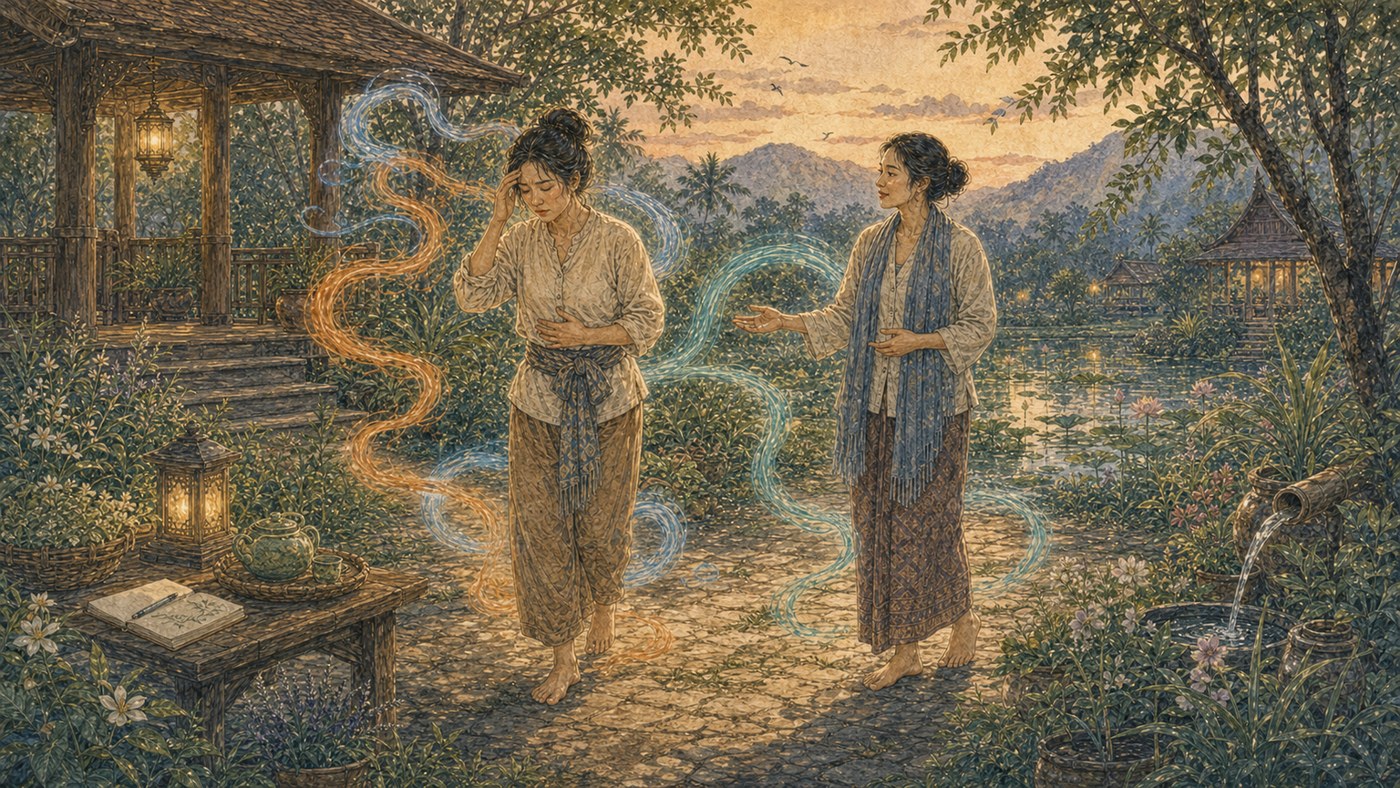
A day when everything feels too much
Imagine Ou, thirty-eight, caring for two children and calling her younger sister after a difficult week. Everyone has told her to exercise. Running has brought palpitations; hot yoga has left her dizzy; a long meditation has made her more aware of racing thoughts. Now even choosing what to do feels overwhelming.
A helpful first response is to listen. Palpitations and dizziness deserve attention, especially when new, recurrent or associated with exertion. They should not be labelled Wind and treated by simply changing the workout. Ou stops the activities that provoke them and seeks appropriate medical advice. Urgent symptoms need urgent care.
Once it is appropriate to move, a short, comfortable walk in a nearby park may be more manageable than another demanding class. Twenty minutes is an option if she is well enough; a shorter walk or rest may be right. It may help her feel less pressured, but one evening's walk cannot promise a good night's sleep.
This chapter concerns the relationship between self-care and help from others. Movement can be part of care for stress, sleep, persistent pain and many long-term conditions. Sometimes it needs modification, supervision or a temporary pause.
Listening includes recognising when the next caring action is to ask for help.
When stress is prominent
People experience stress differently. Plearnprai's elemental language can help us describe a felt pattern—restless, heated or heavy—without claiming that the pattern explains its medical cause.
A restless, Wind-like pattern
We may feel mentally scattered, caught in repetitive thought, tense or unable to settle. Symptoms such as palpitations, cold hands, abdominal discomfort or headache have many possible causes; a Type cannot establish the diagnosis.
When ordinary stress is the issue and movement is suitable, options include an unhurried park walk without a step target; ten to fifteen minutes of familiar gentle ruesi dat ton; supported restorative yoga or a carefully adapted yin practice; Manee Vej with an appropriate teacher; or a comfortable warm shower followed by a little stretching.
If fast running, hard intervals, heated yoga or rapid transitions leave us more unsettled, reduce the demand or choose something else. That is an observation about our response, not a permanent ban on those activities for Wind Types.
A heated, Fire-like pattern
We may notice irritability, impatience, anger or the urge to turn everything into a contest. A new rash or a severe or unusual headache needs its own assessment; it is not evidence of stored Fire.
A comfortable pool session, a shaded walk on easy terrain, a suitable Moon Salutation, gentle cycling or qigong may offer engagement without a competitive target. Avoid overheating and activities that repeatedly intensify distress. Open-water swimming is not a simple substitute for a supervised pool and is unsuitable when we are dizzy, unwell or alone without adequate precautions.
A heavy, Water-like pattern
We may feel withdrawn, tearful, slow to begin or uninterested in familiar pleasures. These experiences can occur with depression and other conditions. Sleeping longer and still feeling exhausted is not proof that we need to push harder.
A small, supported beginning may help: a morning walk with someone kind, a modified Sun Salutation, social dance, light resistance exercise, or a manageable bicycle session. The pace need not be fast. Rest remains legitimate. We try to interrupt long, unwanted stretches of inactivity without treating sleep, meditation or quietness as moral failures.
What helps across all three patterns
Choose a smaller demand when capacity is low; there is no universal rule to halve every session. Avoid self-judgement. Invite a companion who does not pressure us. Seek professional support when distress persists, affects daily life, or feels difficult to manage. We do not have to wait two weeks if symptoms are severe or we are worried.
If we might harm ourselves or cannot stay safe, movement advice is not the next step: seek immediate help through local emergency services, an urgent mental-health service or a trusted person who can stay with us. Exercise can accompany treatment; it does not replace it.
When sleep is difficult
Difficulty falling asleep, waking repeatedly and waking too early can have different causes. Activity may support a routine, but persistent insomnia deserves assessment. Cognitive behavioural therapy for insomnia, CBT-I, is a recommended first treatment for long-term insomnia. It is more than general sleep tips. [11]
Morning: a clear beginning to the day
For a daytime schedule, a comfortable outdoor walk in morning daylight can combine movement with a regular waking routine. Fifteen to thirty minutes is an example, not a required light dose. Protect skin and eyes appropriately; there is no need to stare at the sun. A modified Sun Salutation or a familiar ruesi dat ton set can be another way to begin.
Late afternoon: activity within our capacity
A thirty-minute walk, a suitable hatha class of up to forty-five or sixty minutes, or comfortable swimming may fit an established routine. Start shorter if needed. The purpose is not to exhaust ourselves until sleep becomes unavoidable.
Evening: notice what helps us settle
Gentle stretches, a supported resting posture, a short walking meditation or easy qigong may help mark the end of the day. A session can be much shorter than thirty minutes.
If vigorous exercise near bedtime repeatedly leaves us alert, move it earlier or reduce the intensity. Evening activity does not inevitably cause insomnia in everyone. Our work schedule and actual sleep response matter.
New's example makes this practical. Suppose she runs at nine after work, then experiences palpitations and difficulty sleeping until two. She should have the palpitations assessed rather than assuming they are a Wind response. When suitable, she might try an earlier walk and a brief evening stretch, while addressing the rest of her sleep routine. Improvement is possible, but not guaranteed simply by choosing six o'clock instead of nine.
When pain persists
Persistent back, neck, shoulder or knee pain deserves a plan suited to its cause and its effect on life. Appropriate activity is often part of that plan; for chronic primary pain, NICE recommends a supervised exercise programme that considers the person's needs, preferences and abilities. [12]
Seek assessment for pain that has not been evaluated, especially with fever, significant injury, worsening night pain, numbness or weakness. New loss of bladder or bowel control, numbness around the saddle area, or rapidly progressing weakness requires urgent care. We should not try to stretch through those symptoms.
Begin with manageable movement rather than forceful pulling or manipulation. Use an agreed pacing plan. Stop and obtain advice for sharp, severe, new or rapidly worsening pain. With some persistent pain conditions, a clinician may help us work within an acceptable symptom range; a small fluctuation is not automatically damage, and pain easing during one movement does not prove it is safe for every condition.
Back pain
An elemental label cannot tell us whether back pain comes from a joint, muscle, nerve, fracture or another cause. We can still use preferences to help choose among activities already judged suitable.
A Wind Type may prefer a predictable, gentle movement sequence or supported yoga. A Fire Type may prefer water-based activity or a less competitive class. A Water Type may appreciate a structured strengthening plan, water walking or a level walk. Manee Vej, hip-opening positions, chest-opening positions and core exercises all require appropriate selection; none is a universal correction for a Type's presumed structural weakness.
Neck and shoulder discomfort
When prolonged sitting contributes to discomfort, brief changes of position may help. Options include small, comfortable head turns instead of full neck circles; gently lifting and releasing the shoulders; and a short walk or movement break during desk work.
If comfortable, a shoulder lift can be held for about three seconds and repeated up to ten times, using fewer repetitions at first. Avoid strain and breath-holding. A teacher or physiotherapist can help adapt a familiar movement sequence. We do not attempt to put the neck “back into place”. A five- to ten-minute break every couple of hours is one possible reminder, not a reason to sit motionless between reminders.
Knee pain
Reduce or temporarily avoid activities that repeatedly provoke the painful knee, such as jumping or running during a flare. Water walking or suitable swimming may reduce weight-bearing demand, though not every swimming stroke suits every knee.
A physiotherapist can advise on thigh and other lower-limb strengthening. Easy cycling on a suitable bicycle helps some people but aggravates others; seat height, resistance and range matter. A hot, markedly swollen knee, an inability to bear weight after injury or other concerning symptoms requires assessment.
When weight is a concern
An accessible beginning matters more than an ambitious plan we cannot use. Body size does not identify an elemental Type, and Type does not explain why someone has gained weight.
Start smaller than expected if necessary: five minutes of comfortable walking may be an appropriate first step. Water-based activity can be useful when weight-bearing is difficult, but a pool is not mandatory. Chair-based movement, suitable strengthening and short level walks offer alternatives.
Avoid crash diets or exercise as punishment. Nutrition, sleep, medication, health conditions and social circumstances can all matter; seek individual support when needed. Physical activity benefits health even without substantial weight loss. Plearnprai's food companion offers another perspective on everyday eating, rather than replacing an individual nutritional plan.
Choose a way of monitoring progress that helps rather than distresses us. Some people use weight measurements; others focus on function or an agreed clinical measure. Daily changes can reflect fluid and other short-term factors. There is no requirement either to weigh daily or to stop doing so if it forms a helpful supervised plan.
Three possible routines illustrate different preferences:
- Water Type: begin with a manageable morning walk, perhaps building from fifteen towards thirty minutes over several weeks if recovery allows; add a suitable Sun Salutation or supported alternative a few times a week, and a social dance session. Five floor rounds are not a compulsory starting dose.
- Fire Type: consider comfortable swimming, perhaps up to thirty minutes three times weekly once accustomed, plus a park walk. A timer is useful if it supports pacing; set it aside if it turns every session into a contest.
- Wind Type: try a gentle morning walk of up to twenty minutes, with suitable hatha yoga or tai chi during the week. Attend to stress and sleep without assuming that these must be the cause of weight gain.
These are adaptable examples, not weight-loss prescriptions or requirements to add every activity immediately.
With diabetes, high blood pressure or heart disease
Long-term conditions call for an activity plan that fits treatment. Ask the clinician who knows the condition about unfamiliar or substantially harder activity, especially after a recent diagnosis, when symptoms are unstable, or when medication changes the response to exercise. Being older than forty-five alone does not mean everyone needs a stress test before ordinary movement.
Diabetes
Physical activity can help manage blood glucose. Insulin and some other medicines can cause low glucose during or after exercise. Agree on when to check glucose, what fast-acting carbohydrate to carry, and how to respond to a low reading or symptoms. Do not change medication doses without the agreed plan. Foot problems, neuropathy, eye disease and other complications may alter the choice of activity. [13]
Regular manageable movement—walking, suitable cycling, swimming or an adapted exercise sequence—can be a beginning. Thirty minutes is not the minimum. A medical plan takes precedence over the elemental menu.
High blood pressure
Regular activity can help blood-pressure management. Suitable aerobic activity and appropriately selected resistance training may both belong in a plan. Begin gradually and breathe regularly; avoid straining with a held breath. Uncontrolled pressure, symptoms or complex conditions need clinical advice. [14]
Walking, suitable swimming, tai chi, qigong or adapted yoga may be options. Deep inversions, highly demanding holds and heated classes are not automatic choices. Ask about sauna or steam-room use when relevant rather than assuming it is always safe immediately after exercise.
Heart disease
An individual plan is essential when disease or symptoms affect exercise safety. Ask about cardiac rehabilitation where appropriate. Testing, including an exercise stress test, depends on the clinical assessment; it is not required for every person before every new activity. [8]
Walking, water-based activity, tai chi, qigong or supported yoga may be considered within that plan. Swimming deserves particular discussion because the setting can complicate rescue. High-intensity intervals and maximal efforts should not be started independently on the basis of a general book.
Stop and seek urgent help for chest pressure or pain, severe or unusual breathlessness, fainting, or a concerning combination of palpitations, dizziness and feeling unwell. Pain can spread to either arm, the back, neck or jaw; do not wait for a textbook left-sided pattern. Follow a prescribed emergency plan if we have one, and use local emergency services for suspected heart attack or other severe symptoms.
In Korn's illustrative story, a clinician identifies high blood pressure and agrees on a manageable routine. He replaces activity that provokes palpitations with an assessed plan that may include comfortable swimming and tai chi. Follow-up readings improve, and his clinician may adjust medication if appropriate. The decision depends on measurements and the whole treatment plan—not proof that the activities match Fire. We never reduce medication ourselves because exercise feels helpful.
Pregnancy, after birth and after surgery
During pregnancy
For many uncomplicated pregnancies, appropriate activity is beneficial. ACOG recommends discussing exercise with the maternity clinician and generally supports at least 150 minutes of moderate activity weekly when appropriate. Walking, swimming and properly adapted prenatal exercise are common options. A previously inactive person starts gradually. [4]
Avoid activities with substantial collision or fall risk, overheating and hot yoga. From around twenty weeks, prolonged flat-back positions may need modification. Individual circumstances decide the plan; conditions such as placenta previa later in pregnancy, preterm labour or severe pre-eclampsia require specialist direction. Pelvic-floor exercises may be appropriate with guidance, especially if there is pain or difficulty relaxing the muscles.
Stop and contact the maternity service for warning symptoms, including bleeding, fluid leakage, painful regular contractions, dizziness, chest pain, breathlessness before exertion, or calf pain and swelling. An elemental Type cannot clear someone to continue.
After birth
Recovery varies with the birth, complications, symptoms and prior activity. Some gentle movement may be appropriate early after an uncomplicated birth; others need a different plan. The six- to eight-week review is a useful checkpoint, not a universal instruction to remain inactive until then or a guarantee of readiness afterwards.
A short walk—perhaps five to ten minutes or less—comfortable breathing and individually guided pelvic-floor work may be a beginning. Later, suitably adapted yoga, Pilates or strengthening can be added as appropriate. Pain, increasing bleeding, pelvic heaviness or continence difficulties deserve advice. Avoid pressure to lose weight rapidly, particularly while feeding and recovering.
After surgery
Follow the surgical team's instructions about walking, lifting, wounds and progression. Different procedures have very different restrictions; a general four-, six- or twelve-week timetable cannot safely govern them all. Early mobilisation may be encouraged for some operations, while particular movements remain restricted.
Begin with the activities explicitly allowed. Seek advice for unexpected wound pain, redness, swelling, discharge, fever or other concerning symptoms. Do not interpret surgical pain as an elemental imbalance to stretch away.
When even starting feels impossible
There are days when opening a chapter about exercise feels like one more demand. We can be tired, discouraged or overwhelmed without having failed at self-care.
For an ordinary low-energy day, shrink the task:
- Sit up and make one comfortable stretch, with support if needed.
- Walk to a window or balcony for a minute if it is safe.
- Make a few small head turns within a comfortable range.
- Sit or stand by the window and notice the daylight for a minute or two.
If today requires rest or help, that also belongs in care. Persistent exhaustion or a marked worsening after small amounts of activity deserves assessment; we should not automatically increase exercise to overcome it.
Low mood, loss of interest, sleep or appetite changes and difficulty functioning for roughly two weeks can signal depression. Seek help sooner if symptoms are severe or worrying. Movement may support recovery alongside psychological, social or medical treatment. It is not a test of whether we are trying hard enough.
In our family example, Grandmother says she does not want to go out. Her daughter-in-law accepts that, then offers a small invitation: the pink trumpet tree has started to flower. They may spend five or eight minutes looking at it and walking nearby. There is no coercion and no claim that this resolves depression. Sometimes companionship makes a small action possible.
A menu alongside appropriate care
These options are preferences to discuss or adapt, not treatments selected by Type. The diagnosis, precautions and our response come first.
| Situation | Wind-like preference | Fire-like preference | Water-like preference |
|---|---|---|---|
| Everyday stress | Unhurried walk; gentle ruesi dat ton; supported yoga | Comfortable pool; shaded walk; Moon Salutation | Short morning walk; modified Sun Salutation; social dance |
| Sleep difficulty | Brief evening stretch; walking meditation | A quiet yoga session; earlier park walk | Morning daylight walk; suitable active sequence |
| Persistent pain | An individually selected gentle sequence | Appropriate water activity or supported movement | Graded strengthening or suitable walking |
| Weight concerns | Manageable walk; hatha yoga; tai chi | Comfortable swimming; enjoyable park walk | Manageable brisk walk; adapted sequence; dance |
| High blood pressure | Walking; tai chi; qigong within the plan | Suitable swimming; tai chi; shaded walking | Suitable walking; tai chi; adapted yoga |
| Diabetes | Walking; adapted sequence; suitable hatha class | Suitable swimming or cycling; tai chi | Walking; prescribed resistance exercise; adapted sequence |
| Emotional exhaustion | A small supported stretch; a few steps indoors | Comfortable breathing; a gentle stretch | Notice daylight; a short accompanied walk |
Water in this table is Plearnprai's Kapha-related teaching term. It does not mean fluid retention or establish a diagnosis.
Try it: a plan for a difficult week
Day 1: Spend a few minutes naming what is difficult. Is it restlessness, irritability, heaviness, pain, illness, or a need for support? Check whether symptoms call for assessment before planning activity.
Days 2–3: If appropriate, choose one manageable activity. Ten to fifteen minutes is an example; one or two minutes may be enough.
Days 4–5: Continue at the same dose or increase a little only if recovery is comfortable. Twenty or thirty minutes is not a required milestone. Reduce or stop if symptoms worsen and seek advice as needed.
Days 6–7: Notice what helped, what did not, and what support is missing. Use that information to plan the next week with a clinician or other professional when relevant.
Do not use a one-week experiment, a two-week mood threshold or a four-week review as a reason to delay care for serious or worsening symptoms.
What progress may look like
Perhaps activity feels a little more manageable. Perhaps we regain confidence in an everyday task, find moments of connection, or recover more comfortably. Sleep and mood may improve gradually, but their response is not guaranteed. Palpitations, pain or other symptoms should be monitored and assessed according to their significance, not tolerated for weeks while waiting for an elemental routine to work.
Movement can remain part of life during many difficult periods. At times, the right form is supervised rehabilitation; at others, a short supported walk or rest. Some conditions temporarily require avoiding exercise altogether. Understanding those limits is part of the care this book hopes to encourage.
The final chapter brings us back to continuity: how to make a workable relationship with movement that can survive ordinary interruptions and changing circumstances.
MOVEMENT BY THE ELEMENTS
Chapter 15 — Movement as a Way of Life
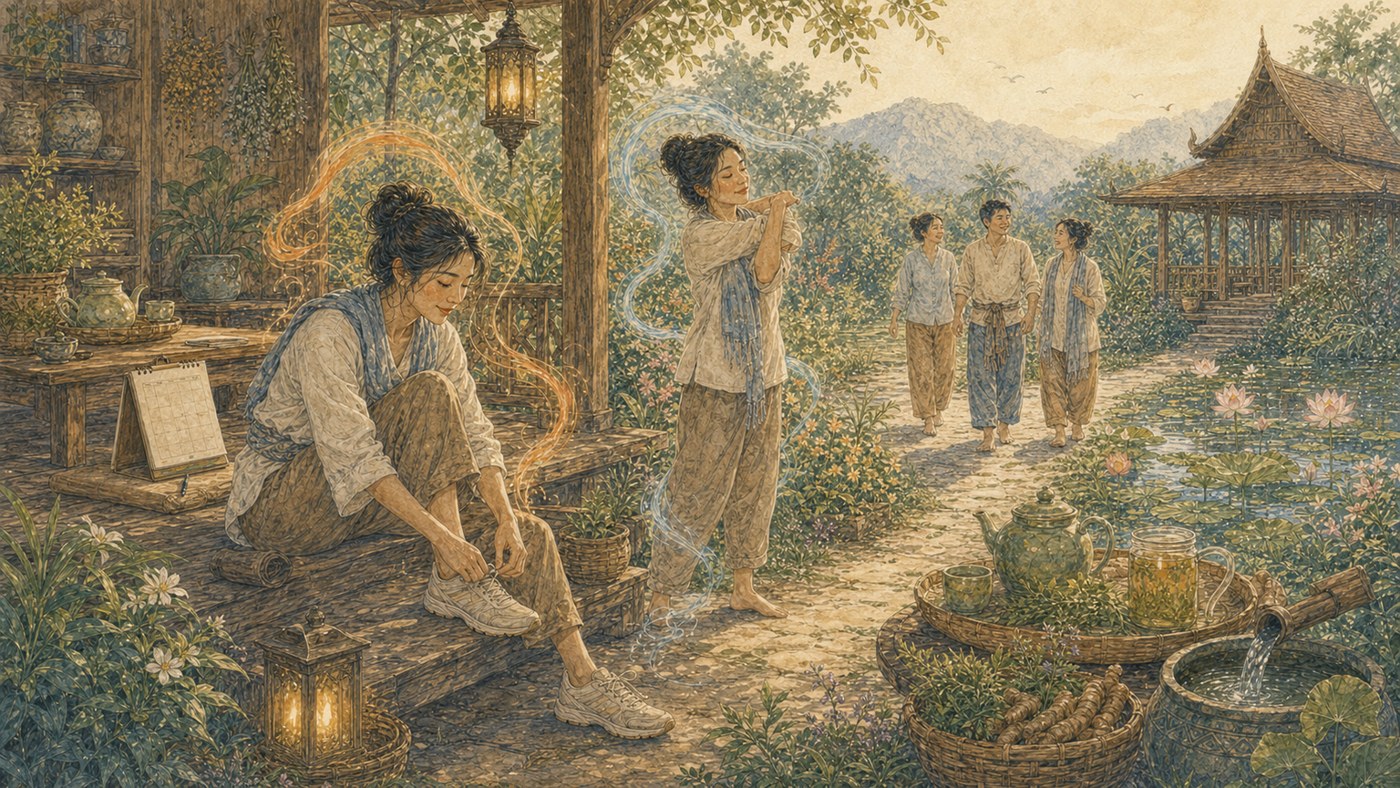
A January promise, an April question
Imagine the family making enthusiastic New Year plans. New joins a sixteen-week marathon course. Korn buys an exercise machine for the living room. Grandmother visits a shopping-centre gym with her daughter-in-law. Ou signs up for hot yoga. On the first day, everyone takes a photograph.
By April, New has stopped because her knee hurts. Korn has hardly used the machine since February. Grandmother misses having friends to talk to. Ou decides the heated class does not suit her. Their first plans have not survived contact with ordinary life.
This experience is familiar without needing an alarming statistic about how many people abandon a resolution. Work, illness, money, access, enjoyment, confidence and unsuitable starting demands can all play a part. A failed plan does not define the person who tried it.
The question is how to make a relationship with movement that we can use in the life we actually have. Plearnprai calls the approach kind discipline: enough structure to support action, and enough responsiveness to change the plan.
This chapter offers a ninety-day planning framework. Ninety days is a useful review period, not a scientifically fixed deadline by which a habit must become automatic.
Kind discipline lets care become something we can return to, even after an interruption.
Four foundations of a workable habit
Begin smaller than we expect
Popular approaches such as James Clear's Atomic Habits and BJ Fogg's Tiny Habits emphasise making an action easier to start. Their work can offer practical ideas; no single method works for everyone.
Instead of beginning with “run thirty minutes every day”, we might begin by putting on comfortable walking shoes. Instead of “do a full yoga session”, we could clear a safe space and practise one familiar movement. A starting action is not the whole health goal, but it can make the next step less daunting.
Plearnprai adds a question: does the activity's quality suit what we need and enjoy? A Wind Type might choose five minutes in a quiet garden. A Fire Type might begin with a short, comfortable pool visit. A Water Type might find a weekly social dance more inviting than another solitary plan. Type does not predict who will quit running or who can tolerate a long yoga class. We learn by trying an appropriate option and observing our response.
The practical formula is a prompt rather than a guarantee: a small beginning, a good personal fit, and a chance to repeat it.
Attach the action to an existing routine
A familiar event can remind us without requiring a new decision every day:
- After getting up and having a drink, take a five-minute walk around the home.
- After an evening shower, make three minutes for comfortable stretches.
- After arriving home from work, change clothes and take a short garden or neighbourhood walk.
The drink need not be warm, and the shower need not be a particular temperature. The useful part is a clear cue followed by a manageable action. If the sequence becomes inconvenient, change it.
Arrange the surroundings to help
Put shoes where they are easy to find, while keeping walking routes clear. Store a mat where it can be used without creating a trip hazard. Save a trusted beginner recording where it is easy to open. Make a simple appointment with a friend. If a step counter helps us remember to move, use it; if it creates pressure or distress, a different reminder may work better.
Our surroundings cannot remove every barrier. They can reduce a few of the small obstacles that otherwise use up attention.
Acknowledge the small action
After doing what we planned, take a moment to notice it. A smile, a brief note or telling someone “I made time for a walk today” can make the effort visible. We do not need to claim a particular brain circuit has been rewired to appreciate encouragement.
If the plan did not happen, ask what got in the way. Self-criticism rarely tells us whether the missing ingredient was sleep, transport, childcare, an easier starting point or medical advice.
The first thirty days: establish a manageable return
During the first month, focus on becoming familiar with the action rather than demanding weight loss or visible muscle changes. A habit may take longer than a month to settle, and that is ordinary.
Choose one suitable activity. Decide on a small dose—perhaps ten to fifteen minutes, or less—and connect it to an existing routine. Repeat it on a schedule that leaves room for recovery. Five or six brief, easy movement days may suit some people; three planned sessions or another arrangement may suit others. Strength sessions and more demanding activities need appropriate recovery.
Keeping the activity and cue reasonably consistent can help us learn. We can still change them for pain, illness, weather, access or a schedule that proves impractical.
New's first month
New chooses a gentle fifteen-minute walk near her condominium before work, Monday to Friday. The first week is awkward. She prepares her shoes the night before and shortens the walk when necessary rather than borrowing from sleep.
By the second week she may find the start more familiar. By the fourth, opening the door may require less negotiation. If she notices calmer mornings or better sleep, she records that. If headaches continue, she follows them up rather than waiting for walking to cure them.
The useful achievement is a routine she can return to. It remains useful even without a change in weight or appearance.
Korn's first month
Korn chooses a suitable pool on Monday, Wednesday and Friday afternoons. Thirty minutes could be appropriate for his established ability; he can begin with much less, including breaks.
At first he counts lengths and checks his speed. His wife gently asks whether he has come to enjoy the water or compete with the pool. He laughs and tries one session without the performance display. A watch can still be useful for pacing; the aim is to loosen pressure, not prohibit equipment.
Over the month he may begin to enjoy the sensation and rhythm of swimming. Wanting to return is a more useful habit signal than expecting a rash to disappear on schedule. Skin symptoms deserve their own care.
Grandmother's first month
Grandmother starts with a weekend market walk and a Wednesday community dance session. Twenty minutes at the market may include pauses to choose vegetables and speak with familiar sellers. At the dance group she uses a comfortable version and rests when needed.
In the first week, company helps her begin. In the second, she laughs while learning unfamiliar movements. By the fourth, she may want to arrive early to see friends. Confidence and everyday function can develop gradually; neither a new class nor a month of walking guarantees easier stairs for everyone.
Days thirty-one to ninety: refine, do not rush
Once a routine is familiar, ask whether it would benefit from a small change. We might add a few minutes, make one part a little more demanding, or introduce a complementary activity. We might instead keep the same dose because it already fits.
Change one aspect at a time when possible, so that we can understand the response. There is no universal ten- or twenty-per-cent weekly increase that is safe for every activity or condition. The right progression depends on the starting point, the load and recovery. Persistent joint pain, unusual exhaustion or a loss of everyday function calls for reducing demands and, when appropriate, seeking advice.
Rest days and pauses are part of the plan. A difficult week during the second month does not undo everything that came before it.
New's next stage
New might gradually build the walk towards twenty-five minutes and add ten minutes of suitable qigong on some days. If she enjoys a supported yin class, that could become a weekly option rather than another compulsory task.
She notices whether her legs feel more confident, whether the original knee pain needs further care, and whether the routine helps her manage the working day. These observations guide the next adjustment; they are not proof that a Type has been corrected.
Korn's next stage
An established swimmer might eventually choose up to forty-five minutes on four days, with a beginner tai chi session at the weekend. This is a possible later routine, not an instruction to double the first month's volume. Korn can add one change at a time and discuss it with his clinician when his health requires it.
He tracks blood pressure through the agreed medical plan. Enjoying a calmer routine may be valuable alongside that care. A lower reading does not justify changing medication on his own.
Grandmother's next stage
Grandmother might learn a small set of ruesi dat ton movements before the market walk, building towards ten suitable movements if she wishes. A Sunday garden walk with her daughter-in-law can add another social opportunity.
She notices confidence with stairs, comfortable reaching, pain, balance and fatigue. New friends matter too. The routine need not be expanded if the current arrangement is already enough.
Beyond ninety days: a living routine
After three months, some actions may feel easier to begin. Others may still need planning. A routine does not become permanent simply because a date has passed.
We can now keep what works and adapt the rest:
- Adjust to seasonal conditions rather than protecting a fixed timetable at any cost.
- Revisit capacity after illness, injury or a major life change.
- Try a new teacher, an accessible walking route or a different qigong sequence when variety would help.
- Invite someone close to join without turning the invitation into pressure.
- Make room for enjoyment as well as health goals.
Over a year and beyond, the questions from earlier chapters remain useful: What is today's capacity? What is the environment asking of us? What kind of movement is available? How did we recover last time?
A week or several weeks may pass with less activity because of illness, travel, a family emergency or work. A living routine includes a route back.
Returning after a pause
Begin without an accusation
There are periods when caring for a child, a parent or ourselves takes priority. Instead of “I have failed again”, we can say, “That period required something else. What is possible now?”
This is not pretending that barriers do not matter. It is choosing a question that can lead to a next action.
Return below the previous demand when needed
After a substantial break, particularly one involving illness or injury, the old routine may be too much. Review medical restrictions and begin with a manageable dose. A short interruption after which we remain well is different from a long or medically complicated one.
As examples, someone who previously walked thirty minutes might restart with fifteen; a swimmer who used to do forty-five might begin with twenty or less; someone who knew five Sun Salutation rounds might begin with two adapted rounds. These are illustrations, not a universal fifty-per-cent rule or a promise of full recovery in two to four weeks.
Ou's story offers another scale. After a month away, she begins with five minutes of walking. She may try ten later that week, fifteen the next, and return towards twenty as comfort allows. If the progression does not suit her, she changes it. Returning is the practice; a fixed deadline is not the measure of success.
A companion can change the experience
Some of us enjoy moving alone. Others find that company adds a reason to leave the house: someone is expecting us, there is a conversation to continue, or a shared joke makes the unfamiliar class less awkward.
A movement companion need not be fitter than we are. Often the useful match is someone whose company we enjoy and who respects our pace. We can walk with a partner, cycle safely with children, accompany a parent to the market, practise tai chi with a sibling, dance with a friend, or take a neighbourhood walk with someone nearby.
Agree that either person may shorten a session or cancel when unwell. Support should not become an obligation to push through symptoms. Different companions can join on different days.
Imagine New becoming bored with solitary walks after a few months. She asks in the condominium group whether anyone wants a morning companion. A fifty-year-old neighbour replies, and they arrange Tuesday, Thursday and Saturday walks. Over the next months, their conversations give the routine another meaning. It may become easier to maintain, without a guarantee that neither will ever miss a day.
A family that makes room for movement
A shared activity can create time together without requiring everyone to perform the same dose or have the same Type. Possibilities include:
- A Sunday park visit before preparing dinner, with shorter and longer route options.
- A Saturday market trip, allowing places to sit and enough time to browse.
- Parent-and-child table tennis without keeping score.
- Tending balcony plants together while getting ready for the day.
- A few gentle ruesi dat ton movements with Grandmother on a Tuesday evening, using only movements suitable for everyone joining.
These small arrangements can carry connection across generations. They do not have to look like a formal family workout.
Try it: our own ninety-day plan
Choose one realistic activity and write a flexible plan.
Days 1–30: Practise a manageable version at a convenient cue. Keep the pattern simple while changing anything that proves unsafe or impractical.
Days 31–60: Review comfort and recovery. If useful, add a little time or one complementary activity. Keeping the same dose is also an option.
Days 61–90: Refine the arrangement. Consider variety, a companion or a different time of day. Retain enough familiarity to make beginning easy.
At ninety days: Review body comfort, mood, sleep, energy, confidence and the practical barriers we have learned about. Acknowledge what we have managed. Set a next step without ranking ourselves against an imagined successful minority.
Three ways to keep the plan kind
Do not turn another person's progress into our deadline. A friend running ten kilometres says little about what our body, experience or circumstances require. Fifteen minutes of suitable walking can be a meaningful step.
Let the schedule serve the life. Unplanned events occur. Rest and revision are compatible with commitment.
Use sharing only if it supports us. A photograph or social post can be enjoyable and encouraging. It becomes less useful if it makes us ignore pain, compare bodies or perform an unsuitable session for an audience.
What to notice over time
In the first few weeks, look for a more workable beginning, comfortable recovery and the sense of having made some room for ourselves. Better sleep is a possible benefit, not a compulsory result.
Over one to three months, everyday activities may feel more manageable. We may enjoy movement more, gain strength or feel steadier. Weight may change little. A pain-free lift, reliable balance or improved stamina should be developed safely, not tested by attempting something beyond our ability.
Over a longer period, clinical measures such as blood pressure or glucose may improve as part of a wider care plan. Activity does not guarantee fewer infections or prevent every illness. The important outcome may be participation: tending a garden, playing with a child, travelling comfortably, or retaining more independence with appropriate support.
At fifty, sixty, seventy, eighty and beyond, our needs will change. Disability or illness does not erase the value of the care we have given ourselves. The aim is the best participation available to us, not a promise that everyone can preserve the same abilities indefinitely.
Closing the chapter
Kind discipline means beginning at a useful scale, choosing a good fit, linking it to everyday life, accepting help, and returning after interruptions. We can use the first month to become acquainted, the next months to refine, and the years ahead to adapt.
A quiet morning stretch, a social dance, a market walk, a gym session or an accessible home exercise can each become part of that rhythm. The value lies in a continuing relationship with ourselves, not a perfect streak.
In the closing reflection, we bring the fifteen chapters together and consider what this relationship can mean beyond an exercise plan.
MOVEMENT BY THE ELEMENTS
Closing Reflection — Movement as an Act of Care

Looking back over fifteen chapters
We have travelled through many ways of thinking about movement. We began with the limitations of asking everyone to follow the same plan. A demanding run, a heated class or a long period of stillness may suit one person and be unhelpful for another. The useful question is what fits this person, in these circumstances, at this time.
We considered Thai traditional medicine, Ayurveda and modern exercise science. They do not use identical concepts or have the same evidence base, but each can contribute questions about the person and the circumstances of care.
We distinguished an enduring constitution, prakriti, from the changing current state, vikriti, and explored bala as a traditional way of thinking about capacity. Then we followed three broad preferences: steadiness and comfortable warmth for Wind, space and moderation for Fire, engagement and continuity for Water. These are starting points, not boundaries around what a person can become or enjoy.
Mixed Types, life stages, seasons and daily schedules widened the picture. We met ruesi dat ton, Thai boxing forms, dance, yoga, tai chi, qigong, Manee Vej and walking meditation. We considered movement when stress, pain, disturbed sleep, weight concerns, pregnancy, recovery or a medical condition changes the plan. We also recognised when assessment, supervision or rest must come first.
Finally, we explored kind discipline: a way of returning to care that does not depend on a perfect January resolution.
What lies beneath the activity
Choosing a movement is also choosing a relationship with our body. We decide whether to listen to discomfort, whether to allow recovery, whether to make space for enjoyment, and whether to ask for help.
A movement brings together attention, surroundings, effort and breath. Sometimes it creates time with someone we love. Sometimes it offers a quiet moment alone. Its significance is not limited to the number on a device or the appearance of a posture.
The elemental perspective can be one tool within that relationship. It should help us notice more, not persuade us to ignore a symptom because it seems to fit a familiar description.
The circumstances we actually live in
Not everyone has a park nearby, access to a pool, a suitable class or predictable free time. Some people work nights, live alone, have limited income, care for family members or manage serious illness or disability. A book that describes pleasant walks must also acknowledge the people for whom leaving home is difficult.
We do not need to reproduce the family examples exactly. A few supported movements beside the bed, a short indoor walk, an appropriate seated leg movement or a comfortable pause during a journey may be what is available. Quiet breathing can be a moment of care even though it does not replace the aerobic or strengthening activity we may need.
The next useful step comes from our circumstances. If an activity requires help, accessible equipment or a professional plan, that is a legitimate part of the arrangement—not evidence that we have failed to listen well enough.
What we can pass on
For children and younger people, we can offer more than a target or an expensive course. We can demonstrate curiosity about the body, respect for individual differences and the willingness to stop when something is wrong.
We can show that rest is compatible with commitment, that enjoyment matters, and that people with different abilities can belong in a shared activity. We can introduce cultural practices with interest rather than claims that they explain everything.
Understanding our patterns should leave room to grow. A child called Wind should still be free to love sport; a child called Water should not carry an expectation of laziness; a child called Fire should not be asked to perform toughness. The framework serves the person.
The everyday richness of Thai movement
Gardening can connect a household with the soil and seasons. A market walk can bring food, conversation and activity together. Sweeping, preparing food and other household tasks involve the body. Dance, temple ceremonies and traditional practice can connect movement with cultural memory.
Care itself often includes movement: walking beside a parent, safely lifting a child, helping someone use an appropriate mobility aid. These tasks also require support and sensible techniques; caring for another person should not demand an unsafe lift or an injured back.
Such activities do not make all traditional life healthy or all modern life deficient. They remind us that movement has meanings beyond exercise. We can bring those meanings into a contemporary routine, including a gym, an accessible class or rehabilitation.
Our needs can change without changing who we are
Within Plearnprai's framework, constitution is understood as enduring. Our current state, fitness, skills, illness, age, environment and opportunities change. A routine that suited us in one period may need a different form later.
On a well-rested day, we may have room for variety or challenge. On a depleted day, a shorter session may be enough. During illness, rest or an individual rehabilitation plan may be necessary. When distressed, company or professional support may matter more than choosing the “correct” exercise.
A Type is therefore not a verdict or a lifelong activity restriction. Listening becomes more useful as it becomes more specific: what is happening now, what is safe, and what support would help?
Thank you for making this time
Thank you for bringing your attention to these pages. In a life with many competing demands, making time to consider care is itself meaningful.
There is no need to have followed every suggestion. Perhaps one question, one small sequence or one way of speaking more kindly to ourselves will travel beyond the book. That is a beginning worth keeping.
Further paths in the Plearnprai library
This book belongs to Plearnprai's Three Elements series. The wider collection explores the individual Types, mixed constitutions, relationships, food, emotional well-being and other areas of everyday care.
For someone interested in eating alongside movement, the food titles offer a companion perspective. Readers seeking a deeper understanding of themselves and others can turn to the introductory and Type-specific books. Emotional care and the relationship between elemental ideas and long-term conditions are explored elsewhere in the collection, with appropriate limits around clinical interpretation.
More detailed tools on yoga, tai chi–qigong, breathing and Manee Vej are development projects. Check the library for what is currently available, its edition and language; a title mentioned here is not a promise of a completed English manual.
- Plearnprai Library: library.plearnprai.org
- LINE Official account: @plearnprai
- YouTube channel name: เพลินไพร หมอข้างบ้าน — Plearnprai, the Neighbourhood Doctor
The family a year later
Imagine the family again after a year. New still enjoys a comfortable morning walk when her schedule allows. Sometimes she uses a watch; sometimes she notices the route without counting. Korn has found a pool routine he can enjoy without making every length a test. Grandmother combines market visits with friends and a suitable dance class. Ou has a short home sequence that fits around caring for the children.
They have not all become athletes. Their bodies have not necessarily changed shape. Some weeks are interrupted, and some activities need revision. What they have gained is a more workable way to return.
The second and third years will bring new circumstances. The enduring value is not an uninterrupted record. It is the understanding that the plan can change while care continues.
A wish for the days ahead
May we find movement that respects our bodies and circumstances.
May we begin at a scale we can use, and allow that beginning to grow without haste.
May we find companions who welcome our pace and respect our limits.
May we return after a pause without turning the pause into an accusation.
May we recognise when rest, treatment or assistance is the care we need.
May our families inherit curiosity, cultural connection and kindness towards different bodies.
And through the later years of life, may we have the support to participate in what matters to us—whether that means walking, stretching, tending a plant, holding a grandchild, or sharing laughter from a chair.
One more step, one more act of care
We began with the elements as an additional way to think about choosing activity. We close with something broader: movement can be a concrete expression of companionship with ourselves.
When we choose an appropriate action, we can say to the body, “We are still here. We will listen. We will ask for help when we need it.” That care does not disappear on a day when we cannot move.
Wind, Fire and Water offer images for different qualities of experience. A real person remains larger than those images. With time, we can become more attentive to the rhythm, effort and rest that support our own life.
Thank you for travelling through these pages. May what follows be neither a demand for perfection nor another reason to judge ourselves, but an invitation to care in the next available moment.
In a day, in a step, in an ordinary breath, we can begin again.
MOVEMENT BY THE ELEMENTS
Glossary
How the terms are used
This book draws on Ayurveda, Thai traditional medicine and modern exercise practice. Similar-sounding terms across these systems are not automatically equivalent. Traditional concepts can explain the framework without becoming laboratory measurements or medical diagnoses.
Water Type and Kapha. Plearnprai uses the accessible name Water Type for its Kapha-related constitution. Classical Ayurveda associates Kapha with both water and earth. The shorter Plearnprai term is a teaching adaptation; it does not remove the earth aspect from Ayurveda or make Kapha identical to the water element in every Thai medical context. In discussions of constitution in this book, Wind, Fire and Water refer to Plearnprai's Vata-, Pitta- and Kapha-related teaching terms.
Ayurvedic and Plearnprai terms
| Term | Meaning in this book |
|---|---|
| Ayurveda | An Indian medical tradition with its own concepts, texts and practices. Its explanations are distinguished here from contemporary clinical evidence. |
| Vata | A dosha traditionally associated with movement and with air and space. Plearnprai uses Wind in its constitution vocabulary. |
| Pitta | A dosha traditionally associated with transformation and with fire and water. Plearnprai uses Fire in its constitution vocabulary. |
| Kapha | A dosha traditionally associated with stability and with water and earth. Plearnprai uses Water Type as its concise constitution name. |
| Prakriti | Constitution, understood as enduring within this framework. It is not a clinical test result. |
| Vikriti | The present pattern or state of imbalance in Ayurvedic interpretation. The current state can change; it should not be used to explain away a medical symptom. |
| Mixed Type | A Plearnprai description in which more than one constitutional pattern is prominent. Examples include Wind–Fire Type, Wind–Water Type and Fire–Water Type. |
| Tridosha | Literally the three doshas. In constitution discussions, a relatively even three-dosha pattern may be described as a tridoshic constitution. It does not establish superior health. |
| Guna | Quality: a descriptive property used in traditional reasoning, such as warm, cool, light, heavy, dry or moist. |
| Ojas | A traditional concept associated with deep vitality and resilience. It is not identical to immunity or a measurable store of energy. |
| Dinacharya | Daily routine in Ayurvedic practice. Sometimes transliterated Dincharya. |
| Vyayama | Physical exercise in Ayurvedic teaching. |
| Ardha shakti | The traditional principle of exercising within roughly half one's capacity. It is not a validated calculation of fifty per cent of maximum heart rate. |
| Pranayama | Yogic practices involving breath and the traditional concept of prana. Techniques differ in demands and precautions. |
| Shitali pranayama | A traditional “cooling” breathing practice involving inhalation across a curled tongue. A sensation of coolness does not make it a treatment for heat illness. |
Bala: three traditional aspects of capacity
| Term | Traditional meaning and use |
|---|---|
| Bala | Strength or capacity. In this book it prompts attention to current readiness without replacing clinical assessment. |
| Sahaja bala | Innate capacity associated with constitution. |
| Kalaja bala | Capacity considered in relation to time, including age and season. |
| Yuktikrita bala | Capacity cultivated through appropriate habits and care, including food, activity and recovery. |
Yoga terms
| Term | Meaning and practical caution |
|---|---|
| Asana | A posture. The name alone does not establish its suitability for a particular person. |
| Hatha yoga | A broad yoga tradition; in many contemporary schedules, a class described as hatha uses a relatively unhurried approach. Actual levels vary. |
| Vinyasa | Linking movements in a sequence, often with breathing. Pace and difficulty vary; it does not always mean fast or strenuous. |
| Yin yoga | A style commonly using longer, relatively still holds. Long holds require individual adaptation and are not automatically gentle on joints. |
| Restorative yoga | Supported resting postures, often using blankets, cushions or other props. |
| Surya Namaskar | Sun Salutation: linked movement sequences, with several forms. A supported or modified version may be appropriate. |
| Chandra Namaskar | Moon Salutation: sequences commonly taught with a slower or more spacious emphasis; forms vary. |
| Hot yoga | Yoga in a heated setting. Heat adds risk for any Type; a Water Type is not inherently protected. |
Thai and other Asian movement practices
| Term | Meaning in this book |
|---|---|
| Ruesi dat ton | Thai hermit self-stretching or self-exercise traditions. Wat Pho records a historical collection of eighty postures under King Rama III; modern teaching sets differ. |
| Ram muay | Thai boxing-related ritual or movement forms. Non-contact practice is distinguished from sparring and competitive boxing. |
| Thai dance | Diverse Thai social, regional and classical movement traditions, with differing demands. |
| Tai chi / taijiquan | Chinese martial and movement traditions, including forms taught for health and balance. |
| Qigong | Varied Chinese practices involving posture or movement, attention and breathing. Qi is a traditional concept, not a medically measured fluid or force. |
| Manee Vej | A Thai movement approach associated with Prasit Kanthawong. Its traditional structural explanations are not proof that exercises reposition bones or regulate hormones. |
| Walking meditation / jongkrom | Walking with deliberate attention, often back and forth along a short clear route in Thai Buddhist practice. |
Modern exercise and clinical terms
| Term | Meaning in this book |
|---|---|
| FITT-VP | Frequency, Intensity, Time and Type, with Volume and Progression: a way to describe and individualise an activity plan. |
| HIIT | High-intensity interval training: harder intervals alternating with recovery. Suitability depends on health, experience and the actual programme. |
| HRV | Heart rate variability: variation in the intervals between heartbeats. Interpretation is context-dependent; it is not an elemental balance score. |
| GERD | Gastro-oesophageal reflux disease. Symptoms and treatment should not be inferred from an elemental label. |
| NCD | Non-communicable disease, a broad category including conditions such as cardiovascular disease and diabetes. |
| CBT-I | Cognitive behavioural therapy for insomnia, a structured treatment for persistent sleep difficulty. |
| Cardiac rehabilitation | A professionally supervised programme supporting recovery and ongoing care after qualifying heart conditions or procedures. |
| ACOG | American College of Obstetricians and Gynecologists. |
| ACSM | American College of Sports Medicine. |
| WHO 2020 guidelines | World Health Organization guidance on physical activity and sedentary behaviour across relevant populations. The advice is adapted to ability and health, not prescribed by Type. |
MOVEMENT BY THE ELEMENTS
References, Further Reading and Safety Index
Reading the evidence alongside the traditions
This book brings together traditional explanations, cultural movement practices, practical suggestions and contemporary health guidance. These are different kinds of knowledge. A traditional description of a posture's purpose is not equivalent to evidence that it treats a disease. Research on yoga, tai chi, walking or resistance exercise does not by itself validate matching those activities to elemental constitutions.
The numbered resources below support the clinical and safety boundaries used in this English edition. The broader reading lists preserve the works and topic areas identified in the Thai bibliography. Where an edition, page range or individual study was not supplied, the entry remains a reading lead rather than a verified citation for a specific claim. No missing publication details have been invented.
Numbered guidance used in this edition
[1] World Health Organization. WHO Guidelines on Physical Activity and Sedentary Behaviour (2020). Guidance for adults, older adults and other populations, including gradual progression and the value of activity within ability. Publication and full guideline.
[2] US National Center for Complementary and Integrative Health, NIH. Yoga: Effectiveness and Safety. Benefits, limits of evidence, qualified instruction and precautions for pregnancy, older age and health conditions. Yoga guidance.
[3] US Centers for Disease Control and Prevention. Heat and Athletes; and Heat and Cold Illness in Travelers, CDC Yellow Book. Heat exposure, hydration, gradual pacing and recognition of illness; fluid needs also require individual consideration. Exercise in heat · Heat and cold illness.
[4] American College of Obstetricians and Gynecologists. Exercise During Pregnancy and Committee Opinion No. 804, Physical Activity and Exercise During Pregnancy and the Postpartum Period (2020). Individual assessment, suitable activity, contraindications and warning symptoms. Patient guidance · Committee opinion.
[5] World Health Organization. Guidelines on Physical Activity, Sedentary Behaviour and Sleep for Children under 5 Years of Age (2019). Age-specific activity and sleep guidance; supervised awake tummy time is distinguished from sleep positioning. Full guidance.
[6] US Department of Health and Human Services. Physical Activity Guidelines for Americans, second edition (2018); and CDC, What Counts as Physical Activity for Children and Adolescents? Age-appropriate aerobic, muscle- and bone-strengthening activity. Guidelines PDF · CDC youth guidance.
[7] US National Institute on Aging, NIH. Guidance on exercise, physical activity, falls and fracture prevention in older adults. Exercise types · Falls and fractures.
[8] American Heart Association. Develop a Physical Activity Plan for You; What Is Cardiac Rehabilitation?; and Exercise Stress Test. Individual clinical assessment, rehabilitation and the role of testing. Activity plan · Cardiac rehabilitation · Stress testing.
[9] US National Center for Complementary and Integrative Health, NIH. Tai Chi: What You Need To Know. Evidence, safety and the importance of an appropriate instructor. Tai chi guidance.
[10] Wat Pho. Institutional account of ruesi dat ton and its historical posture collection. Used for the historical eighty-posture statement, not as clinical evidence for the postures' traditional indications. Wat Pho historical account.
[11] US National Heart, Lung, and Blood Institute, NIH. Insomnia: Treatment. Includes CBT-I as a usual first treatment for long-term insomnia. Insomnia treatment.
[12] National Institute for Health and Care Excellence. Chronic Pain (Primary and Secondary) in Over 16s, NG193 (2021), recommendations on assessment and supervised exercise for chronic primary pain. Recommendations.
[13] US National Institute of Diabetes and Digestive and Kidney Diseases, NIH. Healthy Living with Diabetes. Activity, medication-related hypoglycaemia and individual planning. Diabetes guidance.
[14] American Heart Association. Getting Active to Control High Blood Pressure. Gradual activity, regular breathing, aerobic and resistance exercise and individual precautions. Blood-pressure guidance.
These resources were checked during preparation of this edition on 13 October 2026. Online guidance can change; personal advice should use current information and the individual's circumstances.
Thai traditional medicine and Ayurveda: reading leads
- Royal Medical Texts of the Reign of King Rama V (Tamra Vejasat Chabap Luang), particularly material concerning elements and bodily care. The Thai bibliography does not specify volume or pages.
- Khamphi That Wiphang (Dhatu Vibhanga in some transliterations), for traditional elemental explanations. Edition not specified.
- Ruesi dat ton teaching materials associated with the Department of Thai Traditional and Alternative Medicine, Thai Ministry of Public Health. The original list names an eighty-posture resource but does not supply an identifiable edition; consult the actual manual before using its instructions.
- Vasant Lad, Ayurveda: The Science of Self-Healing (1984), for traditional Vata, Pitta and Kapha care.
- Vasant Lad, The Complete Book of Ayurvedic Home Remedies (1998), for traditional everyday applications.
- Robert Svoboda, Prakriti: Your Ayurvedic Constitution (1989), for constitutional interpretation.
- David Frawley, Yoga & Ayurveda: Self-Healing and Self-Realization (1999), for a traditional integration of yoga and Ayurveda.
- Charaka Samhita and Sushruta Samhita, especially discussions of vyayama and daily routine. Translation, edition and passages were not specified.
- Thai health-wisdom publications of the Department of Thai Traditional and Alternative Medicine, particularly on self-exercise and ruesi dat ton; individual titles were not specified.
The tridosha framework is used comparatively in Plearnprai. It is not a claim that all Thai and Ayurvedic concepts are interchangeable.
Modern exercise physiology and rehabilitation: reading leads
- William D. McArdle, Frank I. Katch and Victor L. Katch, Exercise Physiology: Nutrition, Energy, and Human Performance, eighth edition.
- Jack H. Wilmore, David L. Costill and W. Larry Kenney, Physiology of Sport and Exercise; edition not supplied.
- Frank H. Netter, Atlas of Human Anatomy; edition not supplied.
- American College of Sports Medicine resources on exercise prescription.
- Research areas identified in the Thai bibliography: exercise and ageing in The Journals of Gerontology and Aging Cell; sarcopenia and resistance training; movement disorders and rehabilitation. No individual articles were supplied for these entries.
Physical activity and health: reading leads
- WHO's 2020 guidelines and the US 2018 guidelines, identified in [1] and [6].
- ACSM's Guidelines for Exercise Testing and Prescription, eleventh edition, as named in the Thai bibliography. This edition entry should not be interpreted as a statement that it remains the newest available edition.
- Thai Department of Health guidance on exercise and physical activity; individual documents not specified.
- Thai Ministry of Tourism and Sports national sport-development plans and population activity recommendations; editions not specified.
- American Heart Association work on activity and cardiovascular prevention.
- American Diabetes Association work on activity and type 2 diabetes.
- Research on exercise and mental health in JAMA Psychiatry.
- Research on sedentary behaviour and health outcomes.
- Work on walking and longevity, including work by I-Min Lee and colleagues.
The last five entries identify organisations or research topics rather than particular studies. They should not be used to support a numerical effect or specific clinical claim without locating the actual publication.
Yoga, tai chi and qigong: reading leads
- B.K.S. Iyengar, Light on Yoga (1966).
- T.K.V. Desikachar, The Heart of Yoga: Developing a Personal Practice (1995).
- David Frawley and Sandra Summerfield Kozak, Yoga for Your Type: An Ayurvedic Approach to Your Asana Practice (2001).
- Patanjali, Yoga Sutras; translation and edition not specified.
- Cheng Man-ch'ing, T'ai Chi Ch'uan: A Simplified Method of Calisthenics for Health and Self-Defense; edition not supplied.
- Yang Jwing-Ming, Taijiquan: Classical Yang Style; edition not supplied.
- Roger Jahnke, The Healing Promise of Qi: Creating Extraordinary Wellness Through Qigong and Tai Chi (2002).
- Kenneth Cohen, The Way of Qigong: The Art and Science of Chinese Energy Healing (1997).
- Topic leads: Cochrane reviews on tai chi and balance in older adults; yoga and chronic pain studies in Pain Medicine; qigong and cardiovascular-health studies in the American Journal of Cardiology. Individual reviews and articles were not identified in the supplied bibliography.
Traditional and popular books can explain a practice's ideas and history. Their inclusion does not endorse every health claim or make an advanced posture suitable for self-teaching.
Thai movement and cultural heritage: reading leads
- Wat Pho's ruesi dat ton records and teaching tradition; see the specific historical source in [10].
- Ruesi dat ton manuals of the Department of Thai Traditional and Alternative Medicine.
- Traditional Muay Thai materials concerning wai khru and movement forms; individual titles not specified.
- Thai Fine Arts Department materials on dance, including regional and festive dance forms; individual titles not specified.
- Department of Cultural Promotion materials on Thai intangible cultural heritage and movement traditions.
- Teaching materials associated with Prasit Kanthawong and Manee Vej; editions and dates require verification against the actual materials.
- Thai research on ruesi dat ton in Thai Journals Online and Thai traditional medicine journals; the bibliography supplies no individual study citations.
Habit formation and psychology: reading leads
- James Clear, Atomic Habits: An Easy & Proven Way to Build Good Habits & Break Bad Ones (2018).
- BJ Fogg, Tiny Habits: The Small Changes That Change Everything. The Thai list gives 2019; publication dates vary by market and edition, and the particular edition was not supplied.
- Charles Duhigg, The Power of Habit: Why We Do What We Do in Life and Business (2012).
- Carol Dweck, Mindset: The New Psychology of Success (2006).
- Kelly McGonigal, The Joy of Movement: How Exercise Helps Us Find Happiness, Hope, Connection, and Courage. The Thai list gives 2019; the particular edition should be checked.
- Daniel Lieberman, Exercised: Why Something We Never Evolved to Do Is Healthy and Rewarding (2020, as listed; editions differ by market).
- Research leads: habit formation by Phillippa Lally and colleagues in the European Journal of Social Psychology; self-compassion and health behaviour work associated with Kristin Neff; and social support and exercise adherence. Full study details were not supplied.
These reading leads do not establish a universal thirty- or ninety-day habit deadline, a New Year failure percentage, or a fixed multiplication of success from having an exercise companion.
Additional reading leads
- Dan Buettner, The Blue Zones (2008), on described lifestyles in selected long-lived communities.
- Bessel van der Kolk, The Body Keeps the Score (2014), on trauma and bodily experience.
- Stuart McGill, Back Mechanic: The Step-by-Step McGill Method to Fix Back Pain (2015), as named in the Thai bibliography.
- Norman Doidge, The Brain That Changes Itself (2007), a popular account of neuroplasticity.
- Mihaly Csikszentmihalyi, Flow: The Psychology of Optimal Experience (1990).
- Héctor García and Francesc Miralles, Ikigai (2016 in the original bibliography; language and edition not specified).
- Qing Li's writing on forest bathing, or shinrin-yoku; exact title and edition not specified.
- WHO resources on healthy ageing and functional ability.
- CDC resources on physical activity for different groups.
- Thai Department of Cultural Promotion records of local health and movement practices; individual documents not specified.
Books about longevity, trauma, the brain or back pain are not substitutes for individual diagnosis or rehabilitation. A compelling story and a clinical recommendation require different kinds of support.
Safety index
This index points to relevant discussions and questions for an individual plan. It is not a complete contraindication list. Some groups below need advice beyond what Chapter 14 can provide.
| Situation or group | What to consider | Relevant discussion |
|---|---|---|
| Diabetes | Medication-related low glucose during or after activity; agreed glucose, food and medication plan; complications affecting feet or eyes | Chapter 14 and the diabetes team |
| High blood pressure | Control of blood pressure, breath-holding and straining, unsuitable demanding holds or heat exposure | Chapter 14 |
| Heart disease | Individual activity prescription, symptoms, rehabilitation and testing when indicated | Chapter 14; treating team |
| High blood lipids | Gradual activity; other conditions and medicines may determine precautions | Chapter 14 |
| Kidney disease | Individual fluid, blood-pressure and activity advice; avoid self-prescribing protein or electrolyte supplements | Clinical plan; Chapter 14's general principles |
| Asthma | Personal treatment plan and triggers such as cold dry air, pollution or pool irritants | Clinical plan; Chapter 14's general principles |
| Pregnancy | Individual assessment; overheating, collision and fall risk; positional adaptations and warning symptoms | Chapters 11 and 14 |
| After birth | Birth-specific recovery, symptoms, pelvic-floor function and gradual progression; no universal clearance date | Chapter 14 |
| Infants and young children | Age-appropriate active play; awake supervised tummy time where relevant; safe supervision | Chapter 11 |
| Children aged 6–12 | Enjoyable activity and appropriate supervision; properly designed strength work differs from unsafe maximal lifting | Chapter 11 |
| Adolescents | Suitable coaching, progressive load, recovery and pressure around competition or body image | Chapter 11 |
| Older adults | Balance, safe transitions, strength and individual joint or health limitations | Chapters 11 and 14 |
| Older adults with several conditions | A coordinated plan reflecting medications, symptoms and functional needs | Chapters 11 and 14; clinical team |
| Osteoporosis | Fracture and fall risk; individual advice on loaded or forceful spinal flexion and twisting | Clinical or physiotherapy plan; Chapter 14 |
| Persistent back pain | Assessment, appropriate pacing, suitable lifting and movements; urgent neurological warning signs | Chapter 14 |
| Persistent knee pain | Provoking loads, swelling or injury; individual strengthening and activity choice | Chapter 14 |
| Persistent neck or shoulder pain | Avoid forceful stretching or self-manipulation; review posture changes and symptom patterns | Chapter 14 |
| After surgery | Procedure-specific walking, lifting and wound restrictions, with agreed progression | Chapter 14; surgical team |
| Seizure history or epilepsy | Individual safety plan, especially for water and heights; no swimming alone; avoid forced hyperventilation | Clinical plan; Chapter 14's general principles |
| Recurrent dizziness | Assessment of cause; supported movement, transitions and fall precautions | Chapter 14 |
| Balance difficulties | Stable support, seated alternatives and supervised balance work where needed | Chapters 11 and 14 |
| Severe depression or anxiety | Movement as optional support alongside appropriate treatment; urgent help when safety is at risk | Chapter 14 |
| Disordered eating or compulsive exercise | Specialist support; do not use these routines to compensate for eating or enforce extreme weight control | Chapter 14 and an appropriate specialist |
| Medicines affecting blood pressure, heart rate or glucose | An activity plan that accounts for their effects; do not adjust doses independently | Chapter 14; prescriber or pharmacist |
The limits of a general book
This is an everyday-care book, not a clinical rehabilitation manual. It cannot replace a clinician, physiotherapist, qualified exercise professional or other practitioner who understands our condition and local scope of practice.
Seek individual advice when a medical condition, pregnancy, recent birth, surgery, injury, unexplained pain, severe emotional distress, balance problem or medication makes the appropriate activity uncertain. A substantial increase in effort may require a different plan from ordinary daily movement. Age alone does not determine the need for exercise testing.
The detailed movement tools mentioned elsewhere in this book are separate projects. A short description of yoga, tai chi, qigong or Manee Vej is not sufficient instruction for every posture or clinical circumstance.
Prepare for an emergency locally
Keep the emergency medical number for the country we are in, a trusted contact, relevant medical information and any prescribed emergency plan somewhere easy to find. When travelling, check local arrangements in advance. Use current official local information to confirm the correct service.
For suspected heart attack, stroke, severe breathing difficulty, collapse or another immediate medical emergency, stop the activity and seek emergency help promptly. Do not wait to see whether a different movement restores balance.
For an immediate risk of self-harm or inability to stay safe, contact local emergency or urgent mental-health services and ask a trusted person to remain with us when possible. For non-urgent but persistent distress, seek appropriate professional care. Movement can be part of support, but it is not an emergency response or a substitute for treatment.
The purpose of these boundaries is practical: to help ordinary care and appropriate professional care work together.
Caring for one another.