
The Plearnprai Three Elements Series · Book One
WIND TYPE
Understanding Yourself and
Caring for Your Well-Being
PLEARNPRAI
First English Edition · 2026
A COMPANION TO EVERYDAY CARE
WIND TYPE
Understanding Yourself and Caring for Your Well-Being
The Plearnprai Three Elements Series · Book One
Plearnprai · English editorial adaptation
13 October 2026 · First English Edition
This edition follows the complete fifteen-chapter route of the Thai book คนธาตุลม, with its introduction, closing and reference appendix. It uses the agreed concise name Wind Type and the inclusive voice “we”.
It is an adaptation for English readers, with corrections to distinguish traditional interpretation, Plearnprai's current framework and clinical information. The accompanying editorial notes document substantive changes. The original watercolour cover and all seventeen chapter illustrations have been retained.
English edition 1.0 · Published in the Plearnprai Library on 13 October 2026.
Contents
Introduction · A Book for Us4PART ONE · GETTING TO KNOW OUR BODY
1 · Our Origins82 · The Body We Live In113 · Recognising Our Strengths14PART TWO · GETTING TO KNOW OUR MIND
4 · Our Mind in Balance175 · When the Mind Becomes Unsettled206 · Body and Mind in Conversation23PART THREE · WHEN BALANCE BECOMES DIFFICULT
7 · Understanding Symptoms Without Predicting Illness268 · A Four-Phase Map of Strain299 · Signals That Deserve Attention32PART FOUR · CARING FOR THE BODY
10 · Food That Supports Us3511 · Movement at a Sustainable Pace3912 · Rest and Sleep42PART FIVE · CARING FOR THE MIND
13 · Making Space for the Mind4514 · A Daily Rhythm of Our Own48PART SIX · APPROACHES TO CARE
15 · Exploring Complementary Approaches52Closing · Our Capacity for Change56Sources and Further Reading59A Short Glossary63INTRODUCTION
Introduction · A Book for Us

A story that may sound familiar
People sometimes arrive at Plearnprai with remarkably similar stories.
Gaining weight seems difficult, however much they eat. Sleep takes time to come, or breaks in the middle of the night. When they do sleep, their nights seem full of dreams. Their digestion is unsettled: constipation one day, loose stools another, and frequent bloating. They startle easily. Their heart sometimes races, or they feel light-headed when standing up quickly. Their hands and feet feel cold; their skin and hair feel dry.
Some have had blood tests, scans or other investigations without finding an explanation for how they feel. The results may be reassuring, yet daily life still does not feel comfortable.
Perhaps we have been told, “There is nothing wrong,” or “You are thinking too much.” After hearing this often enough, we may begin to doubt ourselves. Why does caring for this body seem so difficult? Why do we seem more sensitive than other people?
If this story reminds us of ourselves, or of someone we love, this book is written with us in mind.
There is nothing wrong with being sensitive
From the first page, Plearnprai wants to offer a kinder starting point: sensitivity does not make us defective, and a slender body is not a measure of our worth or strength.
In Plearnprai’s three-element framework, Wind Type is our short term for a person with a Wind constitution. Some of the patterns described in this book are associated with this type. We will explore how qualities that can feel difficult in one setting may also be sources of ability and possibility in another.
A light, agile body brings a runner to mind. Quick awareness of movement and sound suggests a watchful member of a travelling group. Throughout the book, the image of an “early hunter” helps us imagine the value of movement, alertness and adaptability.
This is a storytelling metaphor, not a claim that a constitutional type proves our ancestry or explains an individual symptom. It invites us to see ourselves with curiosity rather than blame.
The purpose of this book is to help us understand ourselves and consider ways of caring for ourselves. It is not to tell us that we are ill because we fit a type.
Recognising the Wind Type
Before going further, we can pause and notice what feels familiar. The following are observations used in this framework, not a diagnostic test or a validated score. It matters whether a feature has been part of our long-standing nature or has appeared only recently.
- A slender build or small frame, with a long-standing tendency to find weight gain difficult.
- Cold hands and feet, or sensitivity to cold surroundings.
- A tendency towards dry skin, dry hair or fragile nails.
- Light or easily interrupted sleep, vivid dreams, or a busy mind in the evening.
- Sensitive digestion, bloating, or changes in bowel habits.
- Being easily startled; sometimes noticing palpitations or light-headedness when standing.
- Energy that arrives in bursts: thinking and acting quickly, then tiring.
- Quick observation, curiosity and enjoyment of novelty, with thoughts that become scattered when tired.
Several familiar features may make this book useful to explore. They do not, by themselves, establish our constitution or the cause of any symptoms.
Within this model, everyone has Wind, Fire and Water. Some people show a more prominent Wind pattern; others recognise a mixture. We do not need to force ourselves into every description.
What do we mean by an element?
In Thai traditional medicine, the body is described through four elements: Earth, Water, Wind and Fire. Broadly, Earth refers to bodily structure, Water to fluids, Wind to movement, and Fire to transformation and heat.
This series uses Plearnprai’s three-element framework to make patterns of everyday care easier to discuss. It focuses on Wind, Fire and Water, while recognising the four-element foundation of Thai traditional medicine.
We also draw comparisons with Ayurveda’s Vata, Pitta and Kapha. These are comparisons between frameworks, not a claim that the traditions use identical definitions. Here, “element” and “energy” are terms within the model, not chemical elements or measured physical energy.
One distinction is essential. In Plearnprai’s current framework, constitution means an enduring pattern understood to be present from early life. Our current state is how we are doing now, and can change with circumstances and care. We can work towards a more comfortable balance without describing this as changing our underlying constitution.
A different way of seeing ourselves
Living with difficult sleep, unsettled digestion or worry can make our body feel like a list of problems. The early-hunter metaphor offers another way to look.
Imagine someone who moves lightly across open ground, notices small changes in the surroundings, and responds quickly when the group needs attention. In that picture, sensitivity and mobility have a place. They are not faults to be erased.
Our lives today may allow much less movement, outdoor time or regular rhythm than we would like. The metaphor invites us to notice that mismatch and ask what helps us feel more at ease. It does not establish why we have insomnia, digestive symptoms, palpitations or anxiety.
We will return to this image in the first part of the book. For now, we can hold on to a gentler thought: caring for ourselves need not begin with a struggle to become someone else. It can begin with learning what supports us.
Our route through the book
The book follows six parts:
- Getting to know our body. We explore the story behind the Wind pattern, look at bodily functions and recognise possible strengths.
- Getting to know our mind. We consider emotional experience and the connections between body and mind.
- When balance becomes difficult. We notice signals of distress and distinguish self-care questions from concerns that call for medical attention.
- Caring for the body. We explore food, movement, rest and sleep.
- Caring for the mind. We consider practices and daily rhythms that may help us feel more settled.
- Approaches to care. We examine the approaches discussed in the Thai book, their intended roles and their boundaries.
The closing chapter returns to our capacity for change: our habits, circumstances and present balance can shift, even when our constitution is described as enduring.
Three agreements before we begin
First, we will use “we”. Writer and reader are travelling together. Plearnprai is not speaking from outside ordinary human life; we, too, are learning how to care for it.
Second, this book will not judge us. A constitutional description is not a verdict, and struggling with our health is not a moral failure. We can meet what we notice with patience.
Third, the book is a companion to care, not a replacement for medical assessment. Seeking professional help is part of looking after ourselves. It is not a failure to manage alone.
With these agreements in place, we can begin: with curiosity about this body, and respect for the life it carries.
PART ONE · GETTING TO KNOW OUR BODY
1 · Our Origins
A journey into the distant past
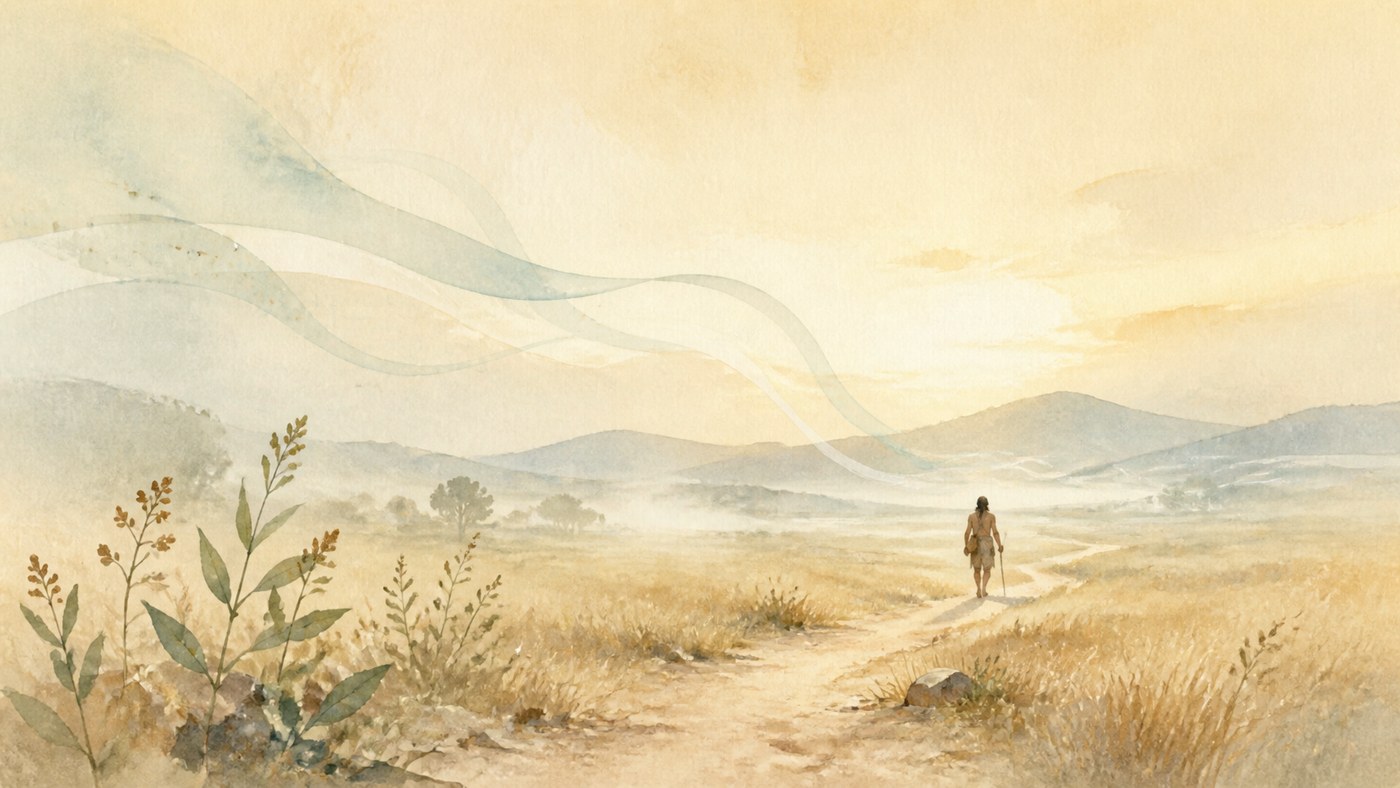
Let us begin by stepping away from the present for a moment. Imagine an open African landscape in the distant past: bright sunlight, dry ground, and an antelope disappearing beyond the grass. A human runner cannot match the animal's first burst of speed. Yet the runner keeps moving, sometimes running, sometimes tracking, finding the trail again after it seems to have disappeared.
This scene invites us to think about endurance rather than speed. The important qualities are persistence, observation, an ability to manage effort, and the knowledge of when to stop. It is an imagined scene, not a reconstruction of the ancestry of any particular person.
The Thai book calls this figure the “early hunter”. We will keep that image as a companion through the English edition. It helps us see value in lightness, alertness and movement. It does not mean that people described as Wind Type descend from a separate group of hunters, or that their symptoms prove an evolutionary role.
The hunter and the endurance-running hypothesis
How could a relatively slow human compete with a fast animal? Researchers have explored the possibility that sustained running contributed to the evolution of the human body. In their 2004 paper, Dennis Bramble and Daniel Lieberman discussed features that may support endurance running, with fossil evidence reaching back roughly two million years. This is a hypothesis about human evolution, not a study of Plearnprai's constitutional types. [1]
Sweating, body proportions, the spring-like action of tendons and the coordination of breathing and movement are among the subjects discussed in this wider field. They invite us to appreciate a body capable of steady effort rather than judge it only by its size or its speed over a short distance.
We should not turn the illustration into a claim that every early human hunted without tools, that every hunt followed the same sequence, or that every slender person is naturally an endurance athlete. The picture is useful because it broadens our imagination. Its limits matter as much as its appeal.
What looks like a weakness may also have value
A slender frame can feel like a disadvantage in a world that prizes visible muscle. Sensitivity can seem inconvenient in a noisy room. Noticing every small movement can be tiring. Yet the same descriptions look different when we imagine someone moving across unfamiliar ground and paying close attention to the surroundings.
Long, relatively slender limbs bring to mind a body that releases heat readily. The Thai source uses Allen's rule, a broad ecological idea about body proportions and climate, as a comparison. It is not an explanation of an individual person's constitution, weight or cold sensitivity. Those characteristics have many influences.
Quick awareness suggests a watchful companion: someone who notices a change in the landscape or a sound that others have missed. Light sleep suggests the image of a sentinel. These images can help us stop treating sensitivity as a personal defect. They do not establish that insomnia is inherited watchfulness, or that we need less restorative sleep.
The same care is needed when we speak about digestion. A lively, mobile way of living is a useful story; it is not evidence that digestive symptoms are the legacy of a hunter's gut. We can honour the metaphor while still taking discomfort seriously.
Living traditions are not constitutional labels
The original book points to distance-running traditions among the Rarámuri of Mexico, the San of southern Africa, and Kenyan runners, including people from Kalenjin communities. These examples invite interest in human skill, training, culture and environment.
They should not be used to assign an elemental type to an ethnic group. A community contains many different people, bodies, abilities and ways of life. Nor does a running tradition tell us why a particular reader is thin, anxious or sensitive to cold. We can appreciate these traditions without turning them into a biological classification.
An old image in a modern day
Now return to the present. We may spend hours seated, moving mainly between a desk, a vehicle and a screen. Messages arrive faster than we can answer them. Meals and sleep move around our obligations. There may be little outdoor time and few pauses that feel like real rest.
Against that background, the early-hunter image asks a practical question: what opportunities for comfortable movement, attention and recovery are missing from our day?
Perhaps we think more clearly after a walk. Perhaps a predictable meal makes the afternoon easier. Perhaps quiet time gives an alert mind room to settle. These are observations we can explore. They are not proof that “Wind has nowhere to go”, and they do not explain away a racing heart, persistent insomnia or unexplained weight loss.
Four ways of looking, with different meanings
The Thai book places several traditions alongside one another. Keeping their differences visible makes the comparison more useful.
Thai traditional medicine uses Wind, or vayo dhatu, in descriptions of movement and bodily function within a four-element framework. Plearnprai draws on this language while organising its own three-element approach to everyday care.
Ayurveda describes Vata and an enduring constitution, or prakriti. Some qualities associated with Vata resemble the Wind pattern discussed here. Similarity does not make the two systems identical. A 2015 genetic study of 262 selected men explored associations with three prakriti groups; it did not validate Plearnprai's Wind Type or establish a genetic test for this book's readers. [2]
Traditional Chinese medicine has its own accounts of qi, movement and patterns of imbalance. These offer another comparative vocabulary, not a direct translation of Thai Wind or Ayurvedic Vata.
Contemporary biomedicine describes anatomy, physiology, disease and individual variation through different methods. “Ectomorph” is a description of physique, not a diagnosis of Wind Type. Inherited influences on body size do not prove the hunter story or connect every symptom to one constitution.
These are conversations between frameworks. Their resemblance is not four independent demonstrations of the same medical theory.
Pause and notice · When do we feel most at ease?
Think of a day when our body felt comfortable and our attention felt alive.
- Were we moving, resting, spending time outdoors, or sharing an activity?
- What pace allowed us to feel engaged without feeling driven?
- What helped us recover afterwards?
There is no answer we are supposed to give. A person who enjoys stillness has not failed the Wind description. We are collecting clues from our own experience, not proving a label.
Before the next chapter
We began with an image that gives sensitivity and movement a place. Next, we will come closer to the body we actually live in: its everyday patterns, its changes, and the signals that deserve our attention.
CHAPTER 02
2 · The Body We Live In

Meeting the body that wakes with us
In the previous chapter, we travelled into an imagined past. Now we return to the body that wakes with us every morning.
Many of us have lived in our body for years without feeling that we understand it. Why does it respond this way? Why does one day feel easy and another feel unsettled? Without a way to make sense of our experience, small changes can become sources of worry.
This chapter invites us to become familiar with our usual patterns. The Wind description is a starting point for reflection, not a checklist that can diagnose our body. We will begin with what we can see, then move towards what we can notice from within.
Our shape · the image of a runner
The traditional Wind portrait often includes a slender build, a relatively light frame and difficulty gaining weight. It may also mention visible veins, prominent joints, dry skin, brittle nails or hair that feels dry. Some readers will recognise these descriptions; others will recognise only a few.
The word ectomorph sometimes appears in discussions of a lean physique. It does not identify an illness or explain a person's metabolism. Nor does a lean build automatically mean that we are healthy or unhealthy, eating too little or exercising too much.
Body size reflects many influences, including inherited characteristics, nutrition, activity and health. We do not need to judge ourselves for our shape. At the same time, being unable to maintain an adequate weight, losing weight unintentionally, or noticing a marked change deserves assessment rather than a constitutional explanation.
A responsive nervous system
The autonomic nervous system helps regulate functions such as heart rate, blood pressure and digestion without our having to direct each action. The Wind portrait uses “sensitivity” to describe a person who notices and responds quickly to changes around them. This is not a measured diagnosis of autonomic dysfunction.
We may recognise easy startling, a racing heart during stress, or light-headedness when standing. Such experiences have several possible explanations. They should not simply be assigned to Wind.
For example, orthostatic hypotension involves a fall in blood pressure on standing. POTS, or postural orthostatic tachycardia syndrome, involves a particular pattern of increased heart rate on standing and requires clinical assessment. These are distinct conditions, not synonyms for a sensitive constitution. [3]
If symptoms recur, interfere with life or lead to fainting, we should discuss them with a clinician. Palpitations with chest pain, severe breathlessness or fainting need urgent attention; Chapter 9 explains this more fully.
The gut that speaks with the mind
An unsettled stomach may be one of the most familiar parts of the Wind portrait. Bloating, constipation, loose stools and sensitivity to particular foods can make eating feel unpredictable.
The brain and digestive system communicate in several ways, including neural, hormonal and other signalling pathways. The vagus nerve is one participant in this network, not the whole explanation. Irritable bowel syndrome is understood as a disorder involving gut–brain interaction; its causes are complex and are not reducible to worry. [4]
We may notice that a difficult meeting affects our stomach, or that a painful stomach makes concentration and patience harder. Recognising that interaction does not make symptoms imaginary. It also does not mean that all digestive trouble is IBS or caused by stress.
Our task is to notice patterns without deciding the medical cause for ourselves. Persistent changes, bleeding, severe pain or weight loss belong in a clinical conversation.
Sleep and the watchful mind
Some readers will know the experience of lying down tired while thoughts continue to move. Others wake easily or remember vivid dreams. The image of the night watchkeeper can make that experience feel less like a personal failing.
It remains an image. We cannot infer a person's sleep stages from how many dreams they remember, and there is no established rule that Wind Type needs lighter sleep or has more REM sleep.
A state of heightened arousal can be one part of insomnia, but sleep difficulties have many possible contributors. The useful question is not “Was I born to stay awake?” It is “What is making rest difficult, and what support would help?” We return to that question in Chapter 12.
Skin and hair · caring for the surface
Dry skin, dry hair and brittle nails are included in the traditional Wind description. Rather than assuming that a constitution determines oil production or water loss, we can begin with the skin in front of us.
Does it feel worse in dry weather? Is a product irritating it? Does gentle moisturising help? Ordinary skin care can be worthwhile without an elaborate explanation. Persistent irritation, cracking, a spreading rash or signs of infection should not be dismissed as an element expressing itself.
The larger lesson is simple: needing care is not a defect. We can respond to discomfort with attention instead of criticism.
Energy that comes in waves
The Wind portrait describes bursts of enthusiasm followed by a need to pause. We may work quickly when an idea catches us, then struggle to sustain the same pace for the rest of the day. Hunger may disappear while we are absorbed in a task and return all at once later.
This picture may help us plan our day, but it does not establish a special metabolic rate or explain marked fluctuations in energy. Sleep, food, illness, medication and demands on our attention can all matter.
When possible, we can place demanding work in a period when we usually feel able to do it. We can also leave room for recovery rather than treat every pause as lost time. A useful schedule responds to the person, rather than requiring the person to match a label.
Learning our usual pattern
The most useful skill in this chapter is recognising what is usual for us. A familiar pattern gives us a point of comparison when something changes. It does not make every familiar symptom harmless; symptoms that remain troublesome still deserve care.
Pause and notice · A week of getting acquainted
For one week, observe without grading ourselves.
- How much sleep usually leaves us feeling rested? When is our energy most dependable?
- What is digestion like on a comfortable day? Which meals seem to agree with us?
- When we feel calm, how does breathing feel? What happens when we are under pressure?
- What is the earliest sign that we have taken on too much?
A few notes are enough. We do not need to monitor every heartbeat or turn our day into a medical chart. The aim is the familiarity we might develop with a close friend.
Before the next chapter
We have looked at shape, sensitivity, digestion, sleep, skin and daily rhythm. Next, we will turn from what feels difficult to what helps us contribute, adapt and enjoy our lives: our strengths.
CHAPTER 03
3 · Recognising Our Strengths

More than a list of difficulties
If someone asked us to name the things that are difficult about our body or mind, the answers might come quickly. We sleep lightly. We worry. We become distracted. We tire after doing too much.
Now imagine being asked a different question: what do these same qualities help us do well? We may need longer to answer. That pause tells us something about how often we have been encouraged to notice our problems and how rarely we have been invited to recognise our abilities.
The Wind portrait is most useful when it makes room for both. It should not become a catalogue of shortcomings. This chapter invites us to look for strengths in our own experience, whether or not every description feels familiar.
Strengths we may recognise in the body
The early-hunter image brings endurance and agility to mind. Some of us enjoy walking for a long time, moving lightly, or responding quickly when something changes. A smaller frame can feel comfortable for certain activities; coordination and practice can make movement satisfying.
These are possibilities, not promises attached to Wind Type. Endurance depends on health, training and circumstances. A slender person is not automatically fit, and a larger person is not automatically less agile. We do not need to compare bodies to appreciate what our own can do.
The Thai portrait also describes quick waking and a body that does not easily accumulate weight. In everyday life these may feel useful in some settings and difficult in others. Weight regulation is not a virtue, and persistent difficulty maintaining weight is not a strength to be celebrated at the expense of health.
We can ask a more personal question: when does movement leave us feeling capable and alive? The answer is more useful than an idealised picture of what a Wind body ought to be.
Strengths we may recognise in the mind
A quick mind can connect ideas that first appear unrelated. While others are considering one route, we may already be imagining several. This can be valuable when a problem needs a fresh approach.
Close observation can also be a gift. We may notice a change in someone's expression, an overlooked detail, or the moment when a conversation needs a gentler tone. Sensitivity can support attentiveness and care, even though it can also become tiring.
Curiosity gives us another source of energy. A new subject, a question or an unfamiliar place may wake our interest. We may enjoy learning by making connections rather than following only one fixed path.
Flexibility can help when a plan changes. We may be able to improvise, discover an alternative or find something worthwhile in an unexpected situation. None of these abilities belongs exclusively to one type. The purpose is to recognise what is present, not to claim what others lack.
The roles in which we come alive
The Thai book describes a person who starts things: suggesting a project, seeing a possibility, or giving a group its first spark of enthusiasm. It also describes a person who notices early signs, brings people together, or translates one person's idea into language another can understand.
We may recognise ourselves as a connector, an observer, a storyteller or a creative problem-solver. Such roles can appear in a family, a classroom, a clinic, a workshop or an ordinary conversation. They do not require a particular job title.
A constitution should not decide our career. Training, opportunity, values, responsibilities and preference matter. The helpful question is where our abilities are welcome and where we have enough support to use them sustainably.
When a strength becomes too much
The same quality can help or strain us depending on the circumstances. Quick thinking can become scattered attention. Close observation can turn into constant checking. Enthusiasm can lead us to accept more than we can manage. Empathy can leave us carrying feelings that are not ours to resolve.
This does not mean that the original quality was a mistake. It means that a strength also needs a boundary and a rhythm. We can keep our curiosity while finishing one task at a time. We can care about people while allowing ourselves to rest. We can be enthusiastic without saying yes immediately.
The aim is not to become less ourselves. It is to make our abilities easier to live with.
A rhythm of movement and stillness
Wind in nature is not always a storm. It moves, softens and becomes quiet. This is a useful image for a life that contains both activity and recovery.
A good day need not be a day of constant productivity. It might include a lively conversation, a period of focused work, a walk and enough space to stop. Rest is not something we must earn by becoming exhausted first.
The balance will differ from person to person and from one season of life to another. What matters is that we are able to notice the cost of our effort and respond before every enjoyable activity becomes another demand.
Pause and notice · Three strengths of our own
Write down three qualities we recognise in ourselves. They may be mentioned in this chapter or may be entirely different.
- Recall one occasion when one of those qualities helped us or someone else.
- Notice what made it possible to use that strength well.
- Write one kind sentence to remember on a difficult day.
We do not need to make the list impressive. A small, reliable act of attention belongs on it as much as a visible achievement.
Before the next part
The first part has invited us to know our body and recognise its possibilities. In the next part, we turn towards our inner life: what a comfortable rhythm feels like, what happens when it becomes unsettled, and how body and mind influence one another.
PART TWO · GETTING TO KNOW OUR MIND
4 · Our Mind in Balance

A day when the mind feels light
Think of a day when our mind felt comfortably alive. We woke with some lightness. One idea led naturally to another. Conversation flowed. We noticed something interesting in an ordinary moment, or learnt something new with the delight of a child discovering a toy.
Such a day need not be perfectly quiet. In the language of this book, it is a day when Wind has a rhythm: thought moves, but we are not being pulled in every direction at once.
We have spent the first part getting acquainted with the body. Now we enter the landscape of the mind, beginning with what is nourishing about it. We are not measuring a personality type. We are looking for experiences that help us understand ourselves.
The mind of the early hunter
Return briefly to the image from Chapter 1. A tracker notices a faint mark, a movement in the grass, a sound that does not quite fit. A plan changes as the surroundings change. Attention is quick, but it has something meaningful to attend to.
This is how the Thai book introduces an active, observant mind. In contemporary life, the trail may be an idea, a story, a new skill or a question we want to understand. The metaphor gives movement in the mind a purpose.
It is not a claim about our ancestry or a scientific explanation of personality. We can use the image to ask where our attention feels usefully engaged and where it is simply being pulled around.
Qualities that emerge on a good day
When the Wind portrait feels familiar, a good day may reveal several qualities.
Quick connections. We see how one subject relates to another. A new problem wakes our interest, and several possibilities become visible. We can consider them without needing to chase every one.
Imagination. We explore an idea before acting on it. We picture something that does not yet exist, try a different perspective, or find a fresh approach to an old question.
Lively communication. Words come more easily. We enjoy telling a story or helping people understand one another. We can also listen, rather than feeling that we must fill every silence.
Enjoyment of learning. New information feels inviting instead of overwhelming. We can be interested without being compelled to collect more than we can absorb.
Adaptability. A changed plan may still be disappointing, but it does not have to leave us stranded. We can look for another way forward.
These qualities are not a test we must pass. No one needs to be creative, sociable or quick all the time. A quiet day can be a good day too.
What nourishes our interest?
The Thai book names four sources of inner motivation: curiosity, novelty, connection and freedom. They can help us reflect on what gives our day meaning.
Curiosity asks “Why?” or “What might happen if…?” It keeps us in conversation with the world. We may feel more engaged when there is something to discover rather than only a task to complete.
Novelty can bring freshness to a repetitive day. It does not have to mean a dramatic change. A different walking route, a new skill or a thoughtful conversation may be enough.
Connection gives ideas and relationships a wider context. We may enjoy seeing how separate pieces belong together, or helping people find something they share.
Freedom gives us room to choose, try and revise. Too much rigidity can feel stifling. Yet freedom can coexist with supportive routines; a dependable meal or bedtime need not take away our creativity.
Understanding these preferences helps us make room for them. It does not mean that other types need no curiosity or freedom, or that our obligations disappear because they do not match our preferred rhythm.
Balance does not require an empty mind
We often hear that a healthy mind should be perfectly still. If our mind is naturally active, this can lead to a long struggle to become someone else.
The aim of this book is different. We are looking for movement with enough space around it: time to think, create and explore, and time to pause, release a task and notice what is here.
A balanced day might contain excitement and rest, company and solitude, discovery and repetition. We do not have to remove movement to find ease. We can learn to notice when movement is useful and when it needs somewhere to settle.
Pause and notice · Remember a good day
Think of a recent day when our mind felt well supported.
- What were we doing, and who was with us?
- Was there room for choice, learning or something fresh?
- What kind of mental activity felt satisfying rather than scattered?
Keep these clues. They will help us choose practices and routines later in the book.
Before the next chapter
We have looked at a mind that feels curious, flexible and engaged. Next, we will look kindly and directly at the times when thought becomes restless, attention becomes harder to settle, and the same responsiveness begins to feel like a strain.
CHAPTER 05
5 · When the Mind Becomes Unsettled

The night when thought keeps moving
There is a kind of night many of us recognise. The body is tired, but the moment our head reaches the pillow, thought begins its work. Something that happened today. Something due tomorrow. A sentence we wish we had said differently. A small incident from several days ago.
One thought leads to another. The later it becomes, the more aware we are that we are still awake. We wish there were a switch, but cannot find it.
In the language of the Wind portrait, the mind has lost a comfortable rhythm. The image can help us describe an experience without blaming ourselves. It cannot tell us whether the cause is stress, a sleep disorder, medication, a mental health condition or something else.
Signs that our rhythm is changing
Restlessness often becomes noticeable in small ways before it feels overwhelming. A minor concern is harder to put down. We revisit a question without moving closer to a decision. An unfinished task keeps drawing us away from the one in front of us.
Concentration may feel more fragile. We begin one thing and find ourselves thinking about another. Even a small choice can become tiring when we keep seeing the advantages and drawbacks of every option.
We may startle more easily, forget ordinary things, or feel less present in our body. Some of us notice a racing heart as well. These experiences deserve attention, but they do not establish a Wind imbalance as their medical cause.
If several descriptions feel familiar, we can begin with a kinder response than criticism. Something is making life harder. We can notice it, reduce avoidable strain and seek help when it persists or affects daily functioning.
What tends to come before an unsettled period?
The Thai book groups common pressures into five areas. They are prompts for observation, not causes that will apply to everyone.
Accumulated stress. Sometimes there is no single large event. Several small demands build up without enough opportunity to recover: unfinished work, responsibility for others, financial pressure or repeated interruptions.
An unpredictable schedule. Travel, changing work hours, irregular meals and disrupted sleep can make it difficult to find a dependable rhythm. The problem is not a failure of discipline; circumstances may leave us little choice.
Stimulation and insufficient sleep. Caffeine can make some people feel more alert than they want to be, especially later in the day. Too little sleep can also leave attention and emotional responses harder to manage.
Too much coming in. News, messages, loud environments and an endless stream of images may leave little space to finish processing one experience before the next arrives.
Physical discomfort and weather. The traditional portrait links Wind with cold and dryness. We may notice that uncomfortable weather affects our mood or sleep. This is worth recording as an individual experience, without assuming the same response in every reader.
Knowing our own pattern is more useful than avoiding everything on a list.
Cycles that keep themselves going
Consider one familiar loop: we worry at night, feel increasingly alert, and find sleep difficult. After a poor night, the next day feels harder. By evening, we are worried about sleep itself.
Another loop may begin in the stomach. Worry and discomfort appear together; then concern about the discomfort becomes another source of strain. A cycle may begin with a physical problem, an emotional pressure or both. Its existence does not prove that the mind caused the illness.
Seeing a loop can give us more than one place to respond. We may not be able to resolve tomorrow's problem tonight, but we might write down a practical next step. We might step away from messages, make room for a regular meal, or ask someone to share a responsibility.
Small changes will not solve every condition. They can still be useful supports while we obtain whatever other care is needed.
Being unsettled is not a personal failure
When our mind feels difficult to live with, self-criticism can arrive quickly. Why am I thinking so much? Why can't I be stronger? Why does everyone else seem to cope?
We can set those questions down for a moment. Struggling does not make us weak, and noticing distress is not evidence that we have done something wrong. A constitution is not a verdict on our character.
Even with good care, there will be difficult days. The aim is not to eliminate every uncomfortable feeling. It is to notice sooner, respond more gently and recognise when support from another person or a professional would help.
Persistent anxiety, panic or sleep problems deserve more than an instruction to relax. We do not have to earn help by first trying every self-care practice perfectly.
Pause and notice · Our personal pattern of strain
Recall two or three recent periods when the mind felt unsettled.
- What was happening beforehand? Consider sleep, meals, work, relationships, travel and physical discomfort.
- Which pressures seem to recur?
- What was the first change we noticed?
- What helped, even a little, and what support was missing?
We are making a practical map, not investigating ourselves for faults. Stop the exercise if it becomes another way to worry.
Before the next chapter
We have noticed that thoughts, sleep, the heart and the stomach often enter the same story. The next chapter explores that connection while keeping an important boundary clear: body and mind influence each other, but neither a metaphor nor an elemental label can replace an explanation of a particular illness.
CHAPTER 06
6 · Body and Mind in Conversation

Why does worry reach the stomach?
On a day when something important is approaching, our stomach may feel unsettled. During a startling moment, the heart may race before we have consciously decided to do anything. When thought circles late at night, the body may find it difficult to settle into sleep.
These experiences are familiar, yet remarkable. What we feel and think is connected with functions throughout the body. We do not live as a mind in one compartment and a body in another.
The Thai chapter describes this as body and mind expressing the same element. In this edition we retain the connection while distinguishing two kinds of explanation: Plearnprai's model, and what physiology tells us about communication within the body.
Wind, Fire and Water as functional qualities
Within the Plearnprai framework, the elements are ways of discussing qualities and functions. They are not chemical substances or measurable units of physical energy.
Wind is associated with movement. The model uses it to speak about breathing and movement in the body, and about the movement of thought.
Fire is associated with transformation. The comparison links digestion and heat with the drive to decide, act or pursue a purpose.
Water is associated with nourishment and continuity. The model places bodily fluids alongside the emotional language of attachment, care and being sustained.
These are interpretive connections, not demonstrations that one physical energy causes both a thought and an organ's behaviour. They can help us consider the whole person while leaving medical questions open to appropriate investigation.
The nervous system as one bridge
The nervous system is one of the routes through which body and mind communicate. The autonomic nervous system includes sympathetic and parasympathetic activity. A simple teaching image calls these mobilisation and recovery, although real regulation is more complex than two switches.
When we feel threatened or under pressure, bodily responses can change quickly. Heart rate, muscle tension and digestive activity may shift. Signals from the body also influence how we feel and respond. This is a two-way conversation, with additional hormonal, immune and other pathways involved.
Research in mind–body medicine and psychoneuroimmunology explores such relationships. It does not show that every detail of a traditional elemental framework has been scientifically confirmed. We can welcome the conversation between fields without making them say the same thing.
Sensitivity without a hierarchy of types
Some people notice bodily changes almost as soon as an emotion appears. Others recognise them later. If we identify with the Wind portrait, this immediacy may feel familiar: worry and stomach discomfort seem to arrive together, or an intense conversation leaves the whole body tense.
The original text contrasts this with Fire and Water types. Here we avoid ranking constitutions by nervous-system sensitivity. The book does not provide evidence that one type has a reliably faster autonomic response than another.
Our own experience still matters. If body and emotion seem closely linked for us, it may help to care for both. That does not mean that a sensitive person can make every symptom disappear through emotional work.
Recognising the two-way loop
We met two examples in Chapter 5: worry alongside digestive discomfort, and thought alongside disturbed sleep. Once a cycle is established, it may be difficult to identify one beginning. A physical problem can increase worry; worry can make the experience more difficult; poor sleep can reduce our capacity to cope the next day.
We do not need to decide which side is “really” responsible before offering care. We can address the physical symptom appropriately and also consider the pressure surrounding it. Taking both seriously is more helpful than choosing one and dismissing the other.
More than one place to begin
On a day when thought is hard to settle, beginning with an argument against every worry may be exhausting. We might start with something more concrete: sit comfortably, loosen tense shoulders, eat if a meal has been missed, or take a gentle walk if that is safe and welcome.
On a day when the body is uncomfortable, a conversation with someone who listens may make the experience less lonely. Practical help can matter as much as a relaxation technique. A clinician may also identify a condition that needs specific treatment.
The bridge image reminds us that there is more than one way to support ourselves. It does not promise that a small calming action will resolve the whole problem, or that warmth is suitable in every situation.
Breathing · a practice within reach
Breathing happens automatically, but we can also give it gentle attention. A comfortable, unforced breathing practice may offer a brief pause. It is not necessary to take the deepest possible breath or reach a prescribed rate. [5]
The Thai book suggests breathing in for four counts and out for six. In this edition those numbers are optional. If counting adds effort, we can let it go. Breath-holding and rapid, forceful breathing are not part of the exercise.
Try it · A few comfortable breaths
Sit in a position that feels supported. Let breathing remain easy.
- Notice a natural breath without changing it first.
- If comfortable, allow the next few breaths to become a little slower.
- An easy four-count in-breath and six-count out-breath is one possible rhythm, not a target.
- When attention wanders, return without criticism.
Stop counting or return to normal breathing if we feel dizzy, breathless or more distressed. Looking around the room or feeling the support of the chair is another option. This is not an exercise for treating acute breathlessness or chest pain.
Before the next part
We have explored the mind when it feels balanced, the mind when it feels unsettled, and its continuing conversation with the body. Next we turn to symptoms, changes and decisions about care. The purpose is to help us respond wisely, not to teach us to diagnose ourselves through an element.
PART THREE · WHEN BALANCE BECOMES DIFFICULT
7 · Understanding Symptoms Without Predicting Illness

A familiar story in the consultation room
Some people arrive at Plearnprai after seeing several clinicians. Digestive symptoms took them to one service; palpitations, headaches or sleep difficulties took them to another. Investigations may have been reassuring, yet daily life still feels uncomfortable.
It can be confusing to hear that no serious abnormality has been found while continuing to feel unwell. We may wonder whether we have explained ourselves badly or whether our experience is being taken seriously.
This chapter begins by taking that experience seriously. It does not offer Wind Type as the missing diagnosis. Instead, it asks how we can hold the whole story together while allowing each symptom to receive the assessment it needs.
The conditions discussed in the Thai source
The original chapter lists symptoms and diagnoses often discussed in the Wind portrait. The list is retained below so that its scope remains visible. It is not a validated risk profile: this book does not establish that Wind Type predicts any of these conditions.
| Area | Experiences or conditions discussed | What the distinction means |
|---|---|---|
| Digestion | Bloating, constipation, loose stools, reflux and irritable bowel syndrome | A symptom is not the same as a diagnosis; several causes can produce a similar experience. |
| Sleep and nervous system | Insomnia, headache, migraine and dizziness | A constitutional label cannot distinguish a familiar pattern from a condition needing assessment. |
| Heart and circulation | Palpitations, low blood pressure and light-headedness on standing | Persistent or recurrent symptoms need attention; associated red flags change the urgency. |
| Emotional well-being | Anxiety and panic | These are not weaknesses of character and may benefit from professional care. |
| Skin and bone health | Dry skin, eczema and reduced bone density | The source mentions these, but provides no evidence that Wind Type itself predicts them. |
We do not need to search our body for every item. A long list should not become a set of expectations about our future.
A shared pattern is not a single proven cause
The Thai book links these experiences through the idea of rhythm: the movement of the gut, the beating of the heart, the cycle of sleep and the movement of thought. In traditional language, Wind helps describe movement and change.
That connection can be useful as an organising image. It becomes misleading if we conclude that all the conditions have one cause, or that restoring a daily rhythm will treat them all.
Plearnprai's current framework makes an important distinction: constitution is a frame for considering the person, not the cause of every symptom. We still need to ask about the actual circumstances, including health conditions, medicines, food, sleep, work, relationships and the environment.
Sometimes several symptoms are influenced by shared pressures. Sometimes they have different causes. Both possibilities must remain open.
Why shared supports can still matter
We may remember a period when more dependable sleep, regular meals and less pressure made several parts of life feel easier at once. That observation is worth keeping. It may help us identify a practical support that has been missing.
It does not prove a single underlying cause. Improvement after rest cannot, by itself, rule out illness. Nor does a symptom that fails to improve mean that we have not tried hard enough.
The encouraging idea is that care need not be fragmented. We can receive treatment for a specific condition while also making daily life more supportive. Later chapters explore those everyday supports without presenting them as a universal treatment.
Different frameworks, different questions
Contemporary medicine uses the term disorders of gut–brain interaction for conditions such as IBS. Symptoms are real even when routine tests do not show visible damage that explains them. This does not mean that every unexplained symptom is a functional disorder, or that no further assessment is ever needed. [4], [6]
Thai traditional medicine offers a different language for looking at patterns in the whole person. Ayurveda's Vata and Chinese medicine's accounts of qi provide further perspectives. They may bring attention to daily habits, relationships between functions and individual differences.
These languages are not interchangeable. A traditional account does not cancel a biomedical diagnosis, and a normal investigation does not establish an elemental explanation. A thoughtful conversation can use more than one perspective while being clear about what each can and cannot show.
Specialist care also has value. Looking at the whole person should support coordination, not imply that investigating a particular organ is narrow-minded or unnecessary.
A tendency is not a sentence
The original heading speaks of the diseases “we are at risk of”. In this edition, we use that idea cautiously. Without suitable research, we cannot assign an increased medical risk on the basis of Wind Type.
What we can do is recognise our own history. If lack of sleep often precedes a difficult week, that is useful information. If a symptom is new or different, that matters too. A personal observation can guide a conversation without becoming a prediction.
We are not sentenced to a list of illnesses. We are also not promised protection from illness by understanding our constitution. The more useful task is to notice changes, build appropriate support and seek care when needed.
Pause and notice · Bring the story together
Choose a symptom we already know, rather than searching for new ones.
- When did it begin, and has it changed?
- What tends to happen around the same time?
- What has helped, and what has already been assessed?
- What question would we like to bring to a clinician?
A relationship in time is a clue, not proof of a cause. We can bring that clue into a shared investigation.
Before the next chapter
We have kept the whole person in view without treating one element as the explanation for every illness. Next, we examine the book's four-phase teaching map and how to use it without mistaking it for a medical staging system.
CHAPTER 08
8 · A Four-Phase Map of Strain

A map for noticing change
Some difficulties gather gradually. A few unsettled nights become a tiring week. A demanding period leaves less room for meals, recovery and contact with people who support us. Looking back, we may see signs that were easy to miss at the time.
Other illnesses begin suddenly. Some serious conditions cause few early symptoms. We therefore cannot assume that all illness develops slowly or gives us a reliable sequence of warnings.
Plearnprai's Thai book organises accumulating strain into four phases. We keep the map here as a teaching tool. It is not a validated progression of disease, does not identify a diagnosis, and cannot tell us how serious a symptom is. The signs in Chapter 9 take priority at any point.
Phase 1 · Strain begins to gather
In the first picture, we notice a change in our inner life. Small concerns are harder to put down. Thought keeps moving at night. Sleep takes a little longer to arrive. There may be no obvious physical complaint.
It is easy to dismiss this as “just thinking too much”. A kinder response is to ask whether demands have increased and recovery has become scarce. We might need a more manageable workload, a conversation, a dependable meal or help with an unresolved problem.
The map invites early attention. It does not establish that illness begins in the mind, and it does not guarantee that a simple routine will reverse the problem. Persistent distress deserves support even when there are no physical symptoms.
Phase 2 · The body joins the picture
In the second picture, physical discomfort appears from time to time. Perhaps headaches, stomach upset or palpitations occur more often. They may come and go rather than remain throughout the day.
The Thai image describes the body–mind bridge carrying strain in both directions. In practice, intermittent symptoms still have many possible causes. The fact that something disappears does not automatically make it harmless.
We can note what is happening and seek appropriate advice. We should not wait for a symptom to become constant before asking for help, especially if it is new, recurrent or accompanied by a warning sign.
Phase 3 · Symptoms interfere with daily life
In the third picture, discomfort has become more persistent or begins to limit what we can do. Sleep may remain difficult, digestive symptoms may disrupt meals, or worry may make work and relationships harder.
This is a clear reason to involve a clinician. A specific diagnosis may or may not be made; either way, impairment deserves attention. Everyday care and professional treatment can work together.
There is no moral judgement in this phase. We have not necessarily reached it because we ignored earlier advice. Circumstances, disease and access to care can all affect how a problem develops.
Phase 4 · Prolonged strain and exhaustion
The final picture describes prolonged difficulty, several concerns at once and a sense that recovery is taking longer than before. The original text mentions burnout and chronic exhaustion.
These terms should not be treated as the final stage of Wind imbalance. Long-lasting fatigue has many possible explanations, and burnout refers to a particular context of occupational strain rather than every form of exhaustion.
What we preserve from the source is its practical message: do not rush recovery, do not blame ourselves, and do not try to carry a difficult situation alone. Medical assessment, appropriate treatment, practical assistance and people we trust may all have a place. Improvement is possible in many circumstances, but the course cannot be promised by this map.
Earlier attention can make room for care
A small change in our usual pattern can be an invitation to check what we need. It may be easier to make a practical adjustment before every part of the day feels overloaded.
That is different from saying that early phases are always easy to reverse, or that most readers are in a harmless phase. The original source does not provide evidence for those claims. We will not use them to reassure ourselves away from appropriate care.
We can be hopeful without predicting the outcome. Asking for support earlier is worthwhile even when we do not yet understand the whole problem.
A staircase is only an image
The Thai chapter describes stairs that can be travelled in both directions. The hopeful part of the image is that our present difficulty does not have to define our whole future.
Real health does not always move in orderly steps. Symptoms may improve, return, change or need a different approach. Some conditions require ongoing management. None of this is evidence that we have failed to “step back down”.
Use the map to start a conversation, not to score ourselves or decide how long we can safely wait.
| Teaching picture | A useful question | A reasonable next step |
|---|---|---|
| Early strain | What has become harder lately? | Reduce avoidable pressure and seek support if distress persists. |
| Intermittent symptoms | Is this new, recurring or different? | Record the pattern and obtain appropriate advice. |
| Persistent disruption | What can we no longer do comfortably? | Arrange clinical assessment and a workable care plan. |
| Prolonged exhaustion | What care and practical help are missing? | Coordinate professional care and ongoing support. |
Pause and notice · What support is needed now?
Rather than assigning ourselves a stage, ask:
- Are we mainly noticing a change in thought or sleep?
- Are physical symptoms appearing or recurring?
- Is daily life being affected?
- Is there any warning sign that means we should seek help now?
The answer is a starting point for care, not a diagnosis or a forecast.
Before the next chapter
The four-phase map encourages attention to change. The next chapter gives a more important skill: recognising when a situation belongs outside the boundaries of self-care, whatever phase we think we are in.
CHAPTER 09
9 · Signals That Deserve Attention

Listening without becoming frightened of every sensation
The body does not speak in sentences. It communicates through sensations, symptoms and changes in what we can do. We may respond by ignoring everything or by watching every sensation so closely that ordinary life becomes harder.
This chapter invites a middle path. We can notice meaningful changes without trying to interpret every moment. Knowing when to seek help can make self-care more confident, because we no longer have to ask an elemental description to answer a medical question.
Small changes from our usual pattern
Perhaps thought is more restless, sleep less settled or energy less dependable. Digestion may feel different. We may notice cold hands, dry skin, a mild headache or tiredness during a difficult week.
The useful observation is that something has changed from our usual experience. These are not specific signs of Wind imbalance. If they are mild, familiar and improving, ordinary support such as food, fluids, rest and a manageable schedule may be reasonable alongside any existing care plan.
If a symptom is new, unexplained, persistent, worsening or worrying, seek advice. We do not need to wait until it becomes severe. Feeling better after a rest is welcome, but does not prove that the cause was harmless.
When ordinary self-care has a place
Self-care is most appropriate when the situation is within our experience, symptoms are mild, there are no warning signs, and we can watch for improvement without delaying needed treatment.
The book's practices can support us, but they cannot examine us, review all our medicines or determine the cause of a symptom. When we are unsure, asking a qualified professional is a reasonable next step, not an overreaction.
Seek emergency help
The following examples follow Plearnprai's safety and referral framework, with clinical sources listed in the references. They are not an exhaustive list. Seek local emergency medical help rather than continuing an exercise or home treatment if any of these occur.
- Chest pain or pressure, severe breathing difficulty, or palpitations with faintness or fainting. Palpitations that do not settle also need urgent assessment. [7]
- Sudden, extremely severe headache; new facial droop, weakness, numbness, speech difficulty, loss of vision, or severe difficulty balancing. Do not attribute these to stress or a constitution. [8]
- Collapse, unexplained loss of consciousness, seizure, marked confusion or difficulty waking.
- Major injury, uncontrolled bleeding, vomiting blood, black tarry stools or coughing blood. Acute gastrointestinal bleeding can be serious. [9]
- Sudden severe pain or a rapidly deteriorating condition. Plearnprai's conservative referral framework also treats high fever above 39°C as an emergency referral signal; infants and vulnerable people need earlier assessment.
If there is immediate danger of self-harm or harm to another person, seek emergency help and ask a trusted person to stay with us. Thoughts of suicide or self-harm deserve immediate support even when we are uncertain whether we will act. This book is not a crisis-care tool.
Arrange medical assessment promptly
Some changes may not be an immediate emergency but should be assessed before we rely on self-care:
- Unintentional weight loss, a new lump, a wound that does not heal, unusual bleeding, persistent cough or hoarseness, difficulty swallowing, or an ongoing change in bowel habits.
- Repeated vomiting, persistent symptoms, or a marked change from what is usual for us.
- Palpitations, dizziness or light-headedness in an older adult; a fever continuing over several days.
- Swelling in one leg, or swelling with breathlessness when lying flat. Severe or sudden breathlessness belongs in emergency care.
- Anxiety, low mood or insomnia that substantially affects daily life; marked loss of interest or persistent distress.
- Unusually elevated or agitated mood, very little sleep without feeling tired, risky behaviour or major uncharacteristic spending; loss of contact with reality.
We should seek help earlier for infants, older adults, pregnancy or breastfeeding, immune suppression or significant chronic illness. An older person's fall and a young child's fever also deserve particular attention. If a caregiver feels unable to keep the person they support safe, outside help is needed promptly.
A threshold such as “two weeks” is not a requirement to wait. Severe symptoms, unsafe behaviour or rapid change need attention sooner.
Seeking help is part of caring for ourselves
Some of us hesitate because we fear being told that we are worrying too much. Others feel that needing a clinician means we have failed at self-care.
Neither judgement is helpful. We can bring a clear description of what has changed, when it began, what makes it better or worse, and how it affects daily life. We can also ask what changes should prompt us to return.
A reassuring assessment can be valuable, but new or changed symptoms still deserve review. We are allowed to return to the conversation when the situation changes.
The place of this book
This book accompanies everyday learning and care. It can help us notice habits, choose manageable supports and speak about our experience with more kindness.
It cannot identify a disease, prescribe treatment or decide that an emergency is only an elemental imbalance. It should never be used to stop prescribed treatment or delay a recommended assessment.
Try it · A brief, kind check-in
Once a day, pause for a moment and ask how we are doing. Notice changes that matter rather than checking every sensation.
- Is there a mild, familiar difficulty we can support safely?
- Is something new, persistent or affecting daily life?
- Is there a warning sign that needs immediate help?
If we are uncertain, seek advice. If frequent checking increases worry, a simpler plan agreed with a clinician may be more helpful.
Before the next part
We have explored symptoms, the teaching map of strain and the boundaries of self-care. Now we turn to practical daily support, beginning with food. Knowing when to seek help allows those ordinary practices to take their proper place.
PART FOUR · CARING FOR THE BODY
10 · Food That Supports Us
A choice we meet every day
The first three parts have been about understanding. Now we turn towards care, beginning with something close at hand: the meals that punctuate our day.
Food is more than a collection of ingredients. It is also timing, preparation, company, pleasure and the circumstances in which we eat. A meal can become another hurried task, or a dependable moment when we attend to a basic need.
Individual preferences and tolerances matter. They sit alongside ordinary nutritional needs, medical conditions, allergies, available food and advice we have received from a qualified clinician or dietitian. A constitutional description should not override these.
Three useful words · warm, soft, regular
The traditional Wind portrait emphasises coldness, dryness and movement. Its dietary response favours warmth, moisture, softness and regular meals. We can remember the practical invitation as warm, soft, regular.
These words are a starting point for comfortable eating, not a rule that all Wind Type readers must follow. Food temperature, traditional “warming” qualities and nutritional composition are different things. A warm dish can still contain too much salt; a cool food can still be nourishing.
In Plearnprai's current approach, we also distinguish constitution from the state we are in now. We should not prescribe the same meal to ourselves regardless of illness, appetite, weather or our response to it.
Meals that feel nourishing
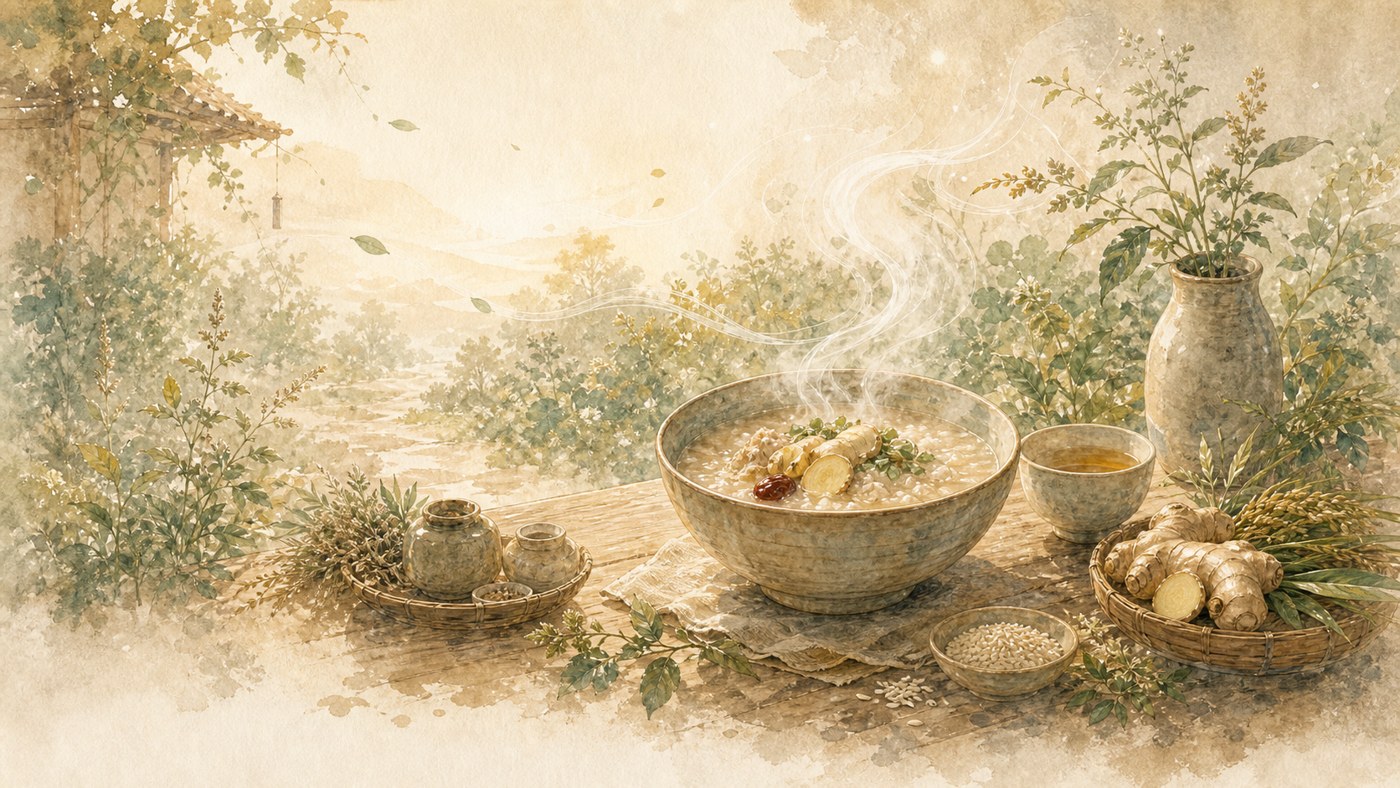
Soup, rice porridge, congee and gently cooked dishes are familiar examples in the Thai book. They can offer warmth and a soft texture that some people find comfortable. Their nutritional value depends on what we put into them.
A bowl of porridge can be made more substantial with egg, tofu, fish, chicken or another protein food that suits our preferences. Cooked vegetables, pulses and grains can contribute variety. Beans may be useful, but are not easy on everyone's digestion; preparation and portion size can matter. Mushrooms can add flavour and variety, but should not be treated as the main protein source in a meal.
The traditional discussion includes naturally sweet foods such as pumpkin and sweet potato, along with mild sourness and moderate saltiness. This is not advice to add sugar or salt to correct a constitution. Flavour is one feature of food, not its complete health profile.
Culinary amounts of ginger, galangal, lemongrass, pepper or garlic may be enjoyable. We can use them for flavour if they agree with us, rather than assuming that stronger spice is always better. Concentrated herbal products belong to a different discussion from ordinary seasoning.
For everyday fats, favour unsaturated sources such as olive, canola or other suitable vegetable oils, nuts and seeds. Coconut oil is high in saturated fat and is not a preferred daily fat simply because a traditional description associates oil with nourishment. [10]
Warm water or a caffeine-free drink may feel soothing. Hydration matters more than meeting a compulsory temperature. Choose a temperature that is comfortable, not scalding, and follow any fluid advice given for an existing condition.
Why warmth may feel comforting
A warm meal can have meaning beyond its temperature. It may remind us of being cared for, invite us to slow down, or make a soft dish easier to enjoy. Cooked textures may suit us better on some days.
We do not need to claim that warm food directly switches on the vagus nerve or that raw food universally requires excessive digestive effort. Those explanations are stronger than the evidence presented in the source.
The practical test is more modest: does this meal agree with us, provide enough nourishment and fit our life? We can notice comfort without turning it into a universal physiological law.
What we might adjust
The traditional advice is to reduce very cold foods, large raw salads and strong stimulants when they seem to aggravate discomfort. In this edition, that becomes an individual experiment rather than a ban.
If a large raw meal leaves us uncomfortable, try a smaller portion or a cooked alternative. We should not eliminate vegetables, fruit or entire food groups solely because of Wind Type. If restrictions are multiplying, or symptoms are persistent, seek dietary advice rather than making the diet narrower and narrower.
Caffeine may worsen sleep or palpitations in some people. We can notice the amount, timing and our response, then reduce it if needed. Alcohol is not a sleep treatment. A drink that feels relaxing at first is not necessarily helping us rest well.
A note on fasting
The source warns that long periods without food may leave some readers shaky, irritable or uncomfortable. We can preserve the useful part of that advice without assuming a special Wind metabolism.
If skipping meals makes us feel unwell, a regular eating pattern may be more suitable. There is no need to follow a fasting trend to demonstrate that we are caring for ourselves.
Fasting decisions require particular care if we are underweight, pregnant, have a history of disordered eating, use medicines affected by food timing, or have a condition such as diabetes. In those circumstances, discuss the plan with an appropriate professional. Feeling faint or repeatedly shaky deserves assessment rather than a label.
How we eat matters too
A predictable mealtime gives the day a dependable pause. It does not have to occur at the exact same minute. It helps if we can avoid repeatedly working through hunger and then eating in a rush.
When possible, sit down, chew at a comfortable pace and put aside whatever is making the meal feel urgent. We might leave the news or messages until afterwards. A calmer setting can make it easier to notice appetite and comfort.
We need not turn mindful eating into another performance. Shared meals can be lively. A meal eaten during a demanding shift still counts as care. The aim is to reduce avoidable strain, not to make eating perfect.
Adjusting to the season and the day
On a cold day, warmth may be welcome. In hot weather, comfort and hydration may call for a different approach. Travel, illness and changing appetite may also affect what is practical.
The three words remain an invitation, not a fixed prescription. Adequate nourishment and our actual response take priority over making a meal look like the textbook.
Try it · One supportive day of meals
Choose one change rather than replacing everything at once.
- Morning: porridge, congee or another breakfast we enjoy, with a suitable source of protein.
- Midday: a balanced cooked meal with vegetables, a staple food and protein.
- Evening: a comfortable portion of a familiar meal; soup can be part of it without being the whole meal.
- Through the day: enough fluid for our needs and a realistic, dependable eating pattern.
Over a week, notice appetite, comfort and energy. We are learning what supports us, not testing whether we are a “good” Wind Type.
Before the next chapter
Food helps meet the body's needs. Movement gives us another way to participate in our well-being. Next, we explore a rhythm of activity that can be sustained rather than a demand to exhaust ourselves.
CHAPTER 11
11 · Movement at a Sustainable Pace

Making room to move
The early-hunter image introduced movement as part of life rather than a separate achievement. It invites us to ask how our day feels when most of it is spent sitting, and what changes when we have opportunities to move comfortably.
Movement can mean many things: walking, lifting, dancing, gardening, playing, stretching or adapting an activity to a disability or health condition. It need not resemble the imagined runner from Chapter 1.
The purpose of this chapter is to help us find a sustainable starting point. Wind Type does not determine our fitness, and a constitutional label alone cannot tell us which exercise is safe or sufficient.
Endurance is not the same as exhaustion
It may seem contradictory to admire an endurance runner and then recommend gentleness. The distinction is between developing capacity and repeatedly exceeding it.
A story about human endurance does not oblige us to run long distances. Nor does being Wind Type make vigorous exercise unsuitable. Training, health, enjoyment, recovery and individual circumstances are more useful guides.
If we are repeatedly left depleted, unable to recover or increasingly uncomfortable, doing more is not automatically the answer. We can adjust the activity, intensity or amount, and seek assessment when the response is unusual or persistent.
Three principles for a workable rhythm
Rhythm. Choose movement we can perform with reasonable coordination and control. A steady pace may be easier to sustain than repeatedly pushing to a limit.
Consistency. An activity we can return to has more practical value than an ambitious plan that leaves no room for ordinary life. Small amounts can form a beginning, even when they are not the eventual goal.
Comfort and recovery. Allow time to warm up, recover and meet food and fluid needs. Comfortable conditions matter, but warmth does not mean exercising in excessive heat.
These principles are supports for participation. They are not a reason to keep every activity permanently light if we are able and want to develop further.
Activities we might enjoy
Gentle yoga offers controlled movement and attention to breathing. Choose a level and instructor suited to our needs. We need not force a stretch or copy a shape that causes pain.
Tai chi and qigong use slow, continuous sequences. Some people enjoy their combination of movement, attention and routine. Learning the basics can make the practice easier to adapt.
Walking is a simple possibility for many people, outdoors when conditions are safe and comfortable. A short walk can also provide a pause from work or screens. For others, seated movement or another accessible activity may be more appropriate.
Swimming or water-based activity may feel comfortable in a suitable setting. Water temperature, swimming ability, supervision and health conditions matter; “warm water” is not a guarantee of safety.
The useful question is what we can practise safely and continue to enjoy. No one activity is compulsory.
Relaxation is only one benefit of activity
The source discusses heart rate variability, or HRV, as a possible way of studying autonomic regulation. HRV measures variation between heartbeats. Its interpretation depends on context and measurement; it is not a simple score of elemental balance.
Some research explores changes in HRV during practices such as slow movement or breathing. That does not show that all Wind Type readers need the same activity, or that a wearable device can tell us whether our constitution is balanced.
We can appreciate a practice that feels settling without needing a number to prove it. Physical activity also supports capacities beyond relaxation, including strength and endurance.
For most adults, general guidance includes at least 150 minutes of moderate-intensity activity each week, or an equivalent amount of vigorous activity, plus muscle-strengthening activity on at least two days. Some activity is better than none; the starting point should fit our health and ability. Gentle stretching alone does not replace every part of that guidance. [11]
What deserves caution?
Repeatedly exercising to exhaustion, increasing too quickly or ignoring pain can make a routine difficult to sustain. The source particularly cautions against very intense intervals and hard running. Here, the caution is about appropriateness and recovery rather than a prohibition based on type.
Someone who enjoys running may continue to enjoy it. Someone who is inactive, recovering from illness or living with a relevant medical condition may need a more individual plan. Persistent dizziness, disproportionate fatigue, chest discomfort or unusual breathlessness should not be explained as Wind reacting to exercise.
Weather also matters. Dress and prepare for cold conditions, and avoid overheating. A desire for warmth is not a reason to exercise through heat illness or ignore hydration.
Small movements throughout the day
We do not always need to change clothes or set aside a full session to move. Standing up when feasible, taking a short walk, stretching comfortably or changing position can break up long periods of sitting.
These moments are especially useful when work makes the day feel physically narrow. They can complement planned activity rather than compete with it. A little movement after a meal or between tasks may also create a pleasant transition.
Listening to experience without making it the only test
After activity, ask how we feel immediately and later. Do we recover reasonably? Does the routine make life easier overall? Is there pain, dizziness or a delayed worsening that needs attention?
Feeling refreshed is a useful clue, but temporary pleasure does not prove safety, and ordinary exertion need not mean that an activity is wrong. Combine personal observation with appropriate guidance rather than relying only on enthusiasm, a fitness trend or a device.
Try it · A manageable week of movement
- Choose one activity that fits our present ability and circumstances.
- Begin with an amount we can repeat, leaving room for recovery.
- Add small opportunities to move during long sedentary periods.
- Notice the response later that day and the next day, not only immediately afterwards.
If we need help adapting a plan, a clinician, physiotherapist or appropriately qualified instructor can be part of the process.
Before the next chapter
We have explored activity that belongs within a life, rather than activity that consumes all our capacity. Rest and sleep are the next part of that same rhythm.
CHAPTER 12
12 · Rest and Sleep

Helping the watchkeeper stand down
A tired body and an alert mind can make a long night. We may fall asleep slowly, wake repeatedly or feel that dreams have occupied the whole night. By morning, we may already be worrying about the next one.
The watchkeeper image from Chapter 2 offers a gentle way to describe this. Something in us seems to remain on duty. We are not failing because we cannot order it to stop.
The image does not establish the cause of insomnia. Sleep can be affected by stress, routines, medicines, pain and other health conditions. Our task is to create supportive conditions and recognise when a sleep problem needs assessment.
Why trying harder can feel unhelpful
We can decide to make time for sleep, but cannot command sleep to happen at a particular moment. The effort to force it may become another task we are afraid of failing.
Rather than treating the night as an examination, we can give ourselves a transition away from the demands of the day. The aim is to make room for sleep, while letting go of the idea that every technique must produce an immediate result.
A bad night is difficult enough without adding a judgement about our character. If poor sleep continues, that is a reason to obtain help, not to blame ourselves for failing to relax.
Rest is more than stopping work
Sitting down with an endless stream of messages, news or short videos may stop physical activity without giving attention much of a pause. Sometimes it is enjoyable. Sometimes we finish feeling more crowded than before.
We can ask what kind of rest is actually needed. Is the body tired? Is attention overloaded? Do we need quiet, company, practical help or a break from decisions? Different needs may call for different forms of rest.
Two forms of rest
The source distinguishes gentle activity from deeper stillness. Both can belong in a restful day.
Rest through light activity might mean watering plants, walking slowly, doing a simple craft or preparing something without hurry. For some people, this offers an easier transition than immediately sitting still.
Quiet rest might mean sitting comfortably, listening to a calm environment or closing our eyes for a brief pause. Sleep is another essential form of recovery, with functions that waking relaxation does not replace.
We do not need to rank these experiences by how virtuous they look. A useful rhythm can move between them. If an activity remains demanding, however, calling it rest will not remove that demand.
A dependable sleep–wake rhythm
The Thai chapter emphasises sleeping and waking at similar times. A regular waking time and a predictable wind-down can support a daily rhythm. Going to bed when sleepy is generally more useful than lying awake for hours to meet an exact target.
For persistent insomnia, routine advice alone may not be enough. Cognitive behavioural therapy for insomnia, or CBT-I, is a recommended first treatment for long-term insomnia and goes beyond general sleep tips. A clinician can help decide what is appropriate. [12]
We can keep the routine gentle rather than rigid. Caring for children, shift work, illness and other responsibilities may require adaptation. The aim is a workable pattern, not a nightly test of discipline.
The transition before bed
A quieter final part of the evening can help distinguish the end of the day from its busiest hours. We might reduce bright light, leave stimulating work for another time, and set aside a screen when its content keeps us engaged.
A comfortably warm shower, a familiar caffeine-free drink or a small calming ritual may feel pleasant. Avoid excessive heat. The bedroom should be dark, quiet and at a comfortable temperature, generally cool rather than hot. A person who feels cold can use suitable bedding without overheating the room.
Gentle breathing is optional. There is no need to practise deeply or reach a particular rate. If paying attention to the breath makes us more alert or uncomfortable, we can choose another quiet activity.
The meaning of the ritual is its familiarity. It tells us that the day's demands are being set down, even if sleep does not follow immediately.
When sleep does not come
Try not to turn the clock into a countdown. Repeatedly calculating the remaining hours can keep attention fixed on the problem.
If we are awake and becoming frustrated, it may help to leave the bed for a quiet, dimly lit activity, then return when sleepy. The purpose is to reduce the association between bed and struggle. This is one component used in insomnia care, not a complete treatment plan. [12]
One difficult night does not define our health. At the same time, tiredness can affect safety. We should avoid driving or other hazardous activity when too sleepy to do it safely, rather than telling ourselves to push through.
Repeated sleep difficulty, loud snoring with breathing pauses, or persistent daytime sleepiness are reasons to seek assessment. [17] A constitution cannot tell us which sleep problem is present.
Recovery during the day
Short pauses can prevent the day from becoming one uninterrupted demand. We might stop between tasks, look away from a screen, move gently or sit for a moment without taking in new information.
A pause does not have to be long to be real. It also does not replace adequate sleep. If we are exhausted despite reasonable opportunities to rest, the answer may involve more than another relaxation technique.
Try it · A thirty-minute wind-down
Choose a simple sequence that fits the evening.
- Reduce bright light and put aside content that keeps the mind busy.
- Do one comfortable activity, such as a warm shower or quiet reading.
- Prepare the room and anything needed for tomorrow, without starting a new project.
- Go to bed when sleepy; let breathing remain easy rather than making it a task.
Repeat what helps. Leave out what does not. A ritual is there to support us, not to make the night more complicated.
Before the next part
Food, movement and rest already influence how we experience the day. In the next part, we approach care more directly through attention, emotion and the small practices that help us find space within a busy mind.
PART FIVE · CARING FOR THE MIND
13 · Making Space for the Mind

Caring from the other side of the bridge
In the previous part, we approached care through food, movement and rest. Now we approach the same life through attention and emotion.
This does not mean that the mind is the cause of every bodily difficulty. It means that our inner experience deserves care in its own right. A practice can be valuable because it gives us a little room to respond, even when it does not remove a symptom.
The aim is not to make an active mind permanently still. It is to make space for thought to move and for attention to pause.
One principle, several possible tools
The principle of this chapter is simple: create a small place for the mind to rest within the day.
We do not need to adopt every practice. Choosing one or two that feel feasible is more useful than building an impressive routine that becomes another burden. A technique that suits someone else may not suit us, and we are allowed to change our approach.
Tool one · comfortable breathing
Breathing can provide something simple to notice when thought becomes crowded. We met a gentle practice in Chapter 6. Its purpose is a brief pause, not a performance or a physiological test.
Some breathing approaches use approximately six breaths per minute. That rate is not a requirement, and this book does not claim it is uniquely suitable for Wind Type. We can let the breath become a little slower only if that feels easy.
A longer out-breath is one option. Equal in- and out-breaths, or simply noticing normal breathing, may be more comfortable. Do not force depth, hold the breath or continue through dizziness. If attention to breathing increases distress, choose a different way of orienting to the present. [5]
A moment of practice can fit between tasks or before a difficult conversation. We do not need to wait until we are already overwhelmed.
Tool two · meditation, prayer or a repeated phrase
Meditation is sometimes imagined as the achievement of a completely empty mind. That expectation can make an ordinary wandering thought feel like failure.
Another way to understand the practice is learning to return. We notice that attention has moved, then bring it back gently to an object such as a sound, a phrase or the felt support of the body. The return is part of the practice, not evidence that it is going badly.
Prayer, chanting or a repeated phrase may offer a familiar rhythm for those who find it meaningful. A secular phrase or quiet listening is also possible. No religious commitment is required to use the other practices in this book.
Meditation and mindfulness may help some people with stress or emotional symptoms, but benefits vary and uncomfortable experiences can occur. They are not substitutes for needed mental health care. If a practice brings marked distress, traumatic memories or a sense of disconnection, pause and seek suitable guidance. [13]
Tool three · grounding in present experience
In this book, grounding means bringing attention towards something concrete in the present. It does not refer to a proven transfer of healing electrical energy from the earth.
We might notice the support of a chair, the contact of feet with the floor, the texture of a leaf, the sound of water or a few visible objects in the room. Gardening and time outdoors may offer a similar shift from circling thought to an activity we can feel and see.
The original text mentions barefoot walking. Bare feet are not necessary. Suitable footwear and a safe environment matter, particularly if sensation, circulation or balance is impaired. We can connect with a place without risking injury.
Morning outdoor light may also help establish the day’s rhythm. We can enjoy it without looking directly at the sun or treating exposure as a cure.
Tool four · reducing what comes in
Sometimes care involves removing a demand rather than adding a practice. A mind that has received messages, noise and urgent information all day may not need one more thing to learn before bed.
We might choose a short period without scrolling, turn off nonessential notifications, or let the first few minutes of the morning belong to something other than the news. The aim is not to withdraw from life. It is to leave enough room to participate in it deliberately.
Notice which inputs leave us informed and connected, and which repeatedly leave us agitated. A small boundary may be more sustainable than trying to avoid every stimulus.
Meeting a difficult feeling
When worry appears, the first response can be simple recognition: “This is a difficult moment,” or “My mind is moving quickly right now.” We do not have to add “and I should be better at this”.
Then ask what would help next. Perhaps a gentle breath, a brief walk, a practical action, a conversation or a break from a task. Sometimes the right response is to address the problem rather than calm ourselves into tolerating it.
Feelings often change, but we should not promise that every anxious state will pass if we wait or breathe correctly. Persistent or overwhelming distress deserves professional support. Seeking that support is one of the available tools.
Relationships and emotional space
Being attentive to others can be a strength. It can also become tiring if we feel responsible for every mood around us.
We can care about someone without absorbing every part of their experience. Time with people who listen, room for solitude, clear boundaries and shared responsibilities may all support well-being.
A boundary need not be harsh. It may sound like “I want to listen, and I need a little time first,” or “I can help with this part, but not everything.” These are ordinary ways of making care sustainable. We do not need a type label to justify them.
Try it · Choose one practice for a week
- Breathing: a short period of comfortable, unforced attention to the breath.
- Meditation, prayer or a phrase: a brief practice that feels meaningful and safe.
- Grounding: notice the room, the support beneath us or a safe outdoor setting.
- Less input: protect one small period from unnecessary messages or scrolling.
Choose one. Notice whether it helps and whether it creates any difficulty. We can continue, adapt or stop; the practice is in service of our life.
Before the next chapter
We now have several ways to create a pause. Next, we bring food, movement, rest and attention into a daily pattern with enough structure to support us and enough flexibility to remain human.
CHAPTER 14
14 · A Daily Rhythm of Our Own

Care that returns each day
We have gathered many possibilities: meals that suit us, comfortable movement, time to rest, attention to the mind and support from other people. This chapter places them within the shape of an ordinary day.
Ayurveda uses the term dinacharya for daily practices that support health. The idea is that repeated, ordinary actions matter alongside the things we do only occasionally.
The Thai book calls rhythm a kind of medicine. Here we use that as a metaphor for supportive habits, not a claim that routine treats every illness. A dependable pattern may make care easier to sustain. It should work alongside any treatment we need.
A channel for the day's movement
Imagine wind moving through an open space, then through a passage that gives it direction. A routine can offer a similar structure for our attention. We do not have to decide anew every day whether there will be time to eat or when work might end.
When life is unpredictable, such decisions can consume energy. A few familiar points can reduce that burden. This is one reason a routine may feel supportive, without needing to claim that it directly regulates every symptom.
The right structure leaves room for change. It is a support, not a set of bars around our life.
A few anchors rather than a perfect timetable
A schedule that assigns every minute can become another source of pressure. We are looking instead for a few dependable moments: waking, eating, pausing and preparing for sleep.
These everyday anchors do not need to occur with mechanical precision. A similar time window may be enough. The hours between them can respond to work, family, weather and opportunity.
We can also distinguish an intention from a promise. “I will make room for a pause after this task” is more workable than “I will never let myself become tired again.”
Morning · a gentle beginning
When possible, begin with a fairly consistent waking time. Allow a little transition before entering the full stream of demands.
A comfortable drink, some daylight, light movement and a nourishing breakfast are options. They do not all need to happen, and breakfast need not look exactly like the example in Chapter 10. What matters is meeting our needs in a way we can repeat.
If mornings are necessarily busy, choose a very small beginning: opening the curtains, sitting for a moment, or preparing food ahead of time. A brief act of care still belongs to the day.
Midday · use energy without emptying it
During the busiest hours, it is easy to work through hunger and ignore fatigue until both become difficult to manage. A planned meal and short pauses can help prevent care from disappearing beneath tasks.
We might stand or change position between activities, look away from a screen, or take a few unhurried minutes before moving on. A break does not have to become a new productivity technique. Its purpose may simply be to stop for a moment.
If our work leaves little control, a realistic plan should acknowledge that. Support from colleagues, adjustments to workload or practical help may matter more than individual willpower.
Evening · a transition rather than a sudden stop
The mind does not always move from a demanding day into rest as if a switch has been turned off. A transition can help us put things down gradually.
A comfortable evening meal, a gentle walk, a simple household activity or time with someone we enjoy may fit here. We may choose to leave stimulating work and distressing news for another time when that is possible.
This is not a rule that every evening must be quiet. Social life and enjoyment belong too. The question is whether our overall pattern leaves enough opportunity to recover.
Before bed · a familiar closing
Chapter 12 described a short wind-down. It might include preparing the room, reducing bright light, putting aside messages and doing something calm.
A regular waking time and enough opportunity for sleep are useful supports. We do not need to force sleep at an exact minute. Persistent insomnia needs appropriate care rather than a stricter timetable.
Let the ritual be short enough that it remains possible on an ordinary evening. A long list of compulsory steps can make bedtime feel like another shift of work.
Three anchors to remember
If the details feel like too much, begin with three broad commitments:
- A workable sleep–wake rhythm: protect time for sleep and keep a dependable waking time where possible.
- Dependable nourishment: make room for meals and enough fluid, adapted to our needs and medical advice.
- One daily pause: a moment for attention to settle, whether through quiet, gentle movement, prayer, breathing or another suitable practice.
These are not rules that must never be broken. They are points to return to. Missing one does not erase the care we have already given ourselves.
Fitting the plan to real life
Shift workers, parents of young children, caregivers and people living with illness may not control their schedules. A useful book should recognise that rather than turn circumstances into a personal failure.
We can look for what is stable within an irregular day: a sequence after waking, a meal before a shift, a short pause when another person takes over, or a quiet transition after work. Support may include asking someone to share a task.
If the plan repeatedly fails, change the plan before condemning ourselves. It may be too large, poorly timed or asking for resources we do not currently have.
Start with one thing
Enthusiasm can make a whole new life seem possible by tomorrow. Sustaining many changes at once is often harder than imagining them.
Choose one anchor. Practise it for a week or two, then ask whether it is helping and what needs adjustment. Only then consider adding another. We are building familiarity, not completing a challenge.
Try it · Sketch a day that could actually happen
On one page, note:
- Morning: our likely waking time and one gentle beginning.
- Midday: where meals and short pauses could fit.
- Evening: a realistic transition out of the busiest part of the day.
- Before bed: a simple closing ritual and enough opportunity for sleep.
Circle one anchor to begin with. Include a smaller version for difficult days. Leave room to revise the page.
Before the next part
We have brought daily care together without requiring perfection. The final part looks at additional approaches from several traditions: what role they might play, where their limits are, and how to explore them safely.
PART SIX · APPROACHES TO CARE
15 · Exploring Complementary Approaches

A wider world of care
Food, movement, rest, emotional support and workable routines form the everyday foundation of this book. For some people these supports are enough for the question they came with; for others, medical treatment or further help is also needed.
Many cultures have developed additional practices of care. Plearnprai's wider teaching collection discusses 37 approaches through five dimensions. This chapter retains the five-dimensional organisation of the Thai source, while recognising that the practices differ in evidence, risks and professional requirements. Being included in a collection is not an endorsement of effectiveness for every person or condition.
We do not need to try everything. An additional practice is useful only if it serves a real purpose in our life.
How might we choose?
The traditional Wind selection principle is warmth, calm, grounding and rhythm. As a practical preference, this may help us identify experiences that feel supportive.
It is not enough on its own to establish safety. Our health, medicines, pregnancy, skin condition, mobility and the skill of the practitioner can change what is appropriate. A practice that feels pleasant can still carry risks, and a pleasant sensation is not proof that a disease is being treated.
Keep three questions in view: what are we hoping it will help with, what is known about that use, and what would make it unsuitable for us?
Dimension one · movement and flow
Gentle yoga and breathing practices offer ways to combine movement and attention. The source mentions pranayama, a broad term that includes practices of very different intensity. This book recommends only comfortable, unforced breathing; rapid breathing, long breath-holding and demanding techniques need appropriate guidance and are not interchangeable with a simple pause.
Qigong offers slow, continuous sequences that some people find enjoyable. Learn from a suitable instructor and adapt movement to ability rather than trying to reproduce a shape at any cost.
Acupressure involves pressure at particular locations. Learn any technique from a qualified source and avoid painful pressure or damaged areas. This chapter does not provide a treatment protocol or claim that a point will reliably treat insomnia.
Acupuncture requires an appropriately qualified practitioner using safe techniques and sterile needles. Evidence relates to particular conditions, not to a general diagnosis of Wind Type. Incorrect treatment can cause harm, so it should not be attempted as a home procedure. [14]
Dimension two · structure and touch
Massage, including oil massage, may offer a welcome sense of care and relaxation. Touch should be consensual, comfortable and adapted to the person. More pressure is not automatically more beneficial.
Herbal compresses and steam treatments combine heat with other exposures. Their traditional use does not make them suitable during fever, acute illness or all cardiovascular conditions. Burns, dizziness and dehydration are reasons to be cautious with heat.
A comfortable foot bath is a simple example in the source, but it is not necessary for everyone. Reduced sensation, poor circulation, skin damage or difficulty checking temperature calls for professional advice and careful adaptation. Do not assume that “warm” water is safe because it feels tolerable to someone else.
Plearnprai's procedure guidance excludes massage or compresses over acute clots, fractures, open wounds, inflamed skin and other serious conditions. Severe osteoporosis, recent cardiac illness, pregnancy or medicines affecting bleeding also require individual advice. We should not use a constitutional preference for warmth to bypass those boundaries.
Dimension three · sensory experience
Scent may make a space feel familiar or restful, but it can also irritate. A fragrance-free setting is a valid choice. Essential oils should not be swallowed or applied undiluted as a casual home practice. Children, pregnancy, asthma, allergies and pets require particular caution and appropriate advice.
Time in nature, sometimes called forest bathing, can offer an unhurried setting for attention. We do not need a remote forest or an elaborate programme. A safe, accessible green space may be enough for the experience we want.
A hug or reassuring touch from someone we trust may feel supportive when it is welcome. Consent and personal preference are central. Touch is never owed, and declining it does not mean that we are resisting care.
Dimension four · emotional and mental care
Meditation and prayer or chanting were introduced in Chapter 13. A brief, suitable practice may give attention a place to return. It should not be pushed through marked distress.
Loving-kindness practice offers words of goodwill towards ourselves and others. It may begin very simply: wishing for safety, patience or enough support for the day. We do not have to force a feeling we do not currently have.
Deep listening means making room for a person's experience without immediately correcting or solving it. Being heard can matter, as can expressing something that has remained unspoken. Peer support and companionship are valuable, while psychotherapy and treatment have their own professional roles.
These approaches can accompany mental health care. They do not replace assessment when mood, anxiety or other symptoms substantially affect functioning or safety. [13]
Dimension five · nourishment and herbal care
Food remains the everyday starting point: adequate nourishment, a workable meal pattern and choices that agree with us. The traditional preference for warm, soft meals is one option within those needs.
Herbs used as medicines require a different level of care from ordinary culinary ingredients. Concentrated products may interact with medicines, vary in quality or be unsuitable in pregnancy or certain health conditions. A qualified clinician or pharmacist can help review the product and its intended use. [15]
Ginger in a meal is not equivalent to a concentrated supplement. We should not choose a medicinal product solely because it is described as warming, natural or appropriate for Wind.
Combining approaches safely
First, distinguish a simple, adaptable practice from a procedure or medicinal treatment. Comfortable attention to breathing is different from intensive breathwork; ordinary food is different from a concentrated extract; gentle touch is different from deep manipulation.
Second, treat complementary approaches as additions to appropriate care. Tell the clinician or practitioner what medicines, supplements and treatments we use. Do not stop prescribed treatment or postpone assessment in order to test a new practice.
Third, notice both benefit and difficulty. Feeling calmer can be worthwhile, but it is not the only measure. Pain, dizziness, skin reactions, worsening symptoms or an increasing dependence on expensive treatment deserve attention. Evidence and safety matter alongside personal preference. [16]
Where to begin
Start with something simple, affordable and compatible with an existing routine. A brief period outdoors, a suitable guided movement practice or a quiet pause may be enough to explore.
If we want to try a practitioner-based treatment, ask about qualifications, the reason for recommending it, likely benefits, relevant risks and what to do if it does not help. We can decline or stop. Care should make room for our questions.
Try it · One addition, with a clear purpose
Choose one suitable practice for a short trial, such as two weeks, if there is no reason for earlier assessment.
- Write down what we hope it will support.
- Check whether our health or treatment makes it unsuitable.
- Fit it into an existing routine without crowding out essentials.
- Notice benefits, difficulties and whether we want to continue.
A practice that does not suit us is information, not a failure. We do not have to keep collecting tools.
Before the closing chapter
We have explored a wider range of care while keeping daily foundations and professional boundaries in view. The closing chapter returns to the central invitation of the book: we can understand ourselves more kindly and make choices that support the life we actually live.
CLOSING
Closing · Our Capacity for Change

Looking back at the journey
We began with a familiar story: a person who finds sleep difficult, digestion unsettled or sensitivity tiring, and who has started to wonder whether something is wrong with the person they are.
At the end of the book, we hope that question feels a little different. Symptoms still deserve appropriate attention. Yet difficulty does not make us defective, and care need not begin with self-criticism.
The journey has been from uncertainty towards a more informed and compassionate relationship with ourselves.
What we have explored
In Part One, we used the early-hunter image to see value in movement and alertness, then met the body we actually live in and recognised possible strengths. We kept the metaphor separate from claims about ancestry or diagnosis.
In Part Two, we explored an active mind: how it feels when comfortably engaged, what happens when it becomes unsettled, and how body and mind communicate.
In Part Three, we considered symptoms, the four-phase teaching map and the boundaries of self-care. We learnt not to mistake a constitutional description for the cause of illness.
In Parts Four and Five, we brought care into ordinary life through food, movement, rest, attention and dependable daily anchors.
In Part Six, we looked at additional approaches and the questions that help us choose them thoughtfully.
Constitution is not a verdict
A distinction introduced near the beginning deserves to be carried with us. In Plearnprai's current framework, constitution is the enduring pattern understood to be present from early life. Our current state is how we are doing now.
Food, sleep, circumstances, illness, relationships and care can change our present experience. We do not describe those changes as replacing our underlying constitution. Nor does this internal distinction establish that a constitutional type is a scientifically validated predictor of disease or personality.
Put simply: our state, habits and circumstances can change; constitution is described as enduring within the model.
Most importantly, neither word is a sentence passed on our future. A description should help us ask useful questions, not close off possibilities.
Becoming more at ease with ourselves
The aim is not to turn a curious person into someone without questions, or an active mind into one that never moves. We do not need to discard creativity, sensitivity or enthusiasm to deserve rest.
Instead, we can look for a rhythm in which those qualities have support. We can give attention a meaningful task and a place to pause. We can recognise fatigue without treating it as a moral failure. We can ask for care without believing we should have managed everything alone.
We are not required to perform an ideal Wind Type. We are learning to live more comfortably as ourselves.
Three things to take with us
Kindness on difficult days. There will be nights of poor sleep and days when the routine disappears. Those moments do not cancel what we have learnt. A gentle response may be especially valuable when the day has been hard.
A small beginning. One realistic change can be more useful than a complete plan that cannot survive an ordinary week. We can begin with the need that is closest: a meal, a pause, a conversation, an appointment or help with a task.
Permission to begin again. A disrupted rhythm is not a closed door. We can return to care, though the right next step may differ from the one that helped before. Hope does not require a promise that every condition will reverse.
If we want to explore further
Plearnprai offers further material and reflective assessments for people who want to explore its framework. These may help organise observations and conversations. They should not be treated as medical diagnostic tools or precise measurements of elemental energy.
Such tools are optional. We do not need another score or product before taking a useful step today. A qualified professional can also help us distinguish a longstanding pattern from a recent change that needs assessment.
The other books in this series explore Fire Type, Water Type, Mixed Type, relationships and emotional well-being. Their value is in widening understanding, not sorting everyone we know into a box.
A final word
Perhaps the early hunter now means something gentler than a body that must keep going. Perhaps it means attention, curiosity and the ability to find a path, together with the wisdom to stop and recover.
We can keep that image without requiring it to explain our biology. We can appreciate the language of Wind while continuing to ask clear questions about health.
Thank you for travelling through these pages with us. May what we take from them be practical enough to use, kind enough to return to, and open enough to grow as our understanding grows.
Our life is larger than a type. Care is how we make room for it.
REFERENCE
Sources and Further Reading
How to read the references
This book is an English editorial adaptation of Plearnprai's Thai volume คนธาตุลม. It is not a research report or a clinical practice guideline. The Thai source brings together traditional texts, comparative ideas and health information. These kinds of sources do different jobs and should not be treated as equivalent evidence.
References R1–R17 below support the specific historical or health statements linked to them. They do not validate Wind Type as a medical classification, the early-hunter metaphor as an account of an individual person's ancestry, or the four-phase map as a disease-staging system. Web sources were checked on 12 October 2026.
Traditional sources named in the Thai edition
The original bibliography names the following Thai sources. English descriptions here identify the works; they are not claims that an official English translation was consulted.
- Tamra Wetchasat Chabap Luang, compiled during the reign of King Rama V: the royal collection of medical texts concerning elements, illness and remedies.
- Khamphi That Wiphang: a classical text concerning the bodily elements and their disturbances.
- Khamphi Rok Nithan: a classical account of illness and its origins in Thai traditional medicine.
- Textbooks of traditional Thai medicine associated with Thailand's Department of Thai Traditional and Alternative Medicine, Ministry of Public Health.
- University teaching materials on Thai traditional assessment and advice.
The Thai bibliography does not identify exact editions, page numbers or all individual teaching documents. Those details remain a bibliographic task before a scholarly edition is issued. These sources are retained as the Thai author's stated background, not presented as independently checked quotations.
Vata belongs to Ayurveda. It should not be described as a term established by the Thai classical sources simply because it is compared with Wind in this book.
Comparative background named in the Thai edition
The source also mentions Allen's rule, constitutional thinness, personality writing including Big Five and MBTI, Vasant Lad's Ayurvedic writing, general integrative nutrition books, sleep physiology, autonomic regulation and the Rome Foundation's work on gut–brain interaction.
Apart from the specifically identified studies below, the Thai bibliography gives topics rather than complete citations. The English edition therefore does not present these broad references as proof of claims about Wind Type. It also does not use MBTI to diagnose a constitution.
The source's suggested research routes include PubMed, Google Scholar and ThaiJO. Its health-information organisations include NIDDK, Mayo Clinic, NINDS, Johns Hopkins Medicine, NHLBI, the American Academy of Sleep Medicine, CDC and NCCIH. Specific sources consulted for this edition are listed next.
Research and clinical information checked for this edition
R1 · Human endurance and evolution
Bramble, D. M., and Lieberman, D. E. (2004). “Endurance running and the evolution of Homo.” Nature, 432, 345–352. A hypothesis concerning human evolution, not a study of Plearnprai types. Read the paper.
R2 · Preliminary research on prakriti
Govindaraj, P., et al. (2015). “Genome-wide analysis correlates Ayurveda Prakriti.” Scientific Reports, 5, 15786. Its selected sample and classification do not establish a diagnostic test for Wind Type. Read the paper.
R3 · Symptoms on standing and POTS
Johns Hopkins Medicine. “Postural Orthostatic Tachycardia Syndrome (POTS).” Used to distinguish a clinical syndrome from the book's constitutional description. Read the information.
R4 · Gut–brain interaction
National Institute of Diabetes and Digestive and Kidney Diseases (NIDDK). “Symptoms & Causes of Irritable Bowel Syndrome.” Read the information.
R5 · Comfortable breathing
NHS. “Breathing exercises for stress.” Supports comfortable, unforced practice rather than a compulsory rate or depth. Read the exercise.
R6 · Taking unexplained symptoms seriously
NHS. “Medically unexplained symptoms.” Used for the distinction between real symptoms and the absence of an explanation from investigations. Read the information.
R7 · Palpitations and emergency symptoms
NHS. “Heart palpitations.” Used for the distinction between assessment of recurring symptoms and immediate help for relevant associated symptoms. Read the information.
R8 · Headache warning signs
NHS. “Headaches.” Used for sudden severe headache and neurological warning signs. Read the information.
R9 · Gastrointestinal bleeding
NIDDK. “Symptoms & Causes of GI Bleeding.” Read the information.
R10 · Everyday nutrition
World Health Organization. “Healthy diet.” Used for the preference for unsaturated fats over saturated fats, including coconut oil, and the importance of a varied dietary pattern. Read the fact sheet.
R11 · Physical activity
Centers for Disease Control and Prevention. “Adult Activity: An Overview.” Used for general aerobic and muscle-strengthening guidance, distinct from gentle relaxation practices. Read the guidance.
R12 · Insomnia care
National Heart, Lung, and Blood Institute (NHLBI). “Insomnia—Treatment.” Used for CBT-I and the distinction between supportive routines and treatment of long-term insomnia. Read the information.
R13 · Meditation and mindfulness
National Center for Complementary and Integrative Health (NCCIH). “Meditation and Mindfulness: Effectiveness and Safety.” Read the information.
R14 · Acupuncture
NCCIH. “Acupuncture: Effectiveness and Safety.” Read the information.
R15 · Ayurvedic products and care
NCCIH. “Ayurvedic Medicine: In Depth.” Used for limits of evidence, product safety and coordination with other care. Read the information.
R16 · Complementary approaches and safety
NCCIH. “Chronic Pain and Complementary Health Approaches: Usefulness and Safety.” Evidence and safety relate to a practice, a condition and a person, not an elemental label alone. Read the information.
R17 · Sleep symptoms needing assessment
NHLBI. “Sleep Apnea—Symptoms.” Used for loud snoring, breathing pauses and daytime sleepiness as reasons to seek assessment. Read the information.
Plearnprai framework sources
This edition follows Plearnprai's current distinction between enduring constitution and current state, as described in Canon 0, Card 01, “Constitution”, including its 8 October 2026 update. Referral wording is derived from Plearnprai's red-flags source, version 1.1 (2 October 2026). Procedure cautions are derived from the corresponding Plearnprai safety source, version 1.0.
The source manifest accompanying this review edition records the exact local files and hashes. The Thai book has not been overwritten. Material that differs from its wording is identified in the separate editorial notes.
A note on the edition
This is a complete English edition, with all fifteen chapters, introduction, closing and reference appendix represented. It is an editorial adaptation, not a sentence-by-sentence certified translation. Traditional concepts, reflective exercises and everyday care remain central; unsupported causal claims have been qualified or removed, and the changes are documented.
REFERENCE
A Short Glossary
| Term | Meaning in this book |
|---|---|
| Wind Type | The concise name for a person with a Wind constitution in Plearnprai's framework. It is not a biomedical diagnosis. |
| Fire Type / Water Type | The corresponding concise names for Fire and Water constitutions within the framework. |
| Mixed Type | A combined constitutional pattern; a specific pair can be named when relevant. |
| Wind–Fire Type / Wind–Water Type / Fire–Water Type | The approved English names for paired types. |
| Constitution | An enduring pattern understood to be present from early life within Plearnprai's current model. |
| Current state | How we are doing now; unlike constitution in the model, it can change with circumstances and care. |
| Element | A traditional or model-based way of describing qualities and functions; not a chemical element. |
| Wind / Fire / Water | In the introductory model, movement / transformation / nourishment. These are interpretive descriptions. |
| Earth | The fourth element in the Thai traditional foundation, associated broadly with bodily structure. |
| Vata / Pitta / Kapha | Ayurvedic terms. Comparisons with Plearnprai's types are approximate, not interchangeable definitions. |
| Prakriti | Ayurveda's term for constitution; its use in research should be distinguished from Plearnprai's classification. |
| Vayo dhatu | A transliteration of the Wind element in the traditional vocabulary. |
| Balance / imbalance | Framework language for patterns of comfort or difficulty; not a substitute for clinical assessment. |
| Grounding | Orienting attention to present, concrete experience; no claim about electrical healing through contact with the earth. |
| Daily anchor | A dependable point in an ordinary routine. This phrase is used informally here, not as a technical assessment term. |
| Dinacharya | An Ayurvedic term for daily practices or routine. |
| Gut–brain interaction | Communication between digestive and nervous-system processes; relevant to IBS, without reducing it to worry. |
| Autonomic nervous system | Neural regulation of bodily functions that do not require continuous conscious direction. |
| HRV | Heart rate variability: variation in time between heartbeats, interpreted in context rather than as an elemental score. |
| CBT-I | Cognitive behavioural therapy for insomnia, a structured treatment that goes beyond general sleep tips. |
| Complementary approach | A practice used alongside appropriate healthcare, not in place of necessary assessment or treatment. |
Words that leave room for a person
We use “Wind Type” to make the title and conversation concise. We use “we” to keep writer and reader on the same side of the page. Neither choice requires everyone to fit the same description.
A type can open a question. It should not close a life.
Caring for one another.